On this page
- How a digital scale works
- The main types of digital scales
- Laboratory balances
- Bench and counting scales
- Retail scales
- Shipping and parcel scales
- Floor, pallet and mobile scales
- Crane and hanging scales
- Truck, vehicle and livestock scales
- Checkweighers and process scales
- Accuracy classes: matching the scale to the job
- Features that matter
- How to choose a digital scale
- Related
- Sources
Quick answer: almost every modern scale is digital. The main types are lab balances, bench and counting scales, retail scales, shipping scales, floor and pallet scales, crane scales, vehicle and livestock scales, checkweighers and tank or hopper scales. They share the same basic electronics (usually a load cell and a weighing indicator). What separates them is capacity, how finely they read, the shape of the platform, the features, and whether they are legal for trade.
This guide explains how digital scales work, walks through each type, and lists what to check before you buy.
How a digital scale works
A digital (electronic) scale turns weight into an electrical signal and shows it as a number. As HowStuffWorks puts it, “most modern scales share one component in common: a load cell.”
- Load cell scales (strain gauge). The load bends a precisely machined metal body very slightly. Strain gauges bonded to it change resistance, producing a signal of a few millivolts. The electronics amplify it, an analog-to-digital converter turns it into numbers, and the display shows the weight. This design is simple, robust and easy to make in large sizes, from bench scales to truck scales. See load cells, weighing indicators and transmitters for the details.
- Electromagnetic force restoration (EMFR or EMF). Instead of measuring how much a metal body bends, a coil and magnet push back against the load until it is balanced. The current needed is proportional to the weight. Shimadzu describes the electromagnetic type as more accurate but more complex and harder to downsize than the load cell type, so it is used in analytical and other high-precision balances. Some makers also use it in checkweighers; one, Wipotec, cites its very short settling time.
Digital vs mechanical: mechanical scales use springs or levers with a dial or beam. Digital scales are easier to read, can tare, count, convert units and send data, and are the norm for new equipment. Mechanical scales still have niches where no power is available.
The main types of digital scales
| Type | Typical use | What sets it apart |
|---|---|---|
| Analytical and precision balances | Labs, pharma, QC, jewelry | Very fine readability, draft shield on analytical models |
| Bench scales | Production, packing, QC, small parts | Compact platform on a bench or table |
| Counting scales | Parts and inventory counting | High internal resolution to work out piece weight |
| Price computing, label printing and POS scales | Delis, grocery, butchers, markets | Price and label calculation; legal for trade |
| Shipping and parcel scales | Mailrooms, e-commerce, warehouses | Connect to shipping software; legal for trade when they set charges |
| Floor and pallet scales | Pallets, drums, carts, bulk goods | Large platform at or in floor level |
| Pallet jack and forklift scales | Weighing during handling | Load cells built into the truck or forks |
| Crane and hanging scales | Suspended loads | Hangs from a hook; rated for lifting use |
| Truck, vehicle and livestock scales | Weighbridges, farms, sale barns | Very high capacity; coarse divisions |
| Checkweighers | Packaging lines | Weigh items in motion and reject out-of-tolerance packs |
| Tank, hopper and process scales | Batching, silos, vessels | Load cells under a vessel, wired to a PLC |
Laboratory balances
Lab balances weigh small amounts very finely. An analytical balance reads to 0.1 mg (0.0001 g) inside a draft shield; precision (top-loading) balances trade some readability for more capacity; micro and ultra-micro balances go finer still. Moisture analyzers combine a balance with a heater. See the laboratory balances guide and types of laboratory balances.
Bench and counting scales
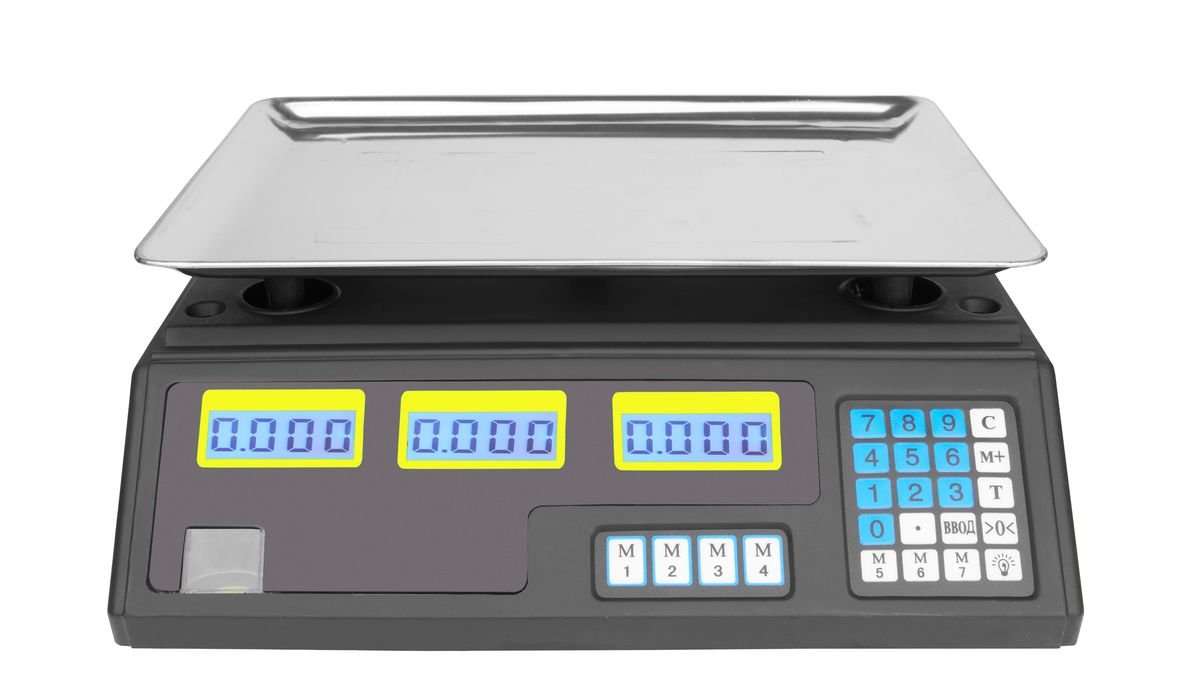
Bench scales are the general-purpose workhorse for production, packing and quality checks. A counting scale works out the average piece weight from a sample and then counts by weight, so it needs high internal resolution for small, light parts.
Retail scales
Retail scales are built for selling by weight. A price computing scale multiplies weight by unit price; a label printing scale prints the price label; a POS scale sends the weight to the checkout. Because the weight sets the price, these scales must be legal for trade. See how to choose a retail scale.
Shipping and parcel scales
From small parcel scales to heavy-duty bench and floor scales, shipping scales usually link to shipping software. If the weight sets a shipping charge, the scale must be legal for trade. See the shipping scales guide.
Floor, pallet and mobile scales
Floor scales weigh pallets, drums and carts on a large platform. When moving loads to a scale is the bottleneck, a pallet jack scale or a forklift scale weighs them during handling. See the pallet scale buying guide.
Crane and hanging scales
Crane scales hang from a hook to weigh suspended loads. Treat them as lifting equipment: never exceed the rated capacity of the scale, the crane or the rigging, and follow the manufacturer’s inspection rules.
Truck, vehicle and livestock scales
These are the highest-capacity digital scales, usually several load cells under a deck, wired to an indicator in a scale house or office. See how to buy a truck scale and the livestock scales guide.
Checkweighers and process scales
A checkweigher weighs packages on a moving line and rejects those outside limits. Process scales put load cells under tanks, hoppers and silos so a controller can run batching or track inventory; see drum and hopper scales. In NIST Handbook 44, automatic weighing systems and belt-conveyor scales have their own codes, separate from the general scales code.
Accuracy classes: matching the scale to the job
If a scale is used for trade, US rules (NIST Handbook 44, Section 2.20) sort it into one of five accuracy classes: I, II, III, III L and IIII. Each class limits the size of the scale division and how many divisions the scale can have.
| Class | Typical examples | Number of divisions (n) |
|---|---|---|
| I | The highest precision, laboratory-grade weighing | at least 50,000 |
| II | Precision weighing, such as precious metals and gems | 100 to 100,000 (5,000 minimum with divisions of 100 mg or more) |
| III | Most commercial scales: retail, shipping, bench and floor scales | 100 to 10,000 (500 minimum with divisions of 5 g or more) |
| III L | Large scales, such as vehicle, railway and livestock scales | 2,000 to 10,000 |
| IIII | Low-precision applications | 100 to 1,200 |
Division limits from NIST Handbook 44 (2025), Section 2.20, Table 3. Examples are typical, not a legal list: check the class your application needs with your state weights and measures office.
Two practical rules from weights and measures guidance:
- Don’t weigh tiny loads on a big scale. Wisconsin’s weights and measures program recommends a minimum load of 20 divisions on a Class III scale and 50 divisions on a Class III L scale (10 for refuse and recycling).
- Use the middle of the range. The same guidance says most weighing should fall between 25% and 75% of the scale’s capacity.
A trade scale also needs an NTEP certificate and inspection under state law. See what an NTEP scale is.
Features that matter
- Capacity and readability: the heaviest load (including containers or pallets) and the smallest step you actually need.
- Platform size and type: bench, floor, low-profile, hanging or built into equipment.
- Functions: tare, counting, checkweighing (over/under), percentage weighing, accumulation and unit conversion.
- Connectivity: printer, USB, RS-232, Ethernet or wireless output to software, a PLC or a POS system.
- Power: mains, rechargeable battery or both for portable use.
- Environment: stainless steel and a suitable IP rating for washdown; certified equipment in hazardous areas.
- Legal for trade: NTEP certification and the right accuracy class when the weight sets a price or charge.
- Calibration and service: who will calibrate and repair it. See industrial scale calibration.
How to choose a digital scale
- Define what you weigh: the lightest and heaviest loads, their size and how often.
- Decide what the weight is used for: process control, inventory, or a price or charge (legal for trade).
- Pick the type from the table above, then the capacity and readability, aiming for everyday loads in the middle of the range.
- Check the environment: washdown, dust, temperature, vibration or hazardous areas.
- Plan the data: printers, software, PLC or POS connections.
- Plan the service: installation, calibration and repairs near you.
This is general information, not engineering or legal advice. Confirm legal-for-trade requirements with your state weights and measures office, have scales installed and calibrated by a qualified technician, and never load a scale beyond its rated capacity.
Next step: request free quotes from scale suppliers, or browse the scale supplier directory.
Related
- Industrial weighing scales: types, capacities and how to choose
- Load cells, weighing indicators and transmitters
- Laboratory balances guide
- Retail scales guide
Sources
- National Institute of Standards and Technology, NIST Handbook 44, Section 2.20 Scales (accuracy classes; division limits from Table 3 of the 2025 edition)
- Shimadzu, Electromagnetic type and load cell type
- Wipotec, Weighing principle (EMFR)
- HowStuffWorks, How digital scales work
- Tacuna Systems, Load cell classes: NIST requirements (Class III L for vehicle, railway and livestock scales)
- Wisconsin Department of Agriculture, Trade and Consumer Protection, Determining scale suitability
Questions & answers