







Every retail business that sells goods by weight is operating a weighing instrument that the law treats as a measurement standard. The weight on the display determines what the customer pays. That makes the scale a legal instrument — not just a convenience tool — and subjects it to certification, calibration, and inspection requirements that most retail operators underestimate until a state Weights and Measures inspector walks through the door.
This guide covers every retail and commercial scale type, NTEP certification and legal-for-trade requirements, the Weights and Measures inspection process, POS and software connectivity, and how to match the right scale to every commercial weighing application from the deli counter through to the receiving dock.
Table of Contents
Why Retail Scale Accuracy Is a Legal Requirement — Not Just a Best Practice
A retail scale used in a commercial transaction sits at the intersection of consumer protection law and commercial fairness. When a customer buys 0.75 lb of deli turkey and pays based on the scale’s display, the Weights and Measures program administered by NIST and enforced by state authorities holds the scale to the same legal standard as any other certified measurement instrument.
Three legal realities govern retail scale use in the United States.
NTEP certification is mandatory for any scale used where weight determines price. A scale must carry a valid NTEP Certificate of Conformance before it can legally be used in a commercial transaction. A non-certified scale — regardless of its accuracy — is not legally authorized for use in determining the price a customer pays.
State Weights and Measures inspects the individual unit. NTEP certification applies to the scale model. The state inspection seal — applied by a Weights and Measures officer after testing the specific unit in place — authorizes that individual scale for commercial use in that state. Both are required. A certified model without an inspection seal, or a unit whose seal has expired, is not in legal compliance.
Out-of-tolerance scales expose businesses to a penalty. A Weights and Measures inspector who finds a commercial scale reading outside the allowable tolerance — set by NIST Handbook 44 in scale divisions (d); for a Class III retail scale the maintenance tolerance is 1 d up to 500 d, 2 d from 501 to 2,000 d and 3 d from 2,001 to 4,000 d, with acceptance tolerances at half those values — can reject (red-tag) the scale and order it out of service until it is repaired and re-inspected, and some jurisdictions also issue fines.
The 5 Retail and Commercial Scale Types
Price Computing Scales
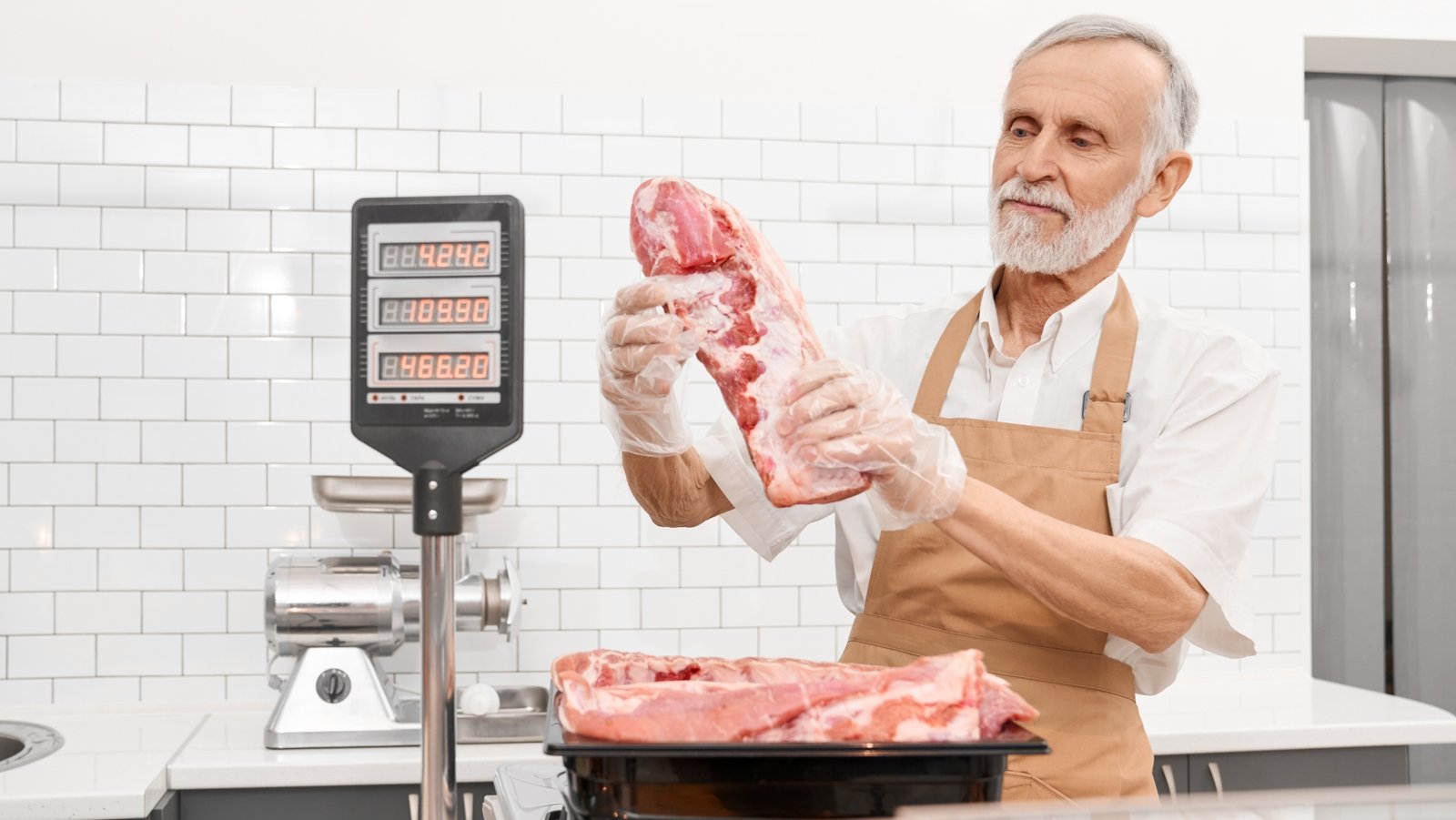
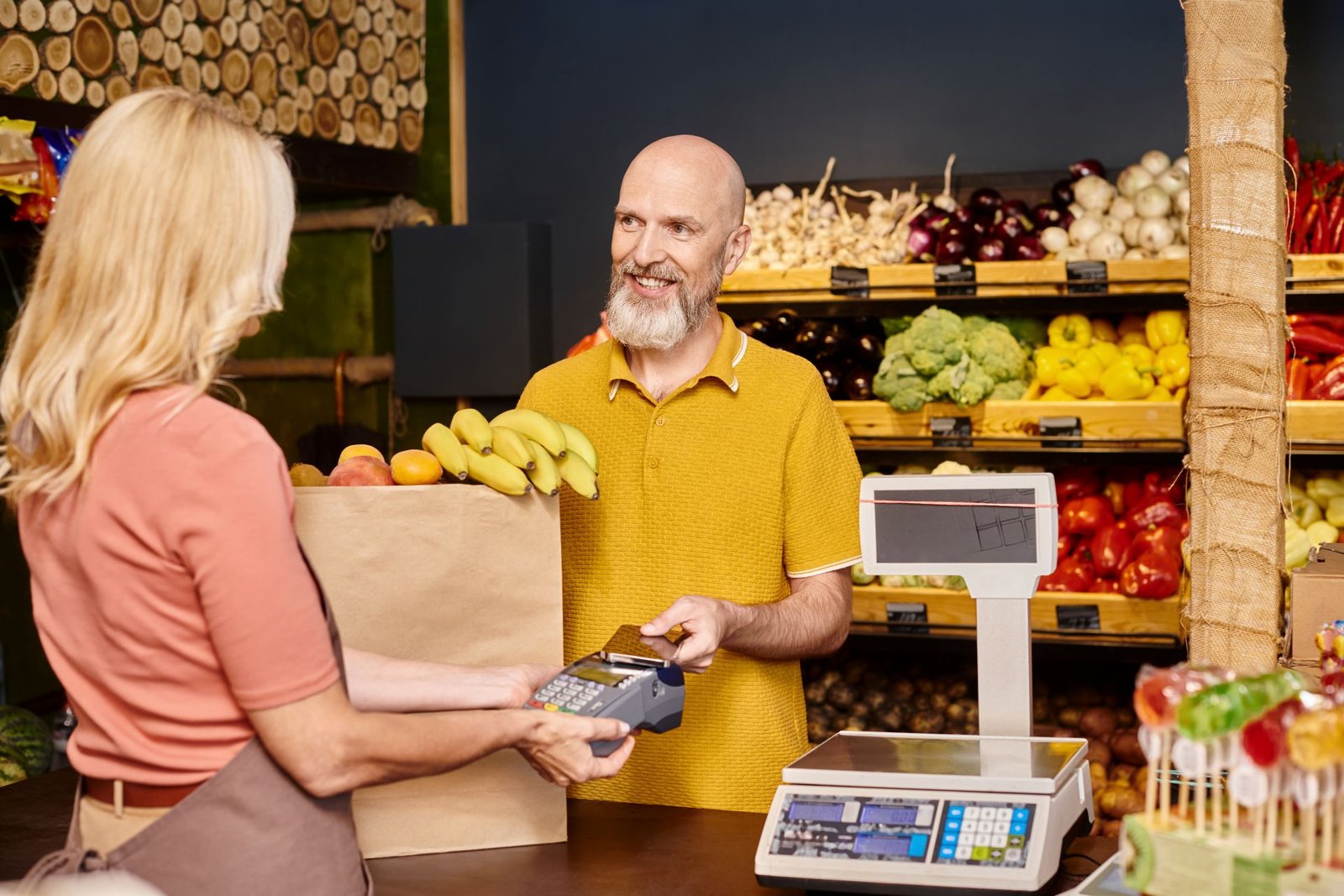
A price computing scale is the standard instrument for any retail environment where goods are sold by weight at a price per pound or per kilogram. The operator places the item on the platform, enters or selects the price per unit weight, and the scale computes and displays the total price automatically. Customer-facing dual displays show the weight and price simultaneously — the customer sees the same numbers the operator sees.
Price computing scales are available in capacities from 6 lb to 60 lb, with common divisions of 0.005 lb or 0.01 lb (some models offer 0.002 lb, about 1 g) for Class III NTEP-certified retail use. Battery-powered models serve farmers’ markets, roadside stands, and any retail environment without reliable mains power access.
Best for: Produce markets, butcher shops, farmers markets, specialty food retailers, fish counters, candy stores, and any retail environment selling loose goods by weight where the total price must be calculated at the point of sale.
Key requirement: NTEP Class III certification for any application where the weight reading determines customer pricing.
For the complete breakdown of how price computing scales work at every department in a grocery store — produce, deli, seafood, checkout, and receiving — see our article on grocery store scales: every scale type and where it belongs.
Deli Scales and Label Printing Scales
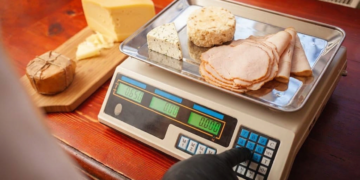
Deli scales are price computing scales with specifications matched to the demanding conditions of a deli counter — NSF certification for food contact surfaces, stainless steel removable platforms for cleaning, PLU (Price Look-Up) memory for fast product recall, and label printing capability for pre-packaged products.
Label printing deli scales add a thermal printer that produces a price-embedded barcode label — showing product name, weight, price per lb, total price, sell-by date, and ingredients — that is applied to pre-packaged deli products for the self-service case. The cashier scans the barcode at checkout rather than re-entering the price manually.
Best for: Full-service deli counters, meat and seafood departments, cheese counters, prepared food departments, and any deli operation that pre-packages products for self-service display alongside made-to-order service.
Key specifications: NSF certification for food contact surface compliance. Stainless steel removable platform for sanitation. PLU memory sufficient for the full product range. Thermal label printer with enough label formats for all required information fields. NTEP Class III certification.
POS Interface Scales
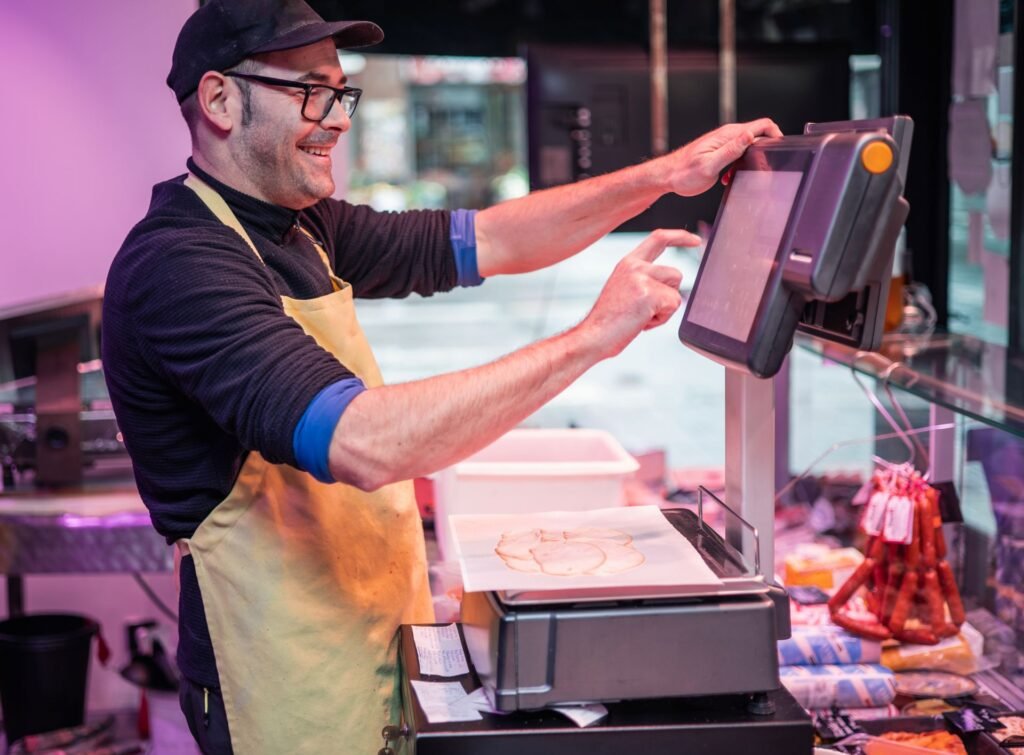
A POS interface scale connects directly to the point-of-sale system at a checkout lane — sending weight data to the POS terminal automatically when a weighted item is placed on the platform. The POS system retrieves the price per unit weight from its product database, calculates the total, and adds it to the transaction without any operator data entry beyond placing the item on the scale.
Best for: Grocery store checkout lanes, supermarket self-checkout stations, and any high-throughput retail checkout environment where weighted items are processed as part of a mixed transaction, including both weighed and non-weighed goods.
Key specifications: Compatibility with the specific POS platform in use — confirm the scale model is listed on the POS vendor’s compatible hardware list before purchasing. NTEP Class III certification. Bizerba, Mettler Toledo, and CAS are among the established manufacturers with broad POS system compatibility documentation.
For the complete guide to POS scale integration — connectivity standards, compatibility verification, and the checkout workflow that eliminates price lookup errors — see our article on what is a POS scale and how does it connect to your checkout system.
Postal and Shipping Scales for Commercial Operations
Commercial postal and shipping scales serve mailrooms, shipping departments, print shops, e-commerce fulfillment operations, and any commercial environment that ships parcels via USPS, UPS, or FedEx and needs to generate accurate postage or shipping labels.
These are bench-top instruments with USB or Bluetooth connectivity to postage software or shipping platforms. Capacity ranges from 5 lb for standard mailroom use to 150 lb for e-commerce and commercial shipping applications. NTEP certification is required where you charge a customer based on the scale reading — for example at a pack-and-ship counter. If you only use the scale to buy postage, the carrier’s own measurements govern, but a certified scale still helps avoid adjustments.
Best for: Corporate mailrooms, print and copy shops, e-commerce businesses, and retail operations that ship products to customers and generate shipping labels at the point of sale.
Connectivity requirement: Confirm the scale is supported by your shipping software — for example Stamps.com, ShipStation, UPS WorldShip or FedEx Ship Manager — before purchasing. For the full guide to shipping scale selection and software connectivity, see our article on how to choose a shipping scale for your business.
Counting Scales for Retail Inventory
A counting scale uses weight-based counting to determine quantities of uniform items — the same technology used in manufacturing parts counting, applied to retail inventory management. A sample of known quantity establishes the average piece weight, and subsequent batches are counted by weight.
Best for: Retail operations managing high-volume uniform inventory — fasteners, small hardware, bulk candy, loose tea, craft supplies, and any retail environment where counting individual items at receiving or restocking is labor-intensive and error-prone.
Key limitation: Counting scales require uniform piece weights. Mixed SKUs or items with significant weight variation produce counting errors. For the complete guide to how counting scales work and when they are and are not the right tool, see our article on how counting scales work and when to use one.
NTEP Certification and the Weights and Measures Inspection Process
NTEP certification and state Weights and Measures inspection are the two-step compliance process for any commercial retail scale in the United States. Understanding both steps — and where each applies — is essential for any retail operator.
NTEP Certification — The Model Standard
NTEP, administered by the National Conference on Weights and Measures (NCWM), tests scale models against the accuracy, construction, and performance requirements of NIST Handbook 44. A scale model that passes testing receives a Certificate of Conformance (CC) with a unique CC number. That number appears on the scale’s data plate and in the NCWM’s online CC database.
When purchasing a retail scale for commercial use, the first verification step is confirming the CC number. Do not rely on marketing language such as “legal for trade” or “commercial grade” without verifying the CC number in the NCWM database. Some products use these terms informally without holding a valid NTEP certification.
State Weights and Measures Inspection — The Unit Authorization
State Weights and Measures authorities conduct periodic inspections of commercial scales throughout their state. An inspector tests the individual unit in place using certified test weights, confirms the readings are within NTEP tolerance, and applies the state inspection seal to the scale if it passes. This seal is the legal authorization for that specific unit to be used for commercial transactions in that state.
Inspection frequency varies by state — most commercial retail scales are inspected annually. A scale whose inspection seal has expired is not in legal compliance for commercial use, regardless of how accurately it is reading. Many states allow service company inspections to supplement state inspections — check with your state’s Weights and Measures office for the specific requirements in your location.
What Happens When a Retail Scale Fails Inspection
A scale found out of tolerance during a Weights and Measures inspection is typically rejected — a red tag is applied and the scale must not be used commercially until it has been repaired or adjusted, usually by a registered service agency where your state requires one, and placed back in service under that state’s rules. (“Condemned” is reserved for devices that cannot be repaired.)
A condemned scale that continues to be used for commercial transactions is a legal violation — not just a compliance gap. Fines vary by state and by the severity of the out-of-tolerance condition.

POS Connectivity and Software Integration for Retail Scales
Modern retail scales are not standalone instruments — they are data points in an integrated retail transaction system. The connectivity specifications of a retail scale determine how weight data flows from the platform to the POS terminal, the pricing database, and the receipt.
The three retail scale connectivity configurations:
Direct POS interface scales communicate with the POS system via a dedicated RS-232 or USB connection, using a protocol specific to the POS platform. These are the tightly integrated checkout lane scales where the POS system controls the scale display and retrieves weight data automatically when a weighted item is identified.
Price computing scales with RS-232 output connect to label printers and data management systems, but do not require a full POS integration — they compute and display price locally and print a label or receipt that the cashier scans or enters manually.
USB HID-compliant scales connect to any software that accepts keyboard-equivalent input — postage software, shipping platforms, and basic retail POS systems — by sending the weight value as a data string to the active field in the connected application.
Verification before purchase: The specific scale model must be verified as compatible with the specific POS software version in use. Compatibility lists are maintained by the POS vendor — not the scale manufacturer — and are the authoritative source for confirming integration before purchasing.
Retail Scale Environments: Matching Specifications to Location
Every retail scale location has a different set of environmental requirements. A scale that performs correctly in one location will fail quickly in another if its specifications do not match the environment.
Deli counter and meat department: Exposure to raw meat, cheese, fish, and cleaning chemicals daily. Food-contact surfaces must be cleanable and corrosion-resistant under your food code, and many health departments expect NSF-certified equipment. Stainless steel platform with easy removal for cleaning. IP65 or higher for the indicator housing to withstand surface cleaning spray.
Produce section: Lower contamination risk than deli, but high product volume and frequent platform changes. Stainless steel platform. Battery operation for portable produce stands at markets without power access.
Checkout lane: High transaction volume, moderate environmental exposure. POS integration compatibility is the primary specification requirement. Durability and ease of platform cleaning are secondary.
Receiving dock: The receiving dock scale handles the widest range of loads — individual parcels, bulk deliveries, and pallet verification. A floor scale at the receiving dock rather than a retail price computing scale is the appropriate instrument for this location. For the complete receiving dock scale guide, see our article on inbound freight receiving: how to use scales to verify deliveries.
Farmers’ markets and mobile retail: Battery operation, portability, and weather resistance are the primary requirements. Price computing scales with battery power, and protective carrying cases are the standard for outdoor and mobile retail environments.
Retail Scale Calibration and Maintenance
A retail scale that was accurate at installation drifts over time through normal mechanical wear, environmental exposure, and the accumulated effect of frequent loading and unloading cycles. Calibration — verifying the scale’s accuracy against certified reference weights and correcting any deviation — maintains the accuracy that legal-for-trade use requires.
Recommended calibration intervals for retail scales:
High-volume retail environments — deli counters, checkout lanes, busy produce sections — should have scales calibrated annually at a minimum, and verified between state inspections using certified test weights. Low-volume retail environments — mailrooms, specialty stores — are typically adequate with annual calibration aligned to the state inspection cycle.
After any of the following events, check the scale with test weights (and have it adjusted by a qualified technician if needed) before it returns to commercial service: relocation to a new counter or department, physical impact or damage, electronic repair, or a reading that fails an in-house verification check.
Quick Reference: Retail Scale by Application
| Application | Scale Type | Typical Capacity | NTEP Required |
|---|---|---|---|
| Produce, bulk foods, farmers markets | Price computing scale | 6–60 lb | Yes |
| Full-service deli counter | Deli scale with PLU memory | 15–30 lb | Yes |
| Pre-packaged deli products | Label printing scale | 15–30 lb | Yes |
| Grocery store checkout lane | POS interface scale | 15–30 lb | Yes |
| Commercial mailroom / shipping | Postal/shipping bench scale | 35–150 lb | Yes — for shipping charges |
| Retail inventory counting | Counting scale | 5–150 lb | No |
| Receiving dock | Floor scale | 500–5,000 lb | Recommended |
FAQs
What is a legal-for-trade retail scale?
A legal-for-trade retail scale carries NTEP certification — confirming the model meets NIST Handbook 44 accuracy and construction standards — and has been tested and sealed by a state Weights and Measures inspector for commercial use. Both the model certification and the individual unit inspection seal are required. A scale without either one is not legally authorized for commercial transactions where weight determines customer price.
What is the difference between a price computing scale and a POS interface scale?
A price computing scale calculates the total price locally — the operator enters the price per pound and the scale displays the total. A POS interface scale connects directly to the checkout POS system — it sends the weight to the POS, which retrieves the price from its database and adds it to the transaction automatically. Price computing scales are used at service counters. POS interface scales are used at checkout lanes where the full transaction is managed by the POS system.
How often do retail scales need to be inspected?
State Weights and Measures authorities inspect commercial retail scales on a schedule that varies by state — most commercial retail locations are inspected annually. The state inspection seal on the scale confirms it has been tested and authorized for commercial use. A scale with an expired seal is not in legal compliance for commercial transactions, regardless of its accuracy.
Do I need an NTEP-certified scale for a farmers’ market?
Yes, if you sell goods by weight, the scale reading determines what the customer pays. NTEP certification is required for any commercial transaction where weight determines price — farmers markets are explicitly covered under most state Weights and Measures regulations. Battery-powered NTEP-certified price computing scales are available specifically for outdoor and mobile retail environments without reliable power access.
What is NSF certification for deli scales?
The scale’s food contact surfaces — the platform and any components that contact food — meet sanitation design standards for commercial food service use. Food codes require food-contact equipment to be cleanable and corrosion-resistant, and many health departments expect NSF-certified (or equivalent) equipment in deli, meat, seafood and prepared-food areas. It is a separate certification from NTEP — a deli scale in a commercial food environment typically requires both.
Conclusion
Every retail scale used in a commercial transaction is a legal instrument — subject to NTEP certification, state inspection, and the accuracy requirements of NIST Handbook 44. The type of scale, its environmental specifications, and its connectivity requirements are determined by where in the retail operation it sits and what transaction it supports.
Price computing scales serve the service counter. Label printing scales serve the pre-packaged product case. POS interface scales serve the checkout lane. And every one of them requires both a valid NTEP Certificate of Conformance and a current state Weights and Measures inspection seal before it is legally authorized for commercial use.
The ten articles in the Scale Blog Retail & Commercial cluster cover every retail weighing application in detail — from grocery store scale selection through to commercial scale calibration and state inspection compliance. Use the links throughout this guide to go deeper on any specific retail weighing decision your operation faces.
Sources
- NIST Handbook 44 (2026), Section 2.20 Scales, Table 6 maintenance tolerances — nist.gov
- NIST Handbook 130 (2026), Uniform Weights and Measures Law and Method of Sale regulation — nist.gov
- NCWM National Type Evaluation Program — ncwm.com
- FDA Food Code 2022, Chapter 4 Equipment — fda.gov
Last reviewed September 2026 by the Scale Blog editorial team. Inspection and service-agency rules vary by state; confirm with your state or local weights and measures office.