On this page
Quick answer: most electronic scales are built from the same few parts. Load cells turn weight into a tiny electrical signal. A junction box combines the signals when there is more than one cell. Then a weighing indicator (with a display for people), a weight transmitter (for a PLC or control system) or a weight controller (which also runs filling or batching) converts that signal into a weight. Choosing the right combination comes down to capacity, the environment, how the weight will be used, and whether the scale must be legal for trade.
This guide explains each part, the main load cell types and what to check before you replace a component or specify a new system.
How a load cell works
A load cell, also called a transducer, converts a mechanical force into an electrical signal. Most industrial load cells use strain gauges: thin resistive foils bonded to a precisely machined metal body. When weight bends or shears the body, the gauges stretch or compress and their electrical resistance changes very slightly.
Usually four gauges are wired as a Wheatstone bridge. The indicator supplies a steady excitation voltage; with no load, the bridge is balanced and the output is zero. As load is applied, the bridge outputs a signal of only a few millivolts, in proportion to the weight. That is why load cell sensitivity is quoted as rated output in mV/V, meaning millivolts of signal per volt of excitation at full rated capacity.
The tiny signal travels through the load cell cable to the weighing electronics, which amplify it, convert it to a digital value and turn it into a weight. For the different kinds of scale built on these parts, see types of digital weighing scales.
Capacity vs resolution
Resolution is the scale’s capacity divided by its smallest displayed increment. A 5,000 lb scale that reads in 1 lb increments is a 1:5,000 system; read in 0.5 lb increments, it becomes 1:10,000. The finer the increment, the smaller the millivolt change per increment, so the system becomes harder to keep stable. Pushing a scale to a finer display than its load cells and electronics can support does not make it more accurate.
Main load cell types
| Type | Typical capacity range | Typical uses |
|---|---|---|
| Single point | About 6.6 lb to 4,400 lb (3 kg to 2 t) | Bench, counting and small platform scales; one cell under the center |
| Bending beam | 50 to 2,000 lb | Low-capacity platform and bench scales |
| Shear beam (single and double-ended) | 1,000 to 50,000 lb | Floor scales, tank and hopper scales, livestock scales |
| S-beam (tension) | 25 to 40,000 lb | Suspended hoppers and tanks, hanging loads, conversions |
| Canister / compression (column, ring, rocker) | 100 to 1,000,000 lb | Truck and rail scales, silos and large vessels |
Ranges from Rice Lake Weighing Systems and, for single point cells, Mettler Toledo. Individual models vary, so always check the manufacturer’s data sheet.
A useful rule of thumb from Mettler Toledo: beam-type cells for scales below about 10 t (22,000 lb) capacity, canister or ring cells above that, and S-type cells for loads in tension.
Digital load cells carry their own electronics and send a digital signal instead of millivolts, so they do not use an analog summing junction box. Manufacturers promote them mainly for truck scales, citing cell-by-cell diagnostics and fewer junction box failures. Those are maker claims, so compare service history and support, not just brochures.
Junction boxes: summing several load cells
Floor, tank and truck scales sit on several load cells. A junction box brings their cables together and combines their signals so the indicator sees one value. It is also where technicians start troubleshooting, because every cell connects there.
No two load cells have exactly the same output, so junction boxes can trim each cell to match the others. Without trimming, a scale can read differently depending on where the load sits, which is called a corner or section error. There are two common methods:
- Excitation trim adjusts the voltage supplied to each cell.
- Signal trim adjusts each cell’s output signal.
Either way, trimming is done with test weights placed over each corner and must be finished before final calibration. Choose a junction box enclosure to suit the area: stainless steel for washdown, the right IP rating for dust and water (see IP ratings for industrial scales), and certified equipment in hazardous locations (see explosion-proof scales).
Indicators, transmitters and controllers
All three convert the load cell signal into a weight. What differs is who or what uses the result.
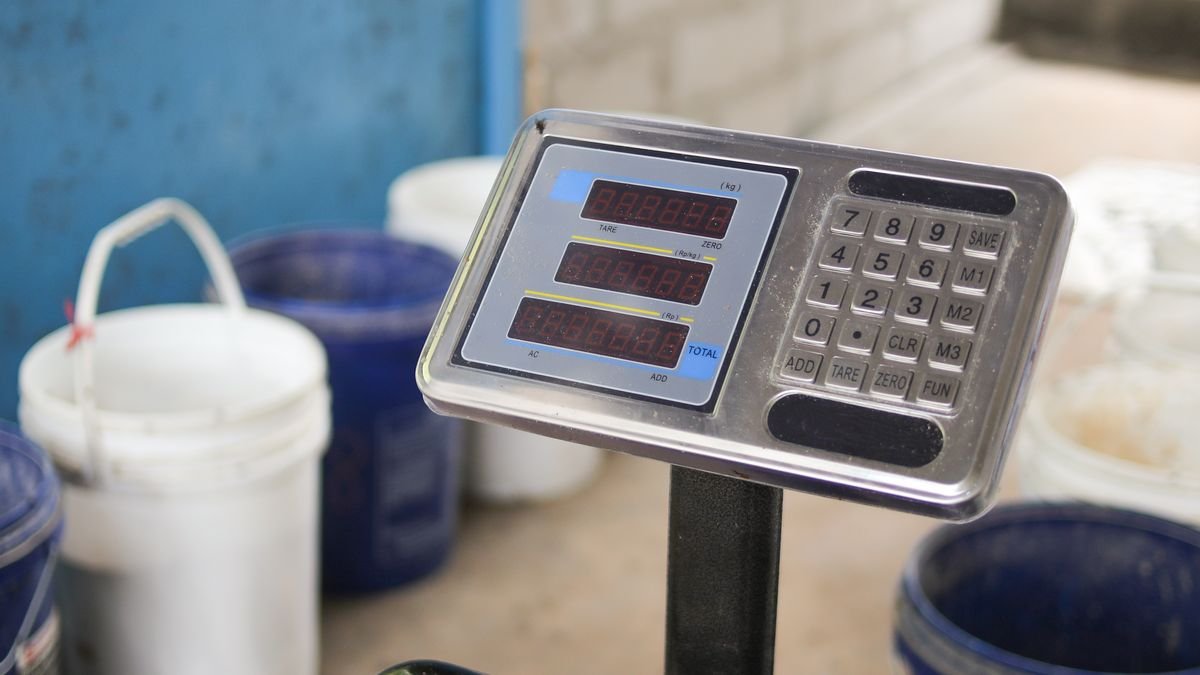
- Weighing indicator: has a display and keys, so an operator reads the weight and uses zero, tare, counting, check-weighing and printing at the scale. Most floor, bench and truck scales use one. Many have serial, Ethernet or fieldbus ports too.
- Weight transmitter: usually mounted on a DIN rail in a control cabinet, with little or no operator display. Its job is to pass the weight reliably to a PLC or process control system, typically from tank, silo and hopper scales. Outputs include analog current (for example 4–20 mA) and industrial networks such as Modbus TCP, PROFIBUS, PROFINET, DeviceNet and EtherNet/IP. Many also have relay or digital outputs to switch valves at set weights.
- Weight controller: goes a step further and runs the weighing process itself, such as filling, dosing or batching, with setpoints and outputs that control feeders and valves. See batch and ingredient weighing systems.
| Indicator | Transmitter | Controller | |
|---|---|---|---|
| Main user | Operator at the scale | PLC or control system | The process itself |
| Display | Yes | Minimal or none | Usually yes |
| Typical outputs | Printer, serial, Ethernet | 4–20 mA, fieldbus, Ethernet | Setpoint relays, I/O, fieldbus |
| Typical use | Floor, bench, truck scales | Tank, silo, hopper scales | Filling, dosing, batching |
Legal for trade: components need their own certificates
If a scale is used for trade, meaning its weight sets a price or a charge, it must meet NIST Handbook 44 and your state’s weights and measures law. In practice, the load cells and the indicator each need an NTEP Certificate of Conformance, and they must suit the scale’s accuracy class and number of divisions.
- Accuracy class: most commercial scales use Class III load cells. Large scales such as vehicle, railway and livestock scales above 30,000 lb typically use Class III L.
- Divisions: each certified load cell has a maximum number of divisions (nmax). The scale’s divisions must not exceed what its cells and indicator are certified for.
- Single or multiple cell use: certificates show whether a cell is approved for single-cell (S) or multiple-cell (M) applications.
A certified load cell does not make the whole scale certified, and a scale’s certificate does not certify the individual load cells inside it. When you replace a cell or an indicator on a trade scale, use a qualified scale service company (registered, where your state requires it) and confirm the rules with your state weights and measures office. See what an NTEP scale is.
This is general information, not engineering or legal advice. Load cell sizing, mounting, wiring and hazardous-area equipment should be specified and installed by a qualified technician following the manufacturer’s instructions. Never load a scale or load cell beyond its rated capacity.
What to check before you buy or replace components
- Capacity: the maximum load including any vessel, platform or other dead load, with headroom for shock loading as the manufacturer recommends.
- Resolution: the smallest increment you actually need, not the finest the indicator can display.
- Load cell type and mounting: compression or tension, and the right mounting hardware or weigh modules.
- Environment: washdown, temperature, corrosion, lightning exposure on outdoor scales, and hazardous areas.
- Interfaces: printer, PLC, plant network or software, and the output or fieldbus they need.
- Certification: NTEP certificates for every component if the scale is used for trade.
- Service: local support for trimming, calibration and repairs. See industrial scale calibration.
Next step: request free quotes from scale suppliers, or find manufacturing and industrial scale companies in the directory, including service companies that replace and calibrate load cells.
Related
- Industrial weighing scales: types, capacities and how to choose
- Batch and ingredient weighing systems
- Drum scales and hopper scales
- How to buy a truck scale
Sources
- Rice Lake Weighing Systems, Operation, capacity versus resolution and common types of load cells
- Rice Lake Weighing Systems, 10 facts about junction boxes
- Mettler Toledo, Load cell types and applications
- Mettler Toledo, POWERCELL technology
- Minebea Intec, Weight transmitters
- Load Cell Central, Load cell and strain gauge basics
- Tacuna Systems, Load cell summing: junction boxes, signal trim and excitation trim
- Tacuna Systems, Load cell classes: NIST requirements (summary of NIST Handbook 44)
Questions & answers