







Industrial weighing is a production-critical activity. When an industrial scale produces an inaccurate reading, the consequences are not limited to a billing discrepancy — they propagate through the entire downstream process. An incorrect batch weight produces an off-spec formulation. An incorrect truck weight produces a transport compliance violation. An incorrect fill weight produces a consumer complaint, a regulatory notice, or a product recall. Getting industrial weighing right is not a quality-of-life improvement — it is a production and compliance requirement.
This guide covers every industrial scale type used in manufacturing, processing, and heavy industry operations, the environmental and durability specifications that determine whether a scale survives its operating environment, IP ratings, NTEP and OIML certification, ERP and WMS integration, and the calibration requirements that keep every measurement defensible.
Table of Contents
Why Industrial Weighing Is Different From Commercial or Laboratory Weighing
Industrial scales operate in conditions that commercial and laboratory instruments are not designed for — and the specifications that matter reflect those conditions directly.
Environmental exposure is the defining challenge of industrial weighing. A scale at a chemical plant faces corrosive vapors, washdown with caustic cleaning agents, and temperature fluctuations across a full production cycle. A scale in a food processing facility must withstand pressure washing multiple times per day. A scale on a mining or aggregate site faces impact loads, vibration, dust, and mud that would destroy a standard commercial instrument within weeks.
High capacity is the second defining difference. Industrial applications regularly require scale capacities from 5,000 lb through to several hundred thousand pounds for truck and rail scales. Load cells in industrial environments must maintain accuracy under dynamic loading conditions — impact from dropped loads, vibration from adjacent production equipment, and the constant mechanical wear of high-cycle use.
Process integration separates industrial scales from their commercial counterparts in a third important way. Unlike commercial or retail scales that produce a reading for a single transaction, industrial scales are often embedded in production processes — feeding weight data in real time to ERP systems, triggering automated dosing systems, controlling conveyor fill rates, or verifying batch completeness before the next process step begins.
The 7 Industrial Scale Types
1. Floor Scales and Platform Scales
Industrial floor scales are the most widely deployed scale type in manufacturing and production environments. They handle loads that cannot be lifted onto a bench — raw materials, finished goods, drums, IBCs, and palletized production batches — at platform sizes and capacities matched to the load and the handling equipment.
Best for: Receiving dock weight verification, production batch weighing, finished goods QC, and any application requiring a fixed, high-capacity weighing point on the production floor.
Typical capacity: 1,000 lb to 20,000 lb with platforms from 2 ft × 2 ft through to 5 ft × 7 ft for heavy industrial applications.
Key industrial specifications: Reinforced welded steel deck to resist deflection under dynamic loading. IP67-rated load cells for chemical and washdown exposure. NEMA 4X indicator housing for wet or corrosive environments. Stainless steel construction for food processing, pharmaceutical manufacturing, and chemical applications.
For the complete floor scale specification guide — covering capacity, platform size, deck material, IP rating, NTEP certification, and pit vs surface mount installation — see our article on how to choose a floor scale for your warehouse and production facility.
2. Bench Scales
Industrial bench scales handle components, materials, and finished products at the bench level in production environments. They serve quality control stations, ingredient portioning lines, packaging verification, and component counting applications where the items being weighed can be lifted by hand.
Best for: Production line QC checkpoints, ingredient portioning in food and pharmaceutical manufacturing, packaging weight verification, and parts counting in assembly operations.
Typical capacity: 5 lb to 300 lb, with readability from 0.001 lb for precise portioning to 0.1 lb for general production use.
Industrial specifications: Stainless steel platform and housing for food and pharmaceutical environments. IP65 or IP67 rating for washdown applications. Counting function for parts inventory. RS-232 or USB connectivity for direct ERP data capture.
3. Counting Scales
A counting scale combines weighing with a parts-counting algorithm — a sample of known quantity establishes the average piece weight, and subsequent loads are counted by weight comparison. In manufacturing environments, counting scales eliminate the labor-intensive and error-prone process of manual counting for fasteners, components, electronic parts, pharmaceutical tablets, and any other high-volume uniform item.
Best for: Incoming material verification, in-process component tracking, finished goods kitting, and inventory management of uniform small parts where physical counting is impractical at production volumes.
Key consideration: Counting accuracy depends on piece weight consistency. Parts with high weight variability — due to manufacturing tolerance, material variation, or mixed SKUs — produce counting errors that accumulate across large batches. For the complete guide to counting scale selection, accuracy limits, and when counting scales are and are not the right tool, see our article on how counting scales work and when to use one.
4. Crane Scales
A crane scale is a suspended weighing instrument that measures the weight of a load hanging from an overhead crane, hoist, or lifting device. Unlike a floor scale, where the load is placed on a platform, a crane scale weighs the load in mid-air — at any point in the lift cycle. No floor space is required, no approach ramps are needed, and loads that cannot be set down on a platform scale — due to shape, temperature, or material state — can be weighed during the lift.
Best for: Metal casting and foundry operations weighing molten or hot loads, structural steel fabrication, offshore and heavy construction, and any application where the load is suspended as a matter of course and a floor-level weighing station would require an additional handling step.
Typical capacity: 500 lb to 300,000 lb and above, with wireless indicators displaying the weight on a handheld receiver at the operator’s position.
For the full guide to crane scale selection, capacity requirements, wireless connectivity, and certification for suspended load weighing in manufacturing environments, see our article on what is a crane scale and how does it work.
5. Truck Scales and Weighbridges
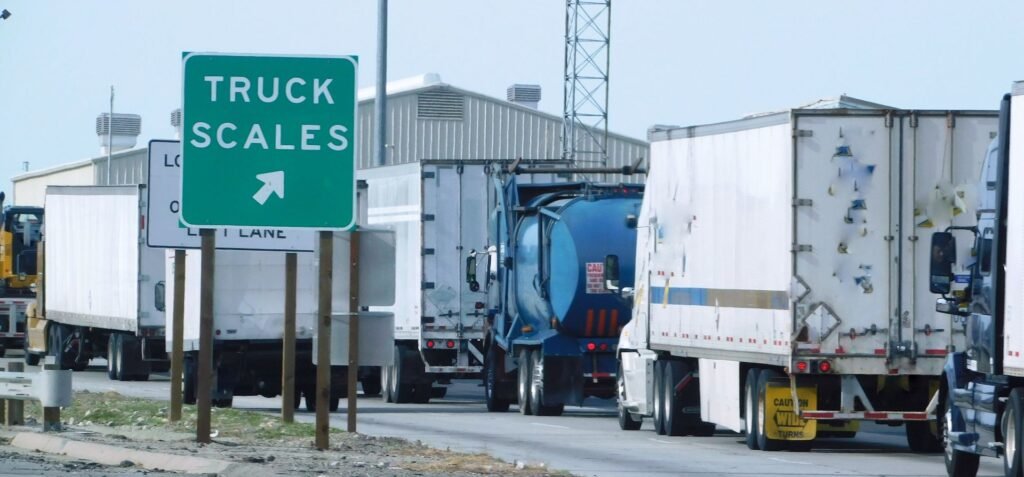
A truck scale — also called a weighbridge — is a large-capacity platform scale installed in the ground or above-ground on a reinforced foundation, designed to weigh loaded vehicles in a single drive-over pass. The vehicle drives onto the platform, stops, and the full gross vehicle weight is recorded. The tare weight of the empty vehicle is subtracted to yield the net payload weight.
Best for: Quarries, mines, aggregate operations, grain elevators, waste management facilities, chemical plants, and any industrial facility where the primary material movement unit is a loaded truck and accurate load weights are required for billing, compliance, or inventory.
Typical capacity: 60,000 lb to 200,000 lb, with platform lengths from 40 to 70 feet accommodating all common truck configurations, including semi-trailers.
Critical compliance requirement: Truck scales used for commercial transactions must be NTEP certified and sealed by the state Weights and Measures for legal-for-trade use. As confirmed by the NCWM and NIST Handbook 44, truck scales used to determine the price of commodities sold by weight — grain, aggregate, scrap metal, waste — are legal-for-trade instruments subject to the same certification requirements as any other commercial scale.
Rice Lake Weighing Systems manufactures the SURVIVOR series truck scales — heavy-duty NTEP-certified weighbridges built with wide-flange I-beam construction for long service life in demanding industrial environments, available in steel deck and concrete deck configurations for different site requirements.
For the complete comparison of farm platform scales versus commercial truck scales — and when each is the appropriate solution for an industrial operation’s load weighing requirements — see our article on farm scale vs truck scale.
6. In-Motion Checkweighers
An in-motion checkweigher weighs products as they move along a production conveyor — without stopping the line. Products are weighed at conveyor speed, classified as underweight, within tolerance, or overweight, and either passed to the next process step or diverted to a rejection lane automatically. In-motion checkweighers operate at speeds from 20 to 200+ packages per minute, depending on model and product type.
Best for: High-speed food, pharmaceutical, and consumer goods production lines where 100% product weight verification at production speed is required — not sampling, not manual spot-checking, but a verified weight on every single unit.
Regulatory context: Many food and pharmaceutical regulatory requirements effectively mandate 100% weight verification at the point of pack. The FDA and USDA FSIS both have net content regulations that require packaged food products to meet declared net weight specifications. In-motion checkweighers provide the only practical compliance mechanism at production line speeds.
Key specifications: Weighing speed matched to line speed. Reject mechanism suited to the product — air blast for light products, pusher for cartons, diverter gate for heavy packages. IP rating for the production environment — IP65 for standard food production, IP69K for high-pressure washdown environments.
For the complete guide to checkweigher selection — covering weighing speed, reject mechanisms, accuracy at speed, and integration with production line control systems — see our article on what is a checkweigher and how does it work.
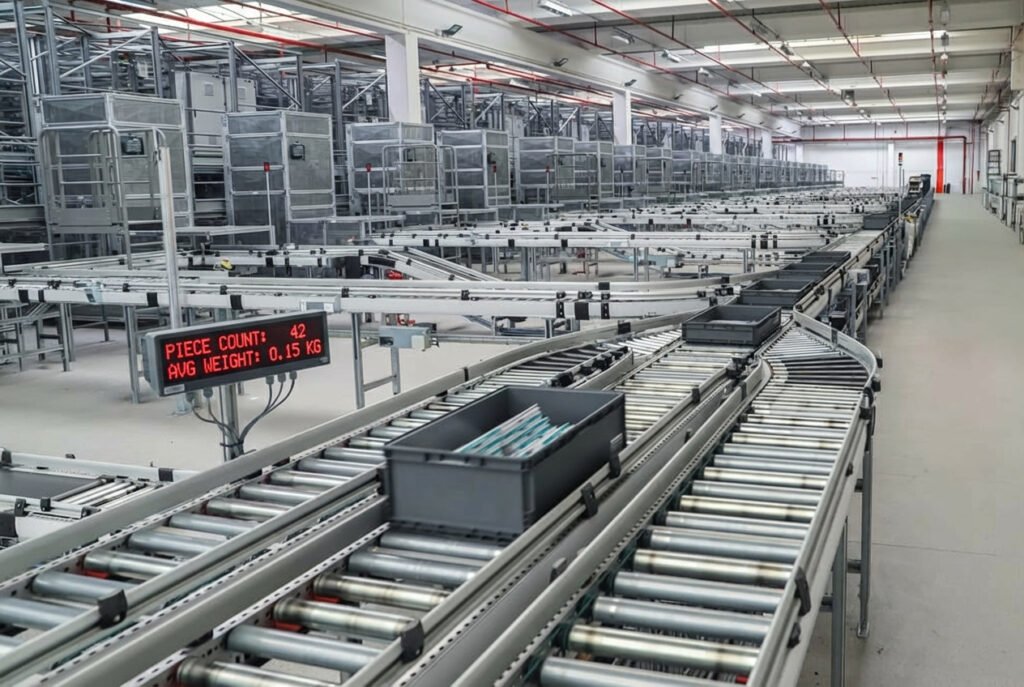
7. Drum and Hopper Scales
Drum scales and hopper scales are specialized platform instruments designed for specific container types. A drum scale is a low-profile platform optimized for 55-gallon steel or plastic drums — typically with a ramp or a hand truck slot and a capacity matched to a full drum’s weight (400–800 lb). A hopper scale combines a structural weighing frame with an elevated container — grain hopper, mixing vessel, or ingredient bin — mounted on load cells so that the contents can be weighed in-place without transfer to a separate scale.
Best for: Chemical manufacturing and liquid handling for drum scales. Food production, pharmaceutical compounding, and agricultural processing for hopper scales, where batch ingredient weights must be verified in the process vessel without transfer.
For the full guide to drum and hopper scale selection for industrial applications, see our article on drum scales and hopper scales: which does your facility need.
IP Ratings: What They Mean for Industrial Scale Selection
IP (Ingress Protection) ratings are the most misunderstood specification in industrial scale selection. Every industrial scale operating in a challenging environment must specify an IP rating for both the load cells and the indicator housing — and the rating must match the actual environmental conditions, not the best-case scenario.
As confirmed by Rice Lake Weighing Systems, the relevant IP ratings for industrial scale applications are:
IP54: Dust-tight and splash-proof. Suitable for indoor industrial environments with moderate dust and incidental moisture — standard production floors away from direct washdown.
IP65: Dust-tight and water jet-protected. Suitable for most indoor food production and chemical environments where the scale is cleaned with a hose or low-pressure spray.
IP67: Dust-tight and submersion-resistant to 1 meter for 30 minutes. Required for any scale that may be directly wetted during washdown, exposed to significant water accumulation, or operated in a food processing environment with regular pressure cleaning.
IP69K: Dust-tight and high-pressure, high-temperature washdown resistant. Required in pharmaceutical cleanrooms, meat processing facilities, and any environment where the scale is subjected to high-pressure steam cleaning at close range.
Common mistake: Specifying an IP65 scale indicator for an IP69K washdown environment. The load cells may carry IP67 or IP69K ratings, while the indicator housing carries only IP65, and the indicator fails within one season of high-pressure cleaning. Confirm both components’ IP ratings independently before purchasing for any washdown application.
NTEP and OIML Certification for Industrial Applications
NTEP certification — administered by the National Conference on Weights and Measures — is the US standard for legal-for-trade commercial weighing. Any industrial scale used to determine the price of goods sold by weight, the weight declared on a commercial shipping document, or any other commercial transaction must be NTEP certified and sealed by a state Weights and Measures inspector.
OIML certification — from the International Organization of Legal Metrology — is the international equivalent, relevant for industrial operations with export transactions or multinational supply chain compliance requirements. OIML R76 is the specific standard for non-automatic weighing instruments. OIML-certified load cells and instruments are accepted in most countries that have adopted the OIML framework.
When industrial scales require certification:
- Truck scales at grain elevators, quarries, and waste facilities, where the truck weight determines the transaction value
- Floor scales at chemical plants weigh raw materials purchased or sold by weight
- Bench scales at food production facilities where fill weight determines net content compliance
- Any production scale where the weight reading directly determines a commercial billing amount
When certification is not legally required:
- Internal production monitoring, where no commercial transaction is based on the reading
- In-process control weighing, where the result feeds an automated system without generating a commercial document
- Quality control spot-checking, where the certified instrument is the final verification, not the production scale
ERP and WMS Integration: How Industrial Scales Connect to Production Systems
In modern manufacturing operations, a scale that is not connected to the production management system is a manual data entry device — and manual data entry is the source of production variance, inventory discrepancy, and batch record errors in operations that have not made the integration investment.
The four integration levels in industrial environments:
Basic output: RS-232 or USB output from the scale indicator to a connected PC or terminal. The operator triggers a print or data send, and the weight is captured in the system. Adequate for low-throughput production stations where operator involvement in data capture is acceptable.
Keyboard wedge: The scale mimics a keyboard — every time a stable weight is reached, the indicator sends the weight value to whatever field is active in the connected application, as if the operator had typed it. Simple to implement, compatible with any software without custom development.
Native WMS/ERP integration: The scale indicator communicates directly with the WMS or ERP via Ethernet or Wi-Fi using the system’s native API or a middleware layer. Weight data is associated with the correct transaction, batch, or purchase order automatically — without operator data entry. This is the integration level that eliminates manual transcription entirely.
Automated process control: The scale is embedded in a production process — a filling line, a batching system, or a conveyor scale — and communicates with a PLC or SCADA system in real time. Weight data triggers actions — valve closure when a target fill weight is reached, line speed adjustment when throughput weight falls below target, rejection actuation when a package is out of tolerance. No operator involvement in the data flow.
For the complete guide to scale-to-WMS integration — covering connection methods, integration architectures, and the most common mistakes that create problems after go-live — see our article on how to integrate warehouse scales with your WMS.
Industrial Scale Calibration: The Production Compliance Requirement
Every industrial scale used in a legal-for-trade or regulatory-compliance application must be calibrated at defined intervals using NIST-traceable reference weights, with calibration records maintained in a format that satisfies the applicable regulatory audit requirements.
Calibration frequency for industrial applications:
| Application | Recommended Calibration Interval |
|---|---|
| Truck scale — commercial transactions | Annually, engineering load test at major capacity changes |
| Floor scale — production batch weighing | Every 6–12 months |
| Bench scale — QC and portioning | Every 6–12 months |
| In-motion checkweigher | Quarterly — performance verification at each shift start |
| Crane scale — suspended load certification | Every 6 months, verification at each batch start |
| Hopper/tank scale — process control | Annually, an engineering load test at major capacity changes |
Any relocation, impact event, or electronic repair requires immediate recalibration before the scale returns to production service. For the complete calibration requirements guide — including in-house verification procedures, professional calibration documentation standards, and out-of-tolerance response requirements — see our article on industrial scale calibration: how often and what compliance requires.
Industrial Scale Applications by Manufacturing Sector
Food and Beverage Manufacturing: Ingredient portioning scales, in-line fill weight checkweighers, washdown floor scales with IP69K ratings, and NTEP-certified finished goods shipping scales. FDA net content regulations require that packaged food products meet declared weights; in-motion checkweighers provide the 100% verification mechanism.
Pharmaceutical Manufacturing: Precision bench scales and analytical balances for API weighing, validated in accordance with GMP requirements under FDA 21 CFR Part 211, with audit trail capability under 21 CFR Part 11. For the pharmaceutical laboratory balance compliance requirements in detail, see our complete Laboratory & Research cluster.
Chemical Manufacturing: Corrosion-resistant stainless steel floor scales and drum scales with IP67 or IP69K-rated load cells for hazardous chemical environments. ATEX or Class I Division 2 rated scales for explosive atmosphere applications.
Metal and Aggregate Processing: High-capacity truck scales for raw material inbound and finished product outbound. Crane scales for weighing metal coils, castings, and structural components during fabrication. Floor scales for scrap metal and finished product verification.
Automotive and Electronics Manufacturing: Counting scales for component inventory and kitting. Bench scales for quality control at assembly stations. In-motion checkweighers for final assembly verification.
Quick Reference: Industrial Scale by Application
| Application | Scale Type | Typical Capacity | Certification |
|---|---|---|---|
| Raw material receiving | Floor scale | 1,000–10,000 lb | NTEP if commercial |
| Truck load weighing | Truck scale / weighbridge | 60,000–200,000 lb | NTEP required |
| Suspended load weighing | Crane scale | 500–300,000 lb | NTEP if commercial |
| Production batch weighing | Floor or hopper scale | 500–10,000 lb | NTEP if commercial |
| Component counting | Counting scale | 5–150 lb | Not required |
| Fill weight verification | In-motion checkweigher | 0.1–500 lb | Required for net content |
| Drum/IBC weighing | Drum scale | 500–2,000 lb | NTEP if commercial |
| QC portioning | Bench scale | 5–300 lb | NTEP if commercial |
FAQs
What types of scales are used in manufacturing?
The seven main industrial scale types are floor scales, bench scales, counting scales, crane scales, truck scales, in-motion checkweighers, and drum/hopper scales. Each serves a specific production application and weight range. Floor scales and bench scales are the most widely deployed. Truck scales handle the heaviest loads in bulk material industries. In-motion checkweighers serve high-speed production line weight verification.
What IP rating does an industrial scale need for washdown environments?
IP65 for water jet spray environments in most food production and chemical settings. IP67 for direct water exposure during washdown, where the scale may be submerged briefly. IP69K for high-pressure, high-temperature steam cleaning in pharmaceutical cleanrooms and meat processing facilities. Both load cells and the indicator housing must carry the appropriate IP rating — confirm each component independently.
Do industrial scales need to be NTEP certified?
Yes, for any application where the scale reading determines the price of goods in a commercial transaction — including truck scale billing at grain elevators and quarries, and fill weight compliance verification on packaged goods. Internal production monitoring and process control applications do not legally require NTEP certification, but calibration traceability is still required for regulatory compliance in pharmaceutical and food manufacturing.
How do industrial scales integrate with ERP and MES systems?
Integration ranges from basic RS-232 output requiring manual operator triggers, through keyboard wedge connections that auto-populate form fields, to native ERP/MES API integration via Ethernet or Wi-Fi that associates weight data with the correct transaction automatically. Automated process control integration embeds the scale in a PLC or SCADA system for real-time production process management with no manual data capture.
How often do industrial scales need to be calibrated?
Truck scales require annual calibration minimum with state Weights and Measures inspection for legal-for-trade use. Production floor and bench scales should be calibrated every 6–12 months. In-motion checkweighers require performance verification at each shift start and formal calibration quarterly. Any relocation, impact, or electronic repair event requires immediate recalibration before return to production service.
Conclusion
Industrial weighing spans a wider range of capacities, environments, and compliance requirements than any other weighing category. A bench scale portioning milligram quantities of a pharmaceutical ingredient and a truck scale weighing a 100,000 lb loaded aggregate haul are both industrial scales — separated by six orders of magnitude in capacity and by entirely different regulatory frameworks.
The right instrument for any industrial application is determined by three facts: what is being weighed, what environment it operates in, and whether the weight reading determines a commercial transaction or regulatory compliance outcome. IP rating, NTEP or OIML certification, and calibration interval all follow directly from those three facts.
The ten articles in the Scale Blog Manufacturing & Industrial cluster cover every application in this category in depth — from floor scale specification through to counting scale accuracy limits and industrial calibration requirements. Use the links throughout this guide to go deeper on any specific area of your industrial weighing decision.