








A warehouse without accurate scales is a warehouse making decisions on estimated data — and estimated data produces receiving discrepancies, shipping overcharges, inventory reconciliation failures, and carrier invoice adjustments. Every one of these problems has a direct financial consequence. Every one of them is preventable with the right scale at the right point in the workflow.
This guide covers every scale type used in warehouse and distribution operations, the workflow position where each one delivers maximum value, NTEP certification and legal-for-trade requirements, WMS integration, and how to build a complete warehouse weighing infrastructure matched to your operation’s specific needs.
Table of Contents
Why Warehouse Weighing Accuracy Has a Direct Financial Consequence
Three operational realities make scale accuracy a commercial priority in warehouse and distribution environments.
Receiving accuracy: When inbound freight is weighed at the receiving dock, and the weight does not match the purchase order, the discrepancy is documented before the goods enter inventory. Without a receiving scale, that discrepancy enters the inventory system as an accepted number — wrong from the first day, compounding through every subsequent transaction.
Shipping accuracy: Every package or pallet that leaves the warehouse with an incorrect declared weight is a potential carrier invoice adjustment — a post-delivery charge that arrives 30–60 days after the shipment has been delivered, by which time the original package and packing station record are often unavailable for dispute. The root causes of weight-based adjustments, and the packing station fixes that eliminate them, are covered in our article on how to avoid carrier invoice adjustments from wrong package weights.
Inventory accuracy: In a data-driven warehouse, weight is a verification tool as well as a measurement. A scale integrated with a Warehouse Management System (WMS) can confirm whether a pick is complete by comparing the weight of the picked items against the expected weight of the order — catching errors before they become mis-shipments.
The 6 Warehouse Scale Types
Warehouse and distribution operations use six distinct scale types. Each one serves a specific workflow position and weight range. Deploying the wrong type — or placing the right type in the wrong workflow position — creates inefficiencies that are often misdiagnosed as training problems or WMS configuration issues.
1. Floor Scales
A floor scale is a heavy-duty platform that sits at or near floor level, allowing pallets, drums, carts, and oversized items to be rolled, slid, or forked onto the weighing surface. Floor scales are the most versatile warehouse scale type — they handle the widest range of loads and serve the widest range of workflow positions.
Best for: Receiving dock weight verification, outbound freight weighing, bulk material measurement, and any application where loads are too heavy or awkward to lift onto a bench-top scale.
Typical capacity: 500 lb to 10,000 lb, with platform sizes from 2 ft × 2 ft to 5 ft × 7 ft.
Key specification: Platform size must accommodate the largest pallet or load with all four corners on the weighing surface. A pallet that overhangs the platform edge transfers part of its weight to the floor, producing a systematic low reading on every oversized load. For the complete floor scale specification guide covering capacity, platform size, deck material, IP rating, NTEP certification, and installation method, see our article on how to choose a floor scale for your warehouse.
2. Pallet Scales
A pallet scale is a floor scale optimized specifically for pallet weighing — with a low-profile deck (typically 3.5–5.5 inches high) sized for standard GMA pallets, and capacity matched to freight weights up to 10,000 lb. The platform size and low profile are what differentiate a dedicated pallet scale from a general-purpose floor scale.
Best for: Outbound LTL freight weighing where the pallet weight declared on the Bill of Lading must match what the carrier measures at their terminal. Since the July 2025 NMFC overhaul, pallet weight now drives freight class directly on most LTL commodities — making accurate pallet scale readings more commercially critical than at any previous point.
Key requirement: NTEP certification for any freight billing application. If you bill customers by weight, the scale must be NTEP-certified; for BOL weights declared to a carrier, NTEP is strongly recommended because carriers bill on their own certified reweighs. The complete specification guide for outbound freight pallet weighing is in our article on the pallet scale buying guide.
3. Bench Scales
A bench scale sits on a work surface — packing bench, receiving counter, or production station — and handles packages and components that can be lifted by hand. Most connect directly to shipping software or WMS platforms via USB or Bluetooth.
Best for: Parcel weighing at packing stations, component counting in pick zones, incoming QC verification for small items, and any application requiring accurate weight at a desk or counter surface.
Typical capacity: 35 lb to 300 lb, with readability from 0.1 oz for postal applications to 0.1 lb for parcel and freight applications.
Software connectivity: USB HID-compliant bench scales are recognized automatically by most shipping software platforms — UPS WorldShip, FedEx Ship Manager, ShipStation — sending weight readings directly to the label being generated. This eliminates the manual entry step that is the primary cause of weight transcription errors in high-volume packing operations.

4. Counting Scales
A counting scale combines a precision balance with a parts-counting algorithm. A sample of known quantity is placed on the scale, the scale calculates the average piece weight, and subsequent weighings display both total weight and estimated piece count simultaneously. Counting accuracy depends on piece weight consistency and sample size — the more consistent the piece weight, the more accurate the count at any sample size.
Best for: Inventory counting of uniform small parts — fasteners, components, packaging materials, hardware — where physical counting is slow and error-prone, and weight-based counting provides a faster, sufficiently accurate alternative.
Key limitation: Counting scales require uniform piece weights. Parts with high weight variability produce counting errors that accumulate across large batch sizes. For the full guide to counting scale selection, accuracy limits, and workflow integration, see our article on how counting scales work and when to use one.
5. Pallet Jack Scales
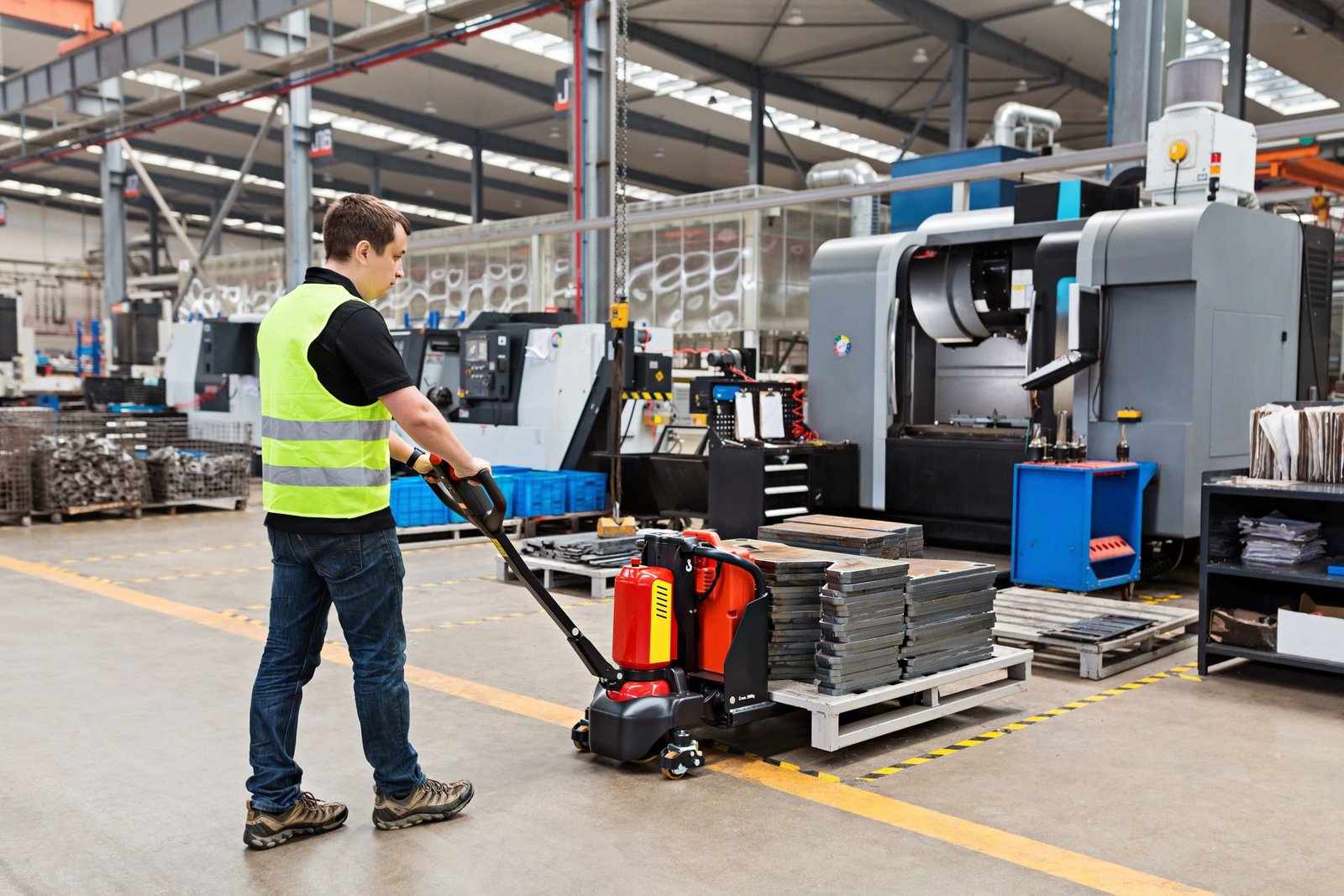
A pallet jack scale integrates a weighing system directly into a standard pallet jack. The operator moves pallets normally — the weight is captured during the same lift that was going to happen regardless. No separate scale station, no additional handling step, no floor space consumed by a dedicated platform.
Best for: High-throughput distribution centers where weighing every outbound pallet at a fixed floor scale station creates a queue, and where pallet jacks already handle ground-level movement as standard practice.
Key advantage over floor scales: Eliminates the separate weighing trip. The pallet is weighed during transport to the staging area or dock door — adding zero time to the standard workflow.
For the complete guide to how pallet jack scales work and the specifications that determine whether a pallet jack scale or a fixed floor scale is the right tool for a specific dock application, see our article on what is a pallet jack scale and how does it work.
6. Forklift Scales
A forklift scale mounts to the forks or carriage of a forklift and captures pallet weight during the lift cycle. Load-cell systems are commonly specified at around ±0.1% of capacity, and some are available with NTEP certification for freight billing use. Hydraulic pressure systems are lower cost but typically much less accurate (often around ±1–2%) — adequate for inventory tracking but not for commercial weight declaration.
Best for: Large warehouses and distribution centers where forklifts handle all pallet movement, loads regularly exceed pallet jack scale capacity, and capturing weight during the existing lift cycle eliminates any separate weighing step.
For the complete comparison of forklift scales against pallet jack scales — including the four-question framework for choosing between them — see our article on forklift scale vs pallet jack scale.
Matching Scale to Workflow Position
The most common warehouse scale deployment error is choosing the right scale type and placing it in the wrong workflow position. The scale type determines what can be weighed on it. The workflow position determines whether it actually gets used — or gets worked around because it is inconvenient, too slow, or too far from the point of action.
Receiving Dock
The receiving dock is where inbound freight is weighed against purchase orders and delivery notes. The right scale for this position depends on how goods arrive.
Palletized freight arriving by LTL carrier: A floor scale or pallet scale at the dock door verifies inbound pallet weights before the carrier’s driver leaves. Discrepancies documented at receiving — with a scale weight ticket — provide the evidence for freight claim disputes.
Individual parcels arriving by parcel carrier: A bench scale or floor scale handles packages that arrive individually. Weight verification at receiving catches short-ship and over-ship discrepancies before they enter inventory.
For the complete guide to inbound freight receiving scales — including what to weigh, when to weigh it, and how to integrate receiving weights into purchase order verification — see our article on inbound freight receiving: how to use scales to verify deliveries.
Packing and Shipping Station
The packing station is where outbound shipment weights are declared on the shipping label or Bill of Lading. This is the highest-value scale position in a warehouse — the weight declared here determines the carrier invoice on every single outbound shipment.
Parcel operations: A USB-connected bench scale at every packing station sends weight readings directly to the shipping software label. No manual entry, no transcription errors.
LTL freight operations: A floor scale or pallet jack scale at the staging area captures fully assembled, wrapped, and secured pallet weights before the BOL is generated. The declared weight must include the pallet, all packaging, and all securing materials.
Pick Zone
Scales in the pick zone serve a verification function rather than a billing function. A bench scale or floor scale at the end of a pick zone confirms that the picked order weighs what it should — catching missing items, wrong items, and pick errors before the order reaches packing.
Weight-based order verification is one of the highest-ROI scale applications in a high-SKU distribution center. When warehouse scales are directly connected to the WMS, the system instantly updates inventory levels based on weight readings — enhancing visibility and supporting just-in-time inventory practices.
WMS Integration: How Warehouse Scales Connect to Your Systems
A warehouse scale without direct WMS or shipping software connectivity is a manual data entry device. The operator reads the weight. The operator types the weight. The typed number becomes the record. That is the source of receiving discrepancies, shipping overcharges, and inventory reconciliation failures in operations that have not integrated their scales.
The four connection methods:
USB: Standard for bench scales at packing stations. The scale connects to the workstation PC and is recognized automatically by most shipping software platforms.
RS-232: The legacy serial standard, still required by many older WMS platforms and some industrial scale indicators. Most commercial floor and bench scales include RS-232 as well as USB.
Ethernet: The standard for floor scales and pallet scales at fixed dock stations that need to connect to a networked WMS. Cable length is not a limiting factor. Fixed IP configuration is required for reliable integration — dynamic IP assignment creates connectivity failures when the address changes.
Bluetooth/Wi-Fi: For mobile applications — pallet jack scales and handheld terminal workflows where a cable connection is impractical.
For the complete guide to scale-to-WMS integration — covering the four connection methods, three integration architectures, and the most common mistakes that create problems after go-live — see our article on how to integrate warehouse scales with your WMS.

NTEP Certification in Warehouse Applications
Most warehouse shipping, receiving and pallet scales fall under Class III, which NIST Handbook 44 (Section 2.20, Table 7a) lists as the typical class for “all commercial weighing not otherwise specified.” Class III allows 500–10,000 verification divisions for divisions of 5 g or more, so a 5,000 lb floor scale reading in 1 lb divisions (5,000 divisions) sits inside that range. Heavier vehicle, axle-load and crane scales fall under Class III L.
Any warehouse scale used where weight determines a price or charge must be legal for trade — in most states, an NTEP-certified model inspected by state or local weights and measures officials.
NTEP is required (or strongly advisable) when:
- You bill customers for freight or handling based on the weight (legally required), or declare BOL weights you need to defend against carrier reweighs (strongly advisable)
- The scale reading determines the price of goods sold by weight
- The scale is used for a SOLAS VGM declaration — equipment must meet the accuracy standards and requirements of the state where it is used
NTEP is not required when:
- The scale is used only for internal inventory tracking or quality control
- Weight is used internally for production monitoring, with no commercial transaction based on the reading
The NTEP Certificate of Conformance (CC) number on the scale’s data plate confirms the model is certified. The state Weights and Measures inspection seal confirms the individual unit has been tested in place and approved for commercial use. A model without a CC number, or a unit without an inspection seal, is not legally compliant for commercial weight declaration, regardless of its accuracy.
Floor Scale Buying: The 6 Decisions That Determine Whether It Works
Most warehouse floor scale purchases go wrong in the same three places: wrong capacity, wrong platform size, and wrong deck material for the environment. Getting all six decisions right the first time prevents the need to replace a scale within two years of installation.
Capacity: Specify at least 20–30% above your maximum expected load weight. Operating consistently near rated capacity accelerates load cell wear and degrades accuracy at the top of the range.
Platform size: The load must sit fully within the platform boundaries — any overhang transfers weight to the floor rather than through the load cells. For standard 48″ × 40″ GMA pallets, a 48″ × 48″ platform is the usual choice so no part of the load overhangs.
Deck material: Painted carbon steel corrodes rapidly in wet, washdown, or chemically exposed environments. Specify stainless steel platforms for any location that receives regular cleaning with water or chemicals.
IP rating: The indicator housing must be rated for the environment. IP54 for dusty indoor applications. IP65 for water spray environments. IP67 for washdown applications where the indicator may be directly wetted.
NTEP certification: Confirm the CC number before purchasing for any commercial application.
Installation method: Surface-mounted scales sit above floor level and require approach ramps for pallet jack access. Pit-mounted scales sit flush with the floor — no ramps, no trip hazard, less floor space consumed — but require concrete preparation and drainage planning.
The complete step-by-step floor scale buying guide is in our article on how to choose a floor scale for your warehouse.
Quick Reference: Warehouse Scale by Application
| Application | Scale Type | Typical Capacity | NTEP Required |
|---|---|---|---|
| Inbound pallet receiving | Floor scale / pallet scale | 2,500–10,000 lb | Recommended |
| Parcel packing station | Bench scale | 35–300 lb | Yes — for shipping charge |
| LTL outbound pallet weighing | Floor scale/pallet scale | 2,500–10,000 lb | Yes |
| Mobile pallet weighing | Pallet jack scale | 2,200–5,500 lb | Yes — NTEP model |
| High-capacity forklift loads | Forklift scale — load cell | 3,000–10,000 lb+ | Yes — load cell model |
| Parts inventory counting | Counting scale | 5–150 lb | No |
| Pick zone order verification | Bench or floor scale | As required | No |
| Internal inventory tracking | Any type | As required | No |
FAQs
What types of scales are used in warehouses?
The six main warehouse scale types are floor scales, pallet scales, bench scales, counting scales, pallet jack scales, and forklift scales. Each serves a specific workflow position and weight range. Floor scales are the most versatile — handling the widest range of loads from receiving docks through to outbound freight staging. The right type for any application is determined by what is being weighed, where in the workflow the weighing occurs, and whether the weight reading determines a commercial transaction.
Do warehouse scales need to be NTEP certified?
Yes, whenever the reading determines a price or charge you bill — goods sold by weight, or freight and handling billed by weight. For weights you only declare to a carrier, NTEP is strongly recommended rather than always legally required. NTEP certification confirms the scale model meets NIST Handbook 44 accuracy standards. The state Weights and Measures inspection seal confirms the individual unit is approved for legal-for-trade commercial use. Internal inventory tracking and QC applications do not legally require NTEP certification.
How do warehouse scales integrate with WMS software?
Warehouse scales connect to WMS platforms via four methods — USB, RS-232, Ethernet, and Bluetooth/Wi-Fi. Each has specific advantages depending on the scale’s location, the distance from the nearest workstation, and the WMS platform’s integration architecture. The complete integration guide is in our article on how to integrate warehouse scales with your WMS.
What capacity floor scale does a warehouse need?
Capacity should be at least 20–30% above the heaviest load the scale will regularly weigh. For standard pallet operations, a 5,000 lb capacity covers most applications. For heavy freight operations with loads above 3,000 lb regularly, a 10,000 lb capacity is more appropriate. The complete capacity selection guide is in our article on how to choose a floor scale for your warehouse.
What is the difference between a pallet scale and a floor scale?
A pallet scale is a floor scale optimized specifically for pallet weighing — with a low-profile deck sized for standard pallets and capacity matched to freight weights. A general-purpose floor scale covers a broader range of applications at various platform sizes and capacities. For outbound LTL freight applications, a dedicated pallet scale with a 48″ × 48″ minimum platform and NTEP certification is the appropriate tool.
Conclusion
A warehouse weighing infrastructure is not built around a single scale — it is built around the right scale at the right workflow position, each one integrated with the system that uses the weight data it produces.
Floor scales and pallet scales at the dock protect receiving accuracy and freight billing compliance. Bench scales at every packing station eliminate the manual entry errors that generate carrier invoice adjustments. Pallet jack scales and forklift scales capture weights during the material handling that was going to happen regardless. Counting scales transform inventory accuracy in high-SKU operations without adding handling steps.
The ten articles in the Scale Blog Warehouse & Distribution cluster cover every one of these applications in depth — from floor scale specification through to WMS integration architecture. Use the links throughout this guide to go deeper on any specific decision your warehouse operation faces.
Sources
- National Institute of Standards and Technology, NIST Handbook 44 (2026), Section 2.20 Scales.
- National Conference on Weights and Measures, NTEP Certificates of Conformance database.
- International Maritime Organization, Verification of the gross mass of a packed container (SOLAS Chapter VI, Regulation 2); U.S. Coast Guard, Marine Safety Information Bulletin 009/16 (April 2016).
- Occupational Safety and Health Administration, 29 CFR 1910.178, Powered Industrial Trucks.
Last reviewed September 2026 by the Scale Blog editorial team. Capacities and accuracy vary by model; never exceed rated capacity.