







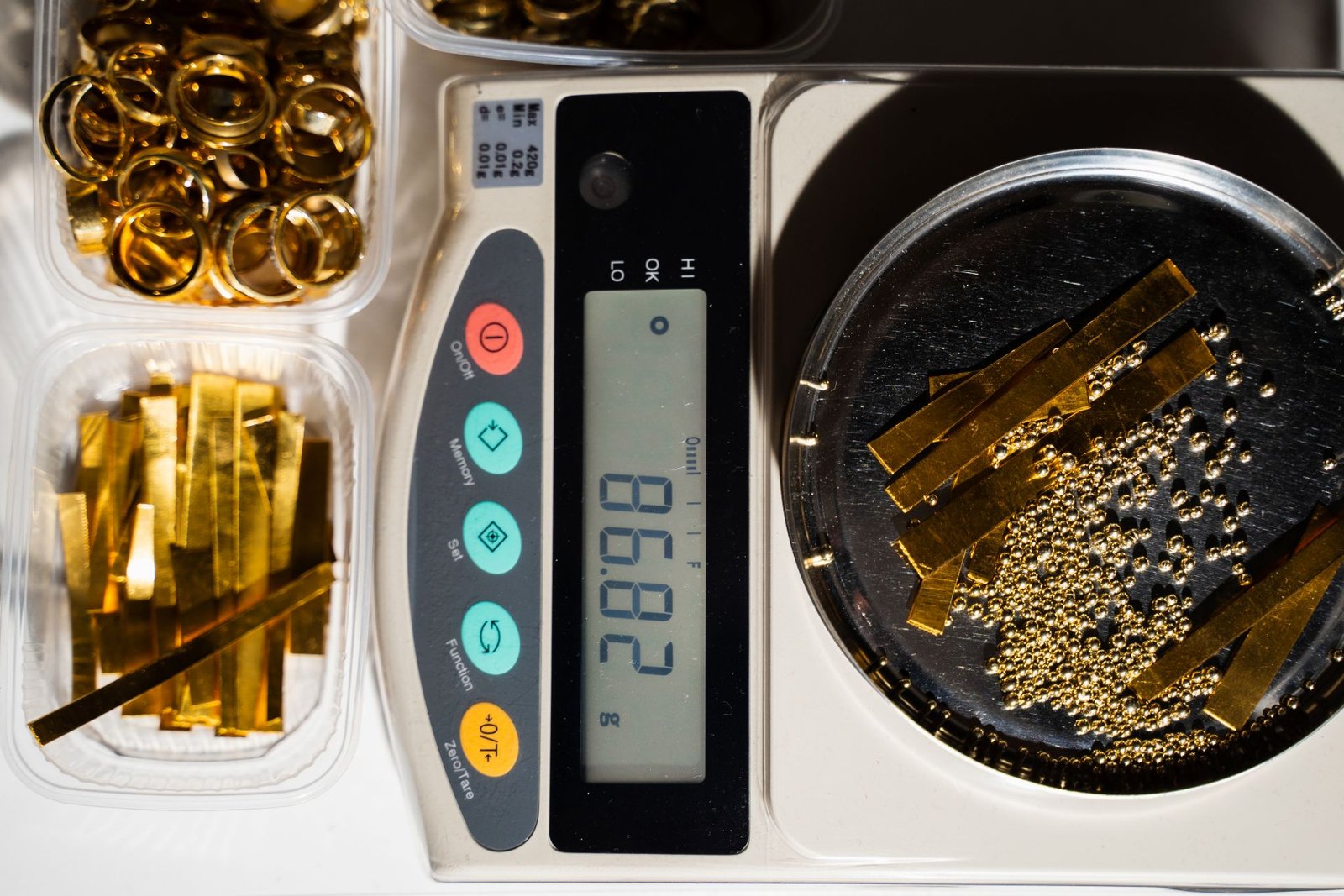
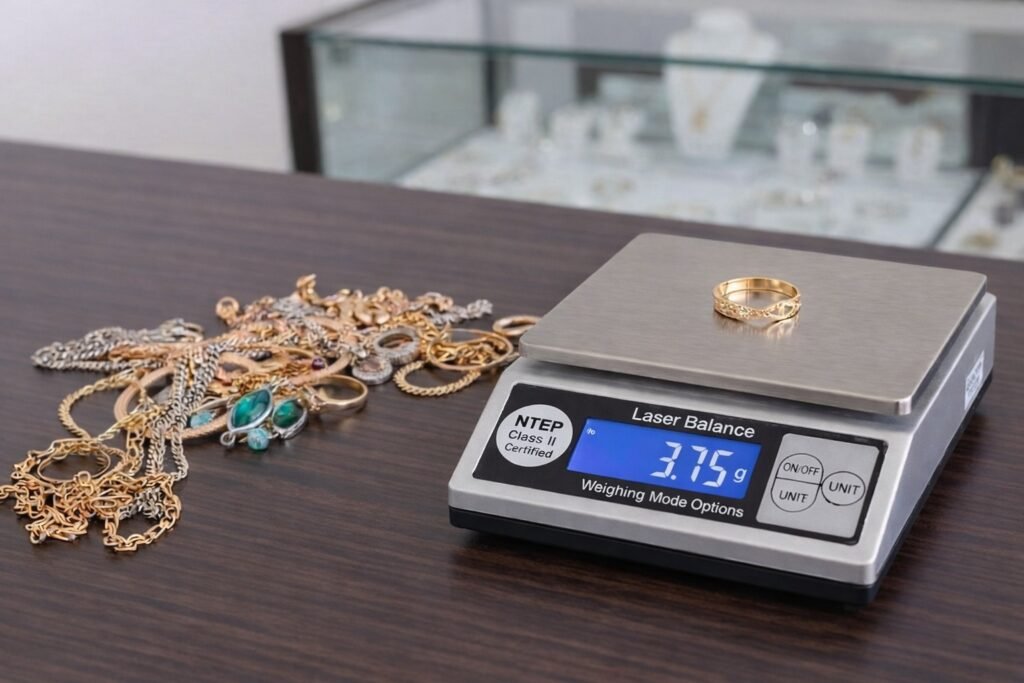
A jewelry scale is a precision balance reading to 0.001–0.01 g, designed for weighing gemstones and precious metals where fractions of a gram determine value. For any commercial transaction — buying or selling gold, silver, or diamonds — the scale must be NTEP Class II certified and sealed by a state Weights and Measures inspector. A standard pocket scale or uncertified balance is not legal for commercial precious metals transactions in the US.
In most retail weighing applications, being off by a tenth of a pound costs a few cents per transaction. In jewelry and precious metals, being off by a tenth of a gram can cost hundreds of dollars per transaction — and being off by a hundredth of a gram when weighing a diamond can change its classification entirely.
Jewelry is a weighing application where the accuracy requirements are most consequential per gram of product. Gold has traded well above $100 per gram through 2025–2026. A single carat diamond weighing 0.20 g can be worth thousands of dollars. The difference between a 0.99-carat stone and a 1.00-carat stone — two milligrams — can be several thousand dollars in retail value.
This is the environment where scale accuracy stops being an operational consideration and becomes a financial one.
Table of Contents
What a Jewelry Scale Is
A jewelry scale is a precision weighing instrument designed to measure the weight of gemstones, precious metals, and jewelry items to the accuracy levels required for valuation, grading, buying, and selling. It is a fundamentally different instrument from a grocery produce scale or a shipping scale — not in its basic operating principle, but in its precision requirements, its unit of measure options, and its environmental design.
The load cell at the heart of a jewelry scale operates on the same strain gauge principle as any other digital scale. But the measurement increments — 0.001 g, 0.01 g, or 0.1 g, depending on the model — are orders of magnitude finer than a retail produce scale reading to 0.01 lb (approximately 4.5 g). A 0.001 g jewelry scale is 4,500 times more precise than a standard produce scale.
That precision comes with corresponding sensitivity to environmental factors — air movement, vibration, electromagnetic interference, and temperature — that have no meaningful effect on a 30 lb produce scale but measurably affect a balance reading to the nearest milligram.
Units of Measure on a Jewelry Scale
A jewelry scale must support the units that the specific application requires. Most commercial jewelry scales support multiple units simultaneously — the operator selects the appropriate unit for the transaction.
Grams (g): The standard metric unit for weighing gold, silver, platinum, and other precious metals in most retail and commercial transactions. A 10 g gold chain, a 5 g gold ring, a 100 g bullion piece — grams are the universal baseline in most jewelry weighing applications.
Carats (ct): ct on a jewelry scale means carat — the unit for gemstone weight. One carat equals exactly 0.20 g. A 1.00 ct diamond weighs 0.20 g. A 0.50 ct diamond weighs 0.10 g. The carat unit exists specifically for gemstone measurement — it is entirely separate from gold purity measurement, which uses the term “karat” (K). A carat scale for gemstones reads to 0.001 ct (0.0002 g) for professional gemological work, or 0.01 ct (0.002 g) for standard retail.
Troy ounce (ozt): The traditional unit for precious metals in wholesale and bullion trading. One troy ounce equals approximately 31.1035 g — significantly heavier than the avoirdupois ounce (28.35 g) used for everyday goods. Gold spot prices are quoted in troy ounces. A jeweler buying scrap gold or bullion needs a scale that reads in troy ounces.
Pennyweight (dwt): A traditional unit still widely used by North American jewelers for gold valuation. One pennyweight equals 1.555 g or 0.05 troy ounces. Many gold buyers and estate jewelry dealers still quote prices in pennyweights per the conventions of their trade.
Grains (gn): An extremely fine unit — 1 grain equals 0.0648 g — used in specialized gemological applications where the finest possible precision is required. Most standard jewelry operations do not work in grains.
A quality jewelry scale supports at minimum grams, carats, troy ounces, and pennyweights — and switches cleanly between them. Class II NTEP-certified jewelry balances typically display in grams, carats, kilograms, pounds, ounces, troy ounces, and grains.
How Accurate Does a Jewelry Scale Need to Be?
The accuracy requirement depends on the application — specifically on what is being weighed and what financial decision the weight reading is supporting.
Precious Metal Buying and Selling (Retail)
Required readability: 0.01 g minimum. 0.001 g preferred for high-value transactions.
With gold above $100 per gram, a 0.1 g error is worth more than $10 on a single transaction. At high volume — a gold buying operation processing dozens of transactions per day — a scale that reads 0.1 g heavy on every transaction generates a systematic undercharge of several hundred dollars per week. A scale that reads light underpays the people selling to you — a weights and measures violation and a reputational risk.
For retail precious metal transactions where the customer pays based on the weight, NIST Handbook 44 lists accuracy Class II for precious metal and gem weighing, so buyers and sellers should use an NTEP-certified Class II scale; many operations choose 0.01 g divisions for gold and finer for gemstones. Confirm the requirement with your state weights and measures office.
Diamond and Gemstone Grading
Required readability: 0.001 g (equivalent to 0.005 ct).
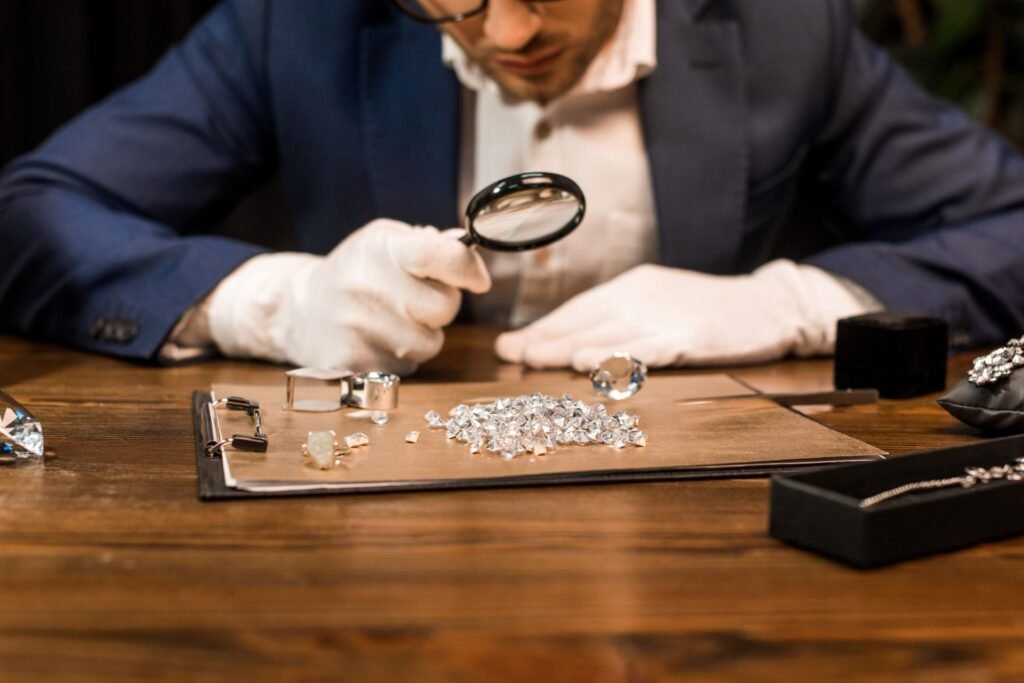
The carat weight of a diamond is the single most significant factor in its valuation. A 0.99 ct stone and a 1.00 ct stone look nearly identical — but the 1.00 ct stone commands a significant price premium because it crosses a major valuation threshold. A scale that cannot reliably distinguish between 0.99 ct and 1.00 ct is not suitable for professional gemstone grading.
Professional gemological instruments — analytical balances used in grading laboratories — read to 0.0001 g (0.0005 ct). For retail gemstone sales and appraisal, 0.001 g readability is the practical standard.
Internal Production and Quality Control
Required readability: 0.01 g is typically sufficient.
A jewelry manufacturer checking finished piece weights for quality control — confirming that a set of silver earrings weighs within specification — does not need the same readability as a diamond grader. A 0.01 g readability scale serves this application adequately and is significantly less expensive than a 0.001 g instrument.
NTEP Class II — Why Jewelry Requires a Different Certification Class
Most retail scales — produce, deli, shipping — use NTEP Class III certification. Jewelry scales require NTEP Class II.
The difference is precision. Under NIST Handbook 44 (Table 3), a Class II scale with divisions from 1 mg to 0.05 g may have from 100 up to 100,000 divisions, while a Class III scale is limited to 10,000 divisions and uses coarser division sizes (0.1 g and up). Class III is the standard for produce, deli and shipping.
Class II certification is required because jewelry and precious metal transactions involve items of very high value relative to very small weight. The financial consequence of a 0.01 g reading error at a deli counter is a fraction of a cent. The financial consequence of a 0.01 g reading error when buying scrap gold at over $100 per gram is more than $1 per transaction, which adds up quickly over volume.
A jewelry store owner buying gold or other precious metals from the public needs an NTEP Class II certified machine to remain fully compliant with state Weights and Measures requirements. The Class II designation is not optional for commercial precious metal transactions in most US states.
Before using any NTEP Class II jewelry scale in a commercial transaction, contact your state Weights and Measures office to confirm local requirements and schedule the required inspection and sealing. Find your state’s office through the NIST state Weights and Measures office directory.
Environmental Factors That Affect Jewelry Scale Accuracy
A jewelry scale reading to 0.001 g measures invisible masses — a small hair, a speck of dust, a breath of air across the platform. The environmental factors that have no effect on a produce scale have significant effects at this precision level.
Air currents: A gentle draft across the scale platform causes the reading to fluctuate. This is why most precision jewelry scales include a draft shield — a clear enclosure that surrounds the weighing platform on three or four sides. A draft shield is essential at 0.001 g readability and helpful at 0.01 g in drafty locations.
Vibration: Floor vibrations from foot traffic, nearby machinery, or a ventilation system cause the load cell signal to fluctuate. A jewelry balance should be placed on a stable, vibration-free surface — a dedicated weighing table with vibration isolation, if possible. Avoid placing a precision balance on a glass display case surface that resonates with foot traffic.
Temperature: Load cells change their electrical characteristics with temperature. A jewelry balance should reach stable operating temperature before use — typically 15–30 minutes after powering on — for consistent accuracy across a shift.
Electrostatic charge: Dry environments and certain synthetic materials generate static electricity that affects the weighing pan reading. This is particularly relevant when weighing synthetic gemstones and materials that accumulate static charge easily.
Leveling: Every precision balance must be level. A scale that is even slightly off-level produces readings that vary depending on where the item is placed on the pan. All precision jewelry scales include adjustable leveling feet and a bubble level indicator. Check and confirm the level before each use session.
Key Features to Specify on a Jewelry Scale
Readability: 0.001 g for professional diamond and gemstone work. 0.01 g for precious metal buying, selling, and general jewelry weighing. 0.1 g for bulk precious metal inventory.
Capacity: Match to the heaviest item you regularly weigh. Most retail jewelry operations are served by a 300–1,500 g capacity balance. A gold buyer handling large items or multiple pieces simultaneously may need a 3,000–6,000 g capacity model.
Draft shield: Essential at 0.001 g readability; useful at 0.01 g if the counter is near vents or doors. Look for a removable draft shield that allows easy placement and removal of items.
Unit modes: Confirm the scale supports all units required for your application — at minimum grams, carats, troy ounces, and pennyweights for a full-service jewelry retail operation.
NTEP Class II certification: Required for any commercial transaction where the customer pays based on the jewelry scale’s reading. Verify the CC number in the NCWM NTEP database before purchase.
Calibration method: External calibration uses a certified test weight placed on the pan manually. Internal calibration uses a built-in reference weight activated automatically — useful for high-volume environments where frequent recalibration is needed. For legal-for-trade applications, confirm that the calibration method meets your state’s Weights and Measures requirements.
Connectivity: RS-232 or USB for printing weight tickets, receipts, or certification records. Essential for any gold buying operation that must document transaction weights for compliance or record-keeping.
Jewelry Scale vs Pocket Scale — A Critical Distinction
Consumer pocket scales — sold online for under $30 — are marketed for jewelry use but are not appropriate for any commercial transaction. They are not NTEP-certified. They read to 0.1 g at best. They are not calibrated to any traceable standard. They are not stable in variable environments. They are not legal for use in any commercial transaction where price is determined by weight.
Even the slightest miscalibration or inaccuracy on a jewelry scale can cost hundreds or thousands of dollars per transaction. The risk of using a consumer pocket scale for commercial precious metal or gemstone transactions is not a calibration risk — it is a financial and legal risk.
A professional NTEP Class II jewelry balance costs more than a consumer pocket scale. At gold prices, the cost difference is recovered in fewer transactions than most business owners expect.
FAQs
What accuracy does a jewelry scale need for weighing gold?
For retail gold buying and selling, where the customer pays based on the scale’s reading, use an NTEP-certified Class II scale — 0.01 g divisions are a common choice. Check your state’s specific requirements. For high-value transactions — large quantities of gold or fine jewelry — 0.001 g readability provides greater confidence and reduces the financial impact of any reading uncertainty.
What is the difference between carat and karat in jewelry weighing?
Carat (ct) is a unit of mass used exclusively for gemstones — 1 carat equals exactly 0.20 g. Karat (K) is a measure of gold purity — 24K is pure gold, 18K is 75% pure gold. These are completely different measurements. A diamond’s carat weight is measured on a scale. A gold ring’s karat is a metallurgical composition, not a weight measurement. A jewelry scale displays carats as a unit of mass. It has no way of measuring gold purity in karats.
Do I need NTEP Class II or Class III certification for a jewelry scale?
NTEP Class II certification is required for commercial precious metal and gemstone transactions in most US states. Class II scales allow finer divisions and up to 100,000 divisions under NIST Handbook 44 — appropriate for the fine readability required in jewelry weighing. Class III is the standard for produce, deli, and shipping applications, and does not provide the precision required for jewelry. Check with your state Weights and Measures office to confirm the specific requirement in your jurisdiction.
Why does a jewelry scale need a draft shield?
At fine readability — especially 0.001 g — air currents across the weighing pan cause the reading to fluctuate. A draft shield — a clear enclosure surrounding the pan on three or four sides — eliminates this effect and produces stable, accurate readings. Without a draft shield, even a slow-moving HVAC airflow can prevent a precision balance from stabilizing on an accurate reading.
Can I use one scale for both gemstones and gold?
Yes — if the scale’s capacity and readability serve both applications. A balance with 300 g capacity and 0.001 g readability handles fine gemstone work and standard jewelry weighing simultaneously. For operations that weigh both small gemstones and larger quantities of scrap gold, two scales are often practical — a 0.001 g readability balance for gemstone work and a 0.01 g readability balance with higher capacity for bulk precious metal transactions.
Conclusion
A jewelry scale is not simply a small scale. It is a precision instrument designed for the most demanding accuracy requirements in retail commerce — where a measurement error of 0.01 g has real financial consequences per transaction, and where the weight of a single gemstone can represent a valuation threshold worth thousands of dollars.
The accuracy requirement is determined by the application. Professional diamond and gemstone grading requires 0.001 g readability. Retail gold buying and selling requires 0.01 g readability with NTEP Class II certification. Internal production quality control is served by 0.01 g without the legal-for-trade certification requirement.
Environmental factors — air currents, vibration, temperature, and leveling — matter at jewelry scale precision levels in ways they do not at produce or deli counter precision levels. Specifying a draft shield, a stable surface, and appropriate warm-up time are not optional refinements at this accuracy class. They are requirements for the instrument to perform within its rated specification.
For guidance on choosing the right retail scale for your broader business — including which applications require which scale type — see our article on how to choose a retail scale for your business.
Sources
- National Institute of Standards and Technology, NIST Handbook 44 (2026), Section 2.20 Scales, Tables 3 and 7a (accuracy classes and applications).
- National Institute of Standards and Technology, NIST Special Publication 811 and NIST Handbook 133: unit definitions (carat 200 mg; troy ounce 31.1034768 g; pennyweight 1.55517384 g; grain 64.79891 mg).
- National Conference on Weights and Measures, NTEP Certificates of Conformance database.
Last reviewed September 2026 by the Scale Blog editorial team. Precious-metal prices change daily; figures are illustrative.