









A Bill of Lading is not a formality. It is the legal foundation of every freight shipment in the United States — the document that makes freight legally movable and commercially protected.
Every LTL freight shipment, every ocean container, and every truckload movement generates a Bill of Lading. Fill it in correctly and it protects you in every dispute. Fill in the weight field with an estimate and it costs you money — in carrier invoice adjustments, reclassification fees, and inspection surcharges that arrive weeks after delivery.
This guide covers what a Bill of Lading is, the eight required fields, why the weight field is the most financially consequential entry on any LTL shipment since the July 2025 NMFC overhaul, the five BOL types, and exactly what happens when the information is wrong.
Table of Contents
The Three Legal Functions of a Bill of Lading
The BOL performs three distinct legal functions simultaneously. These are not interchangeable — each one protects a different party in the freight transaction.
1. Receipt of goods
When the carrier’s driver signs the BOL at pickup, they are formally acknowledging receipt of the freight in the quantity, condition, and weight stated on the document. That signature is the shipper’s legal evidence that the goods left their facility in the stated condition. If the freight is lost or damaged in transit, the signed BOL establishes what was handed over and forms the starting point for any freight claim. According to FedEx Freight’s LTL shipping documentation, the BOL’s receipt function makes it the primary document for establishing carrier liability at pickup.
2. Contract of carriage
The BOL is a legally binding contract between the shipper and the carrier. The terms on the document — carrier liability limits, freight payment terms, delivery requirements, and special handling instructions — govern the rights and responsibilities of both parties for the entire shipment. Once the carrier’s driver signs, those terms are binding. As FreightQuote’s BOL guide explains, any dispute about what was agreed at the time of shipment is resolved by reference to what the BOL states.
3. Document of title
In ocean freight and some domestic commodity shipments, a negotiable BOL is a document of title — the person holding the original has the legal right to claim the cargo. Banks use negotiable BOLs as collateral in letter of credit transactions: the bank holds the original until the buyer pays, at which point the BOL is released and the buyer presents it to the carrier to collect the goods. This function makes the BOL one of the few commercial documents that simultaneously represents a physical shipment and a financial instrument.
What a Bill of Lading Must Contain
Federal law requires specific information on every bill of lading for it to be legally valid. Eight fields are mandatory. The weight and freight class fields carry the most commercial consequence — an error in either produces a carrier invoice adjustment after delivery.
| Field | What It Must Contain |
|---|---|
| Shipper information | Full legal name, address, and contact details of the party sending the goods |
| Consignee information | Full legal name, complete delivery address including suite or dock number, and contact details |
| Date | The pickup date — used for tracking, invoice reconciliation, and dispute resolution |
| Description of goods | Number of handling units, packaging type (pallets, cartons, drums), and NMFC item description |
| Weight | Complete ready-to-ship weight — goods + all packaging + pallet + stretch wrap + banding. This field determines both the freight invoice and freight class |
| Freight class | The NMFC class number — since July 2025, calculated from density (weight ÷ cubic volume) for most commodities |
| Hazmat designation | Required when the shipment contains DOT-regulated hazardous materials — includes proper shipping name, UN number, hazard class, and packing group |
| Special instructions | Liftgate, inside delivery, limited access, appointment requirements, or other carrier instructions |
For the full breakdown of how declared weight drives LTL freight class since the July 2025 NMFC density overhaul, see the Scale Blog guide to LTL freight weight and shipping cost.
The Weight Field — Why It Is the Most Critical Entry on an LTL BOL
Most shippers understand that the weight on a BOL affects their freight bill. Fewer understand that since the July 2025 NMFC overhaul, it also determines their freight class. Together, these two consequences make an inaccurate weight one of the most expensive administrative errors in shipping operations.
It determines the freight charge: LTL carriers price by hundredweight (CWT) — the rate per 100 pounds multiplied by the declared weight at the applicable freight class produces the freight invoice. An underweight declaration generates a lower initial quote and a weight-and-inspection (W&I) adjustment after delivery. An overweight declaration generates a higher initial charge — money the shipper did not need to spend. Either error is avoidable with a calibrated dock scale.
It determines the freight class: Since the July 2025 NMFC density-based overhaul, the freight class for most commodities is calculated from density: declared weight divided by the shipment’s cubic volume. A 500 lb pallet occupying 40 cubic feet has a density of 12.5 PCF — approximately Class 100. The same pallet declared at 400 lb produces 10 PCF — Class 110, a higher and more expensive class. The wrong weight produces the wrong class even when the physical goods have not changed.
What must be included in the declared weight: The weight on the BOL must reflect the complete ready-to-ship unit: the goods, all inner and outer packaging, the pallet, all stretch wrap, banding, and any other securing materials. The carrier weighs the complete unit at their terminal on a certified scale. Any component omitted from the declared weight creates a discrepancy that triggers a W&I charge — the corrected invoice plus an inspection surcharge.
For the complete breakdown of what components must be included and how to avoid carrier invoice adjustments, see the Scale Blog article on how to avoid carrier invoice adjustments from wrong package weights.
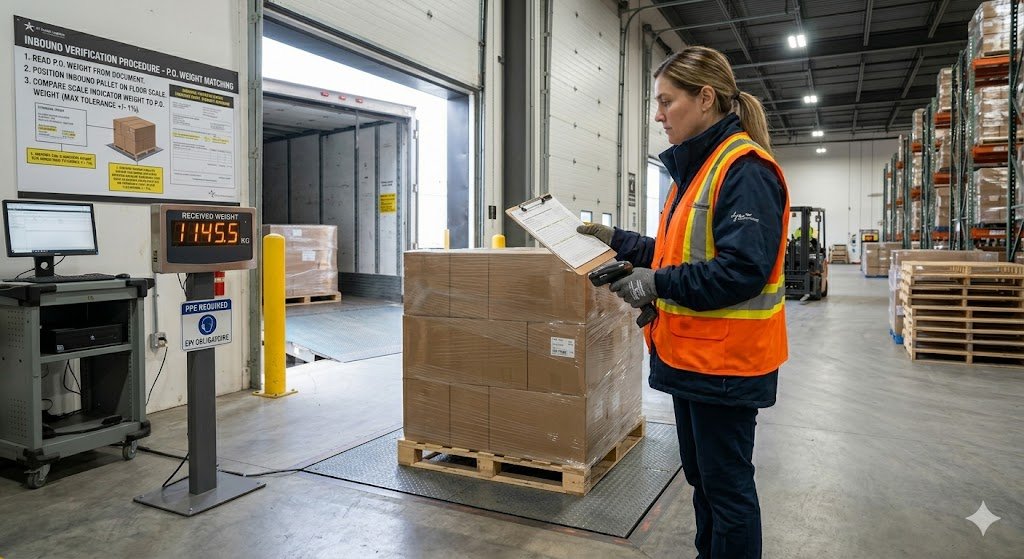
The scale requirement: The only reliable way to produce an accurate BOL weight is a calibrated, NTEP-certified pallet or floor scale at the shipping dock — weighing the complete assembled, wrapped, and secured pallet before the BOL is generated. An estimate, a product specification weight, or a previous shipment’s recorded weight is not adequate. The carrier’s terminal scale is calibrated and certified. To dispute its reading, you need a calibrated scale record from the time of dispatch.
Scale Blog Reader Discount
Liberty Scales supplies NTEP-certified pallet scales and floor scales for shipping dock applications. Scale Blog readers receive 10% off automatically — browse NTEP-certified pallet scales here. The discount applies at checkout automatically through this link — no code needed.
For the complete guide to choosing the right scale for a shipping dock application, see the Scale Blog pallet scale buying guide.

The Five Types of Bill of Lading
The type of BOL used depends on the shipping mode, the payment relationship between buyer and seller, and whether title to the goods needs to transfer during transit.
| BOL Type | When Used | Negotiable? |
|---|---|---|
| Straight BOL | Domestic LTL — payment already made | No — delivers to named consignee only |
| Negotiable (Order) BOL | International trade with letter of credit financing | Yes — can be endorsed and transferred |
| Sea Waybill | Ocean freight between trusted trading partners | No — consignee collects without original |
| Through BOL | Multimodal shipments (truck + ship + rail) | Depends on type issued |
| Electronic BOL (eBL) | Ocean freight replacing paper original | Yes — digitally endorsed and transferred |
1. Straight Bill of Lading
The most common BOL type for domestic US freight. A straight BOL is non-negotiable — the carrier delivers only to the named consignee, and the document cannot be transferred to a third party. Payment is typically made before or at the time of shipment. The vast majority of US domestic LTL freight moves on straight BOLs generated through carrier online portals.
2. Negotiable (Order) Bill of Lading
Used in international trade where payment has not been made before shipment. A negotiable BOL can be endorsed and transferred — making it both a shipping document and a financial instrument. In letter of credit transactions, the bank holds the original negotiable BOL as security until the buyer pays. Upon payment, the BOL is released to the buyer, who presents it to the carrier to take delivery of the goods.
3. Sea Waybill
A sea waybill is not negotiable and cannot transfer title. The consignee can claim cargo without presenting an original document, making release faster and eliminating the logistics of couriering original paperwork. Sea waybills are used between trusted trading partners in established relationships where letter of credit financing is not required, and speed of collection at the destination port is the priority.
4. Through Bill of Lading
Covers freight moving under multiple transportation modes — truck to ship to rail — under a single document from origin to final destination. A through BOL eliminates the need to generate separate documentation for each leg of a multimodal shipment. It is widely used in container shipping, where a freight forwarder manages the entire movement across carriers.
5. Electronic Bill of Lading (eBL)
An eBL is a digitally signed, platform-hosted document carrying the same legal force as a paper original. The DCSA eBL Standard v3.0, published in May 2025, established the interoperability framework that allows eBLs to transfer across different platforms — solving the fragmentation problem that had limited adoption for years. As of 2025, approximately 11% of all bills of lading are issued electronically.
The structural advantage of eBL over paper is significant: a paper BOL takes five to seven days to courier from shipper to consignee, but the vessel sometimes arrives in three. Cargo sits idle, generating demurrage while waiting for paper. An eBL transfers in minutes. For most domestic US LTL freight, the paper BOL has already been largely superseded by carrier-generated electronic shipping documents that serve the same legal function.
What Happens When the BOL Information Is Wrong
BOL errors are among the most predictable sources of freight cost surprises for US shippers. Three specific types of error generate the most significant financial consequences.
Wrong weight
The carrier’s certified terminal scale produces a reading different from the declared weight. The carrier issues a weight and inspection (W&I) charge — a corrected invoice at the actual weight and resulting freight class, plus an inspection surcharge. Without a scale record from a calibrated dock scale taken at the time of dispatch, the shipper has no documentary evidence to dispute the terminal reading. The carrier’s weight stands.
Wrong freight class
An incorrect density calculation — driven by an inaccurate declared weight — produces the wrong freight class. The carrier rebills at the correct class, which is typically higher and more expensive, plus the inspection surcharge. Since July 2025, this risk applies to most LTL commodities because density now drives class directly. A 50 lb underweight error on a pallet can push the shipment across a class boundary and add 20–40% to the freight charge.
Wrong consignee information
Incomplete or incorrect delivery address information delays delivery, generates address correction fees, and in some cases results in freight being returned to the shipper at the shipper’s expense. In international shipments, documentation errors can result in warehouse storage fees and cargo delays that compound daily. For domestic LTL, the consequences are smaller per incident but compound across shipment volume — making BOL accuracy a systematic cost management issue rather than an occasional inconvenience.
The BOL and SOLAS VGM — Sea Freight Weight Compliance
For shippers moving ocean containers, the BOL weight declaration connects directly to SOLAS VGM compliance. Under IMO SOLAS regulations, the Verified Gross Mass of every container must be submitted to the carrier and terminal before loading. The VGM is documented alongside the BOL and must be accurate.
A container VGM that does not match the carrier’s terminal measurement creates a compliance issue that goes beyond a billing adjustment — it affects the vessel’s stowage plan and raises safety concerns that can result in the container being refused loading. For the complete guide to SOLAS VGM compliance and the scale certification requirements it imposes, see the Scale Blog article on SOLAS VGM: what it is and what scale you need to comply.
How to Complete an LTL Bill of Lading: Step by Step
Most US domestic LTL BOLs are now generated through carrier online portals — FedEx Freight, Old Dominion, Saia, XPO, and others all provide online BOL creation tools. The fields are the same regardless of format. Follow this sequence to complete one accurately.
Step 1 — Enter the pickup date: The date the carrier will collect the freight. This becomes the reference date for all tracking, invoicing, and dispute resolution.
Step 2 — Enter shipper details: Full legal name, complete address, and carrier account number. Confirm this matches the carrier’s account records exactly — a mismatch delays processing.
Step 3 — Enter consignee details: Full legal name, complete delivery address including suite or dock number, and contact details. Delivery address errors are the most common cause of LTL delivery failure and the most avoidable.
Step 4 — Add reference numbers: Purchase order numbers, shipper reference numbers, and any identifiers required by the consignee’s receiving department for dock check-in.
Step 5 — Describe the goods: Commodity description, number of handling units, packaging type (pallets, cartons, drums, crates), and the NMFC item number if known. The description must be specific enough to support correct freight class assignment.
Step 6 — Weigh and enter the weight: Before entering a weight, weigh the complete assembled, wrapped, and secured pallet on a calibrated floor or pallet scale. Include the pallet, all packaging, and all securing materials. Record the reading — this record is your evidence if the carrier’s terminal weight differs.
Step 7 — Calculate and enter freight class: Use the declared weight and cubic dimensions to calculate density. Apply the current NMFC density table to assign the correct class. For density-based commodities, an inaccurate weight directly produces an incorrect class.
Step 8 — Complete any hazmat fields: If the shipment contains DOT-regulated materials, complete the required fields: proper shipping name, UN number, hazard class, packing group, and emergency contact number.
Step 9 — Add special delivery instructions: Liftgate, inside delivery, limited access location, appointment required, or any other requirements the carrier’s driver needs at delivery.
Step 10 — Sign and hand to the driver: The BOL must be physically provided to the carrier’s driver at pickup and attached to the freight. The driver’s signature activates the BOL’s legal function as a receipt and contract.
FAQs
What is a Bill of Lading?
A Bill of Lading (BOL or B/L) is a legal document issued for every freight shipment that simultaneously serves as a receipt confirming the carrier collected the goods, a contract of carriage governing the terms of transport, and — in international shipments — a document of title representing cargo ownership. Without a BOL, a carrier has no legal basis to move freight.
Who issues a Bill of Lading?
For domestic LTL freight, the shipper typically generates the BOL through the carrier’s online portal or their own TMS, and the carrier’s driver countersigns at pickup. For ocean freight, the carrier or freight forwarder issues the BOL after the vessel departs. The party that generates the BOL is responsible for the accuracy of the information on it.
Why is the weight on a Bill of Lading so important?
The declared weight determines both the freight charge and — since the July 2025 NMFC overhaul — the freight class for most LTL commodities. An inaccurate weight produces an incorrect density calculation, the wrong freight class, and a carrier weight and inspection adjustment after delivery. The declared weight must include goods, all packaging, the pallet, and all securing materials.
What is the difference between a straight BOL and a negotiable BOL?
A straight BOL is non-negotiable — the carrier delivers to the named consignee only and the document cannot be transferred. It is used for domestic LTL freight where payment has been made. A negotiable BOL can be endorsed and transferred to a third party, making it a financial instrument as well as a shipping document. It is used in international trade where the BOL serves as collateral in letter of credit transactions.
What is an electronic Bill of Lading?
An eBL is a digitally signed, platform-hosted version of the BOL carrying the same legal force as a paper original. It eliminates the courier delay that causes cargo to arrive at the destination port before the paper document, generating demurrage charges. As of 2025, approximately 11% of all BOLs are issued electronically, with adoption accelerating following the DCSA eBL Standard v3.0 published in May 2025.
What happens if the weight on the BOL is wrong?
The carrier weighs the shipment at their terminal on a certified scale. If that weight differs from the declared weight, they issue a weight and inspection (W&I) charge — a corrected invoice at the actual weight and freight class, plus an inspection surcharge. Without a calibrated scale record from the time of dispatch, the shipper cannot dispute the terminal weight.
Do I need a special scale for BOL weight declarations?
For commercial freight transactions where the declared weight determines the invoice, the scale should be NTEP certified and calibrated. NTEP certification confirms the scale meets national accuracy standards for commercial use. A calibrated pallet scale or floor scale at the shipping dock, weighed after the pallet is fully assembled, wrapped, and secured, produces the only reliable declared weight for BOL purposes.
What is SOLAS VGM, and how does it relate to the BOL?
The Verified Gross Mass (VGM) is a requirement under IMO SOLAS regulations for every ocean container — the accurate gross weight must be submitted to the carrier and terminal before loading. The VGM is documented alongside the BOL and must match. A VGM that does not match the terminal measurement can result in the container being refused loading.
Conclusion
A Bill of Lading is the legal foundation of every freight shipment. Fill it in accurately, and it protects you in every dispute. Fill in the weight field with an estimate, and it costs you money in carrier adjustments, reclassification fees, and inspection surcharges that arrive weeks after delivery.
The weight field is where most avoidable BOL errors originate — and it is the field most directly connected to the scale at your shipping dock. An NTEP-certified pallet scale at the point where pallets are assembled and wrapped eliminates the weight variance that generates carrier adjustments.
For the complete guide to specifying the right pallet scale for shipping dock applications, see the Scale Blog pallet scale buying guide. For the full breakdown of how the July 2025 NMFC changes affect LTL freight class calculations, see the guide to LTL freight weight and how it determines your shipping cost. For dimensional weight calculations that interact with your BOL declared weight, see dimensional weight vs actual weight: which one do you pay.