






A grocery store is not a single weighing environment. It is five or six distinct weighing environments operating simultaneously under the same roof. The produce section needs a different scale than the deli counter. The deli counter needs a different scale than the checkout lane. The checkout lane needs a different scale than the receiving dock.
Treating a grocery store as a single scale application is how businesses end up with the wrong instrument in the wrong location — a produce scale that cannot handle a watermelon, a deli scale that cannot print a label, a checkout scale that cannot connect to the POS system.
This article maps every scale type to its specific grocery store application, explains what each must do to perform correctly, and identifies the key specifications that separate a well-chosen instrument from one that creates daily friction.
Table of Contents
Why Every Scale in a Grocery Store Must Be NTEP-Certified
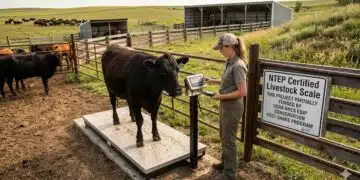
Every scale in a grocery store that is used in a transaction where a customer pays based on weight must carry NTEP certification. In a grocery store, that includes virtually every customer-facing scale — produce, deli, checkout, and any other location where weight determines price.
NTEP stands for National Type Evaluation Program. It is the national type-evaluation program, run by the National Conference on Weights and Measures with NIST technical support, that confirms a scale model meets the accuracy and construction requirements of NIST Handbook 44. NIST Handbook 44 has been adopted, in whole or in part, by every US state. Every grocery scale used in a legal-for-trade application must carry a Certificate of Conformance number on its data plate.
Internal scales — back-of-house portion control, receiving verification, kitchen prep weighing — do not require NTEP certification unless the weight they record directly determines what a customer is charged.
For a complete explanation of when NTEP certification is legally required, see our article on what is an NTEP scale and when do you legally need one.
The Five Scale Types in a Grocery Store
Type 1 — Produce Scale (Price Computing)
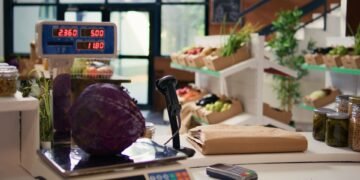
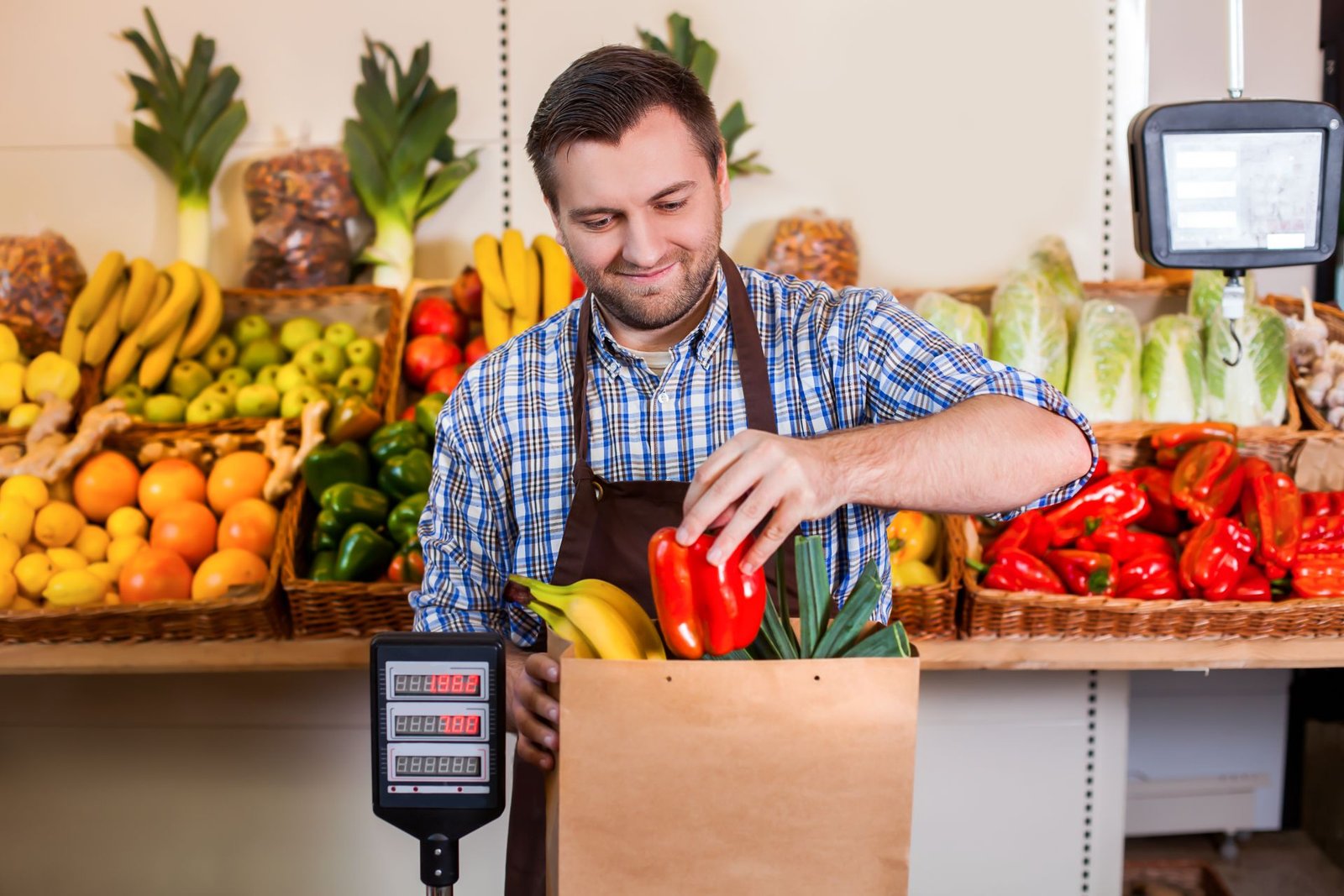
The standard instrument in any produce department where loose fruits and vegetables are sold by weight at the counter. The customer selects the produce. The operator places it on the scale. The scale computes the price based on the stored price per pound and displays the total to both the operator and the customer on a dual display.
Key specifications:
- NTEP Class III certified
- Capacity: 30–60 lb dual-range
- Readability: 0.01 lb (30 lb range), 0.02 lb (60 lb range)
- Dual display — operator and customer-facing
- PLU memory: 20–100 items for the typical produce department product mix
- Battery operation option — useful for outdoor seasonal produce stands or markets
The hanging produce scale — the circular dial scale suspended from an overhead fixture — is still found in some grocery produce sections. It weighs but does not compute the price. The operator reads the weight and calculates the price separately. This instrument is increasingly rare in commercial environments because it cannot meet modern speed, accuracy, or dual-display requirements efficiently. NTEP-certified hanging dial scales exist, but a price-computing bench scale is the standard for any volume production operation.
Type 2 — Deli and Meat Counter Scale (Price Computing or Label Printing)
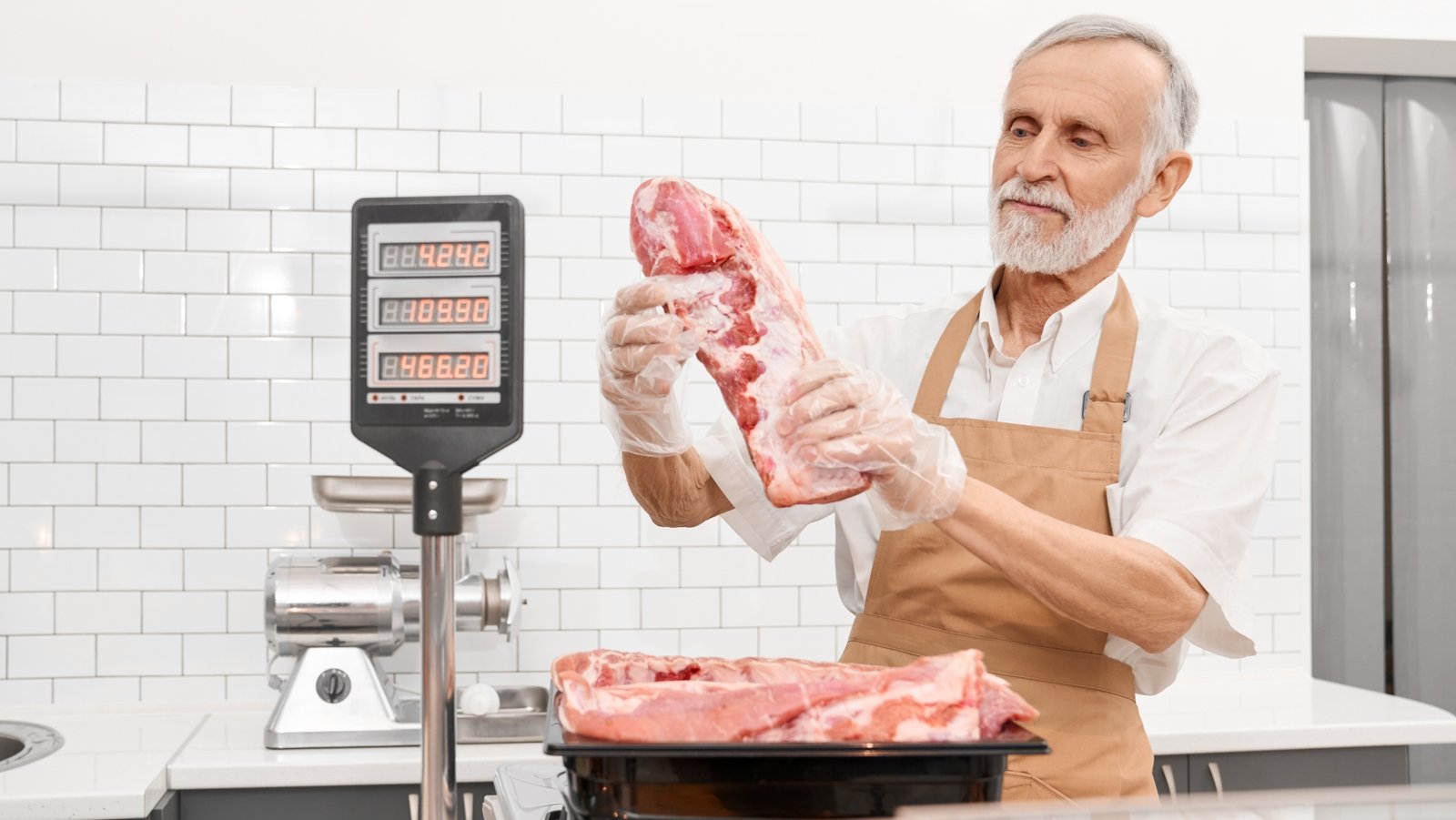
The deli counter operates under the most demanding conditions of any scale location in the store. Products change throughout the day. Prices vary by product and grade. The platform contacts raw meat, cheese, prepared salads, and seafood across multiple shifts. The scale should read to 0.01 lb (or finer), carry NSF certification (or equivalent — many health departments expect it), and have a removable stainless steel platform, and configured with enough PLU memory for the full deli product range.
Deli counters that pre-package products for the self-service case additionally require label printing capability — a thermal printer that produces a price-embedded barcode label the cashier scans at checkout.
POS interface scales connect to the cash register or POS system and work together to ensure that product weights are transferred directly into the transaction without manual entry.
For a complete deli scale buying guide, see our article on best scale for a deli: what to look for and why it matters.
Type 3 — POS Interface Scale (Checkout Counter)
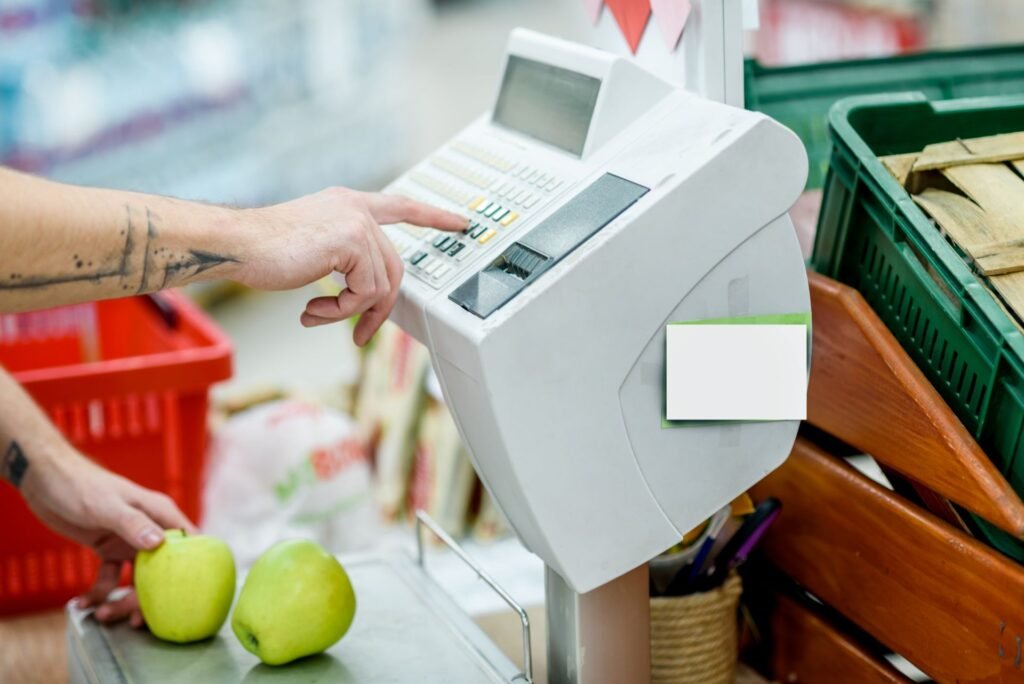
The POS interface scale sits at the checkout lane. It connects directly to the store’s POS terminal via RS-232 or USB. When the cashier selects a produce item in the POS system and places it on the scale, the weight feeds into the transaction automatically. The POS system performs the price calculation and adds the item to the customer’s bill.
This instrument does not display the price itself — that function is handled by the POS terminal and its customer-facing display. The POS interface scale’s only job is to transmit an accurate weight reading to the POS system reliably and quickly.
POS interface scales are compact — designed to fit in the limited footprint of a checkout counter. They are typically flat-top, with a stainless steel platform and a low-profile housing that fits cleanly under the checkout conveyor or alongside the scanner. Checkout scales are most commonly 15–30 lb, and higher-capacity POS interface models are available for bulk items.
Type 4 — In-Counter Scanner Scale (Integrated Checkout)
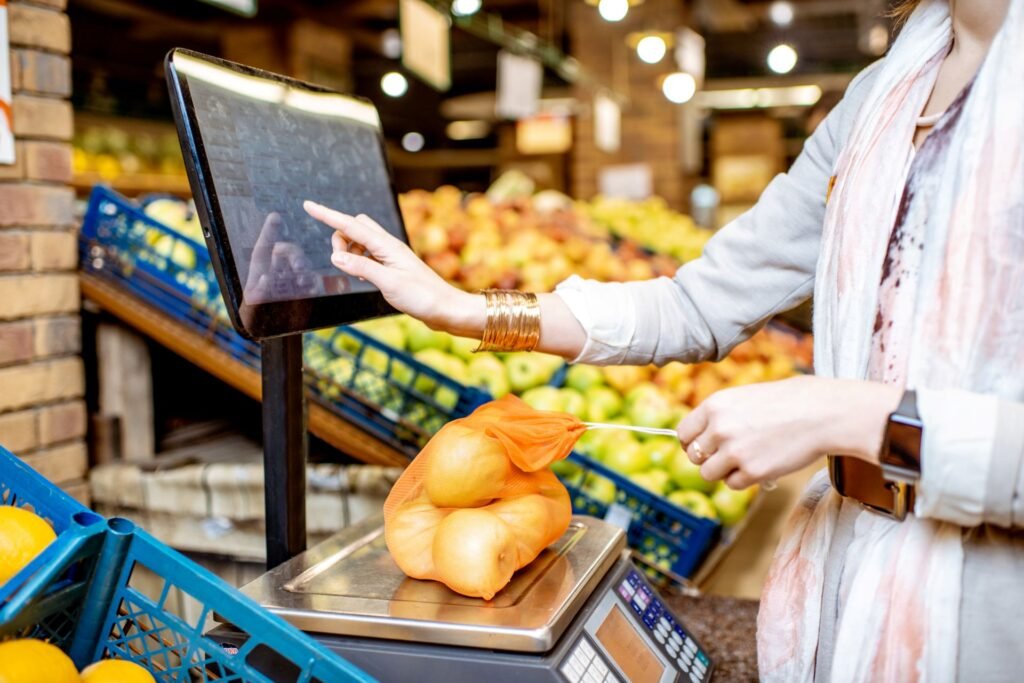
The in-counter scanner scale is the flush-mounted checkout instrument found in supermarket lanes. It combines a barcode scanner with a built-in scale platform — the cashier slides or places items over the scan window, and the scanner and scale work simultaneously. Barcoded items are scanned. Produce items are placed on the scale plate, the PLU is entered or selected, and the price is computed through the POS.
These instruments are the most sophisticated — and most expensive — grocery scale type. They require installation into the checkout counter infrastructure and are typically specified and sourced as part of a complete checkout lane system rather than as a standalone purchase.
Smaller and mid-size grocery stores with standard checkout counters typically use a POS interface scale or a standalone price computing scale at checkout rather than an in-counter scanner scale.
Type 5 — Receiving Scale
The receiving dock scale is not a customer-facing instrument. It is the scale that verifies inbound delivery weights against the purchase order and bill of lading before goods are accepted and put away.
If you purchase any products by the pound — seafood, poultry, beef, or produce — verifying the shipped weight against the actual received weight is essential. Without a receiving scale, there is no way to know whether a 100 lb delivery of shrimp actually weighed 100 lb or only 85 lb when it arrived.
A receiving scale for grocery use is typically a floor scale or heavy-duty bench scale at the receiving dock. It does not require NTEP certification for internal receiving verification purposes — unless the store charges suppliers or customers based on the weight it records. A 500–1,000 lb bench or low-profile scale handles cases and partial loads; weighing full pallets usually calls for a 5,000 lb floor scale.
For guidance on inbound weight verification practices and the equipment that supports them, see our article on inbound vs outbound weighing in a warehouse: what you need to know.
Matching the Scale to the Department
| Department | Scale Type | NTEP Required | Key Specifications |
|---|---|---|---|
| Produce counter | Price computing | Yes | 30–60 lb, 0.01 lb, dual display, PLU 20–100 |
| Deli / meat counter | Price computing or label printing | Yes | 30 lb, 0.01 lb, NSF, removable SS platform, PLU 100+ |
| Seafood counter | Price computing | Yes | 30–60 lb, 0.01 lb, IP65+, NSF, SS platform |
| Bakery | Price computing | Yes | 15–30 lb, 0.01 lb, dual display |
| Checkout counter | POS interface | Yes | 15–60 lb, RS-232 or USB, compact footprint |
| Checkout — integrated | In-counter scanner scale | Yes | Part of full lane system |
| Receiving dock | Floor scale or bench scale | No (internal use) | 500–1,000 lb, stable surface |
| Back-of-house prep | Portion control scale | No (internal use) | 2–30 lb, 0.01 lb |
How Store Size Affects Scale Requirements
Independent grocery store or neighborhood market: The produce section likely needs one or two price computing scales. The deli counter needs a price computing or label printing scale. The checkout counter uses a POS interface scale connected to the cash register. A single floor scale at the receiving dock rounds out the system. Total scale count: 4–6 instruments.
Mid-size supermarket: Multiple produce scales across the department. Dedicated deli and seafood counter scales with label printing. Checkout lanes with a POS interface or in-counter scanner scales. Back-of-house bakery scales. Receiving dock floor scale. Total scale count: 10–20 or more, with centralized PLU management across networked scales, so price changes update simultaneously across all connected instruments.
Specialty or natural foods market: Often sells a higher proportion of bulk and prepared foods than a conventional supermarket. More PLU memory is required per scale. Higher-precision readability for specialty products priced at premium per-pound rates. Produce, bulk bin, deli, and checkout scales are all typically required.
Centralized PLU Management — Why It Matters for Multi-Scale Stores
Any grocery store with more than two or three scales benefits from centralized PLU management. Without it, a price change — from $2.99 to $3.49 per pound for a produce item — must be entered manually at every scale individually. In a store with 10 scales, that is 10 separate manual updates. Each one takes time. Each one is an opportunity for a discrepancy if one scale is missed.
Networked scale systems — connected via Ethernet to a back-office management system — allow all PLU pricing to be managed centrally and pushed to every connected scale simultaneously. A single price change in the back office updates every scale in the store at once.
This capability is part of the connectivity decision when specifying scales for mid-size and larger grocery operations. For guidance on how scale data connects to retail and inventory management systems, see our article on how to integrate a scale with your warehouse management system.
What to Confirm Before Purchasing Grocery Scales
NTEP certification on every customer-facing scale. Verify the CC number in the NCWM NTEP database before purchase. Contact your local Weights and Measures office to schedule an inspection and sealing before the first commercial use.
NSF certification on all food-contact platforms. Any scale platform that contacts food must meet NSF food safety standards. Confirm NSF certification on all deli, produce, seafood, and bakery scales.
POS system compatibility. Confirm that the specific scale models you are purchasing are listed as compatible with your POS software. Compatibility is model-specific — not all NTEP-certified scales connect cleanly to all POS systems.
PLU count and management. Estimate your product count by department. Size PLU memory with 20–30% headroom for growth. Determine whether centralized network management is needed before specifying connectivity.
Calibration and inspection schedule. Plan the calibration and Weights and Measures inspection schedule before installation. Every commercial scale must be re-inspected after relocation or repair. For the correct calibration schedule for retail scales, see our article on retail scale calibration: how often and what the law requires.
FAQs
Do all grocery store scales need to be NTEP-certified?
All customer-facing scales used in transactions where weight determines price must be NTEP-certified. This includes produce scales, deli scales, seafood counter scales, bakery scales, and checkout scales. Back-of-house receiving scales and kitchen prep scales used purely for internal purposes do not require NTEP certification, as long as no customer pays based on what they read.
What is the difference between a POS interface scale and a price computing scale in a grocery store?
A price computing scale calculates the total price internally and displays it on a dual screen for both operator and customer — it operates independently of any POS system. A POS interface scale connects directly to the store’s POS terminal and sends weight data into that system, which performs the price calculation. Price computing scales are standard at deli and produce counters. POS interface scales are standard at checkout lanes where the POS system handles all pricing.
How many PLUs does a grocery store produce scale need?
A typical produce department with 20–40 regularly stocked items needs at least 30–50 PLUs, with additional capacity for seasonal items. A scale with 100 PLUs covers most independent grocery produce departments comfortably. Mid-size supermarkets with broader product ranges should use networked label printing scales with centralized PLU management rather than relying on per-scale PLU limits.
What is a receiving scale, and does it need to be NTEP-certified?
A receiving scale is a floor scale or heavy-duty bench scale at the receiving dock used to verify inbound delivery weights against purchase orders and bills of lading. For internal receiving verification — confirming what arrived — NTEP certification is not legally required. If the receiving scale’s reading directly determines the price the store pays a supplier, NTEP certification is required for that transaction.
How often do grocery store scales need to be calibrated?
Legal-for-trade retail scales must be inspected by a state or county Weights and Measures official at the frequency required by your state, typically annually. Between official inspections, a daily in-house verification check against a certified test weight is best practice. Any scale that is moved, repaired, or serviced must be re-inspected before returning to commercial use.
Conclusion
A grocery store requires a different scale at each point in the product journey — from the receiving dock where deliveries are verified, through the produce department and deli counter where products are weighed and priced, to the checkout lane where weight-based items complete their transaction. Each location has distinct requirements for NTEP certification, capacity, readability, connectivity, and platform construction.
Getting all five scale types right — and sized correctly for the store’s volume and product mix — is not complicated once each application is understood on its own terms. The produce scale is not the deli scale. The POS interface scale is not the price computing scale. And none of them is the receiving scale.
For guidance on choosing and specifying any individual retail scale for your grocery operation, start with our complete buying guide: how to choose a retail scale for your business.
Sources
- NIST Handbook 44 (2026), Section 2.20 Scales — nist.gov
- NIST Handbook 130 (2026), Method of Sale regulation — nist.gov
- NCWM National Type Evaluation Program — ncwm.com
- FDA Food Code 2022, Chapter 4 Equipment — fda.gov
Last reviewed September 2026 by the Scale Blog editorial team. Specifications are typical; confirm with the manufacturer and your weights and measures office.