







The decision feels simple until you start researching. Price computing scale or POS interface scale. 30 lb or 60 lb capacity. NTEP-certified or not. Stainless steel or ABS housing. Battery or AC. Dual display or single display. PLU memory of 3 or PLU memory of 300.
Every one of those decisions matters — and making the wrong one costs money. A scale without NTEP certification used in a legal-for-trade transaction creates a compliance liability with every sale. A scale with too little capacity fails when the heaviest product is placed on it. A scale without battery operation is useless at a farmers’ market without a nearby outlet.
This guide works through every decision in the right order. By the end, you will know exactly which retail scale fits your specific business, your product mix, and your operating environment.
Table of Contents
Step 1: Determine Whether NTEP Certification Is Required
This is the first question — not the last. Every other decision follows from whether you need legal-for-trade certification.
The rule is straightforward. If a customer pays money based on what the scale reads, the scale must be NTEP-certified. This applies to every retail environment in the US where weight determines price — deli counters, produce stands, farmers markets, candy shops, seafood counters, butcher shops, bulk food stores, and any other setting where a dollar amount is calculated from a weight reading.
NTEP stands for National Type Evaluation Program. It is administered by the National Conference on Weights and Measures, using standards set by NIST Handbook 44. A scale that passes NTEP evaluation receives a Certificate of Conformance — a CC number printed on the scale’s data plate. That CC number is the legal proof that the scale meets the required accuracy and construction standards for commercial use.
If your scale is used for internal purposes only — portion control in a kitchen, production yield measurement, food prep weighing — NTEP certification is not required.
Any scale used in a legal-for-trade application must also be inspected and sealed by your local or county Weights and Measures office before its first commercial use. The NTEP certification covers the scale model type. The W&Your specific unit has been tested in place and approved for use. Both are required.
For a complete explanation of NTEP requirements and how the certification system works, see our article on what is an NTEP scale and when do you legally need one.
Step 2: Identify Your Scale Type
Not all retail scales are the same instrument. The four main types each serve a different workflow.
Price Computing Scale
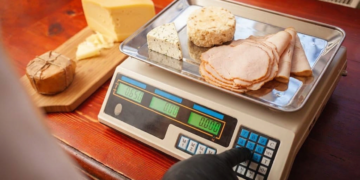
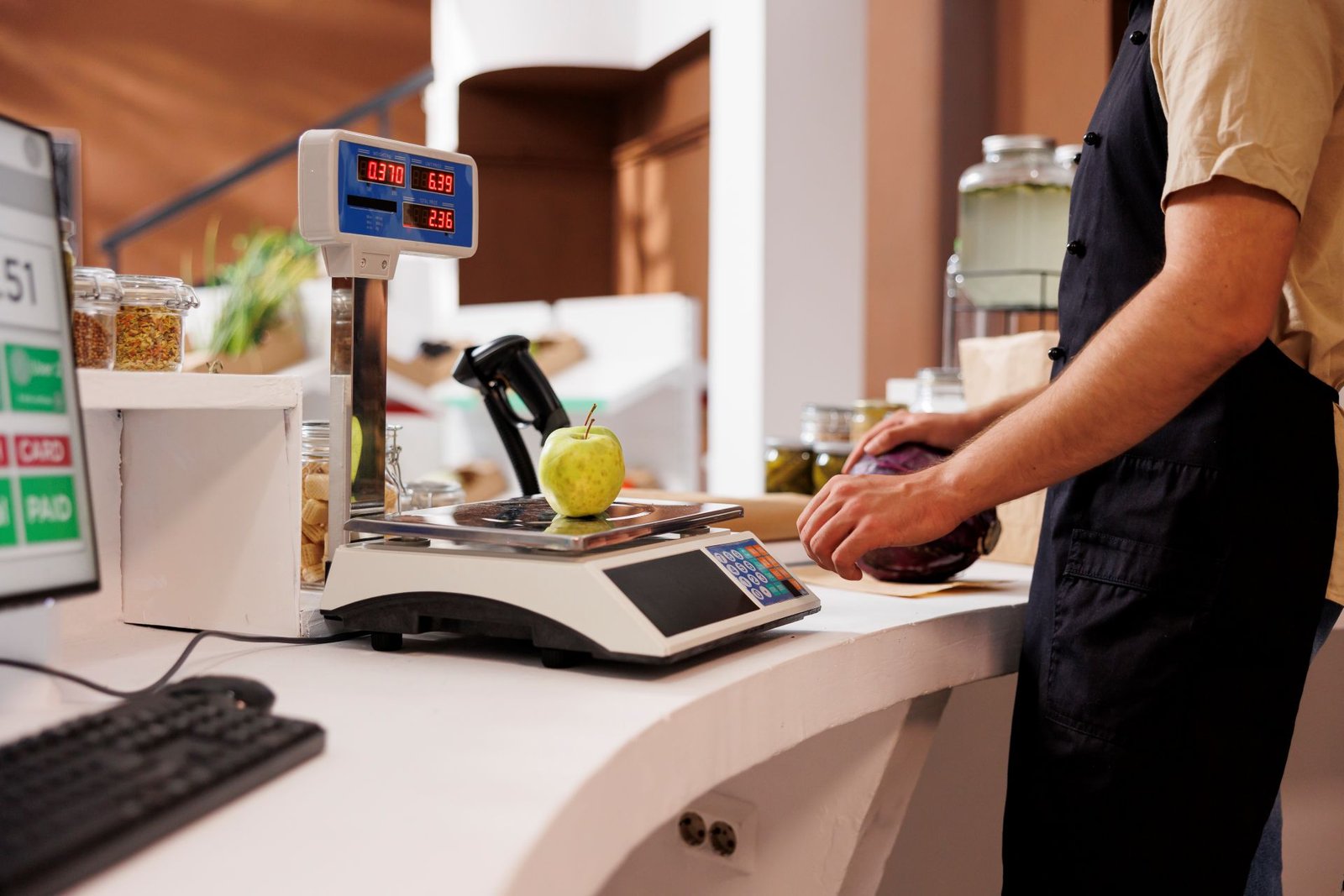
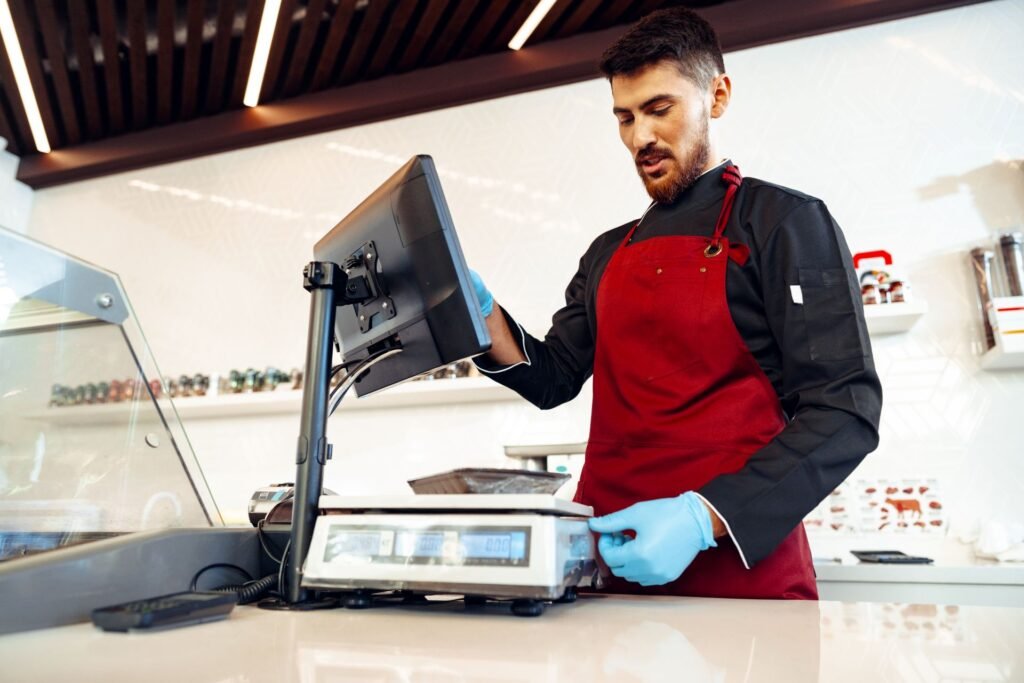
The standard retail weighing instrument. Weighs the item, multiplies by the price per pound, and displays the total price to both operator and customer simultaneously. Used at deli counters, produce stands, farmers’ markets, candy shops, and anywhere a product is sold by weight directly to a customer.
This is the most common retail scale type for small and mid-size retail food businesses. For a full explanation of how it works and what PLU keys do, see our article on what is a price computing scale and how does it work.
Label Printing Scale
A price computing scale with a built-in thermal label printer. Prints a label showing product name, weight, price per pound, total price, ingredients, sell-by date, and barcode — ready to apply to a pre-packaged item. Used in supermarket deli and bakery departments where items are packaged before sale rather than weighed at the time of purchase.
POS Interface Scale
A scale that connects directly to a Point of Sale system — a cash register or POS terminal — and feeds weight data into the transaction automatically. The price calculation and display happen in the POS system, not on the scale itself. Used in grocery stores and supermarkets with integrated POS infrastructure. POS interface scales work together with your POS system or electronic cash register to streamline retail transactions.
Portion Control Scale
Not a price computing scale. A portion control scale measures weight for kitchen and food preparation use — not for direct sales transactions. It does not calculate the price. It does not require NTEP certification unless it is also used in a transaction where the customer pays by weight. Portion control scales are the instrument of choice for back-of-house food service applications.
Step 3: Choose the Right Capacity
Capacity determines what the heaviest item you can weigh on the scale is. The rule from all other scale selection guides applies here equally: identify your heaviest product and add a 20–25% safety margin above it.
For most retail food applications, capacity breaks down as follows:
| Application | Typical Product Weight | Recommended Capacity |
|---|---|---|
| Candy shop, spice retail, coffee | Under 2 lb | 6–15 lb |
| Deli counter — sliced meats and cheese | Under 5 lb | 15–30 lb |
| Produce stand — standard items | Under 10 lb | 30 lb |
| Produce stand — heavy items (melons, squash) | Up to 20 lb | 60 lb |
| Seafood counter | Up to 15 lb | 30–60 lb |
| Butcher shop — large cuts | Up to 20 lb | 60 lb |
| Bulk food — large orders | Up to 30 lb | 60 lb |
One important technical note: a larger-capacity scale usually has a coarser division. A typical 30 lb retail scale reads to 0.01 lb; a 60 lb model typically reads to 0.02 lb (dual-range models switch between the two). For products priced at $10–$20 per pound — specialty cheeses, high-grade seafood, certain spices — the finer readability of a 30 lb model produces a more accurate price per transaction. For produce and bulk items priced at $1–$3 per pound, 0.02 lb readability is more than sufficient.
Dual-range models solve this tradeoff. A dual-range price computing scale with a 30/60 lb configuration reads to 0.01 lb up to 30 lb, then switches automatically to 0.02 lb readability above 30 lb. This gives you fine precision for light, high-value items and sufficient range for heavier products — all on one instrument.
Step 4: Decide on PLU Count
PLU — Price Look-Up — is the stored product memory that allows the operator to recall a product name and price per pound with a single key press rather than re-entering the price each transaction.
Estimate how many distinct products you sell by weight. Add 20–30% for growth. That figure is your minimum required PLU count.
3–10 PLUs: Appropriate for a single-product or very limited-range stand. A coffee roaster selling two or three varietals. A honey producer sells by variety. A single-produce vendor.
10–100 PLUs: The standard range for most deli counters, small produce stands with a full seasonal product range, and candy shops with a moderate product mix.
100–300 PLUs: Required for full-service deli counters with 50+ items, specialty food retailers, and any operation with a broad and frequently changing product range.
300+ PLUs: Label printing scales and high-end deli systems. Supermarket environments. Required when every product also needs a stored description, ingredient list, and barcode for label printing.
The difference between direct PLU keys and indirect PLU memory matters in daily use. Direct keys are physical buttons on the keypad — typically 10–40 — each pre-assigned to a specific product. One press recalls the product. Indirect PLUs are accessed by entering the PLU number on the numeric keypad — faster to set up, slightly slower to recall in a busy transaction flow.
Step 5: Confirm Dual Display Requirement
Every retail price computing scale used in a customer-facing transaction must have a customer display. In most US states, this is a legal requirement under state Weights and Measures regulations — not simply a best practice. The customer must be able to see the weight and price of the transaction as it occurs.
In practice, this means a display on the back of the scale facing the customer as they stand at the counter. Some models have an integrated rear display. Others use a pole-mounted display visible from a greater distance. Both satisfy the legal requirement.
A scale with a single operator-facing display — however accurate — is not compliant for direct customer transactions in most jurisdictions.
Step 6: Determine Power Source Requirements
Fixed indoor counter: AC power is the standard. No battery consideration needed. Some models offer battery backup for power interruptions — worth specifying in areas with unreliable power.
Outdoor or mobile applications (farmers’ markets, outdoor produce stands, mobile food vendors): Battery operation is essential. Confirm battery life covers your full operating shift without a recharge. Modern battery-operated price computing scales offer 40–200 hours per charge, depending on whether the backlight is active.
Cold environments: Batteries lose capacity in the cold, so battery life drops at outdoor winter markets. For operations in cold storage areas or outdoor winter markets, specify a model with both AC and battery capability — and rely on AC power when an outlet is available to preserve battery life.
Step 7: Specify the Platform Material
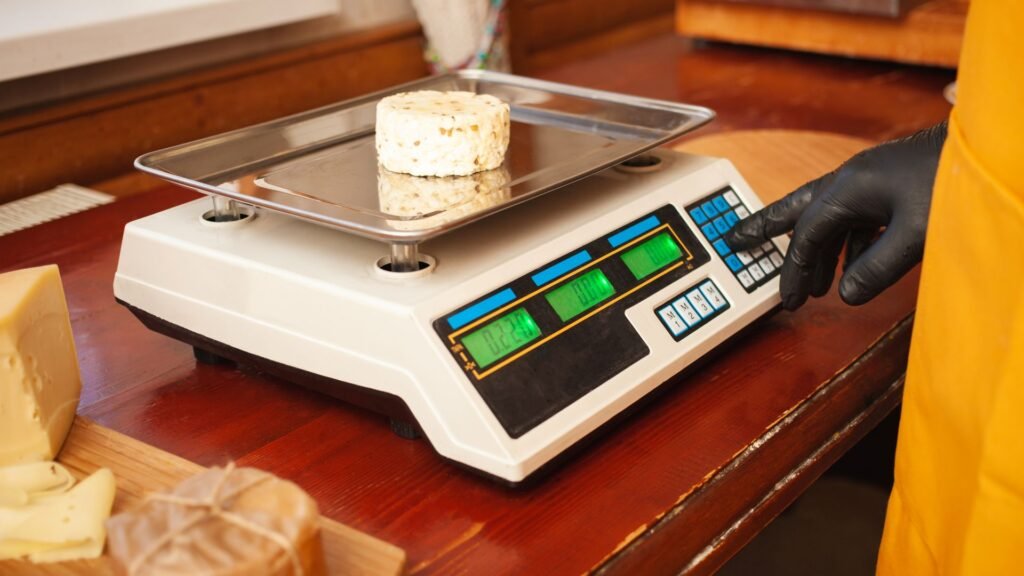
Stainless steel: Required for any food contact application — deli, butcher, seafood, produce, or any environment where the platform contacts food directly or is cleaned with food-safe sanitizers. Stainless steel resists corrosion, cleans easily, meets NSF food safety standards, and tolerates the cleaning chemicals used in food service environments.
ABS plastic: Acceptable for dry, non-food-contact environments — bulk hardware, specialty retail, non-food products sold by weight. Not suitable for deli, seafood, or any wet application.
For deli and butcher environments specifically, look for a removable stainless steel platform. Removable platforms allow thorough cleaning between products and between shifts. A platform that cannot be fully removed leaves residue and potential cross-contamination points that a fixed platform cannot easily address.
Step 8: Consider Connectivity and POS Integration
Standalone operation: No connectivity needed. The scale computes the price. The operator reads the total from the display and enters it into the cash register manually or tells the customer directly.
Printer connection (RS-232): The scale transmits the weight, price, and product information to a connected label printer. Required for any pre-packaging application. RS-232 is the standard connection for label printers and receipt printers in retail food environments.
POS integration (RS-232 or USB): The scale connects directly to a POS terminal. Weight data flows into the transaction automatically. Eliminates manual price entry from the scale display into the POS system — and the errors that entry step generates.
Ethernet or Wi-Fi: Required when multiple scales must communicate with a central server — common in supermarket environments with multiple service counters. Covered in detail in our article on how to integrate a scale with your warehouse management system — the same integration principles apply in retail scale network environments.
Step 9: Assess the Operating Environment
Most retail food environments require at a minimum an IP54-rated indicator — protected against dust ingress and water splash from any direction. This covers the typical deli counter environment where the scale is wiped down daily with a damp cloth and mild sanitizer.
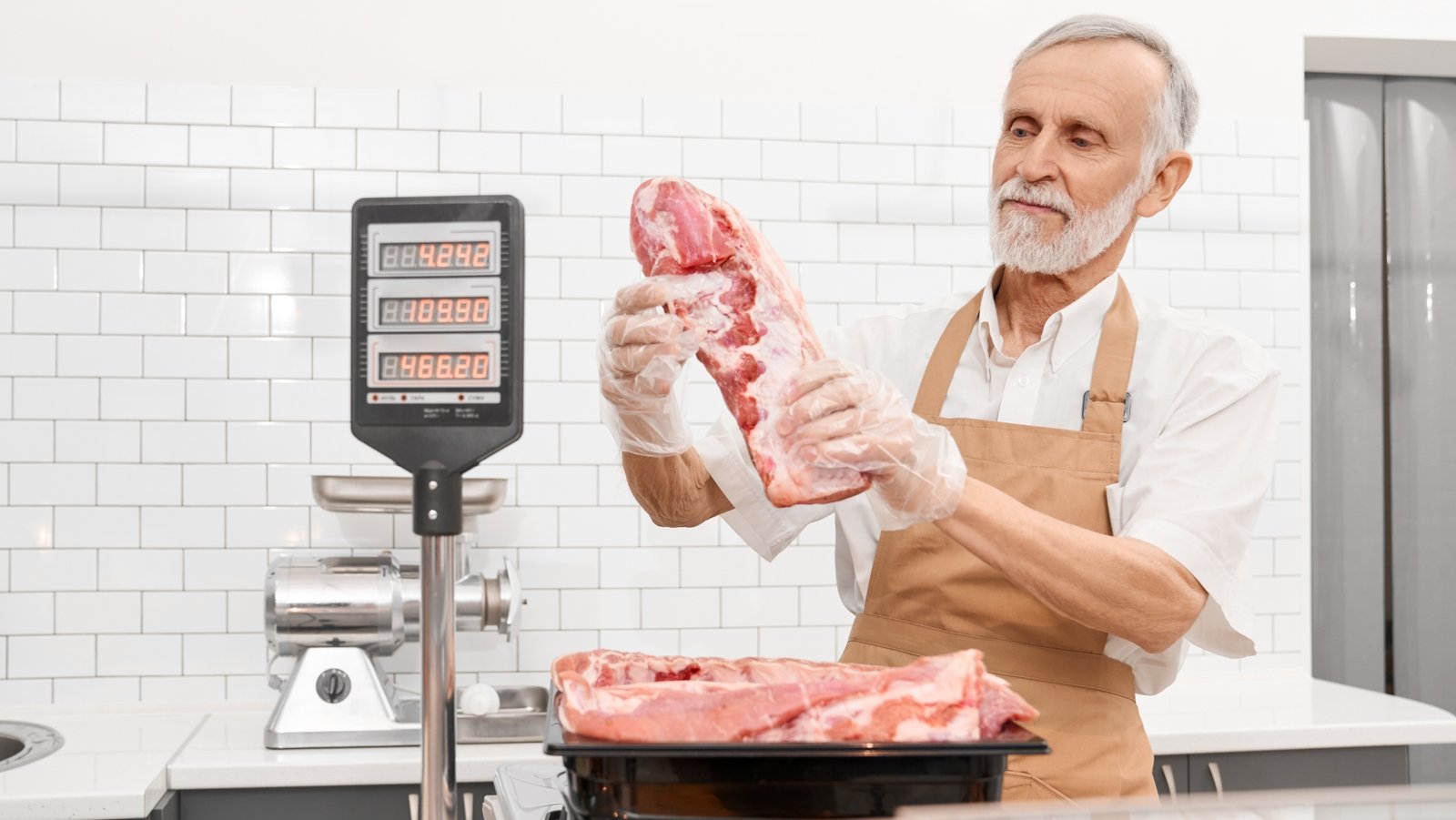
For butcher shop and seafood counter environments — where the scale may contact blood, fish residue, and aggressive cleaning chemicals — specify a minimum IP65 rating on both the indicator and the platform. Their WBZ washdown retail scale, an IP66-rated stainless steel housing is specifically suited for food preparation, packaging, and retail environments requiring frequent cleaning.
For a full guide to IP ratings and what each level of protection means for food service environments, see our article on IP ratings for industrial scales explained.
Quick Selection Guide
| Business Type | Scale Type | Capacity | PLU Count | Power | Platform |
|---|---|---|---|---|---|
| Farmers market — produce | Price computing | 30–60 lb | 10–40 | Battery + AC | Stainless steel |
| Candy / bulk food shop | Price computing | 15–30 lb | 20–100 | AC | Stainless steel |
| Deli counter | Price computing or label printing | 30 lb | 100–300 | AC | Stainless steel (removable) |
| Butcher shop | Price computing | 30–60 lb | 50–100 | AC | Stainless steel (IP65+) |
| Seafood counter | Price computing | 30–60 lb | 30–60 | AC | Stainless steel (IP65+) |
| Grocery produce department | Price computing or POS interface | 30–60 lb | 100–300 | AC | Stainless steel |
| Supermarket deli | Label printing | 30 lb | 300+ | AC | Stainless steel |
FAQs
Do I legally need an NTEP-certified scale for my retail food business?
Yes — if any customer pays based on what the scale reads, NTEP certification is legally required. This applies to every retail food business that sells products by weight, including deli counters, farmers’ markets, produce stands, candy shops, butcher shops, and seafood counters. Before its first commercial use, the scale must be inspected and sealed by weights and measures officials, or placed in service by a registered service agency, depending on your state.
What is the difference between a price computing scale and a POS interface scale?
A price computing scale calculates the total price internally and displays it on its own dual screen — no POS system required. A POS interface scale connects to an external POS terminal and sends weight data into that system, which performs the price calculation and displays the result. Price computing scales are the standard for most small and mid-size retail food operations. POS interface scales are used in supermarkets and large grocery stores with integrated POS infrastructure.
How many PLUs do I need on a retail scale?
Count the distinct products you sell by weight and add 20–30% for growth. A farmers’ market stand with 10 products needs 10–15 PLUs. A full-service deli counter with 50 products needs 60–80 PLUs at a minimum. A supermarket deli with label printing needs 300 or more. Buying more PLU capacity than you currently need costs almost nothing — running out of PLU memory in a busy season is a real operational problem.
What platform material should a retail food scale have?
Stainless steel is the standard for food-contact applications — deli, butcher, seafood, produce and any area cleaned with sanitizers. Food codes require food-contact surfaces to be corrosion-resistant, nonabsorbent and cleanable; stainless steel meets that, is used in NSF-certified designs, and tolerates daily cleaning without degrading. ABS plastic platforms are acceptable only for dry, non-food-contact applications.
How often does a retail scale need to be calibrated?
Legal-for-trade retail scales must be inspected by your state or county Weights and Measures office at the frequency required by your state’s law — many jurisdictions aim for roughly annual inspections. Between official inspections, a daily in-house verification check against a known test weight is best practice. For a full guide to retail scale calibration and compliance, see our article on retail scale calibration: how often and what the law requires.
Conclusion
Choosing a retail scale comes down to nine decisions made in the right order. Start with NTEP certification — if your business sells by weight to customers, it is not optional. Identify the right scale type for your transaction workflow. Match capacity to your heaviest product with a safety margin. Size PLU memory to your product range with room to grow. Confirm dual display is present for customer visibility. Match the power source to your operating environment. Specify stainless steel for any food contact application. Confirm connectivity if POS or printer integration is needed. Match the IP rating to your cleaning environment.
A retail scale chosen this way is compliant from the first sale, accurate throughout its service life, and matched to the specific demands of your operation.
Sources
- National Institute of Standards and Technology, NIST Handbook 44 (2026), Section 2.20 Scales.
- National Institute of Standards and Technology, NIST Handbook 130 (2026): Method of Sale regulation.
- National Conference on Weights and Measures, National Type Evaluation Program (NTEP).
- U.S. Food and Drug Administration, Food Code 2022, Chapter 4 Equipment.
Last reviewed September 2026 by the Scale Blog editorial team. Capacities and readabilities are typical; confirm with the manufacturer’s specification sheet.