







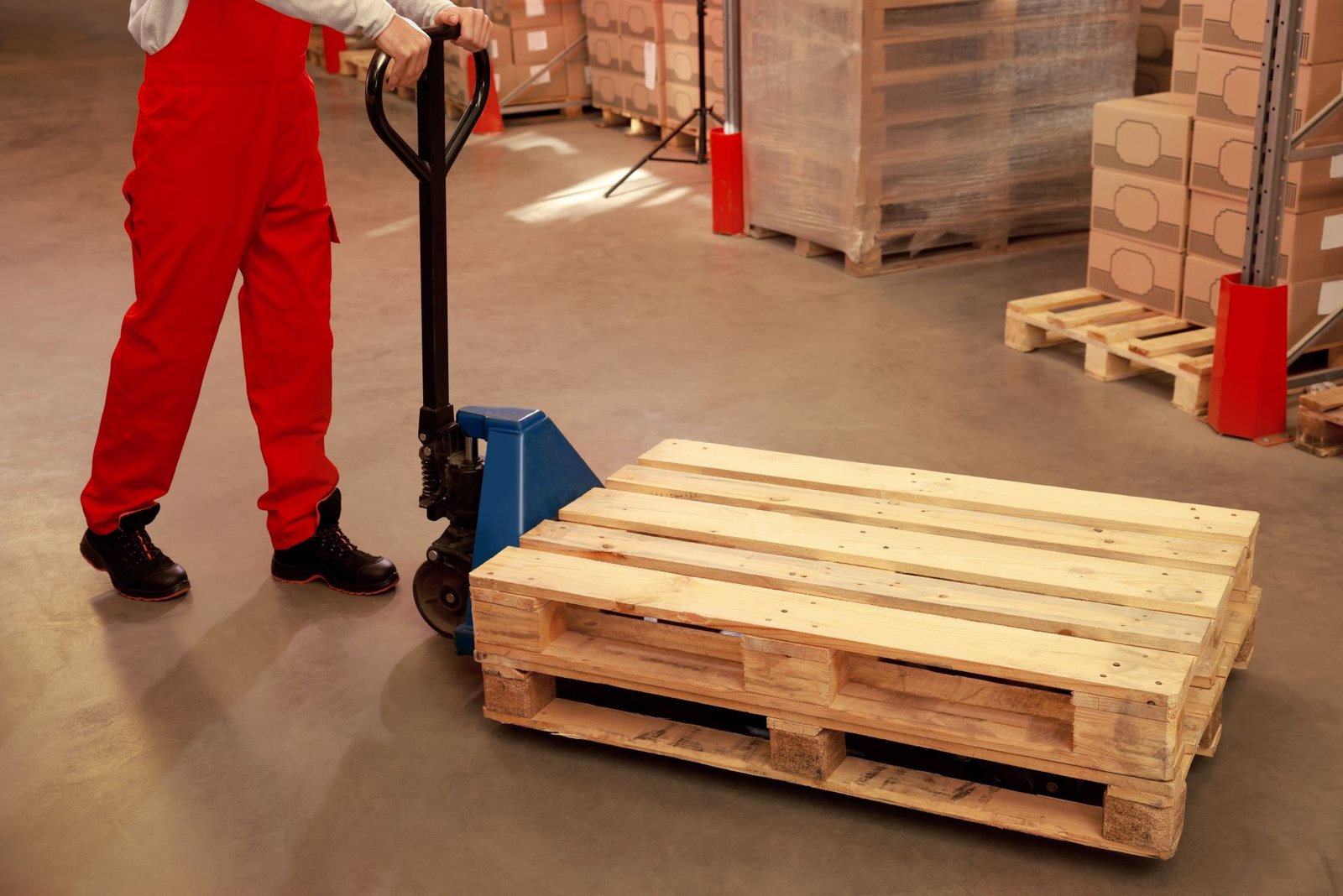
The terms “pallet scale” and “floor scale” are used interchangeably on most product pages and in most warehouse conversations. That causes real purchasing mistakes. A business buys a pallet scale when it needs a floor scale, or specifies a floor scale when the workflow actually calls for a U-frame pallet scale. Both errors result in a scale that technically works but creates friction in the operation every single day.
This article explains the actual difference. It covers how each type is designed, what each is best at, where each falls short, and how to match the right scale to your specific workflow.
Table of Contents
What Is a Floor Scale?
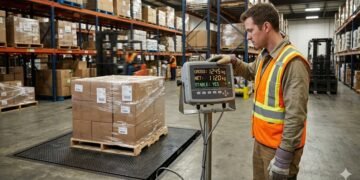
A floor scale is a stationary, flat-platform weighing instrument designed to sit on the warehouse floor. It accepts loads placed on its deck from above — by forklift, pallet jack, hand truck, or manual placement depending on the load.
The platform is a solid, flat deck. It typically sits 3.5–4.5 inches above the floor. It requires either ramps for pallet jack access or a forklift to place loads directly on the deck. Platform sizes for warehouse pallet applications range from 4 ft × 4 ft (48″ × 48″) as the most common standard up to 5 ft × 7 ft and larger for oversized loads.
As B-TEK — a US scale manufacturer — explains, the two primary variations of a floor scale installation are above-ground with ramps, and pit-mounted flush with the floor surface. Above-ground installations are the most common and the most cost-effective. Pit installations eliminate the ramp and the space it requires, but involve concrete work and a higher upfront installation cost.
Floor scales are stationary. Once placed and leveled, they stay. They become a fixed point in the warehouse workflow — a dedicated weighing station that all pallets route through.
What Is a Pallet Scale?
The term “pallet scale” is used to describe two distinct things, and the confusion between them is the source of most purchasing errors.
Definition 1 — Floor Scale Used for Pallet Weighing
The most common usage. When a warehouse manager asks for “a pallet scale,” they usually mean a 4 ft × 4 ft or 5 ft × 5 ft floor scale with a ramp, used specifically for weighing loaded GMA pallets. In this context, “pallet scale” is simply a floor scale specified and sized for pallet applications.
Most industrial scale dealers — including Central Carolina Scale — list these as “floor scales for pallet weighing” or “pallet floor scales.” The underlying instrument is a standard floor scale. The “pallet” designation describes the use case, not a fundamentally different design.
Definition 2 — U-Frame Pallet Scale
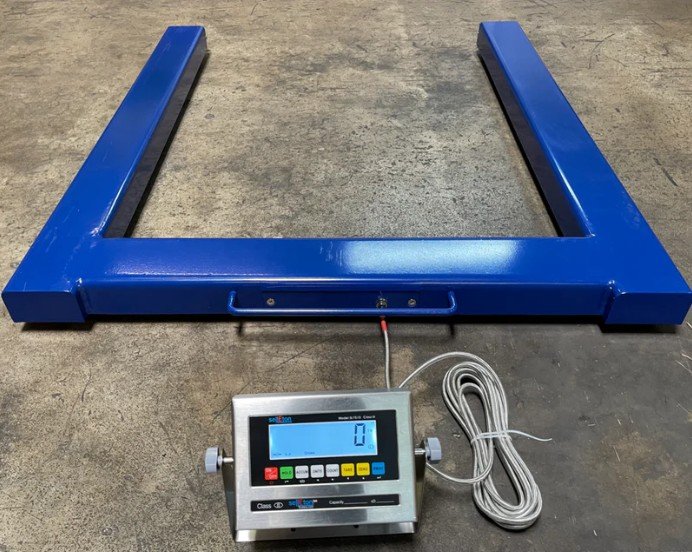
A genuinely different instrument. A U-frame pallet scale has an open, U-shaped frame rather than a solid platform. The two arms of the U slide under the pallet — around its base — without needing to lift the pallet or bring it to a dedicated platform. The load cells are in the two arms. The pallet sits on the floor. The scale measures its weight without either a ramp or a forklift lift.
The U-frame design is what most scale catalogs mean when they list a product specifically as a “pallet scale” rather than a “floor scale.” It is a distinct configuration with distinct operational advantages and limitations.
For the remainder of this article, “floor scale” means a solid-platform stationary scale, and “pallet scale” means a U-frame pallet scale. The comparison is between these two genuinely different designs.
Side-by-Side Comparison
| Feature | Floor Scale | U-Frame Pallet Scale |
|---|---|---|
| Platform design | Solid flat deck | Open U-shaped frame |
| Load placement | Forklift or pallet jack via ramp | Slides under pallet on the floor |
| Installation | Stationary — fixed location | Portable — moves between locations |
| Floor space required | Significant — platform plus ramp(s) | Minimal — arms only |
| Accuracy | ±0.1% of capacity | ±0.1% of capacity |
| Capacity range | 1,000–20,000+ lb | 2,500–10,000 lb typical |
| NTEP availability | Yes — widely available | Yes — available on most models |
| Load types | Any load that fits the deck | Palletized loads only |
| Typical environment | Fixed weighing station | Mobile or space-constrained operations |
When a Floor Scale Is the Right Choice
High-Volume Fixed Weighing Stations
A receiving dock that processes 100+ pallets per shift needs a fixed, dedicated weighing station. Forklifts route pallets through the station continuously. The floor scale with ramps handles each pallet consistently and efficiently.
The stationary nature of a floor scale is an advantage in this context. The scale is always in the same place. Calibration is stable because the scale never moves. The workflow is predictable.
Non-Palletized or Irregular Loads
A floor scale accepts anything that fits on its deck — not just pallets. Barrels, drums, crates, bins, bundles, and irregularly shaped items all weigh accurately on a flat platform. A U-frame pallet scale cannot weigh anything that does not have a standard pallet base for the arms to slide under.
Highest Accuracy Applications
A floor scale installed on a level, stable concrete surface — particularly a pit-mounted scale — produces the most consistent and accurate weight readings of any pallet-level weighing configuration. The platform does not move. The load cells are protected from the vibration and shock that portable scales experience during relocation.
For legal-for-trade applications where weight accuracy directly determines billing, a fixed floor scale is the reference-standard instrument. Cardinal Scale — one of the largest US scale manufacturers — offers NTEP-certified floor scale series in platform sizes from 2 ft × 2 ft up to 12 ft × 10 ft, with capacities from 1,000 lb to 20,000 lb, specifically designed for these applications.
Large or Heavy Pallets
Floor scales are available in much higher capacities than most U-frame pallet scales. Operations regularly weighing pallets above 6,000 lb — steel coils, heavy machinery components, bulk chemical containers — require a floor scale. U-frame designs at those capacities become unwieldy.

When a U-Frame Pallet Scale Is the Right Choice
Space-Constrained Facilities
A ramp-equipped 4 ft × 4 ft floor scale with two ramps occupies approximately 10 feet of linear floor space. In a small warehouse or a facility with densely packed racking, that footprint is difficult to accommodate.
A U-frame pallet scale has no platform and no ramps. The arms slide under the pallet wherever the pallet is sitting. The indicator mounts on a portable stand. The entire instrument can be stored against a wall when not in use.
Mobile or Multi-Location Weighing
Some operations need to weigh pallets at multiple points across a large facility — at different staging areas, in different aisles, or at loading doors on opposite sides of a building. A single U-frame pallet scale can serve all of these locations. It rolls from one point to another on wheels and is ready to weigh at each new location.
A floor scale cannot do this. Adding ramps to every weighing location across a large facility multiplies cost and floor space consumption proportionally.
Receiving Verification Without a Dedicated Station
An inbound receiving team that needs to check a delivery driver’s declared pallet weights before the truck leaves the dock can use a U-frame pallet scale without routing each pallet to a fixed weighing station. The operator wheels the scale to each pallet, slides the arms underneath, lifts slightly, reads the weight, and moves to the next pallet.
This eliminates the bottleneck that forms when every pallet must queue at a single floor scale location — particularly important during peak receiving periods. As Liberty Scales notes, distribution centers processing 300–500 pallets per shift see measurable time savings from removing this single-point bottleneck.
For operations requiring mobile pallet weighing during the transport of the pallet itself — rather than weighing a stationary pallet in place — a pallet jack scale is a better choice than either a U-frame pallet scale or a stationary floor scale. See our article on what is a pallet jack scale and how does it work for a full explanation of that configuration.
Accuracy: Is There a Real Difference?
Both instrument types achieve the same rated accuracy: ±0.1% of capacity is the standard for quality floor scales and quality U-frame pallet scales alike.
However, real-world accuracy differs between the two configurations in practice.
A floor scale on a stable, level concrete surface — particularly a pit-mounted installation — produces the most consistent readings because no variables are introduced by movement or repositioning. The load cell geometry is fixed. The surface is known and level.
A U-frame pallet scale introduces more variables. The reading quality depends on the pallet being on a reasonably level floor surface. It depends on the arms being fully inserted under the pallet. It depends on the pallet not being tilted or off-center on the arms.
For most warehouse receiving, shipping, and inventory applications, the accuracy difference between the two configurations is operationally irrelevant. Both are more than accurate enough for weight verification, freight billing estimation, and inventory tracking.
For legal-for-trade commercial transactions — where the weight reading directly determines money changing hands — a stationary floor scale with a stable installation is the more reliable instrument. For guidance on when legal-for-trade certification is required for your operation, see our full article on how to choose a floor scale for your warehouse or factory.
The Installation Cost Difference
This is where the two instruments diverge most significantly in total cost of ownership.
A U-frame pallet scale requires no installation at all. It arrives, it is powered on, and it is ready to use. There is no leveling, no ramp attachment, and no concrete work.
An above-ground floor scale with ramps requires leveling on a stable surface. Ramps add cost — typically $200–$600 per ramp — and floor space. The ramps must be secured or their position relative to the scale must be consistent to prevent load shifts during weighing.
A pit-mounted floor scale involves the most significant additional cost. Concrete cutting, pit construction, and installation by a qualified service technician are all required before the scale is operational. This cost is offset over time by the elimination of ramps and the improved ease of loading, but the upfront investment is substantially higher.
For calibration requirements that apply to both instrument types, see our article on warehouse scale calibration: how often and how to do it right.
Decision Guide — Which Scale Fits Your Operation?
Choose a floor scale if:
- You weigh a high volume of pallets at a single fixed location
- You weigh non-palletized or irregularly shaped loads
- Your heaviest loads regularly exceed 6,000 lb
- Legal-for-trade accuracy is required and consistency is the priority
- Forklift access to the weighing area is reliable and efficient
Choose a U-frame pallet scale if:
- Floor space is limited and a ramp footprint is impractical
- You need to weigh pallets at multiple locations across a facility
- Your receiving team needs to verify weights at the dock without routing pallets to a fixed station
- You weigh exclusively standard palletized loads
- Portability between locations is a regular operational requirement
Consider a pallet jack scale instead if:
- You need to weigh pallets during the movement of those pallets
- You are eliminating the separate step of routing pallets to any weighing station at all
- Your operation moves dozens of pallets per shift and every handling step adds measurable time
Conclusion
The practical difference between a pallet scale and a floor scale comes down to mobility and load type. A floor scale is a stationary, fixed-point instrument that handles any load type and delivers the most consistent accuracy in a high-volume or legal-for-trade application. A U-frame pallet scale is a mobile instrument that weighs palletized loads anywhere in the facility without ramps, dedicated floor space, or routing pallets to a fixed station.
Most medium-to-large warehouses and distribution centers benefit from having both — a fixed floor scale at the primary receiving dock and a portable U-frame scale for secondary verification, cycle counts, and multi-location weighing across the facility. The two instruments complement each other rather than compete.
FAQs
What is the difference between a pallet scale and a floor scale?
A floor scale is a stationary, solid-platform weighing instrument that sits on the warehouse floor and accepts loads placed on its deck by forklift, pallet jack via ramp, or hand truck. A U-frame pallet scale has an open, U-shaped frame that slides under a pallet where it sits — without ramps or lifting — making it portable and space-efficient. The terms are often used interchangeably to mean a floor scale sized for pallet applications, which creates purchasing confusion.
Which is more accurate — a pallet scale or a floor scale?
Both achieve the same rated accuracy of ±0.1% of capacity under standard conditions. In practice, a stationary floor scale on a stable, level concrete surface produces the most consistent readings because no variables are introduced by repositioning. A U-frame pallet scale’s accuracy depends on the pallet being on a reasonably level surface and the arms being fully and correctly inserted. For legal-for-trade commercial transactions, a stationary floor scale is the more reliable instrument.
What size floor scale do I need for a standard pallet?
A 4 ft × 4 ft (48″ × 48″) platform is the most common size for standard GMA pallets (48″ × 40″) and provides sufficient margin on all sides. For 48″ × 48″ Euro pallets or operations where the pallet jack must also be on the platform during weighing, a 5 ft × 5 ft or 4 ft × 6 ft platform is recommended.
Do I need ramps with a floor scale?
Ramps are needed when pallet jacks are used to load pallets onto an above-ground floor scale. Without ramps, a forklift must lift every pallet onto the deck. A pit-mounted floor scale eliminates the need for ramps entirely because the deck is flush with the surrounding floor, but pit installation involves concrete work and higher upfront cost. A U-frame pallet scale requires no ramps because it slides under the pallet on the floor.
Can a pallet scale be used for non-palletized loads?
A U-frame pallet scale cannot be used for non-palletized loads — it requires a standard pallet base for the arms to slide under. A floor scale accepts any load that fits on its flat deck, including drums, barrels, crates, bins, bundles, and irregularly shaped items. If your operation weighs both palletized and non-palletized loads, a floor scale is the more versatile instrument.