







Choosing a floor scale for a warehouse or factory is not complicated — but it is easy to get wrong. The most common mistakes are buying more capacity than needed, specifying the wrong platform size for the actual loading method, and overlooking the environment the scale will operate in. Any one of those errors turns a scale that looked right on paper into one that sits unused or fails within 18 months. This guide walks through every decision in the right order so you buy the right scale once.
Table of Contents
Step 1: Establish Your Capacity Requirement
Capacity is the maximum load the scale can measure without risking load cell damage or accuracy degradation. It is the first specification to establish — and the most important.
Always select a capacity at least 25–50% above your heaviest expected load — this headroom absorbs shock loads (a pallet dropped from forks can momentarily exceed its static weight) and reduces wear on the load cells. A scale that is routinely loaded close to its limit is more likely to be overloaded by accident.
Typical floor scale capacities by application:
| Capacity | Typical Application |
|---|---|
| 1,000–2,500 lb | Smaller bins, components, bench-height industrial use |
| 5,000 lb | General warehouse — the most common pallet weighing capacity |
| 10,000 lb | Heavy pallets, industrial drums, bulk totes |
| 20,000 lb | Heavy manufacturing, steel coils, large containers |
A standard GMA pallet loaded with product commonly reaches 2,000–4,000 lb. A 5,000 lb capacity scale handles most warehouse pallet applications comfortably at 40–80% of rated capacity. If your operation regularly handles loaded pallets above 3,500 lb, step up to 10,000 lb.
Readability — the smallest increment the scale displays — also matters. A 5,000 lb × 1 lb scale reads to the nearest pound, sufficient for shipping and receiving. A 5,000 lb × 0.5 lb scale provides finer resolution for batching or quality control where smaller weight differences matter.
Step 2: Choose the Right Platform Size
Platform size determines whether your loads actually fit on the scale — and whether your loading method works safely.
Industrial floor scales are widely available in platform sizes from about 2 ft × 2 ft to 7 ft × 7 ft or larger, with capacities from roughly 1,000 lb to 30,000 lb — covering applications from compact general-purpose weighing to oversized industrial loads that exceed standard pallet dimensions. The most common off-the-shelf sizes are:
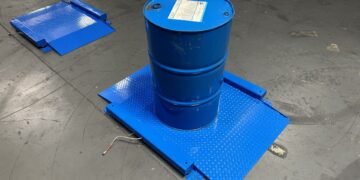
- 2 ft × 2 ft (24″ × 24″) — compact, for drums, cylinders, or single items
- 3 ft × 3 ft (36″ × 36″) — general-purpose bench or small pallet use
- 4 ft × 4 ft (48″ × 48″) — the most common warehouse size; fits a standard GMA pallet (48″ × 40″) with margin
- 4 ft × 6 ft (48″ × 72″) — for longer pallets, crates, or items that overhang a standard platform
- 4 ft × 8 ft (48″ × 96″) — double-pallet or oversized industrial loads
- 5 ft × 7 ft and larger — heavy manufacturing, coil handling, specialty applications
The critical rule: Every part of the load must be on the platform. If any corner of a pallet overhangs the edge, part of the weight transfers to the floor rather than the load cells — and the reading is wrong. A standard 48″ × 40″ pallet fits on a 4 ft × 4 ft platform, but a 48″ × 48″ drum pallet, an oversized load or anything that overhangs may require a larger deck.
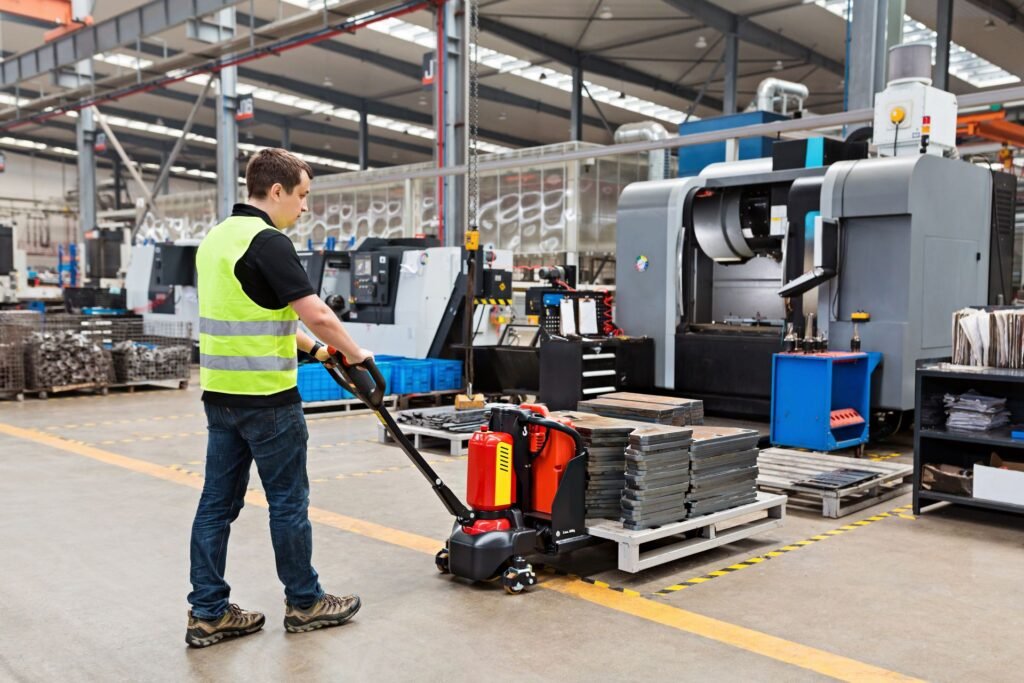
Loading method also determines platform requirements:
- Hand truck or wheeled cart — a low-profile platform (typically 3.5–5 inches high) with access ramps is sufficient
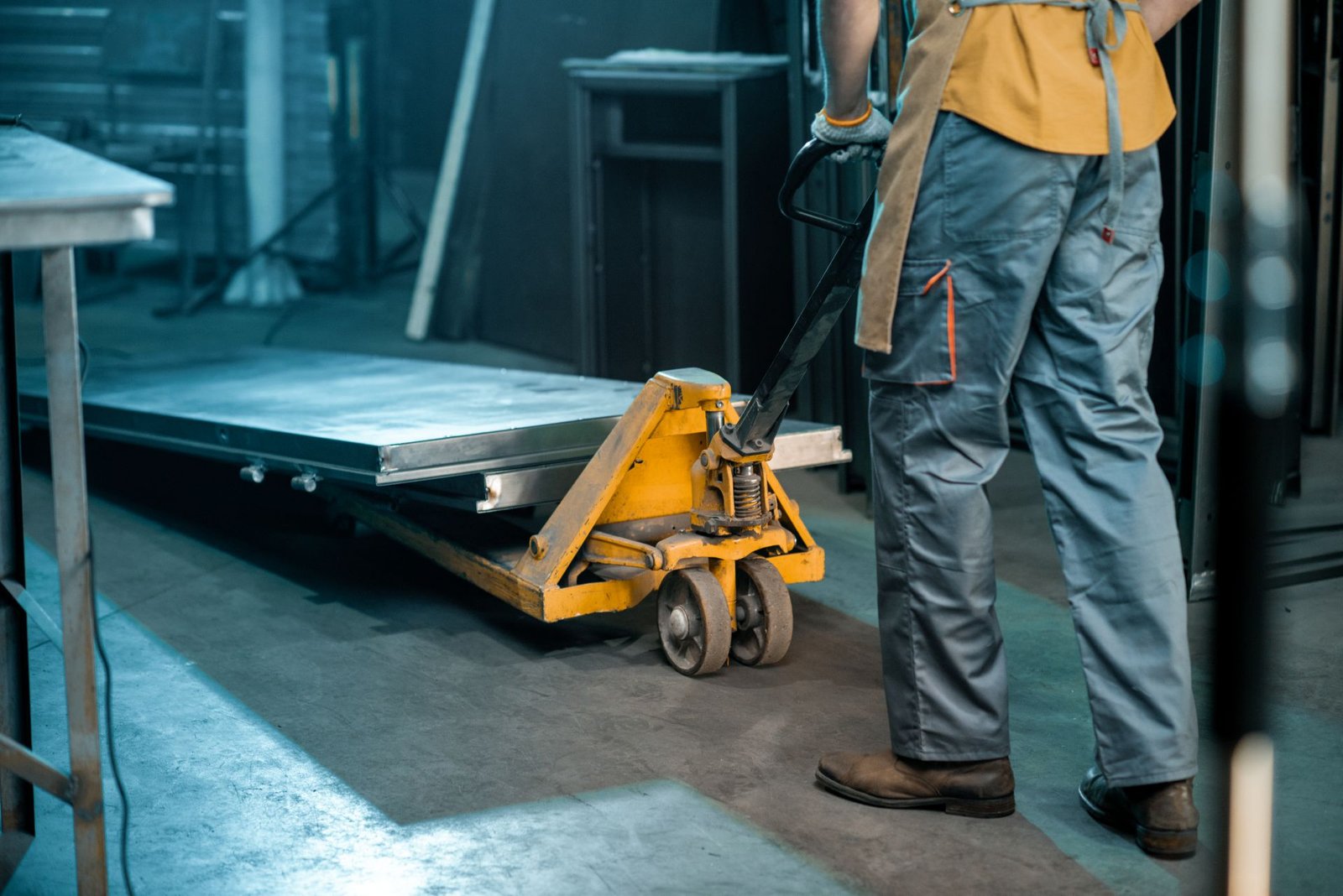
- Pallet jack — the platform must accommodate pallet jack entry; add steel ramps at each end to bridge the height difference
- Forklift — consider a forklift-accessible (U-frame) platform or wide ramp access; standard solid-deck platforms require ramp kits for safe forklift loading
Step 3: Select the Right Deck Material for Your Environment
The deck material determines durability, hygiene compliance, and long-term cost.
Carbon steel with diamond tread plate (painted or powder-coated)
The standard for indoor, dry warehouse and manufacturing environments. Diamond tread provides traction for heavy loads and loading equipment. Painted mild steel is cost-effective and durable in clean, dry conditions. It is not suitable for wet, corrosive, or food-processing environments — moisture leads to rust under the coating over time. For a full breakdown of when to use carbon steel versus stainless steel, see our guide to stainless steel vs mild steel industrial scales.
Stainless steel
Required for food processing, pharmaceutical, chemical, and any washdown environment. Stainless steel resists corrosion from water, cleaning chemicals, and product spillage. It costs significantly more than mild steel but lasts far longer in wet or corrosive conditions. If the scale will be cleaned with hoses or chemical spray at any point, stainless steel is the correct specification — not an upgrade.
Aluminum
Lighter than steel and corrosion-resistant, making it practical for portable floor scales that need to be moved between locations. Generally lower maximum capacity than comparable steel platforms.
The practical decision: indoor dry environment → carbon steel; wet, chemical, or food environment → stainless steel; portable multi-location use → consider aluminum.
Step 4: Determine Whether You Need NTEP Certification
NIST Handbook 44 is the US model code for commercial weighing devices; it is updated annually through the National Conference on Weights and Measures and adopted into law by the states. In most states, a scale used where weight determines price must have an NTEP Certificate of Conformance and pass inspection by state or local weights and measures officials — check your state’s placed-in-service rules.
You need an NTEP-certified floor scale if:
- You charge customers based on the weight your scale records — freight billing, material sales by the pound, or any weight-based invoice
- You receive deliveries and verify invoiced weights against your own measurement
- Your state Weights and Measures inspector will inspect the scale
You do not need NTEP certification if:
- The scale is used purely for internal production monitoring, quality control, or inventory tracking — not for any transaction that determines a price
An NTEP-certified floor scale carries a Certificate of Conformance (CC) number on its data plate. Verify the CC number on the model before ordering — not all floor scales carry this certification, and a non-certified scale cannot legally be used for trade regardless of its measured accuracy. For guidance on ongoing calibration requirements after installation, see our article on how often industrial scales should be calibrated.
Step 5: Match the Indicator to Your Workflow
The indicator — the display unit that shows the weight — determines what the scale can do with its data. Many buyers focus entirely on the platform and treat the indicator as an afterthought. That is a mistake.
Basic indicators display weight and offer tare and zero functions. Suitable for simple shipping and receiving verification where the operator manually records weights.
Mid-range indicators add data storage, print output via RS-232 or USB, checkweighing functions (over/under limits that alert the operator), and connectivity to a warehouse management system. Appropriate for production lines, quality control stations, and operations that require weight records for compliance or traceability.
Advanced indicators offer direct integration with WMS or ERP software via Ethernet or Wi-Fi, real-time data transmission, multiple setpoint outputs for automation triggers, and remote display options. Used in high-throughput shipping departments and automated production environments where manual data entry is a bottleneck.
Indicator housing matters as much as connectivity. IP65 provides dust-tight, water-jet protection suitable for most indoor industrial use; IP67 adds submersion resistance for washdown environments; and IP69K provides complete protection for high-pressure washdown in pharmaceutical cleanrooms. For a full explanation of what each IP rating means in practice, see our dedicated guide to IP ratings for industrial scales.
Step 6: Consider Installation — Pit Frame, Surface Mount, or Portable
A pit frame installation allows a scale to sit flush with the surrounding floor — taking up less space and eliminating ramps — but requires concrete preparation and a drainage solution; surface-mounted scales offer more flexibility but need ramps for pallet jacks and carts.
Surface-mounted (most common)
The platform sits on the floor. Access for forklifts and pallet jacks requires steel ramps. Takes up floor space but requires no construction. Can be relocated.
Pit frame installation
The scale is set into a recessed concrete pit, sitting flush with the surrounding floor. No ramps needed — forklifts and pallet jacks drive straight on. Requires concrete work before installation and a drainage solution. Once installed, it cannot be easily moved. Best for high-traffic permanent weighing stations.
Portable with wheels or handles
Some floor scales include integrated wheel kits or folding handles for movement between locations. Useful for operations that weigh in multiple areas of a facility or move the scale seasonally.
Bumper guards — steel corner protectors — are worth adding to any surface-mounted floor scale in a forklift-active environment. A single forklift strike to an unprotected load cell corner is the most common cause of floor scale damage and premature failure. If you are deciding between a floor scale and a bench scale for your application, our guide to bench scale vs floor scale covers which type fits which operation.
The 3 Most Common Floor Scale Buying Mistakes
Most floor scale purchases that go wrong do so for the same predictable reasons.
Buying on price alone: The cheapest floor scale in the required capacity range is almost always cheapest because the load cells, deck construction, or indicator specification have been cut below what the application demands. A scale that fails within 18 months — or drifts out of calibration every 60 days — costs far more in recalibration fees, downtime, and carrier billing errors than the money saved at purchase.
Specifying the wrong capacity buffer: Buying exactly to the maximum expected load means operating the scale at or near 100% of its rated capacity on heavy loads. Load cells degrade faster in this range. Specify at least 20–30% above the heaviest load you will regularly weigh — a 5,000 lb scale for 3,500 lb pallets, not a 4,000 lb scale.
Ignoring the environment: A painted carbon steel platform in a wet receiving dock or washdown area corrodes within one or two seasons. Stainless steel costs more upfront and saves the cost of a replacement scale within three years in any environment that sees regular moisture, chemical exposure, or outdoor use.
Practical Buying Checklist
Before placing any order, confirm:
- Capacity is 25–50% above your heaviest expected single load
- Platform dimensions accommodate your largest load with all edges on the deck
- Deck material matches the environment — carbon steel for dry indoor, stainless for wet or chemical environments
- NTEP certification required? — Check the CC number on the model before ordering
- Ramps included or available if loading with a pallet jack or hand truck
- Indicator rated for the environment (IP65 minimum for wet or dusty locations)
- Indicator output matches your data needs — USB, RS-232, Ethernet, or Wi-Fi
- Pit frame or surface mount — if pit, allow time and budget for concrete work
- Bumper guards are specified if forklifts operate near the scale
- Load cells are sealed against moisture ingress if the environment is wet or humid
For operations that weigh loads overhead during crane or hoist operations — where a floor scale is not practical — see our guide on how to choose a crane scale for heavy industrial lifting.
Quick-Reference Checklist Before You Buy
Use this before finalizing any floor scale purchase:
- My maximum expected load weight is ___ lb. My specified capacity is at least 25% above this at ___ lb.
- My largest pallet or load measures ___ × ___ inches. My platform size is at least this dimension on all sides.
- My environment is: dry indoor/wet indoor / washdown / outdoor. My deck material is: painted steel / stainless steel / galvanized, accordingly.
- NTEP certification is required / not required for my application. The scale I am specifying carries CC number: ___.
- My indicator connectivity requirement is: USB / RS-232 / Ethernet / Bluetooth / Wi-Fi.
- My installation method is: surface mount with ramps/pit frame flush with floor / portable with wheels.
Conclusion
Choosing a floor scale for a warehouse or factory comes down to six decisions: capacity with a safety margin, platform size that fits your actual loads and loading method, deck material that survives your environment, NTEP certification status for commercial use, an indicator that handles your data requirements, and an installation method that fits your floor layout and workflow. Get those six decisions right, and a floor scale will pay for itself in shipping accuracy, inventory control, and confidence in compliance within months. Rush through them, and you will own a scale that gets worked around rather than worked with.
FAQs
What capacity floor scale do I need for a warehouse?
For most warehouse pallet weighing applications, a 5,000 lb capacity floor scale handles standard loaded pallets comfortably at 40–80% of rated capacity. If your operation regularly handles loaded pallets above 3,500 lb, specify 10,000 lb capacity. Always select a capacity 25–50% above your heaviest expected load to absorb shock loads and avoid accidental overloads.
What size floor scale fits a standard pallet?
A 4 ft × 4 ft (48″ × 48″) platform accommodates a standard GMA pallet (48″ × 40″) with margin on all sides. For 48″ × 48″ Euro pallets, double-stacked loads, or items that overhang a standard platform, specify a 4 ft × 6 ft or 4 ft × 8 ft platform to ensure all load edges remain on the deck.
Does a warehouse floor scale need to be NTEP certified?
Only if the weight it records is used in a commercial transaction where price is determined by weight, such as freight billing, material sales by the pound, or any weight-based invoice. Scales used purely for internal monitoring, quality control, or inventory tracking do not require NTEP certification. If certification is required, verify the Certificate of Conformance (CC) number on the model before purchasing.
Do I need a ramp for my floor scale?
Yes, if you load the scale using a pallet jack, hand truck, or wheeled cart. A ramp bridges the platform height (typically 3.5–5 inches) safely. Forklift-accessible models or pit-frame installations eliminate the need for ramps by providing flush or near-flush access. Confirm ramp inclusion before ordering — many floor scale packages sell the platform and indicator only, with ramps as an optional accessory.
What is the difference between a carbon steel and a stainless steel floor scale?
Carbon steel (painted or powder-coated) floor scales are cost-effective and durable for dry indoor environments. Stainless steel floor scales resist corrosion from water, cleaning chemicals, and product contact, and are required for food processing, pharmaceutical, chemical, and washdown environments. If the scale will ever be cleaned with hoses or chemical spray, stainless steel is the correct specification rather than an upgrade.
Can a floor scale connect to a warehouse management system?
Yes. Many mid-range and advanced indicators offer USB, RS-232, Ethernet, or Wi-Fi connectivity for direct data transfer to WMS or ERP software. Confirm that the indicator’s output protocol is compatible with your specific WMS before purchasing — not all connectivity options work with all systems.
Sources
- NIST Handbook 44 (2026), Section 2.20 Scales — nist.gov
- NCWM National Type Evaluation Program — ncwm.com
- IEC 60529, IP Code — iec.ch
Last reviewed September 2026 by the Scale Blog editorial team. Sizes and capacities are typical market ranges, not product specifications. Installation of pit or surface-mount scales should be done by a qualified scale technician.