









Dimensional weight in shipping — also called DIM weight or volumetric weight — is a pricing method that calculates how much space a package occupies rather than how much it physically weighs. Every major carrier — FedEx, UPS, USPS, and DHL — charges based on whichever is greater: the actual weight on the scale or the calculated dimensional weight. If your package is large but light, you will almost always pay more than the scale suggests. Understanding DIM weight is essential for any business that ships parcels regularly, because it directly determines what appears on your freight invoice — and the rules changed significantly in August 2025 in ways that are costing high-volume shippers thousands of dollars they were not expecting.
Table of Contents
Why Dimensional Weight Exists — and Why It Changed Everything in 2015
Before 2015, shipping costs were calculated almost entirely on actual weight. A 5 lb package in a large box costs roughly the same to ship as a 5 lb package in a small one. For carriers, this created a serious problem: trucks and aircraft fill up based on physical space long before they reach their weight capacity. A delivery vehicle loaded with lightweight, oversized boxes earns far less revenue per cubic foot than one carrying compact, dense shipments.
In 2015, FedEx and UPS simultaneously extended DIM weight pricing to all domestic packages — not just air freight, where it had historically applied. USPS followed in 2019, applying it to Priority Mail packages over one cubic foot. Since then, DIM weight pricing has become the standard carrier billing method across parcel shipping.
The practical consequence: a 7 lb box of pillows measuring 24 × 18 × 12 inches can be billed as if it weighs 38 lbs under a DIM divisor of 139. That gap between actual weight and billable weight represents real money on every single shipment.
The actual weight declared on your Bill of Lading is compared against the dimensional weight before the carrier assigns the billable weight. For the complete guide to the BOL and why accurate weight declaration matters, see what is a Bill of Lading.
The August 2025 Rule Change That Most Shippers Have Not Fully Accounted For
Effective August 18, 2025, both UPS and FedEx implemented a ceiling rounding rule — one of the most significant changes to DIM weight calculation in a decade. As confirmed by UPS rate documentation and FedEx, every fractional inch in a package dimension is now rounded up to the next whole inch before the DIM formula is applied.
What this means in practice:
A box measuring 11.1″ × 8.5″ × 6.2″ is now calculated as 12″ × 9″ × 7″. Under the old calculation method, the dimensional weight was approximately 4.9 lbs. Under the new ceiling rounding rule, it is 6.8 lbs — a 39% increase in billable dimensional weight on a box whose physical dimensions changed by less than an inch on each side.
As reported by PARCEL Industry, this change means a fraction of an inch can now tip a shipment into a higher billable weight tier, trigger additional handling fees, or push peak surcharges higher. Operations that have not re-measured and re-evaluated their standard box sizes since August 2025 are likely being systematically overbilled.
USPS changes (2026): USPS is also tightening dimensional requirements — requiring accurate length, width, and height in the shipping manifest for all parcels on key services, with a $1.50 dimension noncompliance fee for shipments that do not include dimension data. As noted by Transportation Insight, the practical message is the same across all carriers: measurement precision has never mattered more than it does in 2026.
When Did Dimensional Weight Pricing Start?
Dimensional weight pricing is not new — but its application to everyday parcel shipping is a relatively recent development.
2015 — The change that affected every US shipper: FedEx and UPS simultaneously extended dimensional weight pricing to all domestic packages in January 2015, not just air freight and oversized shipments where it had historically applied. Before 2015, most ground packages were billed on actual weight alone. After 2015, every domestic UPS and FedEx package was evaluated against both actual weight and dimensional weight.
2019 — USPS joins: USPS began applying dimensional weight to Priority Mail packages over one cubic foot (1,728 cubic inches) in 2019, extending DIM pricing to the postal service for the first time.
August 2025 — Ceiling rounding introduced: UPS and FedEx implemented ceiling rounding — every fractional inch in a package dimension rounds up to the next whole inch before the DIM formula is applied. This single change increased billable dimensional weight for a significant proportion of everyday shipments.
January 2026 — Cubic volume thresholds replace length-plus-girth: Both carriers shifted from length-plus-girth measurement to cubic volume for triggering Additional Handling and Oversize surcharges — changing the threshold calculation for millions of packages.
The DIM Weight Formula: How to Calculate Dimensional Weight
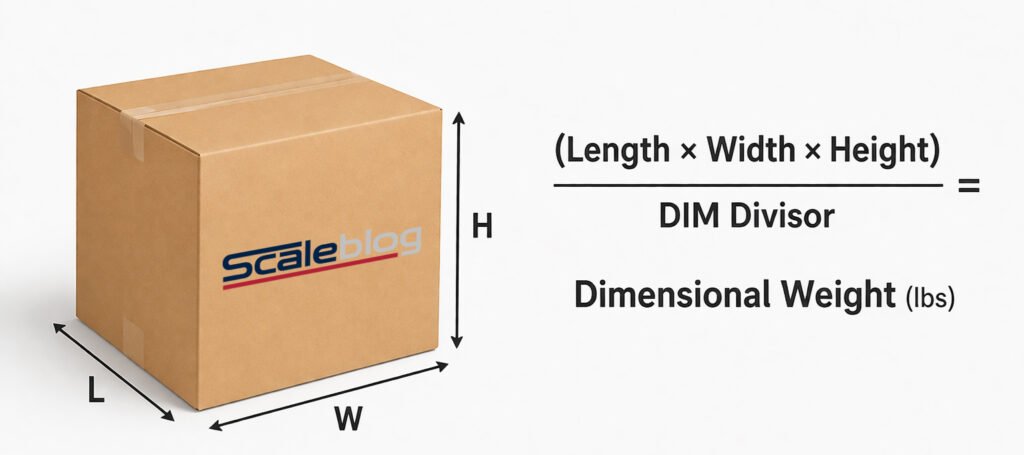
The DIM weight formula is consistent across all major carriers. The only variable that changes is the DIM divisor, which is set by each carrier individually.
Formula:
(Length × Width × Height) ÷ DIM Divisor = Dimensional Weight (lb)
All measurements are in inches, rounded up to the nearest whole inch before calculating (effective August 2025 for UPS and FedEx). The result is always rounded up to the nearest whole pound.
Current DIM Divisors by Carrier (2026)
| Carrier | DIM Divisor | Applies To |
|---|---|---|
| FedEx | 139 | All domestic and international packages |
| UPS | 139 (daily rates) / 166 (retail) | All domestic packages |
| USPS | 166 | Priority Mail packages over 1 cubic foot |
| DHL | 139 | International shipments (inches/lbs) |
Important 2026 update: Since August 2025, both FedEx and UPS round every fractional inch up before applying the DIM formula — meaning a box measuring 11.1 × 8.5 × 6.2 inches is calculated as 12 × 9 × 7 inches. This rule change increases dimensional weight for a large proportion of everyday shipments, particularly those with dimensions near common thresholds.
Carrier billing in the US uses pounds. If your scale indicator displays kilograms, our weight and unit converter converts the reading before you enter it into your shipping software.
How DHL Calculates Dimensional Weight in 2026
DHL applies dimensional weight pricing to all international shipments and most express services. The divisor depends on the unit of measurement used.
DHL dimensional weight formula — US measurements (inches and pounds):
(Length × Width × Height) ÷ 139 = Dimensional Weight (lb)
DHL dimensional weight formula — metric measurements (centimetres and kilograms):
(Length × Width × Height) ÷ 5,000 = Dimensional Weight (kg)
The 5,000 divisor is the international standard for metric DIM weight calculation — equivalent to the 139 divisor used in the US imperial system. Both formulas produce the same billable weight for the same physical package.
DHL key difference from UPS and FedEx: DHL applies dimensional weight to all shipments regardless of size — there is no minimum cubic volume threshold. Every DHL shipment, regardless of how small, is evaluated against both actual weight and dimensional weight. The higher number is the billable weight.
DHL ceiling rounding: As of 2026, DHL Express applies the same ceiling rounding principle as UPS and FedEx for international express shipments — fractional inches or centimetres round up to the next whole unit before the formula is applied. Confirm current rounding rules with DHL for your specific service and origin country, as DHL’s international network applies varying measurement standards by region.
Step-by-Step Dimensional Weight Calculator
Work through this example to calculate your own shipment’s billable weight.
Example package: A box of clothing — actual scale weight: 7 lb. Dimensions: 24 × 18 × 12 inches. Carrier: UPS domestic (DIM divisor: 139).
Step 1 — Measure the package: Measure length, width, and height from the longest point on each side, including any bulges. Round each measurement up to the nearest whole inch (mandatory for UPS and FedEx from August 2025). → 24 in × 18 in × 12 in ✓
Step 2 — Calculate the cubic size: Multiply all three dimensions together. → 24 × 18 × 12 = 5,184 cubic inches
Step 3 — Divide by the DIM divisor: Divide by your carrier’s divisor and round up to the nearest whole pound. → 5,184 ÷ 139 = 37.3 → rounds up to 38 lb dimensional weight
Step 4 — Compare against actual weight: The greater of the two is your billable weight. → Dimensional weight (38 lb) vs. actual weight (7 lb) → Billable weight = 38 lb
The carrier bills this 7 lb package as a 38 lb shipment. That is DIM weight in action.
Your own calculation: Replace the dimensions and DIM divisor with your package’s measurements. If your dimensional weight exceeds your actual weight, you are paying DIM, and right-sizing your packaging is the most direct way to reduce that cost.
Actual Weight vs Dimensional Weight: Which One Gets Billed?
Actual weight is the weight of the package on a scale, including its contents and all packaging materials.
Dimensional weight is the calculated theoretical weight based on the package’s cubic size and the carrier’s DIM divisor.
Billable weight is whichever of the two is greater — and that is what appears on your shipping invoice.
Three practical scenarios:
Dense, heavy items (tools, books, hardware): Actual weight almost always exceeds DIM weight. A 15 lb box of hand tools in a compact 8 × 8 × 10 inch box has a DIM weight of just 5 lb. You pay for the actual weight.
Light, bulky items (pillows, clothing, foam, decorations): DIM weight almost always exceeds actual weight. This is where unexpected charges occur.
Mid-range items (electronics, kitchenware): Either can win depending on packaging efficiency. A well-fitting box switches billing to actual weight; an oversized box switches it to DIM weight.
The 2026 Large Package Surcharge Thresholds That Stack on Top of DIM Weight
Beyond the DIM weight formula itself, UPS and FedEx apply additional surcharges when packages exceed specific size and weight thresholds. These charges stack on top of the billable weight charge and are triggered independently.
As of January 26, 2026, UPS triggers its Large Package Surcharge when:
- Actual weight exceeds 110 lb
- Cubic volume exceeds 17,280 cubic inches (equivalent to a 26″ × 26″ × 26″ box)
- The longest side exceeds 96 inches
- Combined length plus girth exceeds 130 inches
When triggered, UPS bills a minimum of 90 lb regardless of actual weight, with zone-specific surcharges ranging from $46.50 to $58.75 per package. FedEx applies equivalent thresholds under its Oversize pricing category.
For shippers approaching these thresholds, the August 2025 ceiling rounding rule has pushed additional packages over the cubic volume trigger — because dimensions that previously calculated to 17,200 cubic inches now round up to 17,280 or above. Re-measure your standard box sizes and calculate cubic volume under the new rounding rules before assuming you are below the surcharge threshold.
How the Right Scale Prevents DIM Weight Surprises
Understanding dimensional weight reveals that two pieces of equipment determine whether your shipping costs are accurate or excessive — a measuring tool and a scale.
Why the scale matters: The comparison at the heart of DIM weight pricing is between actual weight and calculated dimensional weight. If your actual weight reading is inaccurate because you are using an uncalibrated or non-NTEP-certified scale, you cannot reliably determine whether a given shipment is billed on actual weight or DIM weight. A scale that reads 6 lb when the package weighs 7.5 lb leads you to conclude you are paying on DIM when you may actually be at or above the actual weight threshold — and the carrier’s certified scale at their facility will produce the correct number regardless of what yours shows.
Why measurement precision matters more than ever: Under the August 2025 ceiling rounding rule, a package measuring 11.9 inches rounds to 12 inches for billing. A package you measure as 11.2 inches and record as 11 rounds to 12 at the carrier. If your measuring tools, dimensioner, or manual process record dimensions even slightly below the true value, your calculated DIM weight will be lower than what the carrier will bill. This gap becomes a systematic invoice discrepancy across every shipment it affects.
For operations shipping at significant volume, a calibrated shipping scale paired with a dimensioning system that measures to the nearest tenth of an inch — and applies ceiling rounding before comparing to the DIM threshold — gives you the same number the carrier uses before the package leaves your facility. For guidance on choosing the right shipping scale for your operation, see our shipping scale buying guide.
How to Reduce Dimensional Weight and Lower Your Shipping Costs
Reducing DIM weight is fundamentally about reducing wasted air space in packaging. These are the most effective strategies for 2026.
Right-size your packaging: This is the highest-impact single action. Match the box to the product rather than using the nearest standard box on the shelf. Under the August 2025 ceiling rounding rule, a box that is 0.5 inches too large on each dimension adds a full inch to each measurement in the carrier’s calculation. For high-volume SKUs, even a half-inch reduction in box dimensions can meaningfully reduce billable weight across thousands of shipments.
Re-audit your standard box sizes using the new rounding rules: If you last audited your carton library before August 2025, your DIM weight calculations may be significantly understating actual carrier charges. Remeasure your five highest-volume box sizes, apply ceiling rounding, and recalculate DIM weight. The results will frequently surprise you.
Switch to poly mailers for eligible items: Clothing, soft goods, and non-fragile flat items shipped in poly mailers have no DIM weight issue — they conform to the product. Switching from a box to a poly mailer eliminates DIM charges entirely on qualifying items.
Reduce void fill: Every extra inch of packing peanuts or an air pillow adds cubic size. Use form-fit packaging, tissue wrap, or custom inserts that protect without inflating package volume.
Compare carriers per shipment: USPS’s DIM divisor of 166 produces a lower dimensional weight than FedEx or UPS’s 139 for the same package. For light, bulky items going to eligible USPS zones, Priority Mail can be meaningfully cheaper than private carrier ground service — particularly after the August 2025 rounding changes pushed more packages into higher UPS and FedEx DIM weight tiers.
Negotiate your DIM divisor: High-volume shippers on contract rates can sometimes secure a higher DIM divisor — such as 166 instead of 139 — which directly reduces dimensional weight on every shipment. As noted by ParcelPath, businesses shipping 500+ packages monthly typically qualify for negotiated rates that reduce shipping costs by 10–30% compared to standard published rates.
FAQs
What is dimensional weight in shipping?
Dimensional weight — also called DIM weight or volumetric weight — is a pricing method carriers use to charge based on a package’s volume rather than just its scale weight. The carrier charges whichever is greater: the actual weight or the calculated dimensional weight. It has applied to all domestic UPS and FedEx parcels since 2015.
What is the DIM weight formula in 2026?
DIM weight = (Length × Width × Height) ÷ DIM Divisor. All measurements are in inches. Divide by 139 for FedEx and UPS domestic shipments (both now apply ceiling rounding — every fractional inch rounds up to the next whole inch before calculating, effective August 18, 2025). Divide by 166 for USPS Priority Mail packages over one cubic foot.
What changed with dimensional weight in August 2025?
UPS and FedEx both implemented ceiling rounding — every fractional inch in a package dimension is now rounded up to the next whole inch before the DIM formula is applied. A box measuring 11.1″ × 8.5″ × 6.2″ is calculated as 12″ × 9″ × 7″. This change increases dimensional weight for a large proportion of everyday shipments, particularly those with dimensions near whole-inch thresholds.
When did dimensional weight pricing start?
FedEx and UPS extended DIM weight pricing to all domestic packages in 2015. Previously, it applied mainly to air freight. USPS began applying it to Priority Mail packages over one cubic foot in 2019.
How do I reduce dimensional weight charges?
The most effective strategies are right-sizing packaging to eliminate wasted space using the post-August 2025 ceiling rounding rules, switching eligible items to poly mailers, reducing void fill, and comparing USPS rates for light bulky items where the 166 divisor produces lower charges than UPS or FedEx’s 139.
What is the billable weight in shipping?
Billable weight is the weight a carrier uses to calculate your shipping charge. It is the greater of your package’s actual scale weight or its calculated dimensional weight after applying the carrier’s DIM divisor and rounding rules.
Conclusion
Dimensional weight shipping is not a hidden charge — it is the primary billing method at every major carrier, and has been since 2015. The August 2025 ceiling rounding change introduced by UPS and FedEx has made the stakes higher: a fraction of an inch in any dimension now rounds up to the next whole inch before the DIM formula applies, pushing more packages into higher billable weight tiers than before. Understanding the formula, applying the current rounding rules, re-auditing your standard box sizes, and using a calibrated scale to verify your actual weights puts you in control of one of the largest variables in your shipping cost.
For operations shipping significant parcel volume, the combination of accurate weighing and precise dimension measurement at the packing station is the most direct investment available for reducing DIM weight charges before they appear on your invoice.