







Every industrial scale platform is made of steel — but not all steel performs the same way in all environments. Mild steel and stainless steel differ fundamentally in composition, corrosion resistance, cleanability, and long-term cost, and specifying the wrong material for the environment a scale will operate in is one of the most predictable ways to end up with a scale that fails prematurely, produces inaccurate readings, or fails a hygiene audit. This guide explains the material differences, what they mean in practical scale performance, and how to make the right specification decision for every environment in your facility.
Table of Contents
The Fundamental Material Difference
Mild Steel
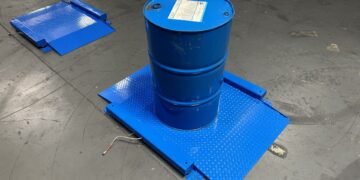
Mild steel — also called low-carbon steel or carbon steel — is an iron-based alloy containing approximately 0.05–0.25% carbon with minimal alloying elements. Mild steel uses carbon as its primary alloying element, which results in lower corrosion resistance compared to stainless steel. Without a protective surface treatment, the iron in mild steel reacts with oxygen and moisture to form iron oxide — rust. Mild steel scale platforms are therefore typically powder-coated or painted to provide a barrier against corrosion in the environments where they are deployed.
Key properties of mild steel for scale applications:
- Lower material cost — usually noticeably cheaper than a stainless equivalent of the same size and capacity
- Excellent weldability and fabricability — straightforward to manufacture into scale frames and platforms
- Strong structural performance for dry load-bearing applications
- Requires protective coating (powder coat or paint) to resist moisture and corrosion
- Coating integrity determines corrosion resistance — once the coating is chipped or scratched, the steel beneath begins to corrode
- Not suitable for food contact, washdown, or wet environments
Stainless Steel
Stainless steel is an iron-based alloy containing a minimum of 10.5% chromium by weight. The chromium reacts with oxygen to form a thin, invisible, self-repairing layer of chromium oxide on the surface — the passive layer that gives stainless steel its corrosion resistance. Stainless steel’s chromium content is what helps the material resist oxidation, rust, and corrosion, and its heat resistance is significantly higher than that of mild steel.
Key properties of stainless steel for scale applications:
- Inherent corrosion resistance — no surface coating required; resistance is built into the alloy
- Self-repairing passive layer — minor surface scratches reseal with oxygen exposure
- Non-porous surface — easier to clean thoroughly and resistant to bacterial harbouring
- Suitable for direct food contact and washdown environments
- Higher initial material cost — but lower long-term maintenance and replacement cost in wet or corrosive environments
- Required by FDA, USDA, NSF, and 3-A Sanitary Standards for food processing applications
Grade 304 vs Grade 316 — The Stainless Steel Decision Within the Decision
For operations that have already determined they need stainless steel, the next decision is which grade. The two most common grades in industrial scale applications are 304 and 316.
Grade 304 Stainless Steel
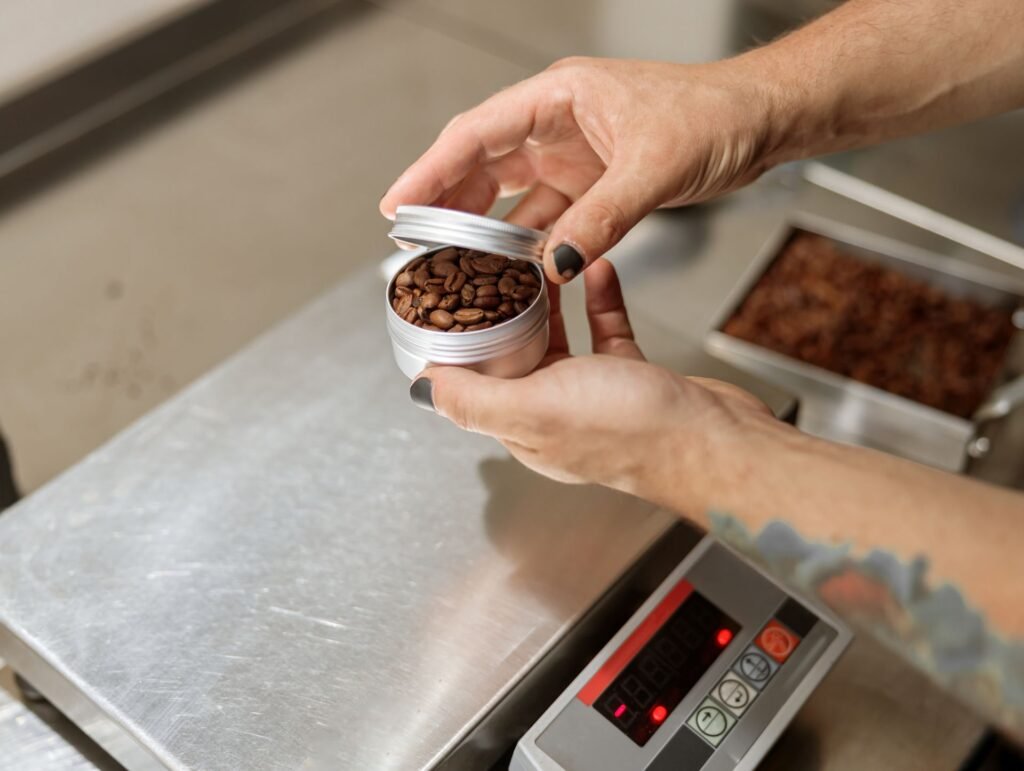
Grade 304 contains approximately 18% chromium and 8% nickel. It is the most widely used stainless steel in the world, widely reported to account for around half of global stainless production. For scale applications, 304 provides excellent corrosion resistance against water, most cleaning chemicals, and mild food acids. That is why 304 is the default for most washdown food scales. Note that a material grade alone does not make a scale “compliant” — food-safety compliance depends on the whole design (welds, crevices, cleanability) and how the equipment is maintained.
Grade 304 is appropriate for:
- General food processing — dry goods, bakery, packaging
- Pharmaceutical manufacturing in non-aggressive chemical environments
- Indoor washdown environments with mild cleaning agents
- Cold storage and refrigerated environments
- Any application where USDA or FDA contact compliance is required without aggressive chloride or acid exposure
Grade 316 Stainless Steel
Grade 316 adds 2–3% molybdenum to the 304 composition, which significantly enhances resistance to chloride-induced pitting and crevice corrosion. 316 works well in seafood processing, with acidic food products like citrus or tomatoes, and in facilities that use aggressive clean-in-place (CIP) systems. In demanding environments, 316 lasts longer and performs more reliably than 304.
Grade 316 is appropriate for:
- Seafood processing — direct contact with salt water and brine
- Meat and poultry processing with chlorinated sanitizers
- Dairy and beverage production with aggressive CIP cleaning cycles
- Pharmaceutical and chemical environments with strong acid or alkali exposure
- Marine and coastal outdoor installations
The practical decision: if your cleaning regime uses chlorinated sanitizers, your process involves salty or acidic products, or your scale will be in a marine environment, specify 316. For all other food and pharmaceutical applications, 304 is both compliant and cost-effective.
Where Each Material Belongs — By Environment
Mild Steel (Powder-Coated or Painted): The Right Choice For
Dry indoor warehouse and distribution — Floor scales in a clean, dry warehouse handling pallets of packaged goods, manufacturing components, or general freight have no meaningful moisture exposure in normal operation. A powder-coated mild steel platform provides the structural strength and capacity needed at the lowest cost. This is the correct specification for the majority of warehouse and general industrial environments in the US.
Indoor manufacturing — dry process — Production facilities where the scale never encounters water, cleaning chemicals, or food product — machining shops, assembly lines, electronics manufacturing, packaging of dry goods in sealed environments — do not require the corrosion resistance of stainless steel. A mild steel bench or floor scale is the correct, cost-effective choice.
Recycling and scrap — Scales in recycling and scrap applications handle abrasive, heavy loads in harsh but typically dry or only incidentally wet environments. Mild steel platforms with heavy-gauge construction are the standard specification. The loads involved — scrap metal, crushed materials, bulk aggregate — would damage a stainless steel platform surface just as readily as a mild steel one, and the cost difference is substantial.
Stainless Steel: The Right Choice For
Food processing — Any scale in direct contact with a food product, or in an area that must be cleaned to food safety standards, requires stainless steel. Stainless steel is ideal for hygienically sensitive areas because it is easier to clean and does not harbour pathogens in crevices, unlike coated mild steel, which can once a coating is compromised.
Pharmaceutical and chemical manufacturing — Under FDA drug GMP rules (21 CFR 211.65), product-contact surfaces must not be reactive, additive or absorptive so as to alter the drug, and equipment must be cleanable — in practice this means materials that do not react with products or cleaning agents, can be verified as clean, and maintain surface integrity under repeat sanitation cycles. Stainless steel meets these requirements; mild steel does not.
Any environment with regular washdown — A mild steel platform that is hosed down regularly will corrode at every point where the coating is imperfect — weld seams, fastener holes, platform edges, and any impact point from loading. In washdown environments, the question is not whether mild steel will corrode but how quickly. Stainless steel eliminates this failure mode entirely.
Outdoor installations — Scales installed outdoors — at agricultural weighing stations, ports, outdoor recycling facilities, or construction sites — face continuous rain, humidity, UV exposure, and temperature cycling. Powder-coated mild steel deteriorates faster in these conditions than in controlled indoor environments. Stainless steel provides substantially better long-term performance outdoors, particularly in coastal or humid climates.
The Total Cost of Ownership Calculation
The upfront price difference between a mild steel and stainless steel scale of equivalent capacity and size is typically significant — the stainless model often costs substantially more — get quotes for both. The decision to choose mild steel on cost grounds is correct for dry environments. The decision to choose mild steel on cost grounds for wet or washdown environments is almost always wrong once the total cost of ownership is calculated.
For a washdown environment, consider:
- Mild steel scale: Lower initial cost. Coating begins to fail at weld seams and impact points within a few years in regular washdown. Rust develops under the coating, compromising both structural integrity and hygiene. In active washdown areas this can shorten service life considerably.
- Stainless steel scale: Higher initial cost. Corrosion resistance is intrinsic — no coating to fail. Properly specified and maintained, a stainless steel scale in a food processing environment can deliver many years of service.
For guidance on calibration intervals that affect both scale types differently, depending on environment severity, see our article on how often industrial scales should be calibrated. For the IP ratings that must accompany stainless steel construction in washdown environments, see our article on IP ratings for industrial scales explained. For a full guide to specifying the right floor scale — including deck material — for your warehouse or factory, see our floor scale buying guide.
Sanitary Design Standards for Food and Pharmaceutical Scale Applications
For food and pharmaceutical operations, the material specification is only the starting point. The scale’s design must also comply with the relevant sanitary standards that govern equipment construction in those environments.
NSF/ANSI 51 — The NSF certification for food equipment materials confirms that construction materials, including stainless steel grades, coatings, and adhesives, are safe for food contact and will not leach harmful substances into food products.
3-A Sanitary Standards — Originally developed for dairy processing equipment, 3-A standards govern equipment design for cleanability — smooth surfaces, continuous welds, no crevices or horizontal surfaces that trap product or cleaning solution, and materials that withstand the cleaning chemicals used in those environments. Scales carrying the 3-A symbol have been independently verified for compliance. HACCP itself is a food-safety management system, not an equipment certification — a sanitary-design scale supports your HACCP plan but does not certify it.
USDA acceptance — The USDA Agricultural Marketing Service (AMS) runs a voluntary Equipment Program that reviews meat, poultry and dairy processing equipment against sanitary-design standards (such as NSF/ANSI/3-A 14159). Scales used to sell product by weight must also meet NIST Handbook 44, which is enforced by state weights and measures officials.
Quick Reference Decision Guide
| Environment | Correct Material | Grade |
|---|---|---|
| Dry indoor warehouse | Mild steel (powder-coated) | N/A |
| Dry manufacturing — no water exposure | Mild steel (powder-coated) | N/A |
| Recycling and scrap | Mild steel (heavy gauge) | N/A |
| General food production — low moisture | Stainless steel | 304 |
| Food production — washdown with mild chemicals | Stainless steel | 304 |
| Meat, poultry, dairy, seafood | Stainless steel | 316 |
| Pharmaceutical — GMP regulated | Stainless steel | 304 or 316 |
| Chemical processing | Stainless steel | 316 |
| Outdoor — non-coastal | Stainless steel | 304 |
| Outdoor — coastal or marine | Stainless steel | 316 |
Conclusion
The stainless steel vs mild steel decision for an industrial scale is not about which material is superior in absolute terms — it is about matching the material to the environment. Mild steel is the correct, cost-effective specification for dry indoor industrial and warehouse environments where the scale will never encounter water, cleaning chemicals, or food contact. Stainless steel is not optional in food processing, pharmaceutical, washdown, or outdoor environments — it is the minimum correct specification.
Within stainless steel, 304 covers the majority of food and pharmaceutical applications; 316 is required where chloride exposure, aggressive sanitizers, or marine conditions are present. Specify the material correctly from the start, and a scale will outlast multiple generations of the wrong specification at a fraction of the total long-term cost.
FAQs
What is the difference between a mild steel and a stainless steel industrial scale?
Mild steel scales use a powder-coated or painted carbon steel platform that provides corrosion resistance through its surface coating. Once that coating is damaged, the steel beneath corrodes. Stainless steel scales use an alloy with at least 10.5% chromium that forms an inherent, self-repairing passive layer resistant to corrosion — no surface coating required. Stainless steel costs more upfront but lasts significantly longer in wet, washdown, or food processing environments.
Do I need a stainless steel scale for food processing?
Yes. Any scale in direct contact with a food product or in an area cleaned to food safety standards should be made of a corrosion-resistant, nonabsorbent, cleanable material — which in practice almost always means stainless steel. (The FDA Food Code sets material requirements rather than naming a single metal.) Mild steel platforms cannot be verified as clean to food safety standards once the surface coating is compromised, and coatings do not withstand repeated washdown cycles reliably over time.
What is the difference between grade 304 and grade 316 stainless steel for scales?
Both are austenitic stainless steels suitable for food contact. Grade 304 contains 18% chromium and 8% nickel — appropriate for general food processing, pharmaceutical manufacturing, and mild washdown environments. Grade 316 adds 2–3% molybdenum, significantly improving resistance to chloride pitting — required for seafood processing, meat and poultry with chlorinated sanitizers, dairy with aggressive CIP cleaning cycles, and marine or coastal outdoor installations.
Is mild steel acceptable for a warehouse floor scale?
Yes — for dry indoor warehouse and general manufacturing environments where the scale has no meaningful moisture exposure. A powder-coated mild steel floor scale is the correct, cost-effective specification for pallet weighing, freight verification, and general industrial use in these conditions. Stainless steel adds cost without proportional benefit in dry environments.
What certifications should a stainless steel scale have for food processing?
For food processing applications, look for NSF/ANSI 51 certification confirming materials are safe for food contact, NSF or 3-A Sanitary Standards compliance confirming the design is cleanable and hygienic, and, for meat and poultry plants, equipment reviewed under the USDA AMS Equipment Program where your customer or inspector expects it. These marks document material and design; your sanitation program still has to keep the scale clean.
Sources
- 21 CFR 211.65, Equipment construction (FDA drug GMP) — ecfr.gov
- FDA Food Code 2022, Chapter 4 (Equipment materials) — fda.gov
- USDA AMS Equipment Program (dairy, meat and poultry equipment) — ams.usda.gov
- NSF/ANSI 51 Food Equipment Materials; 3-A Sanitary Standards Inc. — nsf.org, 3-a.org
- NIST Handbook 44 (2026) — nist.gov
Last reviewed September 2026 by the Scale Blog editorial team. Material and cost comparisons are general guidance; confirm specifications and certifications with the manufacturer.