







An explosion-proof scale is a weighing instrument certified for use in classified hazardous locations — areas where flammable gases, vapors, or combustible dust create a risk of ignition. In the US, these locations are classified under the NEC (NFPA 70) Class/Division system. Using an uncertified standard scale in a Class I Division 1 or Division 2 area is a violation of OSHA 29 CFR 1910.303 and NFPA 70. The two protection methods are explosion-proof (Ex d — contains ignition) and intrinsically safe (Ex i — prevents ignition).
The two major classification systems — NEC Class/Division (used in North America) and ATEX/IEC Zones (used internationally) — divide hazardous locations into the same underlying risk levels using different terminology. If your facility operates under US regulations or sources equipment internationally, this equivalency table is the reference point for matching the correct certified scale to your location’s classification.
| NEC (North America) | ATEX/IEC Zone | Hazard Description |
|---|---|---|
| Class I Division 1 | Zone 0 / Zone 1 | Flammable gases or vapors present continuously or under normal conditions |
| Class I Division 2 | Zone 2 | Flammable gases or vapors present only under abnormal conditions |
| Class II Division 1 | Zone 21 | Combustible dust present under normal operating conditions |
| Class II Division 2 | Zone 22 | Combustible dust present only under abnormal conditions |
| Class III Division 1 | Zone 21 (partial) | Ignitable fibers or flyings present under normal conditions |
| Class III Division 2 | Zone 22 (partial) | Ignitable fibers or flyings present only under abnormal conditions |
What follows covers how each protection method works, which NEC Class, Division, or ATEX Zone applies to your facility, the T-rating system, and the specific OSHA and NFPA 70 conditions that make certified hazardous area weighing equipment a legal requirement — not an optional upgrade.
Table of Contents
Explosion-Proof vs Intrinsically Safe: An Important Distinction
These two terms are often used interchangeably, but they describe two different methods of protection — and understanding the difference matters when specifying equipment.
Explosion-proof (flameproof) scales — designated Ex d under international standards — use a heavy-duty sealed enclosure designed to contain an internal ignition. If a spark or small explosion occurs inside the enclosure, the casing is engineered to withstand the pressure and cool any escaping gases below the ignition temperature of the surrounding atmosphere before they exit. The explosion stays inside. The hazardous environment outside remains safe.
Intrinsically safe scales — designated Ex i — take a different approach entirely. Rather than containing an ignition, an intrinsically safe design prevents one from ever occurring. The electrical energy in every circuit is limited below the threshold required to ignite the specific hazardous atmosphere present, even under fault conditions. Load cells, cables, and indicators in intrinsically safe systems are all designed so that no spark of sufficient energy can occur — under normal operation or when something fails.
In practice, most modern hazardous area weighing equipment combines both approaches: intrinsically safe load cells and cabling in the measurement circuit, and flameproof or explosion-proof enclosures around the digital weight indicator. This combination provides the highest level of protection and is the configuration required for the most hazardous classified zones.
What Are Explosion-Proof Scales Used For?
Explosion-proof and intrinsically safe scales are essential in any industry where weighing operations take place in the presence of flammable gases, vapors, or combustible dust. The most common industries and applications include:
Oil and Gas
Refineries, drilling platforms, fuel storage depots, and pipeline operations involve continuous or frequent presence of flammable hydrocarbon vapors. Hazardous area weighing equipment is required for drum and cylinder weighing, fuel additive batching, chemical dosing, and loading verification — anywhere a standard scale would introduce an ignition risk.
Chemical Processing
Chemical plants handle solvents, acids, and reactive compounds that produce flammable vapors. A Class I Division 1 scale is typically required on the production floor for weighing raw materials, intermediaries, and finished products, where explosive atmospheres exist under normal operating conditions.
Pharmaceutical Manufacturing
Drug production frequently involves flammable solvents such as ethanol, acetone, and isopropyl alcohol. Precision bench-scale weighing of active pharmaceutical ingredients (APIs) in these environments demands ATEX or IECEx certified scales that deliver analytical accuracy without introducing ignition risk.
Grain Elevators and Flour Mills
Combustible dust is among the most underestimated industrial hazards. Grain dust, flour, sugar, and starch are all classified as Class II combustible dusts under the NEC. A grain elevator where dust concentrations regularly build around conveyor belts and storage bins qualifies as a hazardous location requiring certified hazardous location weighing equipment.
Distilleries and Paint Production
Ethanol vapors in distilleries and solvent-based vapors in paint and coating facilities create consistently explosive atmospheres during production. These environments typically require Zone 1 or Division 1-rated scales throughout the weighing process.
Mining
Underground and surface mining operations encounter methane gas and coal dust — both classified hazards. Scales used for batching explosives, weighing ore, or measuring additive dosing in mining environments require certification to the most stringent protection levels.
For the industrial scale calibration requirements that apply to explosion-proof scales used in commercial transactions, see our article on industrial scale calibration: how often and what compliance requires.
Hazardous Area Classification: How Zones and Divisions Work
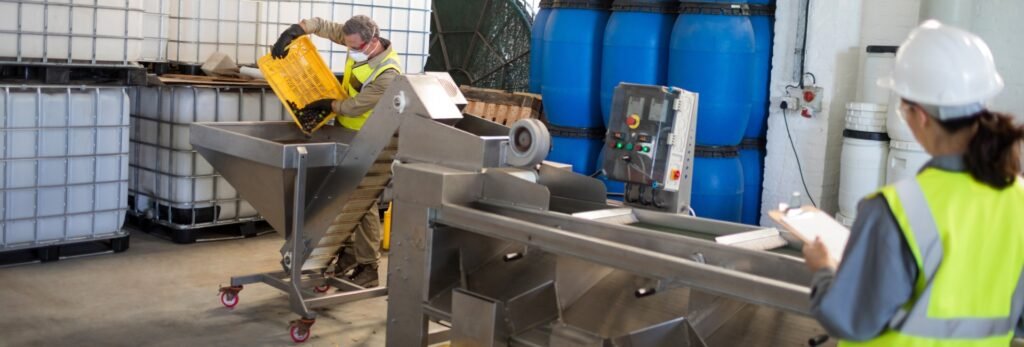
Before specifying an explosion-proof scale, a facility must identify its hazardous area classification. This determines which level of equipment certification is legally required.
The US System — NEC Classes and Divisions (NFPA 70 / OSHA)
The National Electrical Code, enforced by OSHA in the US, classifies hazardous locations by the type of hazard (Class) and the frequency of its presence (Division):
- Class I — Flammable gases or vapors (e.g., petroleum refineries, chemical plants)
- Class II — Combustible dust (e.g., grain elevators, flour mills, coal handling)
- Class III — Ignitable fibres (e.g., textile mills, sawmills)
- Division 1 — Hazardous concentrations present under normal operating conditions
- Division 2 — Hazardous concentrations present only under abnormal conditions
A Class I Division 1 scale is required in the most hazardous environments, where explosive atmospheres exist routinely during normal production.
The International Zone System — ATEX and IECEx (IEC 60079)
Outside the US, and increasingly alongside the NEC in global operations, hazardous locations are classified using the Zone system:
- Zone 0 / Zone 20 — Explosive atmosphere present continuously (very rare for scale applications)
- Zone 1 / Zone 21 — Explosive atmosphere likely during normal operation
- Zone 2 / Zone 22 — Explosive atmosphere possible only in abnormal conditions
A Zone 1 Zone 2 scale must be certified to the corresponding category. Zone 1 requires Category 2 equipment; Zone 2 requires Category 3.
For the full guide to all industrial scale types, including those used in standard industrial environments, see our complete guide to industrial scales.
Certifications: Which One Applies to Your Location?
The correct certification depends on where in the world the scale will be deployed and which regulatory authority has jurisdiction. Using equipment certified for the wrong region is a compliance failure even if the equipment is technically capable.
ATEX (EU) — Directive 2014/34/EU: Mandatory for all equipment used in potentially explosive atmospheres within the European Union. The ATEX Directive requires certification by a Notified Body and carries the CE marking with the Ex hexagon symbol. ATEX is not accepted as a standalone certification in North America.
IECEx (International) — IEC 60079 Series: The International Electrotechnical Commission’s voluntary global certification system, recognised in over 60 countries. IECEx is based on the same IEC 60079 standards as ATEX, making joint certification achievable. For multinational operations, IECEx significantly reduces the number of separate certifications required.
FM Approval (USA) — FM Global: Factory Mutual (FM) approval is one of the most respected certifications for explosion-proof equipment in North America. An FM-approved scale has been independently tested and certified by FM Global to meet NFPA and NEC requirements for classified hazardous locations.
UL Certification (USA/Canada) — Underwriters Laboratories: UL is a Nationally Recognised Testing Laboratory (NRTL) under OSHA. UL-certified intrinsically safe scales carry a certification mark confirming compliance with the applicable NEC standards for Class I, II, and III hazardous locations.
CSA (Canada): The Canadian Standards Association applies the Canadian Electrical Code (CEC) using standards harmonised with IEC 60079. Canadian facilities require CSA certification; ATEX alone is not sufficient.
Important: As confirmed by UL’s Global HazLoc Marking guide, NEC and ATEX classifications are related but not directly interchangeable. Equipment certified for Zone 1 is not automatically certified for Class I Division 1 use in the United States — both certifications are required for equipment used in multi-national facilities. Consult a qualified hazardous area engineer before specifying equipment based on zone equivalency alone.
A scale certified for Zone 1/Division 1 is always acceptable in Zone 2/Division 2 — higher-rated equipment can be used in lower-risk zones. The reverse is not permitted. As Mettler Toledo confirms, explosion-proof floor scales approved for Zone 1/21 Division 1 are also approved for use in Zone 2/22 Division 2 environments.
Temperature Classification: The T-Rating on Hazardous Area Scales
Every explosion-proof and intrinsically safe scale carries a temperature class — designated T1 through T6 — that indicates the maximum surface temperature the equipment can reach under fault conditions. This rating must be lower than the autoignition temperature of the flammable substance present in the facility.
| T-Rating | Maximum Surface Temperature | Typical Application |
|---|---|---|
| T1 | 450°C (842°F) | Most industrial gases and vapors |
| T2 | 300°C (572°F) | Acetylene and some solvents |
| T3 | 200°C (392°F) | Petroleum products, naphtha |
| T4 | 135°C (275°F) | Ethyl ether, some alcohols |
| T5 | 100°C (212°F) | Carbon disulfide |
| T6 | 85°C (185°F) | Most demanding applications |
The practical rule: The T-rating of the scale must be lower than the autoignition temperature of the most flammable substance present in the facility. If a facility uses diethyl ether — autoignition temperature approximately 160°C — the scale must carry at minimum a T4 rating (maximum surface 135°C), which is safely below the autoignition point. A T3-rated scale with a maximum surface temperature of 200°C would not be appropriate for this substance.
Specifying the wrong T-rating is a common compliance error — and one that is not caught by a general certification check that only verifies the Division or Zone classification.
When Are You Legally Required to Use an Explosion-Proof Scale?
If your facility has been formally classified as a hazardous location under the NEC (NFPA 70) or an equivalent international standard, using uncertified electrical equipment in that classified zone is a legal violation. In the US, OSHA enforces NEC compliance under the General Duty Clause and specific standards. As of 2025, OSHA serious violations carry penalties of up to $16,550 per violation; wilful violations reach up to $165,514 per violation, with each piece of non-compliant equipment potentially counted as a separate instance.
Beyond regulatory penalties, the practical consequence is catastrophic risk. A standard load cell — the component at the core of every weighing scale — functions by detecting minute changes in electrical current. Even normal wear on wiring or loose connections can produce a small arc. In an atmosphere containing solvent vapours, grain dust, or methane gas, that arc can be sufficient to trigger an explosion.
If you are unsure whether your area is classified, consult your facility’s Hazardous Area Classification drawing — this is a mandatory document for any site with explosion risk. If one does not exist, it must be produced by a qualified safety professional before any electrical equipment is installed in the area.
Choosing the Right Explosion-Proof Scale: Key Factors
Once you have confirmed your zone or division classification and the type of hazard present, these are the key specification decisions:
- Zone/Division rating — The scale must be certified for the classification of your area. A scale rated for Division 2 cannot be used in a Division 1 area; the reverse is permitted
- Hazard group — Gas groups (A, B, C, D for NEC; IIA, IIB, IIC for IEC) define which specific substances the equipment is rated for. A scale rated for Group D (propane) cannot be assumed safe in Group B (hydrogen) environments
- Temperature classification (T-code) — The maximum surface temperature of the scale must be below the auto-ignition temperature of the substance present. T4 (maximum 135°C) is the most common for general industrial use
- IP rating — The ingress protection rating (IP65, IP67, IP69K) of the load cells and enclosures should match the physical environment — wet areas, washdown zones, and dusty locations each demand a different level
- Stainless steel construction — For chemical, pharmaceutical, and food-adjacent environments, stainless steel load cells and platforms resist corrosion and comply with washdown requirements
- Weighing capacity and accuracy — Explosion-proof certification does not reduce a scale’s weighing performance. Specify capacity, resolution, and accuracy class as you would for any industrial application
For the full guide to IP ratings that apply to industrial scales in other harsh environments, see our article on IP ratings for industrial scales explained.
FAQs
What is an explosion-proof scale used for?
Explosion-proof scales are used for weighing in classified hazardous areas where flammable gases, vapors, or combustible dust are present — including oil refineries, chemical plants, grain elevators, pharmaceutical facilities, and distilleries. They are engineered to prevent or contain ignition in explosive atmospheres.
What is the difference between explosion-proof and intrinsically safe scales?
Explosion-proof (flameproof / Ex d) scales contain an internal ignition inside a sealed heavy-duty enclosure, preventing it from igniting the surrounding atmosphere. Intrinsically safe (Ex i) scales prevent ignition by limiting electrical energy below the threshold required to cause a spark, even under fault conditions. Most modern hazardous area scales combine both methods.
What certifications does an explosion-proof scale need?
Required certifications depend on your location. In the US, FM approval or UL certification under NEC/NFPA 70 is required. In the EU, ATEX certification (Directive 2014/34/EU) is mandatory. IECEx is the globally recognised voluntary certification. Canada requires CSA certification.
When are you legally required to use an explosion-proof scale?
If your facility has a formally classified hazardous location under NEC (NFPA 70), ATEX, or IECEx, all electrical equipment used in that zone must carry the appropriate certification. Using uncertified equipment in a classified area violates OSHA regulations in the US, with serious violations carrying penalties up to $16,550 per violation as of 2025.
What is a Class I Division 1 scale?
A Class I Division 1 scale is certified for use in locations where flammable gases or vapors are present under normal operating conditions — the highest-risk classification under the US NEC system. This corresponds to Zone 1 under the international IEC/ATEX zone classification system.
Conclusion
An explosion-proof scale is a legal requirement — not an optional upgrade — for any weighing operation in a classified hazardous area. Understanding what an explosion-proof scale is used for begins with understanding your area classification: whether your facility falls under Class I Division 1, Zone 1, or another hazardous location designation under NFPA 70, ATEX, or IECEx. Once the classification is confirmed, the required certification becomes clear — FM approval or UL for North America, ATEX for the EU, and IECEx for international operations. The distinction between intrinsically safe and flameproof protection methods matters when selecting equipment for the most hazardous zones.
If you are in doubt about whether certified hazardous area weighing equipment is required at your site, consult your facility’s hazardous area classification documentation and your local safety authority before making any equipment decisions. The cost of the right scale is a fraction of the cost of the wrong one.