








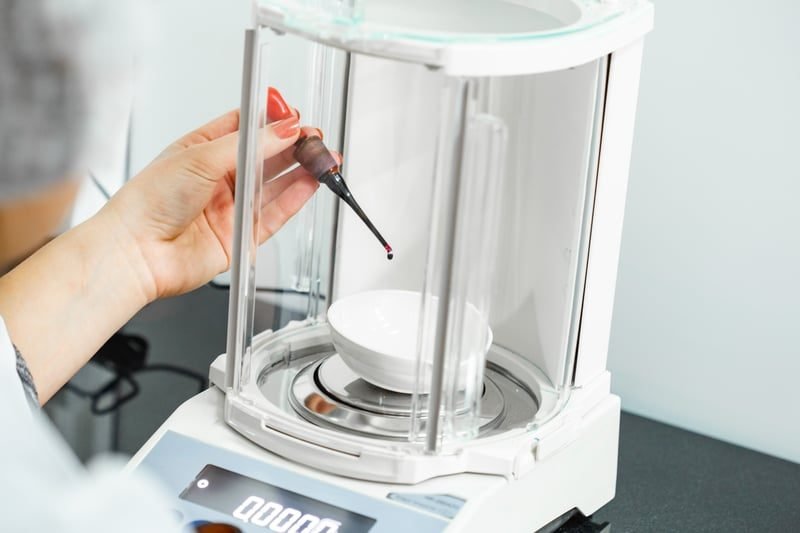
An analytical balance is a laboratory instrument that measures mass to 0.1 mg (0.0001 g) or finer, typically with a capacity of up to about 220–320 g, inside a draft shield that blocks air currents. It is the workhorse for weighing small samples accurately in chemistry, pharmaceutical and QC labs.
If a kitchen scale is a tape measure, an analytical balance is a micrometer. It can register a change of a ten-thousandth of a gram, which is also why it reacts to things you would never notice: a breath, a warm hand, a door opening down the hall. This guide explains what an analytical balance is, how it works, what it is used for, and how to get trustworthy readings from one.
Table of Contents
Parts of an Analytical Balance
Most analytical balances share the same basic layout, whatever the brand. Here is what each part does:
| Part | What it does |
|---|---|
| Weighing pan | Holds the sample or weighing vessel. It sits on top of the weighing cell, so anything resting on it — including a hand or a dangling sleeve — is weighed. |
| Draft shield (weighing chamber) | A transparent enclosure, usually glass, that keeps dust out and stops room air currents from pushing on the pan. Mettler Toledo notes analytical balances are always fitted with one. |
| Sliding doors | Let you load the pan from the side or top. You close them before reading so the air inside settles. |
| Level indicator and leveling feet | A bubble level (or a digital level on newer models) and adjustable feet let you set the balance perfectly level, which affects accuracy. |
| Display and keypad | Shows the reading and gives you tare, zero, calibration, units and application modes such as counting or density. |
| Internal calibration weight | Many models carry a built-in reference weight and adjust themselves automatically; others use external calibration weights. |
| Weighing cell | The sensor hidden inside the housing — usually an electromagnetic force restoration cell — that turns the load into a reading. |
| Data port | RS-232, USB or Ethernet output for printers, LIMS or PC software, which matters for GLP/GMP record-keeping. |

How Does an Analytical Balance Work?
A traditional two-pan balance compared your sample against known weights. A modern analytical balance does something cleverer: it measures how much electromagnetic force it takes to hold the pan perfectly still.
Electromagnetic force restoration (EMFR)
Inside the balance, the pan is connected to a coil sitting in the field of a permanent magnet. When you put a sample on the pan, it starts to move down. An optical position sensor spots the movement, and the electronics increase the current through the coil until the magnetic force pushes the pan back to exactly where it started. According to Mettler Toledo’s explanation of weighing principles, the coil position is controlled to better than a thousandth of a millimeter, and the current needed is directly proportional to the weight on the pan. The balance converts that current into the number on the display.
Mettler Toledo describes this electromagnetic force compensation as the most widely used technology for microbalances, analytical and precision balances, and the right principle for the highest resolutions. You will see it called EMFR, EMFC or “magnetic force restoration” — they all mean the same thing.
Strain gauge load cells (and why analytical balances rarely use them)
Most industrial scales use strain gauge load cells instead: a metal body bends very slightly under load, and thin resistive films bonded to it change resistance as they stretch. That works brilliantly for bench, floor and truck scales, but Mettler Toledo notes strain gauges are limited to lower resolutions — not the 0.1 mg steps an analytical balance needs.
Other sensor designs
A few manufacturers use alternative sensors. Rice Lake’s TA Plus analytical balance, for example, is built around a mono-metal tuning fork sensor, which reads the change in a vibrating fork’s frequency under load. Whatever the sensor, the job is the same: resolve a 0.1 mg change reliably and repeatably.
One consequence of measuring force rather than comparing masses: the reading depends on local gravity. That is why electronic balances must be calibrated where they are used — moving one to a different floor, building or altitude means recalibrating. Our guide to how to calibrate a lab balance walks through it.
Analytical vs Precision vs Semi-Micro vs Microbalance
“Analytical balance” sits in the middle of a family of lab balances. The main difference between them is readability — the smallest step the display shows — and that trades off against capacity:
| Balance type | Readability | Typical capacity | Draft shield? |
|---|---|---|---|
| Precision balance | 0.01 g (some to 0.001 g) | About 600 g to 34,000 g | Not usually at 0.01 g |
| Analytical balance | 0.0001 g (0.1 mg) | Typically up to about 320 g | Always |
| Semi-micro balance | 0.00001 g (0.01 mg) | About 80–250 g, often dual-range | Always |
| Micro / ultra-microbalance | Down to 0.0000001 g (0.1 µg) | Up to about 6 g | Always, often a small chamber |
In practice, the line between a precision balance and an analytical balance is that fourth decimal place. If your method needs results to the nearest 0.1 mg, you need an analytical balance; if 0.01 g is enough, a precision balance is faster, sturdier and cheaper. Our detailed top-loading balance vs analytical balance comparison and the overview of types of laboratory balances cover the trade-offs. For what that fourth decimal really means in practice, read how precise an analytical balance really is.
What Is an Analytical Balance Used For?
Anywhere a small mass has to be known accurately, you will find an analytical balance. Common uses include:
- Pharmaceutical QC and R&D — weighing reference standards, active ingredients and samples for assays, where USP requirements apply.
- Analytical chemistry — preparing standard solutions and reagents to a known concentration.
- Gravimetric analysis — measuring a precipitate, residue or filter before and after a process to work out how much of a substance was present.
- Sample preparation — weighing small portions for chromatography, spectroscopy and other instruments.
- Formulation — dosing small amounts of high-value or potent ingredients in cosmetics, food science and materials labs.
- Education — teaching good weighing technique in university and college chemistry labs.
Each of these depends on the balance being installed, calibrated and used correctly — which is where most errors creep in.
How to Use an Analytical Balance
Good technique matters as much as a good balance. Follow these eight steps every time:
How to use an analytical balance correctly for accurate 0.1 mg readings.
Level the balance
Check the level bubble (or digital level indicator) and adjust the leveling feet until it is centered. Re-check whenever the balance has been moved.
Let it warm up
Leave the balance switched on to reach thermal equilibrium before use. Mettler Toledo advises running a precision balance for one or two hours at its location before measuring; many labs simply leave analytical balances powered on all the time.
Calibrate
Run the internal calibration, or calibrate with a certified external weight, following your lab’s SOP. Calibrate after moving the balance and whenever your schedule requires.
Tare the container
Place a clean, dry weighing vessel on the center of the pan, close the doors, and press Tare so the display reads zero.
Add the sample and close the doors
Open one door, add the sample with a spatula or pipette, keep your hands out of the chamber, and close the door before reading.
Use room-temperature samples
Let warm or cold samples and vessels reach room temperature first. Temperature differences create convection currents inside the draft shield that make the reading drift.
Read when stable
Wait for the stability indicator before recording the result, and record it straight into your notebook or LIMS.
Clean up
Remove the sample, brush away spills from the pan and chamber with a soft brush, and close the doors so dust stays out.
If readings wander, work back through this list before blaming the balance. And if your lab runs under GLP or GMP, write these steps into your SOP so everyone weighs the same way.
What Affects Analytical Balance Accuracy?
At 0.1 mg, the room matters almost as much as the instrument. Mettler Toledo’s guide to adverse influences on weighing lists the usual suspects:
| Factor | What happens | What to do |
|---|---|---|
| Air currents | Drafts from air conditioning, fume hoods or doors push on the pan and make readings unstable. | Keep the draft shield doors closed; Mettler Toledo calls a draft shield indispensable at 0.1 mg. Site the balance away from vents and doorways. |
| Temperature | Temperature differences shift the balance’s zero and sensitivity; warm samples create convection currents. | Warm the balance up, keep the room stable, and let samples reach room temperature. |
| Static electricity | Charged samples or plastic vessels attract or repel the pan, showing up as phantom weight. It gets worse below about 40–45% relative humidity. | Use an ionizer or antistatic device, metal or glass vessels, and ground the balance. |
| Vibration | Footsteps, elevators and nearby equipment make the display jump or shift zero. | Use a heavy, stable weighing table away from traffic and machinery. |
| Leveling | A tilted balance reads low because only part of the load acts straight down. | Level it, and re-level and recalibrate after any move. |
| Magnetism | Magnetic stir bars, steel tools or magnetic samples pull on the weighing mechanism. | Keep magnets and steel tools away; if you must weigh magnetic items, increase their distance from the pan and place them the same way every time. |
| Air buoyancy | Air holds objects up slightly; Mettler Toledo puts the effect at about 0.1% for aqueous solutions. | Apply buoyancy correction when the highest accuracy is required. |
Our full guide to what affects lab balance accuracy goes deeper on room setup, and the complete lab balance guide covers calibration programs and compliance.
Analytical balances and USP Chapter 41
If you work in a pharmaceutical lab, United States Pharmacopeia General Chapter <41> “Balances” sets the rules for balances used in compendial testing. According to a Mettler Toledo white paper on USP <41>, a balance must meet acceptance criteria for repeatability and an accuracy of 0.10%, calibration must include measurement uncertainty, and sensitivity and repeatability checks must be run between calibrations. The related guidance chapter <1251> introduces a safety factor on the balance’s minimum weight, commonly 2 for labs with stable conditions and trained staff.
In plain terms: every analytical balance has a smallest sample it can weigh while still meeting USP accuracy, and you should stay comfortably above it. Our guide to pharmaceutical lab weighing and USP standards explains minimum weight in detail.
How to Choose an Analytical Balance
Here is the short checklist. For the full walkthrough, see our guide on how to choose an analytical balance.
- Readability: confirm you need 0.1 mg. If your method calls for 0.01 mg, look at semi-micro balances instead.
- Capacity: add the weight of your heaviest vessel to your largest sample, then leave headroom.
- Minimum weight: for regulated work, check the balance’s USP minimum weight against your smallest sample.
- Calibration: internal automatic calibration saves time and catches temperature drift.
- Data and compliance: look for USB, RS-232 or Ethernet output and GLP/GMP-ready printouts if you need audit trails.
- Legal for trade: if you sell by weight (precious metals, for example), choose an NTEP-certified model.
- Room and bench: budget for a stable weighing table and a draft-free spot — they matter as much as the balance.

Analytical balances to consider
Both of these are genuine 0.1 mg analytical balances with internal calibration — a sensible starting point for a teaching, QC or research lab.
ScaleBlog may earn a commission if you buy through links on this page, at no extra cost to you. See our affiliate disclosure.
SellEton pick
Rice Lake TA Plus Analytical Balance (sold by SellEton)
- TA Plus-124: 120 g × 0.0001 g; TA Plus-224: 220 g × 0.0001 g
- Internal automatic adjustment weight
- 360° transparent anti-electrostatic windshield
- Mono-metal tuning fork sensor; RS-232 output and ISO/GLP/GMP-compliant data output
Best for: labs that want 0.1 mg weighing with built-in calibration at a moderate price.
Use code SCALEBLOG10 for 10% off.
Liberty Scales pick
Ohaus Explorer EXR224N Analytical Balance (sold by Liberty Scales)
- 220 g capacity, 0.1 mg readability
- NTEP certified (legal for trade) version
- Built-in automatic calibration, touchless sensors and a ventilated weighing pan
- 7 in glass touchscreen with digital leveling
Best for: regulated or legal-for-trade work that needs a premium analytical balance.
Use code SCALEBLOG10 for 10% off.
Frequently Asked Questions
What is an analytical balance used for?
Analytical balances weigh small samples to 0.1 mg or better. Labs use them to weigh reference standards and samples for pharmaceutical testing, prepare standard solutions, carry out gravimetric analysis, and weigh small portions for chromatography and other instruments.
What is the difference between an analytical balance and a precision balance?
Readability. An analytical balance reads to 0.0001 g (0.1 mg) and always has a draft shield; a precision balance typically reads to 0.01 g and handles much larger loads — Lab Manager puts precision balance capacities at roughly 600 g to 34,000 g, versus up to about 320 g for analytical balances.
What are the two main types of analytical balances?
Labs usually choose between standard analytical balances, which read to 0.1 mg, and semi-micro balances, which read to 0.01 mg. By design, most use electromagnetic force restoration sensors, though some use alternatives such as tuning-fork sensors.
How accurate is an analytical balance?
An analytical balance displays readings to 0.1 mg, but real-world accuracy depends on calibration, the room and your technique. For pharmaceutical work under USP <41>, a balance must meet repeatability criteria and an accuracy of 0.10%, and samples should stay above the balance’s minimum weight.
Why does an analytical balance need a draft shield?
At 0.1 mg readability, even gentle air movement pushes on the pan enough to change the reading. The draft shield keeps room air currents and dust out, so the balance can settle on a stable value.
Sources
- Wikipedia — Analytical balance (draft shield, room-temperature samples, electromagnetic force restoration, gravity calibration)
- Mettler Toledo — Electronic weighing principles
- Mettler Toledo — Adverse influences and their prevention in weighing
- Mettler Toledo — Analytical balances
- Mettler Toledo — USP Chapter 41 weighing requirements (white paper)
- Lab Manager — Analytical balances
- SellEton — Rice Lake TA Plus analytical balance specifications
- Liberty Scales — Ohaus Explorer EXR224N specifications
Last reviewed October 2026.