









A laboratory balance that is out of calibration produces results that look correct and are wrong. The display reads to four decimal places. The value is stable. The printout carries a date and operator ID. And the weight is systematically off by enough to affect a concentration calculation, invalidate a batch release, or trigger an FDA observation during a GMP inspection.
Calibration is the process that prevents this. It compares the balance’s readings against certified reference weights of known mass and corrects any deviation. In a regulated laboratory, it also creates the documented record that proves the instrument was performing correctly at the time every measurement was made.
This article covers the two calibration methods — internal and external — what each requires, when each applies, and how to build a calibration program that satisfies GLP, GMP, and ISO/IEC 17025 requirements.
Table of Contents
What Calibration Is — and What It Is Not
Calibration and verification are two distinct activities that are frequently confused.
Calibration adjusts the balance. It compares the instrument’s readings against certified reference weights, identifies any deviation, and applies a correction to the instrument’s span and zero so that subsequent readings are accurate. A calibration event produces a calibration certificate documenting the as-found readings, the adjustment applied, and the as-left readings after adjustment.
Verification confirms the balance is performing within acceptable limits — without adjusting it. A daily verification check places a certified test weight on the pan, reads the displayed value, and confirms it is within the laboratory’s acceptance criteria. If it is, the balance is confirmed fit for use that day. If it is not, the balance is taken out of service until a formal calibration is performed.
Calibration adjusts and aligns the balance with a known standard — verification confirms performance without adjusting. Both activities are required in a properly managed laboratory calibration program. Neither replaces the other.
Before Calibration: Preparation Steps
Calibration performed without adequate preparation produces unreliable results regardless of the quality of the reference weights or the technician’s skill. Uncontrolled environmental factors amplify errors significantly during calibration — the same factors that affect routine weighing affect calibration weighing with equal or greater consequence.
Required preparation before any calibration:
Warm-up. Allow the balance to warm up for a minimum of 30–60 minutes after powering on. Most analytical balances require this period for the electromagnetic force compensation cell to reach thermal equilibrium. Calibration performed before the warm-up is complete is unreliable.
Leveling. Check the built-in bubble level and adjust the leveling feet until the bubble is centered. Recalibrating a balance that is not level introduces a systematic error into every calibration point.
Pan cleanliness. Remove all residue, dust, and debris from the weighing pan. Any material on the pan adds to the weight of the calibration weights and shifts every calibration reading.
Environmental stability. Confirm that drafts, vibration sources, and temperature fluctuations are controlled. Close draft shield doors. Ensure no HVAC vent is directing airflow toward the balance. Confirm room temperature is stable at 20–25°C and relative humidity is 45–60%. The environmental factors that affect routine weighing are fully addressed in our article on what affects lab balance accuracy.
Reference weight equilibration. Allow external calibration weights to equilibrate to room temperature before use. Weights stored at a different temperature than the laboratory environment generate convection currents inside the draft shield that shift calibration readings.
Internal Calibration: How It Works and When to Use It
Internal calibration uses a certified weight sealed inside the balance housing. When calibration is triggered — automatically or manually — a motor-driven mechanism lowers the internal weight onto the weighing pan. The balance records the reading, compares it to the known mass of the internal weight, calculates the correction factor, and applies it digitally to the span. The internal weight is then retracted, and the balance confirms calibration complete.
Most balances manufactured after 2015 offer internal calibration capability. The internal weight is typically 50–100 g and is factory-certified at manufacture. The calibration cycle takes 60–120 seconds with no operator intervention required.
Automatic triggers for internal calibration:
- Power-on — the balance calibrates automatically each time it is switched on
- Temperature drift — the balance’s internal temperature sensor detects a change above a defined threshold (typically 1–2°C) and triggers automatic recalibration
- Timed intervals — the balance recalibrates on a preset schedule (e.g. every 6 hours)
- Manual trigger — the operator initiates calibration via the menu
Advantages of internal calibration:
- Compensates automatically for temperature drift — the most common cause of analytical balance error in normal laboratory conditions
- Eliminates operator handling of calibration weights — removing the contamination and damage risk that affects external weight accuracy
- Faster — no setup time, no weight retrieval, no handling protocol
- Reduces reliance on operator compliance — calibration occurs regardless of whether the operator remembers to initiate it
Limitations of internal calibration:
- Single-point calibration — the internal weight tests one point in the capacity range. It does not verify linearity across the full weighing range.
- Internal weight cannot be independently verified by the operator without service access — if the internal weight’s mass has drifted, the balance adjusts to the wrong value
- May not fully satisfy ISO/IEC 17025 accreditation requirements as a standalone calibration method — external verification using accredited weights is typically required alongside it
Best suited for: GLP and GMP laboratories performing routine daily calibration where temperature drift compensation is the primary requirement, and the documentation trail is supplemented by periodic external calibration verification.

External Calibration: How It Works and When to Use It
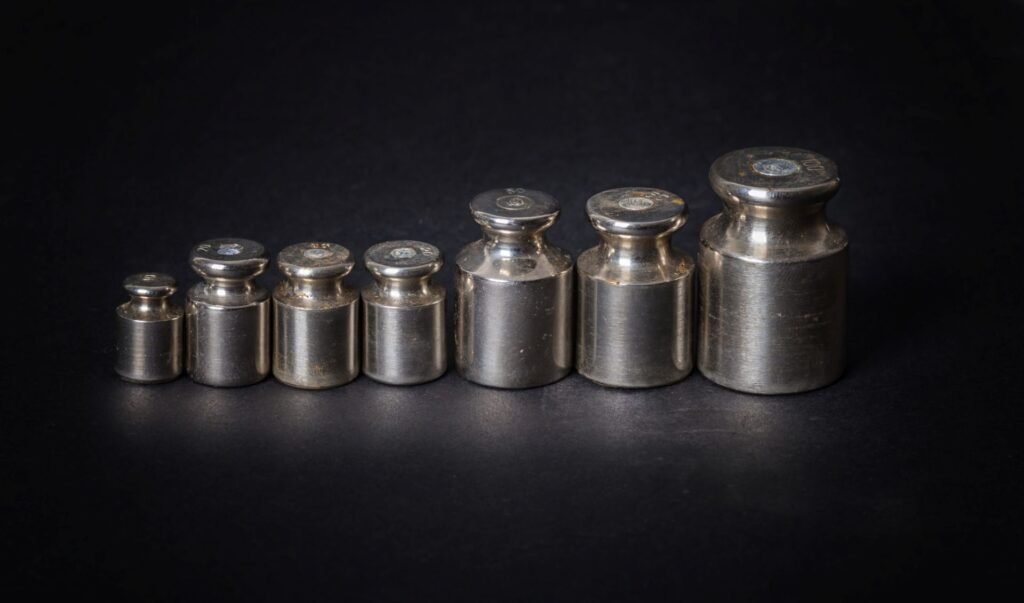
External calibration uses separately certified reference weights placed manually on the weighing pan by the operator or calibration technician. The balance compares its reading at each calibration point against the known certified mass and adjusts accordingly.
Reference weight classes for laboratory balance calibration:
External calibration for analytical balances uses OIML E2 or F1 class weights, or equivalent ASTM Class 1 weights.
| Weight class | Maximum permissible error at 100 g | Typical use |
|---|---|---|
| OIML E2 | ±0.16 mg | Analytical and semi-micro balances |
| OIML F1 | ±0.5 mg | Analytical balances — routine checks; precision balances |
| OIML F2 | ±1.6 mg | Precision balances |
| ASTM E617 Class 0 | ±0.13 mg | High-accuracy analytical work |
| ASTM E617 Class 1 | ±0.25 mg | Analytical balances (common U.S. choice) |
| ASTM E617 Class 2 | ±0.50 mg | Precision balances |
Weight we recommend for daily checks: the Ohaus ASTM Class 1 100 g stainless steel calibration weight with NVLAP certificate suits routine verification of 0.1 mg analytical balances. Handle it only with gloves or tweezers, and recertify it on the interval your procedures specify. As an Amazon Associate, Scale Blog earns from qualifying purchases.
Handling external calibration weights: Always handle reference weights with stainless steel tweezers or lint-free gloves — never bare hands. Fingerprint oils transfer approximately 0.05 mg of mass to a weight surface, introducing a systematic error into every calibration point where that weight is used. Store weights in their original padded case when not in use. Do not drop, stack without padding, or expose to corrosive environments.
Multi-point external calibration procedure:
A complete external calibration verifies the balance at multiple points across its capacity range — not just at a single weight. Linearity — the accuracy of the balance across its full weighing range — must be verified during calibration, not just at a single mid-range point.
A standard multi-point procedure covers:
- Zero point — empty pan, confirm zero reading
- Low point — approximately 10% of capacity
- Midpoint — approximately 50% of capacity
- High point — approximately 100% of capacity
- Corner load test — the mid-point weight is placed in each corner of the pan to verify eccentricity
Each point is recorded as found before any adjustment. If any point is outside the laboratory’s acceptance criteria, the balance is adjusted and the point is re-verified. The final as-left readings at all points are recorded on the calibration certificate.
Advantages of external calibration:
- Full traceability — the calibration weights carry their own NIST-traceable certificates with documented uncertainty values
- Multi-point linearity verification across the full capacity range
- Mandatory for ISO/IEC 17025 accreditation as the primary calibration method
- Accepted universally as the highest-authority calibration method by all regulatory frameworks
Limitations of external calibration:
- Requires a trained operator or an accredited technician — compliance depends on personnel
- Slower than internal calibration — a full multi-point external calibration takes 15–30 minutes when performed correctly
- Reference weights require annual recertification by an accredited laboratory and correct storage and handling between uses
Best suited for: ISO/IEC 17025 accredited laboratories as the primary calibration method; pharmaceutical GMP laboratories as the periodic formal calibration event that supplements daily internal calibration; and any laboratory where multi-point linearity verification is required by the regulatory framework or quality system.
The Combined Approach: Best Practice for Regulated Laboratories
In most GLP, GMP, and ISO/IEC 17025 laboratory environments, the optimal calibration program combines both methods at different frequencies and for different purposes.
Daily — Internal calibration at power-on or on a timed schedule. This compensates for temperature drift, confirms the balance is within operational tolerance, and provides the continuous calibration record that demonstrates the instrument was under control throughout every working day.
Daily or per session — In-house verification check using certified external test weights at one or more points in the capacity range. This confirms the internal calibration is producing correct results and provides an independent check that does not depend solely on the internal weight’s integrity.
Monthly or quarterly — Full multi-point external calibration by an accredited calibration service or qualified internal metrology technician, using OIML E2 or ASTM Class 1 reference weights with current certification. This produces the formal calibration certificate with NIST-traceable documentation that satisfies GMP audit requirements and ISO/IEC 17025 accreditation.
Annually — Recertification of the external reference weights used for in-house verification and calibration checks. Reference weights lose their traceable certification if they are not recertified within the period specified on their certificates — typically 12–24 months depending on the weight class and the accredited laboratory’s certification period.
FDA’s CGMP rules for finished pharmaceuticals require calibration “at suitable intervals in accordance with an established written program” (21 CFR 211.160(b)(4)), and automatic, mechanical and electronic equipment must be “routinely calibrated, inspected, or checked according to a written program” (21 CFR 211.68). The combined approach satisfies both requirements.
Calibration Documentation: What the Record Must Contain
The calibration record is not an administrative formality — it is the evidence layer that supports every weighing result produced by the instrument. In a GMP environment, it forms part of the batch record for every product lot weighed on that balance.
A complete calibration certificate must include:
- Balance identification — model, serial number, asset tag, and laboratory location
- Date and time of calibration
- Calibration technician name and qualification or service provider credentials
- Reference weights used — weight class, serial numbers, and calibration certificate references
- As-found readings at each calibration point — before any adjustment
- Adjustment applied — description of correction performed
- As-left readings at each calibration point — after adjustment
- Pass/fail determination against the laboratory’s acceptance criteria
- Environmental conditions during calibration — temperature, humidity, and any notes on stability
- Next calibration due date
Out-of-tolerance findings: When a balance is found out of tolerance during any calibration event, an impact assessment must be performed for all analyses conducted since the last successful calibration. This is a regulatory requirement in GMP environments — not a discretionary action. Every result generated during the out-of-tolerance period must be reviewed for potential impact on product quality or safety.
For pharmaceutical work, the United States Pharmacopeia sets the performance tests. According to USP’s guidance on balances, the accuracy check uses a single test load between 5% and 100% of capacity with an acceptance criterion of 0.10%, and the repeatability test uses a load of up to 5% of maximum capacity. USP leaves the frequency of these checks to the user, based on risk, and recommends a smallest net weight above the calculated minimum weight, typically with a safety factor of 2.
Calibration Frequency: Risk-Based Scheduling
Regulatory frameworks do not prescribe fixed calibration intervals — they require that intervals be defined, documented, and justified based on risk. Calibration frequency should reflect the type of equipment, usage intensity, and the regulatory guidelines applicable to the laboratory.
Practical calibration frequency guidelines:
| Application | Daily Verification | Formal External Calibration |
|---|---|---|
| Routine QC laboratory — moderate use | Yes | Every 6–12 months |
| Pharmaceutical GMP production | Yes | Every 3–6 months |
| ISO/IEC 17025 accredited laboratory | Yes | As required by accreditation scope |
| Research laboratory | Yes — per session | Annually minimum |
| High-value or critical measurements | Yes — per measurement | Quarterly |
Any of the following events requires immediate recalibration outside the scheduled interval: balance relocation, overload event, physical impact, electronic component repair, or out-of-tolerance finding during a verification check.
FAQs
What is the difference between internal and external balance calibration?
Internal calibration uses a certified weight sealed inside the balance that activates automatically — compensating for temperature drift without operator intervention. External calibration uses separately certified reference weights placed manually on the pan, producing a multi-point linearity verification with full NIST-traceable documentation. Most regulated laboratories use both internal calibration for daily use and external calibration for periodic formal certification.
How often should a laboratory balance be calibrated?
Calibration frequency must be defined by the laboratory based on usage intensity and regulatory framework. Daily in-house verification checks are standard for all regulated applications. Formal external calibration is typically performed every 3–12 months, depending on usage — quarterly for pharmaceutical GMP production balances and annually minimum for research laboratory instruments.
What weight class should I use for analytical balance calibration?
OIML E2 or ASTM Class 1 weights for analytical balances with 0.1 mg readability. OIML F1 weights are acceptable for routine external calibration of analytical balances where the highest traceability level is not required. OIML F2 weights are appropriate for precision balance calibration.
What happens if a balance is found out of tolerance during calibration?
The balance must be taken out of service immediately. An impact assessment must be performed for all analyses conducted since the last successful calibration to determine whether any results were affected. The balance is recalibrated or repaired before being returned to service. All out-of-tolerance findings must be documented, investigated, and resolved in accordance with the laboratory’s quality system procedures.
Does internal calibration satisfy GMP requirements?
Internal calibration satisfies the daily calibration requirement in most GMP frameworks when supplemented by periodic formal external calibration with NIST-traceable reference weights. Internal calibration alone — without periodic external verification — does not satisfy the traceability requirements of ISO/IEC 17025 accreditation or the multi-point linearity verification required in pharmaceutical GMP audits.
Conclusion
A laboratory balance calibration program has two functions: maintaining accuracy during routine use and building the documentary record that supports every result the instrument produces.
Internal calibration delivers the first function — compensating for temperature drift automatically, keeping the balance within operational tolerance throughout the working day. External calibration with certified reference weights delivers the second — producing the NIST-traceable, multi-point calibration certificate that satisfies GMP audit requirements, ISO/IEC 17025 accreditation, and the impact assessment process when an out-of-tolerance event occurs.
Neither method alone is sufficient in a regulated laboratory environment. The combined approach — daily internal calibration, periodic in-house verification, and scheduled formal external calibration — provides both the operational accuracy and the documentary foundation that a well-managed laboratory quality system requires.
Sources
- OIML, R 111-1:2004 — Weights of classes E1, E2, F1, F2, M1… (Table 1, maximum permissible errors).
- ASTM International, ASTM E617-23, Standard Specification for Laboratory Weights and Precision Mass Standards.
- U.S. Food and Drug Administration, 21 CFR 211.68, Automatic, mechanical, and electronic equipment and 21 CFR 211.160, General requirements (laboratory controls).
- United States Pharmacopeia, FAQs: Balances and Weighing on an Analytical Balance (General Chapters ⟨41⟩ and ⟨1251⟩); ⟨1251⟩ Weighing on an Analytical Balance.
- International Organization for Standardization, ISO/IEC 17025:2017, General requirements for the competence of testing and calibration laboratories.
Last reviewed September 2026 by the Scale Blog editorial team. Calibration of balances used in regulated work should follow your quality system’s procedures and be performed by qualified personnel.