








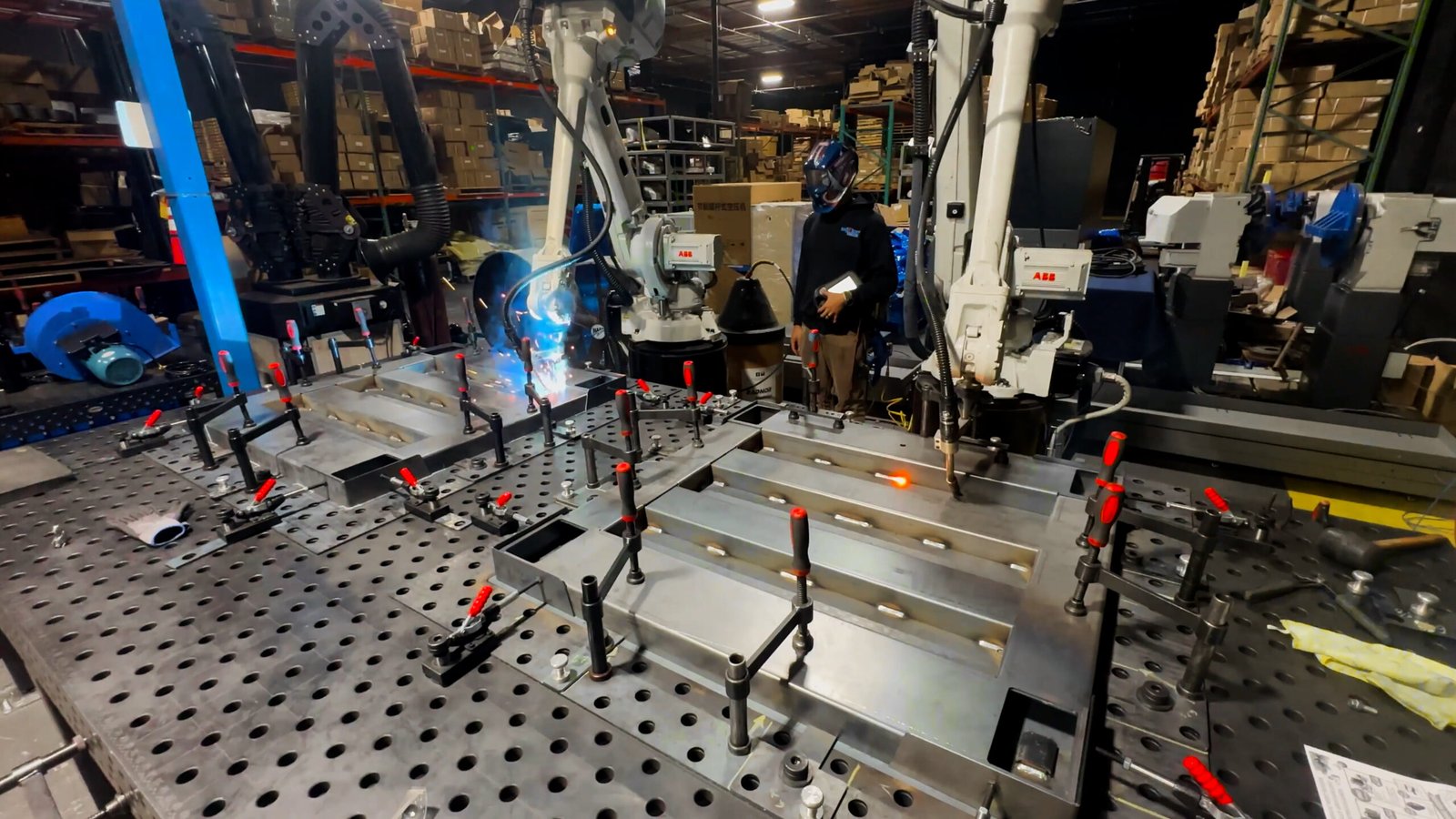
An industrial scale is a heavy-duty weighing instrument designed to measure loads in manufacturing, production, warehouse, and heavy industry environments — under the physical conditions, usage intensities, and capacity requirements that commercial or consumer scales are not built to handle. The term covers a wide range of instruments, from bench-top counting scales weighing a few hundred grams of components to weighbridges handling 200,000 lb truck loads. What they share is a design standard built around durability, accuracy under dynamic loading, and reliability across thousands of weighing cycles in demanding conditions.
This article explains how industrial scales work, the main types used across different industrial sectors, the specifications that separate an appropriate industrial scale from an undersized one, and what compliance requirements apply in the most common industrial weighing applications.
Table of Contents
How Industrial Scales Work
All industrial scales — regardless of type or capacity — operate on the same fundamental measurement principle. A load is applied to the scale. The load deforms a sensing element — a load cell. The load cell converts that deformation into an electrical signal. The indicator processes the signal and displays the result as a weight reading.
The load cell is the component that makes the measurement. Most industrial scales use strain gauge load cells — precision metallic elements bonded with strain gauges that change their electrical resistance when mechanically deformed by a load. The change in resistance is proportional to the applied force, producing an electrical signal that the indicator converts to a weight reading in the unit of measure selected — pounds, kilograms, or tons.
Load cell quality determines scale accuracy, repeatability, and long-term drift performance. Industrial load cells are specified by capacity, accuracy class, temperature rating, IP rating for environmental protection, and material — carbon steel for standard industrial applications, stainless steel for food, chemical, and pharmaceutical environments. Advanced sensors work in tough conditions — the load cell specification must match the actual operating environment of the scale, not the best-case scenario.
The indicator is the display and processing unit — the interface between the load cell’s electrical signal and the operator’s weight reading. Industrial indicators range from simple numeric displays mounted on the scale housing to networked controllers with RS-232, USB, Ethernet, and Wi-Fi outputs connecting directly to ERP, WMS, and SCADA systems.
The Main Types of Industrial Scales
Industrial scales cover a wider capacity and application range than any other weighing category. The seven main types — and the applications each serves — are covered in full in our complete guide to industrial scales. In summary:
Floor scales and platform scales are the most widely deployed industrial weighing instruments — heavy-duty platforms at floor level for weighing pallets, drums, raw materials, and production batches by hand truck or forklift. Typical capacities run from roughly 500 lb to 20,000 lb, depending on platform size and construction.
Bench scales serve production line QC stations, ingredient portioning, and parts counting at work surface height. Capacities from a few pounds to 300 lb.
Counting scales determine quantity by weight — establishing an average piece weight from a sample and dividing the total batch weight by that average to produce a count. For the complete guide, see our article on how counting scales work and when to use one.
Crane scales weigh suspended loads during the lift cycle — for loads that cannot be placed on a floor platform. Capacities from 500 lb to 300,000 lb. For the full guide, see our article on what is a crane scale and how does it work.
Truck scales and weighbridges are large-capacity drive-over platforms installed in the ground for weighing loaded vehicles. Common capacities fall in the 60,000–200,000 lb range; the right size depends on the heaviest vehicle and axle loads you will weigh.
In-motion checkweighers weigh products as they move along a production conveyor — 100% weight verification at production line speed without stopping the line. For the full guide, see our article on what is a checkweigher and when do you need one.
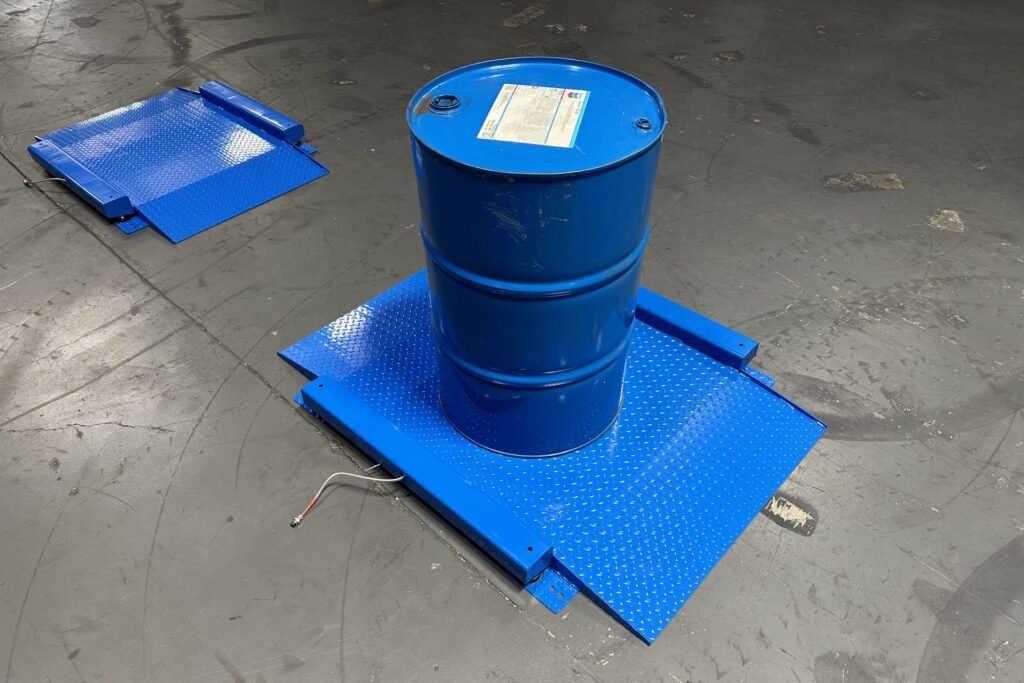
Drum and hopper scales serve specialized container and process vessel applications — drum scales for 55-gallon containers and hopper scales for fixed process vessels. For the full guide, see our article on drum scales and hopper scales: which does your facility need.
What Makes an Industrial Scale Different From a Commercial or Consumer Scale
Three engineering differences separate an industrial scale from a commercial bench scale or consumer instrument.
Structural durability: Industrial scales are built to absorb dynamic loads — pallets dropped onto the platform, forklifts approaching a floor scale, drums rolled onto a ramp. A standard commercial scale platform subjected to these loads fails within weeks. Industrial scale platforms are fabricated from heavy-gauge welded steel with reinforced deck bracing that resists deflection under dynamic loading. Deck deflection under impact transfers force away from the load cells — an industrial platform that deflects under a dropped pallet produces a low reading on every similar event.
Environmental protection: Industrial environments expose scales to conditions that destroy commercial instruments — dust, moisture, cleaning chemicals, temperature extremes, and corrosive vapors. Industrial scales specify IP-rated load cells and indicator housings matched to the actual operating environment. IP ratings for industrial scales, IP67-rated load cells are sealed against water ingress for washdown environments, and IP69K-rated indicators withstand high-pressure steam cleaning in pharmaceutical and food processing facilities. A commercial scale in these environments fails electronically within its first cleaning cycle.
High-cycle reliability: A floor scale at a busy receiving dock may weigh 200–500 pallets per day across two shifts. The load cells, deck hardware, and indicator must maintain calibration and mechanical integrity across millions of load cycles over years of service. Industrial load cells are specified with fatigue ratings — the number of load cycles they can sustain before performance degrades — that far exceed the specifications of commercial instruments.
How to Choose an Industrial Scale
The right industrial scale is the one whose capacity, division size and accuracy class match the job, not the biggest or most expensive model. In the United States, NIST Handbook 44 sets the accuracy classes that commercial scales are built and inspected to, and lists the typical class for each application.
Accuracy Classes and Typical Applications
| Class | Typical applications | Division (e) | Divisions (n) |
|---|---|---|---|
| I | Precision laboratory weighing | ≥ 1 mg | 50,000 or more |
| II | Laboratory weighing, precious metals and gem weighing, grain test scales | 1–50 mg | 100–100,000 |
| II | (as above) | ≥ 100 mg | 5,000–100,000 |
| III | All commercial weighing not otherwise specified, including retail precious metals and semi-precious gem weighing, grain-hopper and grain test scales, animal scales, postal scales, vehicle on-board weighing systems of 30,000 lb or less, and scales used to determine laundry charges | 0.1–2 g | 100–10,000 |
| III | (as above) | ≥ 5 g | 500–10,000 |
| III L | Vehicle scales (including weigh-in-motion), vehicle on-board weighing systems over 30,000 lb, axle-load, livestock, railway track and crane scales, hopper scales other than grain hopper | ≥ 2 kg | 2,000–10,000 |
| IIII | Wheel-load weighers and portable axle-load weighers used for highway weight enforcement | ≥ 5 g | 100–1,200 |
The number of divisions (n) is the capacity divided by the verification division. For example, a 5,000 lb floor scale that reads in 1 lb divisions has 5,000 divisions, inside the 500–10,000 range for Class III. The same platform set to 0.1 lb divisions would have 50,000 divisions, outside the Class III range, so it could not be approved as a Class III device at that setting.
Buyer Checklist
- Capacity: the heaviest load you will weigh, including containers, pallets and anything added to the platform. Never load a scale beyond its rated capacity.
- Readability (division size): the smallest increment you need to see. Check that capacity ÷ division falls inside the range for the scale’s accuracy class in the table above.
- Platform size: the whole load must sit on the platform, clear of the edges, including the largest pallet or container you use.
- Environment: washdown, dust, temperature, vibration and corrosive chemicals decide the IP rating and construction (painted mild steel or stainless steel). See the IP ratings section below.
- Legal for trade: if you sell, bill or charge by weight, most states require an NTEP-certified device, and your state or local weights and measures office inspects it.
- Connectivity: the outputs your indicator must provide (RS-232, USB, Ethernet or wireless) to reach a printer, PLC, ERP or warehouse management system.
- Installation: a level, stable foundation for floor, truck and tank scales, plus power, cabling and access for forklifts or pallet jacks.
- Calibration and service: who will calibrate the scale, how often, and against what traceable test weights. Plan for local support and spare parts.
Confirm the final capacity, readability and certification on the manufacturer’s specification sheet and NTEP certificate. For legal-for-trade, safety-critical or hazardous-area installations, have a qualified scale technician and your local weights and measures authority verify the setup.
NTEP Certification and Legal-for-Trade Requirements
Any industrial scale used in a commercial transaction where weight determines price must comply with NIST Handbook 44 and, in most states, carry an NTEP Certificate of Conformance and pass state or local weights and measures inspection by a state Weights and Measures inspector. This applies to truck scales at grain elevators and quarries, floor scales used to weigh goods sold by weight, and any industrial weighing application where the scale reading determines what a buyer pays or a carrier charges.
The NTEP Certificate of Conformance (CC) number on the scale’s data plate confirms the model is certified. The state Weights and Measures inspection seal on the individual unit confirms it has been tested in place and authorized for commercial use. Both are required — a certified model without an inspection seal, or a unit with an expired seal, is not in legal compliance for commercial transactions.
For internal production monitoring, inventory tracking, and process control, where no commercial price is determined by the reading, NTEP certification is not legally required. Calibration traceability to NIST is still required by most quality management frameworks, including ISO 9001 and pharmaceutical GMP.

IP Ratings: Matching the Scale to Its Environment
The IP (Ingress Protection) rating of a scale’s load cells and indicator housing must match the actual operating environment — not the ideal environment. This is the specification most frequently undersized in industrial scale purchasing, and the one most directly responsible for early scale failure in demanding environments.
The key ratings for industrial applications:
- IP54 — dust-tight, splash-proof. Indoor standard production environments away from direct washdown.
- IP65 — dust-tight, water jet-protected. Food production and chemical environments with hose cleaning.
- IP67 — dust-tight, submersion-resistant. Direct washdown environments, food processing, and dock areas with water accumulation.
- IP69K — dust-tight, high-pressure, high-temperature water-jet washdown. Pharmaceutical cleanrooms, meat processing, and any environment with high-pressure hot water cleaning.
Confirm the IP rating applies to both the load cells and the indicator independently. An IP67 load cell paired with an IP54 indicator fails at the indicator in a washdown environment — the weakest component determines the system’s real-world protection level.
Calibration Requirements for Industrial Scales
Industrial scales require calibration at intervals matched to their usage intensity and regulatory framework. Legal-for-trade commercial scales — truck scales, floor scales used in commercial transactions — require annual calibration and state Weights and Measures inspection. Production monitoring and QC scales require calibration every 6–12 months, depending on usage. In-motion checkweighers require quarterly calibration and shift-start performance verification.
Any relocation, overload event, physical impact, or electronic repair requires immediate recalibration before the scale returns to service. For the complete calibration guide covering all industrial scale types, intervals, documentation requirements, and out-of-tolerance response procedures, see our article on industrial scale calibration: how often and what compliance requires.
ERP and WMS Integration: How Industrial Scales Connect to Production Systems
In modern manufacturing operations, a scale that is not connected to the production management system is a manual data entry device — and manual data entry is the source of production variance, inventory discrepancy, and batch record errors in operations that have not made the integration investment.
The four integration levels in industrial environments:
Basic output: RS-232 or USB output from the scale indicator to a connected PC or terminal. The operator triggers a print or data send, and the weight is captured in the system. Adequate for low-throughput production stations where operator involvement in data capture is acceptable.
Keyboard wedge: The scale mimics a keyboard — every time a stable weight is reached, the indicator sends the weight value to whatever field is active in the connected application, as if the operator had typed it. Simple to implement, compatible with any software without custom development.
Native WMS/ERP integration: The scale indicator communicates directly with the WMS or ERP via Ethernet or Wi-Fi using the system’s native API or a middleware layer. Weight data is associated with the correct transaction, batch, or purchase order automatically — without operator data entry. This is the integration level that eliminates manual transcription entirely.
Automated process control: The scale is embedded in a production process — a filling line, a batching system, or a conveyor scale — and communicates with a PLC or SCADA system in real time. Weight data triggers actions — valve closure when a target fill weight is reached, line speed adjustment when throughput weight falls below target, rejection actuation when a package is out of tolerance. No operator involvement in the data flow.
For the complete guide to scale-to-WMS integration — covering connection methods, integration architectures, and the most common mistakes that create problems after go-live — see our article on how to integrate warehouse scales with your WMS.
Industrial Scale Applications by Manufacturing Sector
Food and Beverage Manufacturing: Ingredient portioning scales, in-line fill weight checkweighers, washdown floor scales with IP69K ratings, and NTEP-certified finished goods shipping scales. FDA net content regulations require that packaged food products meet declared weights; in-motion checkweighers provide the 100% verification mechanism.
Pharmaceutical Manufacturing: Precision bench scales and analytical balances for API weighing, validated in accordance with GMP requirements under FDA 21 CFR Part 211, with audit trail capability under 21 CFR Part 11. For the pharmaceutical laboratory balance compliance requirements in detail, see our complete Laboratory & Research cluster.
Chemical Manufacturing: Corrosion-resistant stainless steel floor scales and drum scales with IP67 or IP69K-rated load cells for hazardous chemical environments. ATEX or Class I Division 2 rated scales for explosive atmosphere applications.
Metal and Aggregate Processing: High-capacity truck scales for raw material inbound and finished product outbound. Crane scales for weighing metal coils, castings, and structural components during fabrication. Floor scales for scrap metal and finished product verification.
Automotive and Electronics Manufacturing: Counting scales for component inventory and kitting. Bench scales for quality control at assembly stations. In-motion checkweighers for final assembly verification.
Quick Reference: Industrial Scale by Application
| Application | Scale Type | Typical Capacity | Certification |
|---|---|---|---|
| Raw material receiving | Floor scale | 1,000–10,000 lb | NTEP if commercial |
| Truck load weighing | Truck scale / weighbridge | 60,000–200,000 lb | NTEP required |
| Suspended load weighing | Crane scale | 500–300,000 lb | NTEP if commercial |
| Production batch weighing | Floor or hopper scale | 500–10,000 lb | NTEP if commercial |
| Component counting | Counting scale | 5–150 lb | Not required |
| Fill weight verification | In-motion checkweigher | 0.1–500 lb | Required for net content |
| Drum/IBC weighing | Drum scale | 500–2,000 lb | NTEP if commercial |
| QC portioning | Bench scale | 5–300 lb | NTEP if commercial |
FAQs
What is an industrial scale?
An industrial scale is a heavy-duty weighing instrument designed for manufacturing, production, warehouse, and industrial environments — built for high-capacity loads, dynamic loading conditions, harsh environmental exposure, and high-cycle usage that commercial or consumer scales are not designed to handle. Industrial scales range from bench-top counting scales to truck scales rated for fully loaded highway vehicles.
How does an industrial scale work?
An industrial scale uses strain gauge load cells — precision metal elements that change their electrical resistance when mechanically deformed by a load. The load cell converts the deformation into an electrical signal proportional to the applied weight. An indicator processes the signal and displays the result as a weight reading in the selected unit of measure.
What is the difference between an industrial scale and a commercial scale?
Industrial scales are built for higher capacities, more demanding environments, and higher usage cycles than commercial scales. They feature heavier structural platforms resistant to dynamic loading, IP-rated load cells and housings for environmental protection, and load cell fatigue ratings specified for high-cycle industrial use. Commercial scales are designed for controlled retail or office environments at lower capacities and lower usage intensities.
Do industrial scales need to be NTEP certified?
Yes, for any commercial transaction where the scale reading determines a price. NTEP certification and state Weights and Measures inspection are both required for legal-for-trade use in the United States. For internal production monitoring and QC applications where no commercial price is determined by the reading, NTEP certification is not legally required — though calibration traceability is required by most quality management frameworks.
What IP rating does an industrial scale need?
IP54 for standard indoor industrial environments. IP65 for water spray and hose-down environments. IP67 for direct washdown. IP69K for high-pressure, high-temperature washdown in pharmaceutical and food processing facilities. Both the load cells and the indicator must carry the appropriate IP rating independently — the weakest component determines the system’s effective environmental protection.
Conclusion
An industrial scale is not simply a large version of a commercial scale — it is an instrument built to different structural, environmental, and performance standards that reflect the realities of industrial use. The load cell specification, platform construction, IP rating, and calibration program together determine whether the scale performs accurately over its service life or fails prematurely in the conditions it was purchased to operate in.
Matching every specification to the actual application — not the ideal application — is the discipline that produces an industrial scale that earns its cost over years of reliable service rather than one that requires frequent repair, recalibration, or premature replacement.
Sources
- National Institute of Standards and Technology, NIST Handbook 44 (2026): Specifications, Tolerances, and Other Technical Requirements for Weighing and Measuring Devices.
- National Conference on Weights and Measures, National Type Evaluation Program (NTEP).
- International Electrotechnical Commission, IEC 60529, Degrees of protection provided by enclosures (IP Code); International Organization for Standardization, ISO 20653:2023 for IP69K.
Last reviewed September 2026 by the Scale Blog editorial team. Capacity ranges are typical market ranges, not product specifications; confirm legal-for-trade requirements with your state or local weights and measures office.