









Every shipping operation that declares a package or pallet weight to a carrier is making a commercial statement. That statement determines the freight invoice, the freight class for LTL shipments, the Bill of Lading weight for sea freight, and the dispute evidence if a carrier issues an adjustment. When the declared weight is wrong — whether by 0.5 lb on a parcel or 200 lb on a pallet — the consequence arrives after delivery, in the form of an invoice adjustment, a reclassification fee, or a compliance penalty.
A shipping scale is the instrument that makes the declared weight correct before the package or pallet leaves the facility. This guide covers every scale type used in commercial shipping and logistics operations, the carrier billing mechanics that make accuracy commercially critical, the compliance requirements that make it legally required, and how to match the right scale to every point in your shipping workflow.
Table of Contents
Why Shipping Weight Accuracy Matters More in 2026 Than Ever Before
Three regulatory and carrier billing changes in 2025–2026 have raised the commercial stakes of shipping weight accuracy to their highest level in a decade.
The July 2025 NMFC overhaul: The National Motor Freight Traffic Association (NMFTA) implemented its most significant freight classification overhaul in decades on July 19, 2025. Density is now the primary classification factor for the majority of LTL commodities — meaning the weight you declare on the Bill of Lading now directly determines freight class on a far higher proportion of shipments than it did before July 2025. An inaccurate weight produces an incorrect density calculation, the wrong freight class, and a reclassification adjustment that includes both the weight correction and an inspection fee.
The August 2025 UPS and FedEx ceiling rounding rule: Every fractional inch in a package dimension now rounds up to the next whole inch before the dimensional weight formula is applied. As covered in our article on dimensional weight shipping, this change means a package measuring 11.2 × 8.7 × 5.4 inches is calculated as 12 × 9 × 6 — producing a higher dimensional weight than most shippers’ systems calculate. The practical consequence is that more packages are now billed on dimensional weight rather than actual weight, making accurate scale readings at the packing station the essential first step in verifying which billing basis applies.
The January 2026 cubic volume threshold shift: UPS and FedEx moved from length-plus-girth measurement to cubic volume for triggering Additional Handling and Oversize surcharges. Packages that previously avoided these surcharges are now triggering them — with no change in physical dimensions — because the cubic volume calculation produces a higher result than the legacy method. Accurate weight at the packing station is the companion measurement to dimensional data in managing these thresholds.
For any operation that has not reviewed its packing station weighing process since mid-2025, the current carrier billing environment is generating adjustments that did not exist under the previous rules.
The 5 Shipping Scale Types — Which One Belongs Where
Shipping and logistics operations use five distinct scale types, each suited to a different weight range, workflow position, and compliance requirement. Understanding where each one fits is the starting point for building a weighing infrastructure that matches your operation.
Parcel and Postal Scales
A parcel scale is a bench-top instrument designed for individual packages — UPS and FedEx accept parcels up to 150 lb, while the USPS limit is 70 lb — shipped via UPS, FedEx, and USPS. Most connect directly to shipping software via USB or Bluetooth, sending weight readings to the label being generated without manual entry.
Best for: E-commerce sellers, corporate mailrooms, retail shipping counters, and any operation shipping individual packages via parcel carriers.
Typical capacity: 35–300 lb, with readability of 0.1 oz for USPS applications and 0.1 lb for UPS and FedEx ground.
Key requirement: NTEP certification for any commercial transaction where the scale reading determines the shipping charge.
For the complete guide to what a parcel scale is and how to choose the right one for your operation, see our articles on what is a shipping scale and how to choose a shipping scale.

Floor Scales
A floor scale is a heavy-duty platform scale sitting at or near floor level, designed for packages and freight too heavy to lift onto a bench surface. Packages are rolled, slid, or moved onto the platform with a hand truck. Floor scales bridge the gap between the parcel scale’s 150 lb ceiling and the pallet scale’s full-pallet capacity.
Best for: Warehouses and distribution centers shipping mixed freight — individual heavy packages alongside palletized loads — from a single dock station.
Typical capacity: 500–5,000 lb, with platforms from 2 ft × 2 ft to 4 ft × 4 ft or larger.
The difference between a parcel scale and a freight scale — and the weight threshold that separates them — is covered fully in our article on parcel scale vs freight scale.
Pallet Scales
A pallet scale is a low-profile, heavy-duty platform designed specifically for weighing fully loaded pallets before they are wrapped and dispatched. The platform sits close to the floor — typically 3.5–5.5 inches high — so a loaded pallet can be rolled or forked into position. Platform size must accommodate a full standard pallet — 48″ × 40″ — with all four corners within the weighing surface.
Best for: Operations shipping LTL freight where the pallet weight declared on the Bill of Lading determines freight class, carrier billing, and compliance with SOLAS VGM requirements for sea shipments.
Typical capacity: 2,500–10,000 lb.
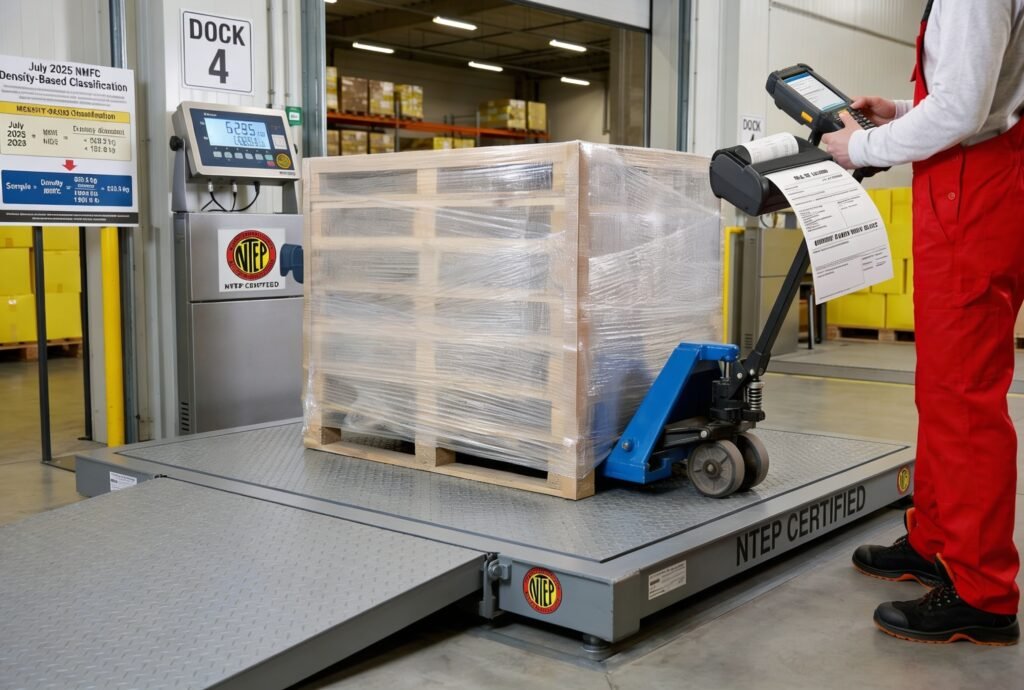
Critical requirement: NTEP certification for freight billing applications. If you bill customers by weight, the scale must be NTEP-certified and inspected; for BOL weights it is strongly recommended, because carriers reweigh on certified scales and disputes are settled on certified weights. The complete specification guide for pallet scales in freight shipping applications is in our pallet scale buying guide.
Pallet Jack Scales
A pallet jack scale integrates a weighing system directly into the pallet jack. The operator moves the pallet normally — weighing occurs during the same lift that was already going to happen. No separate scale platform or additional handling step is required.
Best for: High-throughput dock operations where pallets move by jack, and weighing at a fixed floor scale station would slow the outbound workflow. NTEP-certified pallet jack scale models are available for operations that need legal-for-trade weights.
Typical capacity: 2,200–5,500 lb.
For the full explanation of how pallet jack scales work and when they are the right tool, see our article on what is a pallet jack scale.
Forklift Scales
A forklift scale mounts to the forks or carriage of a forklift and weighs the pallet during the lift cycle, with no separate weighing step required. Load-cell systems are often specified at around ±0.1% of capacity (check the datasheet), and some are available with NTEP certification. Hydraulic pressure systems are less accurate and generally not NTEP certified — appropriate for inventory tracking but not commercial weight declaration.
Best for: Large warehouses and distribution centers where forklifts handle all pallet movement, and weighing every outbound pallet at a separate floor scale station would represent a significant throughput bottleneck.
Typical capacity: 3,000–10,000 lb and above.
The complete comparison of forklift scales against pallet jack scales — including accuracy, NTEP status, and the four-question framework for choosing between them — is in our article on forklift scale vs pallet jack scale.
Carrier Billing Mechanics: How Weight Determines What You Pay
Understanding how carriers use the weight on your shipping label — and what happens when it differs from what their systems measure — is the commercial foundation for every scale investment decision in a shipping operation.
Actual Weight vs Dimensional Weight
Every carrier charges based on the greater of two numbers: the actual weight of the package on a scale, or the dimensional weight calculated from the package’s physical dimensions. As covered in our complete article on what is dimensional weight in shipping, dimensional weight equals length × width × height divided by the carrier’s DIM divisor — 139 for UPS, FedEx and — since July 12, 2026 — USPS parcels over 1 cubic foot (USPS previously used 166).
The practical consequence: a 7 lb box measuring 24 × 18 × 12 inches has a dimensional weight of 38 lb under UPS’s DIM divisor. The carrier bills 38 lb. A calibrated scale at the packing station tells you the actual weight before the label is printed — allowing you to compare it against the dimensional weight and choose packaging that minimizes whichever number is higher.
LTL Freight Weight and Freight Class
For LTL shipments, weight is not just a billing input — it is the primary variable in the density calculation that determines freight class under the post-July 2025 NMFC system. An inaccurate pallet weight produces an incorrect density figure, the wrong freight class assignment, and a carrier weight and inspection (W&I) adjustment at delivery that includes both the corrected freight charge and an inspection fee.
The complete mechanics of LTL freight pricing — including the density formula, the 18 freight classes, and how the July 2025 NMFC overhaul changed classification for most commodities — are covered in our article on LTL freight weight and shipping cost.
Carrier Invoice Adjustments
When a carrier’s hub measurement differs from the declared weight on the shipping label, they issue a billing adjustment after delivery. These adjustments carry both the weight difference charge and a processing fee. The root causes are consistently the same: uncalibrated scales, weighing contents without packaging, manual entry errors, and incorrect dimensional data.
The complete breakdown of every root cause and every fix is in our article on how to avoid carrier invoice adjustments from wrong package weights.
NTEP Certification: The Legal Requirement for Commercial Shipping Scales
Any scale used to determine a shipping charge — or any other commercial transaction where weight determines price — must be certified legal for trade under NTEP (National Type Evaluation Program) and approved by the applicable state Weights and Measures authority.
NTEP certification means the scale model has been independently tested against NIST Handbook 44 accuracy standards. The Certificate of Conformance (CC) number on the scale’s data plate is the verification that this specific model is certified. The state Weights and Measures inspection seal on the individual unit confirms it has been tested in place and approved for commercial use.
When you need an NTEP-certified, legal-for-trade scale:
- The weight determines a shipping or handling charge you bill to a customer (for example at a pack-and-ship counter) — legally required
- The weight is declared on a Bill of Lading or shipping label — strongly recommended, since carriers bill on their own certified reweighs
- The weight is used for a SOLAS VGM declaration — equipment must be calibrated and certified to the requirements of the country (in the US, the state) where weighing takes place
When NTEP certification is not legally required:
- The scale is used only for internal inventory tracking
- Weight is used as an internal estimate only, and the carrier’s certified scale provides the final billing weight
For shipping operations that charge customers by weight, NTEP certification is a legal requirement; for everyone else it is the practical standard that makes your declared weights defensible.
SOLAS VGM: The Sea Freight Compliance Requirement
For any US business shipping goods internationally by sea, SOLAS VGM (Verified Gross Mass) is a mandatory compliance requirement with a binary consequence for non-compliance — a container without a declared VGM cannot be loaded onto the vessel.
The regulation, effective since July 1, 2016, under the IMO’s Safety of Life at Sea convention, permits two methods for obtaining the VGM. Method 1 is weighing the packed and sealed container on calibrated, certified equipment such as a weighbridge. Method 2 is weighing all packages and cargo items, including pallets, dunnage and securing material, and adding the container tare mass, using equipment that meets the national requirements where weighing takes place at the packing facility, then adding the container’s tare weight.
For operations shipping containers from their own facility, the pallet scales and floor scales at the packing dock are the instruments that satisfy Method 2’s weighing requirements — provided they are NTEP certified and within their calibration period. The complete SOLAS VGM compliance guide — including the two methods, documentation requirements, and the scale specifications that satisfy each — is in our article on SOLAS VGM scale requirements.
Shipping Scale Calibration: The Evidence Layer That Protects Every Shipment
A shipping scale calibration program serves two functions simultaneously: keeping weights accurate enough to prevent carrier adjustments, and maintaining the documentary record that allows you to dispute the adjustments that arrive despite your best efforts.
When you dispute a carrier’s weight adjustment, the primary documentation required is a calibration certificate showing your scale was accurate at the time of the disputed shipment. Without a current calibration certificate from an accredited service provider, the carrier’s terminal measurement stands unchallenged.
Recommended calibration intervals by operation:
- Standard parcel shipping operations: annually, minimum
- High-volume operations over 200 shipments per day: every 3–6 months
- LTL freight applications: quarterly minimum
- SOLAS VGM applications: quarterly minimum
Any relocation, overload, or physical impact event requires immediate recalibration regardless of the scheduled interval.
The complete calibration guide — covering legal-for-trade requirements, in-house verification vs professional calibration, NIST-traceable documentation, and the dispute evidence standard — is in our article on shipping scale calibration requirements.
Software Connectivity: How Scales Connect to Your Shipping Workflow
A shipping scale without direct software connectivity requires manual weight entry on every shipment. Manual entry is the primary source of transcription errors that generate carrier invoice adjustments — and it adds processing time to every label printed at high volume.
Standard connectivity specifications for shipping scales:
USB HID (Human Interface Device): The most widely supported connectivity standard. A USB HID-compliant scale is recognized automatically by most shipping software platforms — UPS WorldShip, FedEx Ship Manager, ShipStation, and Shippo — without additional drivers.
Bluetooth: For mobile and tablet-based shipping stations where a USB cable is impractical. Confirm Bluetooth protocol compatibility with your specific software version before purchasing.
Ethernet/Wi-Fi: For high-volume operations where the scale indicator connects directly to a Transportation Management System (TMS) or Warehouse Management System (WMS), populating BOL weights automatically.
Critical pre-purchase step: Confirm that the specific scale model is listed as compatible with your exact software version — USB compliance does not guarantee software compatibility. Verify against the scale model and software version before purchasing.
Quick Reference: Matching Scale to Shipping Application
| Application | Scale Type | Capacity | NTEP Required |
|---|---|---|---|
| E-commerce parcel — UPS/FedEx/USPS | Parcel bench scale | Up to 150 lb | Yes |
| Heavy individual packages — 150–500 lb | Floor scale | 500–1,000 lb | Yes |
| LTL pallet outbound — fixed dock station | Pallet floor scale | 2,500–10,000 lb | Yes |
| LTL pallet outbound — mobile dock | Pallet jack scale | 2,200–5,500 lb | Yes — NTEP model |
| High-throughput forklift operation | Forklift scale — load cell | 3,000–10,000 lb | Yes — load cell model |
| SOLAS VGM Method 2 | Pallet scale + floor scale | Full pallet capacity | Yes |
| Internal inventory tracking only | Any type | As required | No |
FAQs
What is a shipping scale?
A shipping scale is a weighing instrument used to measure the weight of packages, parcels, or pallets before they are handed to a carrier. The weight is used to calculate the correct shipping charge, generate an accurate shipping label or Bill of Lading, and prevent carrier invoice adjustments that occur when the declared weight does not match the carrier’s measurement. For the full explanation, see our article on what is a shipping scale.
Do I need an NTEP-certified scale for shipping?
Yes, for any commercial transaction where the scale reading determines a shipping charge. NTEP certification means the scale has been independently tested against NIST Handbook 44 accuracy standards and is approved for legal-for-trade use. A non-certified scale cannot legally be used to determine shipping charges you bill to customers, and certified weights are what settle disputes with carriers.
What is the difference between a parcel scale and a freight scale?
A parcel scale handles individual packages — up to 150 lb for UPS and FedEx and 70 lb for USPS. A freight scale handles loads above 150 lb shipped via LTL freight carriers, where weight determines freight class under the NMFC system. The full comparison is in our article on parcel scale vs freight scale.
How does weight affect LTL freight cost?
For LTL shipments, weight determines the density calculation that assigns freight class. Since the July 2025 NMFC overhaul, density is the primary classification factor for most commodities. An inaccurate weight produces the wrong freight class, which triggers a carrier reclassification adjustment at delivery. The complete LTL pricing guide is in our article on LTL freight weight and shipping cost.
What is SOLAS VGM, and what scale do I need?
SOLAS VGM (Verified Gross Mass) is a mandatory requirement for all packed containers loaded onto vessels for international maritime transport. Under Method 2, all packages and cargo items (including pallets, dunnage and securing material) are weighed and added to the container tare, using calibrated equipment that meets the requirements where weighing takes place — in the US, typically a legal-for-trade (NTEP) scale. The complete compliance guide is in our article on SOLAS VGM scale requirements.
How often should a shipping scale be calibrated?
Annual calibration is the minimum for most parcel shipping operations. High-volume operations should calibrate every 3–6 months. LTL freight and SOLAS VGM applications require quarterly calibration. The full calibration requirements guide is in our article on shipping scale calibration.
Conclusion
A shipping scale is the instrument that aligns your declared weight with the weight a carrier will measure — before the package or pallet leaves your facility. In the current carrier billing environment — with the July 2025 NMFC density-based overhaul, the August 2025 ceiling rounding rule, and the January 2026 cubic volume threshold changes all active simultaneously — the commercial consequence of an inaccurate weight at the shipping station is higher than at any point in the previous decade.
The right scale for your operation is determined by the weight of your heaviest regular shipment, the carrier service you use, and whether the weight reading is used for a commercial transaction that legally requires NTEP certification. Every additional specification — readability, platform size, software connectivity, and calibration interval — follows from those three facts.
Use the articles linked throughout this guide to go deeper on any specific area of your shipping scale decision. Every one of the ten articles in the Scale Blog Shipping & Logistics cluster is built to answer one specific question completely — from the broadest (“what is a shipping scale”) to the most operationally specific (“how do I avoid carrier invoice adjustments from wrong package weights”).
Sources
- UPS and FedEx service guides (2026), maximum parcel weight 150 lb; USPS Domestic Mail Manual 601, 70 lb maximum — ups.com, fedex.com, pe.usps.com
- NMFTA, NMFC Docket 2025-1 density scale (effective July 19, 2025) — nmfta.org
- SOLAS Chapter VI, Regulation 2; IMO MSC.1/Circ.1475; USCG guidance on VGM — imo.org, uscg.mil
- NIST Handbook 44 (2026) and NCWM NTEP — nist.gov, ncwm.com
Last reviewed September 2026 by the Scale Blog editorial team. Carrier rules and surcharges change; confirm with your carrier.