








A shipping scale that is out of calibration costs money on every shipment it produces. The readings it generates are systematically wrong, and every label printed from those readings either under-declares or over-declares weight to the carrier. This article covers how often shipping scales must be calibrated, what the legal requirements are for commercial shipping applications, what events trigger immediate recalibration outside the normal schedule, and how to build a calibration record that protects you in a carrier dispute.
Table of Contents
Why Calibration Matters Specifically for Shipping Scales
Calibration drift is a normal property of all weighing instruments. Load cells change their output slightly over time as a result of mechanical fatigue, temperature cycling, and the cumulative effect of repeated loading. A scale that reads correctly on day one can drift after months of heavy use. Because UPS and FedEx round billable weight up to the next whole pound, even a small low reading will trigger an adjustment whenever it pushes the declared weight below a pound break that the carrier’s own measurement crosses.
In a shipping context, calibration drift has a direct and measurable financial consequence. For example, if a scale reads 0.5 lb low and you ship 500 packages a week, roughly half of them could land on the wrong side of a whole-pound break — each one a potential adjustment carrying the rate difference and, often, an audit fee.
The second consequence is evidentiary. When you dispute a carrier’s weight adjustment, the primary documentation required is a calibration certificate showing your scale was accurate at the time of the shipment. Without current calibration or verification records, you have little evidence to support a dispute.
The Legal Calibration Framework for Shipping Scales
Shipping scale calibration operates within two parallel frameworks — the legal-for-trade compliance framework and the operational accuracy framework. Both apply to most commercial shipping operations.
Legal-for-Trade: NTEP Certification and State Weights and Measures Inspection
Any scale used in a commercial transaction where weight determines price must be NTEP-certified and sealed by a state Weights and Measures inspector before commercial use. The NTEP Certificate of Conformance (CC) number confirms the scale model meets NIST Handbook 44 accuracy standards. This specific unit has been tested in place and approved for commercial use.
Critically, NTEP certification applies to the scale model — not the individual unit. A brand-new NTEP-certified scale that has not been inspected and sealed by a state Weights and Measures official is not legally authorized for commercial transactions. As Scale Blog’s article on NTEP scale compliance explains, purchasing the certified model is the first step — the state inspection seal is the second.
Inspection frequency: State Weights and Measures authorities conduct periodic inspections of commercial scales on a schedule that varies by state; many jurisdictions aim for about once a year. A scale found out of tolerance can be rejected and must not be used commercially until it is corrected and placed back in service under that state’s rules.
Penalty for non-compliance: Operating an unsealed or uncalibrated scale in a legal-for-trade application exposes the business to fines from the state Weights and Measures authority, invalidation of transactions based on that scale’s readings, and loss of the evidentiary foundation needed to dispute carrier adjustments.

How Often Should a Shipping Scale Be Calibrated?
Beyond the state inspection schedule, operational calibration — performed by an accredited technician with NIST-traceable reference weights — should follow a frequency based on usage intensity and the consequences of inaccuracy.
Standard calibration intervals by operation type:
| Operation Type | Suggested calibration frequency (guide, not a legal requirement) |
|---|---|
| Low volume — under 50 shipments per day | Annually |
| Medium volume — 50–200 shipments per day | Every 6 months |
| High volume — over 200 shipments per day | Quarterly |
| High-value freight — LTL, SOLAS VGM applications | Quarterly minimum |
| After any relocation, overload, or impact event | Immediately — before next use |
These intervals reflect the operational reality that higher usage accelerates mechanical wear on load cells and increases the probability of drift accumulating to the point where it triggers carrier adjustments. For LTL freight applications where weight inaccuracies affect freight class and generate reclassification fees — covered in our article on LTL freight weight and shipping cost — quarterly calibration is the minimum appropriate interval.
Events That Require Immediate Recalibration
The scheduled calibration interval assumes normal operating conditions. Any of the following events requires the scale to be taken out of service and recalibrated before it is used again — regardless of when the last scheduled calibration occurred.
The scale was moved. Even moving a floor scale across the same room shifts load cell alignment and introduces zero drift. Recalibrate after every relocation — including temporary repositioning.
The scale was overloaded. A single overload event can permanently shift a load cell’s zero point or reduce its linearity across the capacity range. If a package or pallet was placed on the scale that exceeded its rated capacity, recalibrate before the next use and have the load cells inspected by a technician.
The scale was impacted. A forklift clip, a dropped load, or a significant physical impact can damage load cells or shift platform geometry. Any visible impact to the scale frame, platform, or indicator wiring is grounds for taking the scale out of service for inspection and recalibration.
The scale was exposed to extreme temperatures. Rapid temperature changes — a scale moved from a cold storage dock to a warm indoor environment, or exposed to direct heat from an adjacent process — produce temporary and sometimes permanent drift. Allow the scale to reach operating temperature equilibrium before use and verify calibration after any significant temperature exposure.
The indicator was replaced or repaired. Electronic repairs to the indicator or junction box reset calibration parameters. Recalibrate after any electronic service.
In-House Verification vs Professional Calibration
Two calibration activities apply to a shipping scale — and they are not interchangeable.
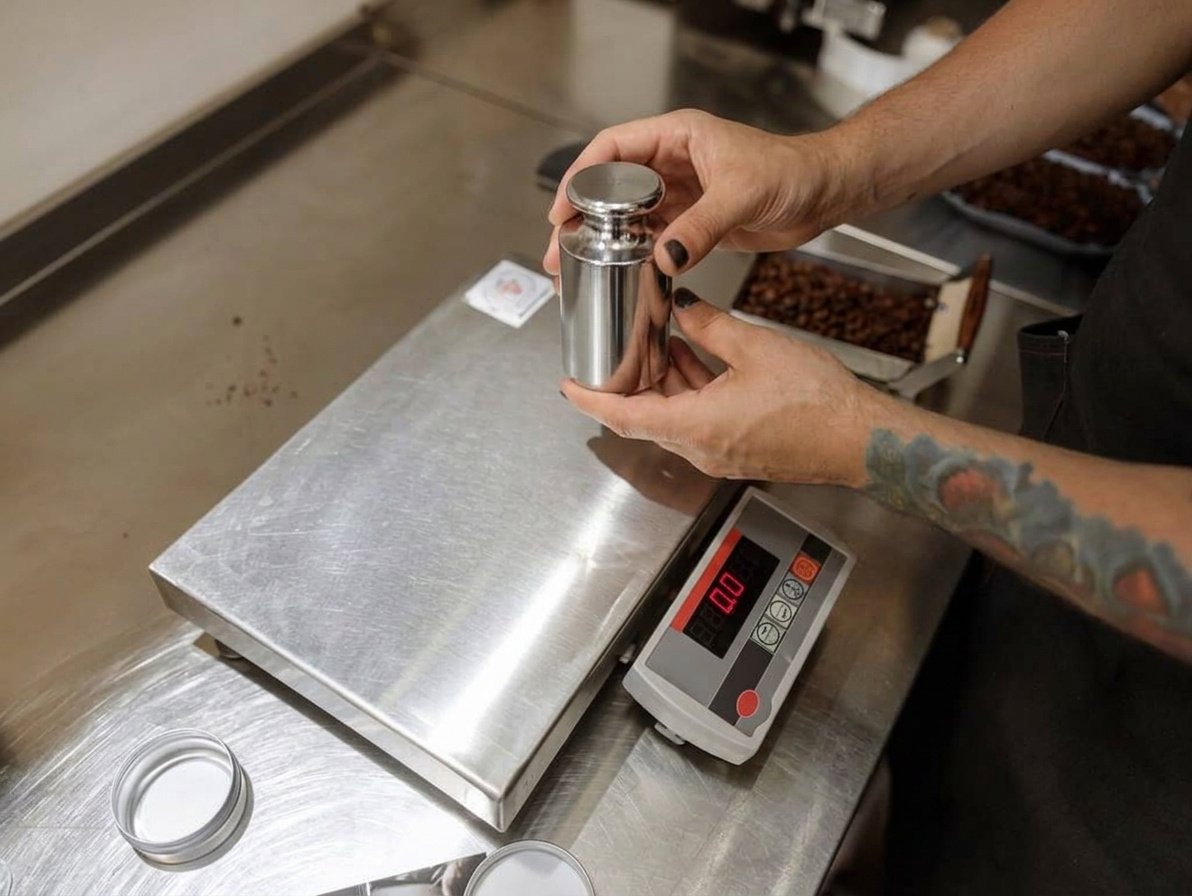
In-house verification is the daily or weekly practice of placing certified test weights on the scale and confirming the reading is within an acceptable tolerance. It catches gross errors between professional calibrations and is appropriate as an operational check. It does not produce a calibration certificate and does not satisfy legal-for-trade, carrier dispute, or ISO 9001 compliance requirements.
Professional calibration is performed by an accredited technician using NIST-traceable reference weights. It produces a calibration certificate that documents the date, the technician’s credentials, the reference weights used, the found readings before adjustment, and the final readings after adjustment. This certificate is the document that satisfies legal-for-trade compliance, carrier dispute requirements, and any quality management system audit.
Test weights for in-house verification: The test weights used for daily or weekly checks must themselves be calibrated. Uncertified weights produce an unreliable check. For shipping applications, NIST Class F or OIML Class M1 test weights are the appropriate specification. These can be sourced from established scale suppliers and should be recertified on a schedule recommended by the supplier — typically every one to two years.

Building a Calibration Record That Protects You in a Carrier Dispute
A calibration record is only useful as dispute evidence if it is complete, current, and accessible. These are the elements a calibration record must contain to be accepted in a carrier weight dispute.
For each professional calibration event:
- Date of calibration
- Name and credentials of the calibration technician or service provider
- Scale identification — serial number, model, and location
- Reference weight specifications used — NIST Class F or equivalent
- Found readings before calibration adjustment (as-found data)
- Final readings after calibration adjustment (as-left data)
- Pass/fail determination against NIST Handbook 44 tolerances
- Technician signature and service provider contact information
Retention period: Retain calibration certificates for a minimum of three years. Carrier disputes and audit requests can reference shipments from several months prior. A calibration record that has been discarded cannot be reconstructed.
Accessibility: Store calibration certificates at the packing station or in a location accessible to the team member who handles carrier disputes. A certificate that cannot be produced promptly when a dispute is filed provides no practical protection.
Daily verification log: Maintain a simple log of daily or weekly in-house verification checks — date, test weight used, scale reading, and pass/fail. This log supplements the professional calibration certificate and demonstrates continuous operational monitoring between formal calibration events.
SOLAS VGM Calibration Requirements
For operations using shipping scales to comply with SOLAS VGM regulations — the mandatory container weight verification requirement for sea exports — calibration documentation carries additional significance. As covered in our article on SOLAS VGM compliance, every individual weighing event under Method 2 must be performed on certified and calibrated equipment. The calibration certificate for the scale used in a VGM calculation is supporting documentation for the VGM declaration itself — and must be available for inspection by the carrier, terminal, or competent authority if the declaration is challenged.
For SOLAS VGM applications, quarterly calibration with current NIST-traceable certification is the minimum standard. Annual calibration is insufficient for this application, given the legal consequences of an inaccurate VGM.
FAQs
How often should a shipping scale be calibrated?
There is no single legal interval. Many shipping operations calibrate at least annually, with routine in-house checks between visits. High-volume operations processing over 200 shipments per day should calibrate every three to six months. Any relocation, overload, or impact event requires immediate recalibration regardless of the scheduled interval. High-volume LTL and SOLAS VGM operations often choose quarterly or semi-annual calibration — base the interval on your verification records.
What is the difference between calibration and NTEP certification for a shipping scale?
NTEP certification applies to the scale model — it confirms the design meets NIST Handbook 44 accuracy standards. Calibration applies to the individual unit — it confirms that your specific scale is reading accurately at the time of testing. Both are required for legal-for-trade commercial shipping use. A certified model that is out of calibration is not compliant for commercial transactions.
Do I need a professional calibration certificate to dispute a carrier weight adjustment?
Yes. Carriers require documentation proving your scale was accurate at the time of the disputed shipment. A professional calibration certificate from an accredited service provider is the primary accepted evidence. In-house verification logs support the certificate but do not replace it.
What test weights should I use for daily shipping scale verification?
NIST Class F or OIML Class M1 test weights in denominations appropriate for your scale’s capacity range. The test weights themselves must be calibrated and within their recertification period. Uncertified test weights do not produce a reliable in-house verification check.
Does a shipping scale need to be recalibrated after it is moved?
Yes. Moving a scale — even across the same room — can shift load cell alignment and introduce zero drift. Every relocation requires recalibration before the scale is returned to service. This applies to both bench parcel scales moved between packing stations and floor scales repositioned on the shipping dock.
Conclusion
A shipping scale calibration program has two functions: keeping weights accurate enough to avoid carrier adjustments, and maintaining the documentary record that allows you to dispute the adjustments that still arrive despite your best efforts.
Annual professional calibration with a NIST-traceable certificate, supplemented by daily or weekly in-house verification checks, satisfies both functions for most commercial shipping operations. High-volume, LTL freight, and SOLAS VGM applications require more frequent professional calibration — quarterly at a minimum. Every relocation or impact event triggers immediate recalibration regardless of schedule.
The calibration certificate is worth more than its face value. It is the evidence layer between your declared weight and the carrier’s post-delivery measurement — and without it, every weight dispute starts from a losing position.
Sources
- NIST Handbook 44 (2026), Section 2.20 Scales — nist.gov
- UPS and FedEx service guides (2026), billable weight rounding — ups.com, fedex.com
- NIST Handbook 105-1, Class F field standards — nist.gov
Last reviewed September 2026 by the Scale Blog editorial team. Calibration intervals are suggestions; set yours from your own verification records and any customer or regulatory requirements.