









A parcel scale is a digital weighing instrument designed specifically to measure the weight of packages, parcels, and mail items before dispatch. It sits at the point in the shipping workflow where weight is captured — the packing station, the mailroom counter, the shipping department bench, or the receiving dock — and produces the weight reading that determines carrier billing, postage cost, and label accuracy.
The term “parcel scale” is used to describe instruments ranging from compact postal scales that weigh letters to the nearest tenth of an ounce, all the way to heavy-duty bench scales that handle 300 lb industrial cartons. Understanding which type fits your operation — and what separates a well-specified parcel scale from one that generates daily friction — is the purpose of this guide.
Table of Contents
What a Parcel Scale Does
A parcel scale performs one essential function. It converts the physical weight of a package into an accurate digital reading. That reading is then used for one or more of the following:
- Calculating the correct postage for a USPS, UPS, FedEx, or DHL shipment
- Feeding weight data directly into carrier shipping software to generate a label
- Verifying that an outbound package matches its declared weight before dispatch
- Checking that inbound packages match the weight declared on the supplier’s documentation
- Determining which carrier service or rate tier applies to the package
Every one of these applications depends on the same thing: an accurate weight reading from a calibrated instrument, taken on the fully sealed package, before the label is printed.
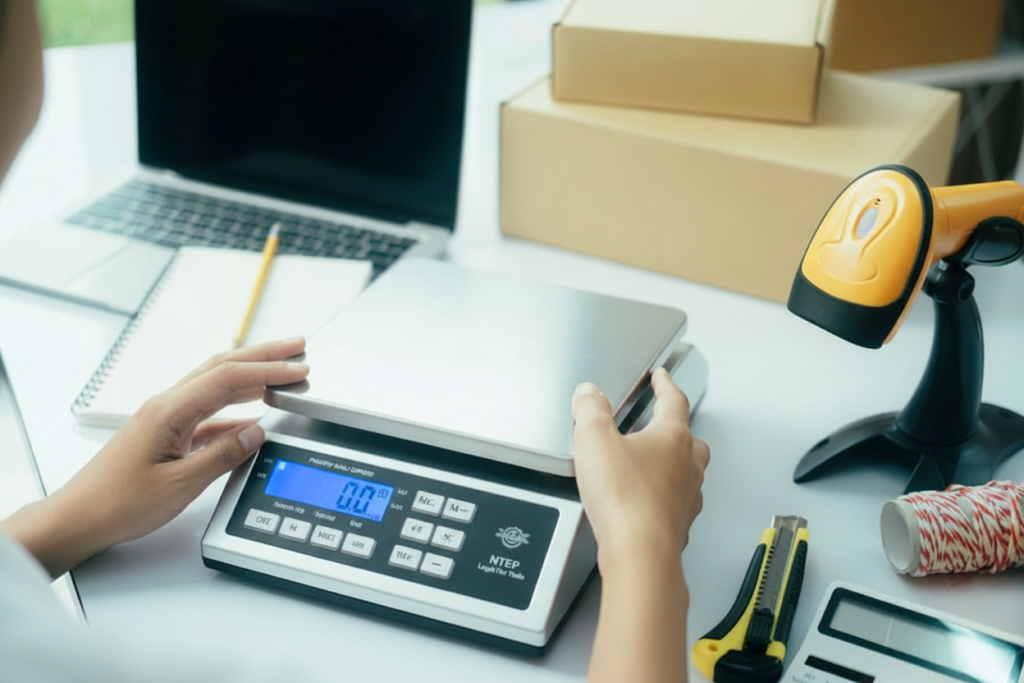
Parcel scales are built for logistics-related weighing operations, including receiving, packing, shipping, mailing, and manifesting. They are designed to accurately and promptly weigh all forms of letters, documents, packages, and parcels.
Where Parcel Scales Are Used
Parcel scales appear across a wider range of business environments than most people assume. The most common are:
E-commerce fulfillment centers — High-volume packing stations where every outbound package must be weighed before a label is generated. USB-connected parcel scales feed weight directly into ShipStation, UPS WorldShip, or FedEx Ship Manager, eliminating manual entry.
Corporate mailrooms — Outgoing correspondence, internal shipments, and regulatory documents all require accurate postage. A parcel scale at the mailroom counter ensures each item is weighed correctly before metering or label printing.
Warehouse shipping and receiving departments — Both outbound and inbound applications. Outbound: verifying package weight before carrier pickup. Inbound: checking that delivered pallet-level and carton-level weights match purchase order documentation.
Retail shipping stores and postal counters — Public-facing locations where customers pay for shipping based on the scale reading. These applications require NTEP-certified scales — the weight reading is a legal-for-trade transaction.
Manufacturing and production facilities — Finished goods verification before palletizing, component weight checking for outbound freight, and production output weighing at the end of a production line.
Healthcare and laboratory facilities — Specimen shipments, reagent packages, and medical supply dispatches all require accurate weight documentation for regulatory compliance.
Types of Parcel Scales
Not all parcel scales are the same instrument. The type determines the workflow it fits and the applications it handles.
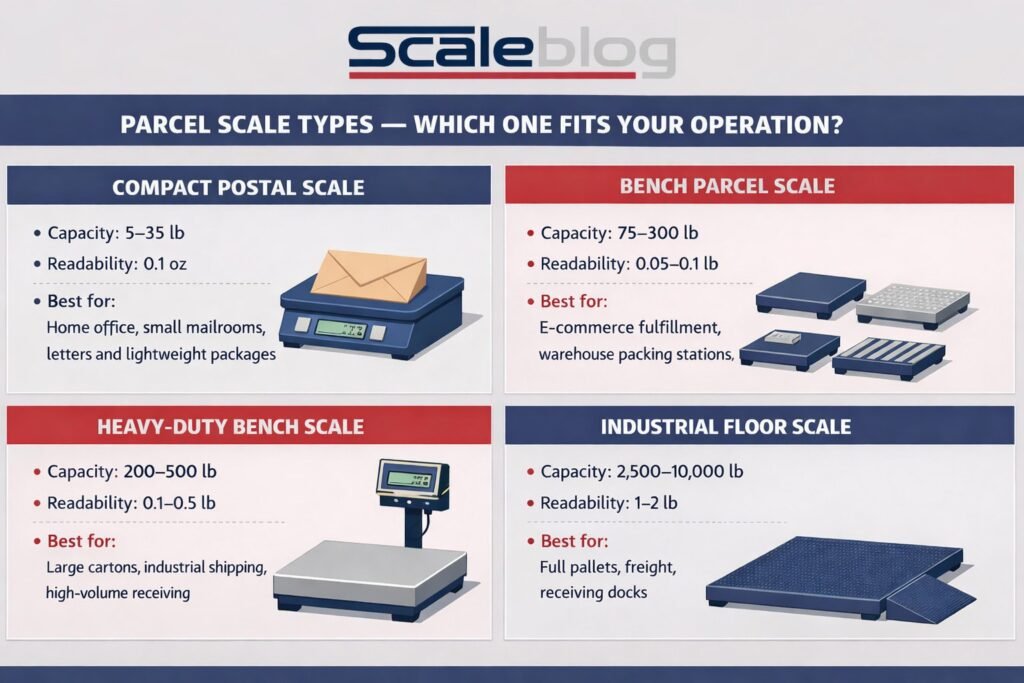
Compact Postal Scale (Light-Duty)
Designed for letters, padded mailers, and lightweight packages. Capacity ranges from 5 lb to 35 lb. Readability to 0.1 oz — useful because USPS prices First-Class Mail letters and flats by the ounce and prices lightweight USPS Ground Advantage parcels in ounce-based tiers.
These are the scales found on residential home office desks and in small office mailrooms. They are not suitable for e-commerce fulfillment or warehouse applications where packages regularly exceed 20 lb.
Bench Parcel Scale (Mid-Range — Most Common)
The standard instrument at most business packing stations and shipping departments. Capacity ranges from 75 lb to 300 lb. Readability of 0.05–0.1 lb — sufficient for UPS and FedEx billing, which rounds to the next whole pound.
Central Carolina Scale — an established US scale dealer — identifies three platform surface designs that matter at this capacity range:
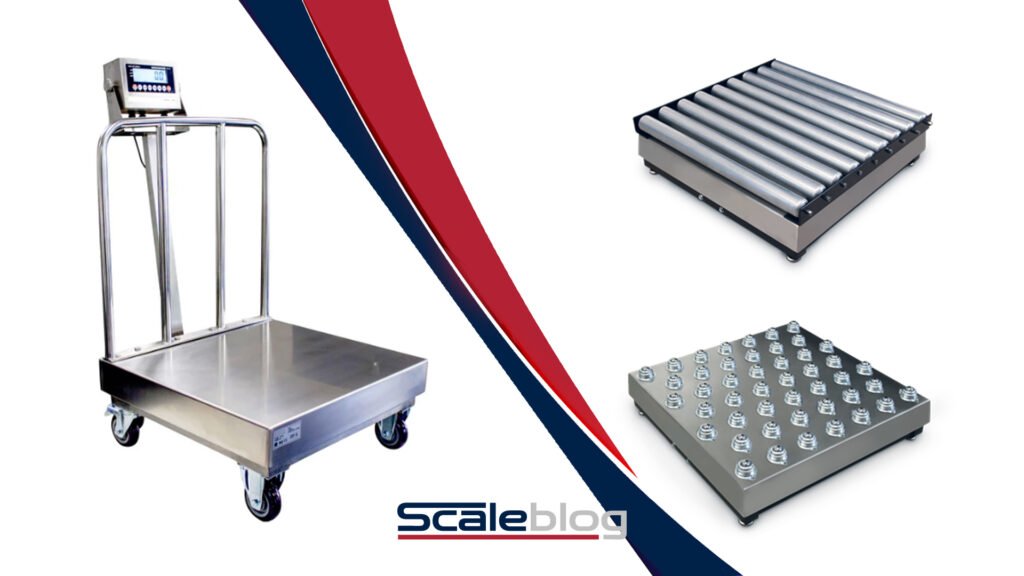
Flat top — A smooth, stable platform. The standard for most parcel weighing applications. Packages are placed directly on the surface. Easy to clean. Provides the most stable surface for accurate readings.
Ball top — A platform embedded with small, free-moving balls. Packages glide across the surface with minimal effort. Useful at high-volume stations where operators need to reposition packages for scanning, labeling, or barcode reading without lifting.
Roller top — A platform with free-spinning rollers. Packages slide on and off with very low friction. Particularly efficient at stations where packages arrive from a conveyor or must be moved to an adjacent conveyor after weighing.
Most manufacturers — including Mettler Toledo — offer their core parcel scale models in all three platform configurations. The underlying weighing mechanism and accuracy are identical across configurations. The platform surface type is a workflow efficiency decision, not an accuracy decision.
Heavy-Duty Bench Scale (High-Capacity)
For operations shipping cartons above 150 lb — bulk supply shipments, industrial components, consolidated freight. Capacity ranges from 200 lb to 500 lb with platforms sized at 18″ × 18″ or larger to accommodate oversized cartons. These instruments bridge the gap between a standard parcel scale and a full floor scale.
Industrial Floor Scale
When packages exceed 500 lb — or when the item to be weighed is a full pallet — the application moves beyond a parcel scale to an industrial floor scale. For full guidance on specifying the right floor scale for receiving and shipping dock applications, see our article on how to choose a floor scale for your warehouse or factory.
Key Features to Specify on a Parcel Scale
Capacity and Readability
Match capacity to your heaviest regular package with a 20–25% safety margin above it. Match readability to your carrier’s billing increment.
For USPS First-Class Mail and lightweight Ground Advantage parcels — specify 0.1 oz readability. For UPS and FedEx parcels — specify 0.05–0.1 lb readability. For heavy-duty carton weighing — 0.1–0.5 lb readability is appropriate.
Hogentogler — a major US industrial distributor — notes that multi-range parcel scales automatically adjust resolution based on weight. For example, 0.01 lb resolution up to 30 lb, then 0.1 lb above. This handles operations with a wide mix of package weights without specifying separate instruments for different weight ranges.
Platform Size
The platform must fully support every package you regularly weigh without overhang. A package that overhangs the platform transfers force to the bench surface rather than the load cells — producing a reading that is lower than the actual weight.
- 10″ × 10″ to 12″ × 14″ — standard for most e-commerce parcel weights
- 14″ × 14″ to 16″ × 20″ — for larger cartons and oversized packages
- 18″ × 18″ to 21″ × 21″ — for heavy-duty bench scale applications
Software Connectivity
A parcel scale without direct software connectivity requires manual weight entry. Manual entry is the primary source of weight discrepancies that generate carrier invoice adjustments. Specify USB connectivity as the minimum standard for any scale used at a computer-based packing station.
Transcell — a US scale manufacturer — produces the PC-150, an NTEP-certified 150 lb bench parcel scale that interfaces with UPS WorldShip and FedEx Ship Manager via both USB and RS-232 ports as standard. This dual-connectivity approach covers both modern USB-based shipping software installations and legacy RS-232-based systems.
Confirm that the specific model you are considering is listed as compatible with your shipping software before ordering. USB connectivity does not guarantee compatibility — the scale must be listed as supported by your specific software platform and version.
NTEP Certification
NTEP certification is required when the weight your parcel scale produces is used in a legal-for-trade transaction — when a customer pays for shipping based on the scale’s reading, or when a carrier charges you based on that reading and you pass the cost to a customer.
For internal use — production verification, receiving checks, or cost estimation — NTEP certification is not legally required. For any public-facing or commercial transaction application, specify an NTEP-certified model and verify the Certificate of Conformance number in the NCWM NTEP database before purchase.
Durability Features
Parcel scales operate in demanding environments. Packing stations accumulate dust, tape residue, dropped packages, and spilled labels. Specify scales with:
- Sealed or protected keypad — tape residue and moisture penetration are the most common failure points on indicator keypads
- Overload protection — prevents load cell damage when a package is dropped onto the platform
- Adjustable leveling feet — ensure accurate readings on imperfectly level bench surfaces
- Non-slip feet — prevent the scale from shifting under repeated package placement
For operations in food, pharmaceutical, or washdown environments, see our article on IP ratings for industrial scales explained to understand what IP rating the indicator and platform require for your specific environment.
Parcel Scale vs Shipping Scale — Is There a Difference?
The two terms are used interchangeably in most catalog listings and in most shipping department conversations. There is no meaningful technical distinction between them. Both refer to the same category of instrument: a digital weighing scale designed for package and parcel weighing at a packing station, mailroom, or shipping department.
The term “postal scale” is sometimes used to describe lighter-duty instruments designed primarily for letter and small-parcel weighing. The term “parcel scale” tends to be applied to mid-range and heavy-duty instruments used in higher-volume commercial applications. In practice, these are distinctions of application range rather than instrument type.
For a full explanation of how any shipping scale works at the component level — including load cell mechanics, signal processing, and tare function — see our article on what is a shipping scale and how does it work.
Parcel Scale Quick Selection Guide
| Operation Type | Capacity | Readability | Platform | Connectivity | NTEP |
|---|---|---|---|---|---|
| Home office / occasional shipping | 10–35 lb | 0.1 oz | 6″–10″ | Optional | Optional |
| Small e-commerce — under 50 shipments/day | 35–75 lb | 0.1 oz | 10″×10″ | USB | Recommended |
| Mid-volume e-commerce fulfillment | 75–150 lb | 0.05 lb | 12″×14″ | USB | Recommended |
| Public shipping counter/mailbox store | 150–300 lb | 0.1 lb | 16″×20″ | USB + RS-232 | Required |
| Public shipping counter / mailbox store | 150 lb | 0.05 lb | 12″×14″ | USB | Required |
| Corporate mailroom | 75–150 lb | 0.05–0.1 lb | 12″×14″ | USB | Required |
| Heavy industrial cartons | 200–500 lb | 0.1–0.5 lb | 18″×18″+ | RS-232 / Ethernet | Required |
Common Mistakes When Buying a Parcel Scale
Choosing by price alone — A low-cost scale without software connectivity requires manual entry on every package. The labor cost and adjustment cost of manual entry errors exceed the price difference within a few weeks of high-volume operation.
Under-specifying capacity — A 150 lb scale used for packages up to 140 lb operates near its rated maximum. Load cells degrade faster. Accuracy at the top of the range decreases. The correct specification adds a 20–25% safety margin above the heaviest package.
Ignoring platform size — A 12″ × 14″ platform does not fit a 16″ × 16″ carton without overhang. The package overhang produces systematically low readings. Measure your largest regular package before specifying the platform.
Buying a non-NTEP model for a legal-for-trade application — If your operation charges customers for shipping based on the scale reading, the scale must be NTEP-certified. A non-certified scale in this application creates compliance risk with every transaction.
Skipping calibration on installation — Every parcel scale should be calibrated on the bench where it will be used before the first package is weighed. For full calibration guidance, see our article on warehouse scale calibration: how often and how to do it right.
Conclusion
A parcel scale is the instrument that connects the physical weight of a package to the carrier billing system. Specified correctly — with the right capacity, readability, platform size, software connectivity, and NTEP certification status for the application — it eliminates an entire category of shipping billing errors and carrier invoice adjustments. Specified incorrectly, it creates daily friction at the packing station and generates systematic billing errors on every package that passes through it.
The selection process follows the same logic as any weighing instrument purchase. Start with the application requirements. Match the specification to those requirements. Confirm connectivity with your specific software. Verify NTEP status for the application. Then calibrate on installation and maintain a regular calibration schedule from that point forward.
For guidance on reducing shipping costs through accurate weighing practices at the packing station, see our article on how to reduce shipping costs with accurate package weighing.
FAQs
What is a parcel scale?
A parcel scale is a digital weighing instrument designed to measure the weight of packages, parcels, and mail items before dispatch. It sits at the packing station, mailroom counter, or shipping department bench and produces the weight reading used for carrier billing, postage calculation, and label generation. Parcel scales range from compact postal models for letters and small packages to heavy-duty bench scales for 300 lb industrial cartons.
What is the difference between a parcel scale and a shipping scale?
The two terms are used interchangeably. Both describe a digital weighing scale designed for package and parcel weighing at a packing station, mailroom, or shipping department. The term “postal scale” sometimes describes lighter-duty instruments for letter and small-parcel weighing, while “parcel scale” tends to describe mid-range and heavy-duty instruments for higher-volume commercial applications — but the distinction is one of application range, not instrument type.
Do I need an NTEP-certified parcel scale?
NTEP certification is required when the parcel scale’s weight reading is used in a legal-for-trade commercial transaction — such as when a customer pays for shipping based on the scale’s reading. For internal use only — production verification, receiving checks, or cost estimation — NTEP certification is not legally required. Verify the Certificate of Conformance number in the NCWM NTEP database before purchasing any scale claimed to be NTEP-certified.
What is the difference between flat top, ball top, and roller top parcel scales?
All three platform types deliver identical weighing accuracy — the difference is workflow efficiency. A flat top provides the most stable surface for standard parcel weighing. A ball top allows packages to glide and rotate for repositioning without lifting — useful when scanning barcodes or reading labels after weighing. A roller top allows packages to slide on and off with very low friction — efficient at stations where packages arrive from or move to a conveyor after weighing.
What capacity parcel scale do I need?
Identify your heaviest regular package and add 20–25% as a safety margin. Most mid-volume e-commerce operations are served by a 75–150 lb capacity model. High-volume fulfillment and warehouse shipping departments typically need 150–300 lb capacity. For packages above 500 lb, the application requires an industrial floor scale rather than a parcel scale.
Sources
- USPS Domestic Mail Manual and Notice 123 price list (First-Class Mail and Ground Advantage weight tiers; 70 lb maximum) — pe.usps.com
- UPS and FedEx service guides (2026), 150 lb maximum and whole-pound billing — ups.com, fedex.com
- NIST Handbook 44 (2026) and NCWM NTEP database — nist.gov, ncwm.com
Last reviewed September 2026 by the Scale Blog editorial team. Check your shipping software’s supported-scale list before buying.