









A shipping scale is a weighing device used to measure the weight of packages, parcels, and freight before they are handed to a carrier for delivery. Every major carrier — UPS, FedEx, USPS, and freight carriers — bases its shipping charges on the weight of what you send them. If the weight you declare does not match what they measure at their facility, you get billed the difference, often with a handling surcharge added on top. A shipping scale eliminates that gap by giving you the same accurate weight the carrier will use — before the package leaves your building.
Whether you ship five packages a week from a home office or 500 pallets a month from a distribution center, the principle is identical: accurate weight before shipment equals predictable shipping costs.
Table of Contents
What a Shipping Scale Actually Does
A shipping scale does three things that matter commercially.
It gives you the billable weight before the carrier does: Every shipment is charged based on the greater of two numbers: the actual weight of the package on a scale, or the dimensional weight calculated from the package’s length, width, and height. UPS and FedEx both charge whichever is higher — actual or dimensional — on every domestic shipment. If you know your actual weight before shipment, you can compare it against the dimensional weight and choose packaging that minimizes whichever number is higher. Without a scale, you are guessing — and guessing costs money.
It prevents carrier invoice adjustments: When a carrier’s scale produces a different weight than the one on your shipping label, they bill the difference back to you after delivery. These adjustments — sometimes called chargebacks or post-shipment surcharges — are one of the most common and avoidable costs in shipping operations. An accurate scale at the point of packing eliminates the primary cause.
It gives you a verifiable record of what you shipped: A weight record matched to a shipment date and tracking number creates an audit trail. If a carrier’s adjustment does not match your scale record, you have the documentation to dispute it.
How a Shipping Scale Works
At the center of every digital shipping scale is one or more load cells. A load cell is a force transducer — a device that converts mechanical force into an electrical signal proportional to that force. Most shipping scales use strain gauge load cells, which work as follows.
When a package is placed on the scale platform, its weight exerts a downward force on the load cell’s metal body. The metal deforms slightly — too small to see with the naked eye, but precisely measurable. Strain gauges bonded to the load cell body deform along with it. That deformation changes the electrical resistance of the strain gauge, altering the voltage output of a Wheatstone bridge circuit inside the load cell. As Mettler Toledo — the world’s largest weighing manufacturer — explains, this load cell technology delivers static weighing accuracy for routine postal and parcel applications in logistics operations.
The electrical signal from the load cell is amplified and sent to an analog-to-digital converter, which translates the analog voltage into a digital value. That digital value is processed by the scale’s internal microprocessor, calibrated against a known reference, and displayed on the indicator screen as a weight reading in pounds and ounces or kilograms. The entire sequence — from placing the package on the platform to reading the stabilized weight — takes two to three seconds on a properly calibrated scale in normal operating conditions.
Three key functions affect accuracy in daily use
Zero and auto-zero: Before weighing, the scale must read exactly zero with nothing on the platform. Most scales include an automatic zero-tracking function that compensates for minor drift — dust accumulation, temperature change, or residual weight from a previous package that was not fully removed.
Tare: The tare function subtracts the known weight of packaging material — the box, bubble wrap, packing peanuts — from the gross weight reading, displaying only the net weight of the package as the carrier will measure it. For a full explanation of how tare works in practice and why it matters for billing accuracy, see our article on the shipping scale tare function and why it matters.
Hold and peak hold: The hold function freezes the weight reading on the display after the scale stabilizes. This is particularly useful when a large package obscures the view of the indicator screen — the operator places the package, the reading stabilizes, then steps back to read the frozen value.
Types of Shipping Scales
Not all shipping scales are the same piece of equipment. The right type depends on what you are shipping, how heavy it is, and how fast you need to process it.
Postal and Parcel Scales
Postal scales and parcel scales are bench-top units designed for packages up to 150 lb. They are the most common type for small businesses, e-commerce sellers, and mailrooms. Most connect to a computer via USB or Bluetooth, allowing shipping software to read the weight directly — eliminating the manual data entry step and the transcription errors that come with it.
Best for: Online sellers, small businesses, retail stores, and any operation shipping individual packages via UPS, FedEx, or USPS.
Typical capacity: 5 lb to 150 lb, with readability of 0.1 oz to 0.1 lb depending on the model.
Floor Scales
Floor scales are low-profile platform scales designed for heavier packages and freight that cannot be lifted onto a bench-top scale. They sit at or near floor level, allowing boxes, bundles, and heavy items to be slid or rolled onto the platform for weighing. Desktop parcel scales from manufacturers such as Rice Lake Weighing Systems are purpose-built for shipping applications with NTEP-certified accuracy for legal-for-trade commercial transactions.
Best for: Warehouses, distributors, manufacturers, and any operation regularly shipping packages over 150 lb or multiple items at once.
Typical capacity: 500 lb to 5,000 lb, with platform sizes ranging from 2 ft × 2 ft to 4 ft × 4 ft or larger.
Pallet Scales
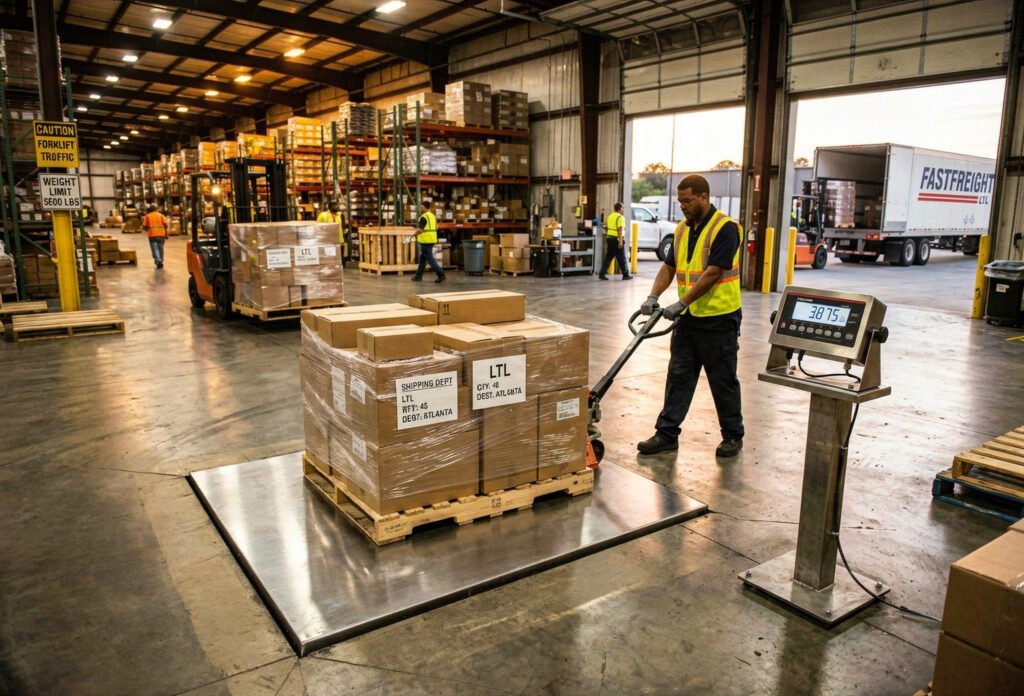
Pallet scales are heavy-duty platform scales designed specifically for weighing loaded pallets before they are wrapped and shipped. They are built with a low-profile platform that makes it easy to slide or fork a pallet into position. For a complete guide to selecting a pallet scale for outbound freight, see our pallet scale buying guide.
Best for: Operations shipping LTL freight where pallet weight determines freight class and shipping cost.
Typical capacity: 2,500 lb to 10,000 lb.
Pallet Jack Scales
A pallet jack scale is a standard pallet jack with a built-in weighing system. The operator moves the pallet with the jack, and the weight is displayed on an indicator mounted on the handle — no separate scale platform required. The pallet is weighed during normal material handling without any additional handling step.
Best for: High-throughput warehouses and distribution centers where weighing every pallet individually on a separate scale would slow operations.
Typical capacity: 2,200 lb to 5,500 lb.
Forklift Scales
A forklift scale mounts directly to the forks or carriage of a forklift. As the forklift lifts a load, the scale reads the weight and displays it to the operator. Like pallet jack scales, forklift scales eliminate a separate weighing step by integrating weighing into the lift cycle. For the complete comparison of pallet jack scales versus forklift scales, see our article on forklift scale vs pallet jack scale.
Best for: Large warehouses and freight operations where loads are moved by forklift as a matter of course.
Typical capacity: Up to 10,000 lb and above, depending on the forklift.
What Makes a Shipping Scale Different From a Regular Scale
A kitchen scale, a bathroom scale, and a shipping scale are all scales — but they are built for completely different requirements. Three specifications separate a commercial shipping scale from a consumer scale.
Accuracy class and legal for trade certification: Any scale used to determine a shipping charge — or any other commercial transaction — must be certified legal for trade under NTEP (National Type Evaluation Program) and approved by the applicable state Weights and Measures authority. The NIST Handbook 44 sets the national accuracy standards that every NTEP-certified scale must meet. The National Conference on Weights and Measures (NCWM) administers the NTEP program and maintains a public registry of all certified scale models. A consumer scale carries no such certification and cannot be legally used for commercial shipping transactions. When evaluating any shipping scale, confirm it carries an NTEP Certificate of Conformance number before purchasing for commercial use.
Tare function: Commercial shipping scales have a reliable tare function that allows the operator to zero out packaging material weight before weighing. Consumer scales often lack this or implement it unreliably.
Connectivity and software integration: Professional shipping scales connect directly to shipping software platforms — ShipStation, Shippo, and carrier-specific tools from UPS WorldShip and FedEx Ship Manager — via USB or Bluetooth. The scale sends the weight reading directly to the shipping label being generated, eliminating manual entry entirely.
What Affects Shipping Scale Accuracy
Several factors support or degrade accuracy in daily use — understanding them prevents the most common shipping weight errors.
Factors that Support Accuracy
Level surface: A shipping scale must sit on a stable, level surface. Load cells measure the vertical component of force. On an unlevel surface, the measured force vector is not perfectly vertical, introducing a systematic error proportional to the degree of tilt. Most scales include adjustable leveling feet and a bubble level indicator for this reason.
Warm-up time: Electronic components including load cells and analog-to-digital converters have operating characteristics that change with temperature. Most quality shipping scales need 5–15 minutes of warm-up time after being powered on in a cold environment before readings fully stabilize.
Centered loading: Single-point load cell scales are most accurate when the package is centered on the platform. Off-center loading introduces bending moments that are not fully compensated by the load cell’s design.
Regular calibration: Load cells drift over time due to mechanical stress, temperature cycling, and normal use. For guidance on how often to calibrate a shipping scale, see our article on shipping scale calibration: how often and what compliance requires.
Factors that Degrade Accuracy
- Vibration from nearby machinery or forklift traffic while the reading is being taken
- Drafts or air currents from HVAC systems, dock doors, or fans directed at the platform
- Overloading — placing packages that exceed the scale’s rated capacity permanently damages load cells
- Debris accumulation under the platform corners, creating a false pre-load that auto-zero does not fully correct
Do You Actually Need a Shipping Scale?
The answer depends on how often you ship and what the consequences of an incorrect weight are for your operation.
You almost certainly need one if:
- You ship more than 10 packages per week via any carrier. At that volume, the accumulated cost of overcharges, carrier adjustments, and time spent disputing billing errors exceeds the cost of a quality shipping scale within weeks.
- You ship freight — packages over 150 lb — via LTL carriers. Freight charges are based on weight and freight class. An incorrect weight triggers an invoice adjustment that typically includes a reclassification fee on top of the weight difference.
- You print shipping labels yourself using any software platform. Every major shipping software integrates with a USB or Bluetooth scale. Entering weights manually adds a transcription error risk to every label.
- You have ever received a carrier invoice adjustment? Recurring adjustments mean your weight declaration process has a systematic error — and a calibrated shipping scale is the most direct fix.
You may not need a dedicated shipping scale if:
- You ship fewer than five packages per month and hand them directly to a carrier retail location for weighing at the counter.
- All your products are identical with a known, consistent weight that you can confidently enter manually without measuring each shipment.
For the vast majority of businesses that ship regularly, a shipping scale is not optional equipment — it is the foundational tool that makes every other part of the shipping process accurate.
What to Look for When Buying a Shipping Scale
Before choosing a specific model, confirm four things:
Capacity: The scale must handle your heaviest shipment. For parcel shippers, 150 lb is sufficient. For freight shippers, you need a floor or pallet scale rated for the full pallet weight, including packaging.
Readability: Carriers calculate charges to the nearest pound or half-pound. A scale with 0.1 lb readability gives you the precision to match carrier measurements. Coarser readability introduces rounding errors that accumulate across high shipment volumes.
NTEP certification: Required for any commercial transaction where weight determines price. Check the scale’s data plate for the NTEP Certificate of Conformance number. The NIST Office of Weights and Measures provides guidance on what certification is required in your state.
Software connectivity: Confirm the scale is compatible with your shipping software before purchasing. Most USB HID-compliant scales work with all major platforms. Bluetooth scales require confirming the specific pairing protocol your software supports.
For a complete step-by-step buying guide covering every specification decision in the right order, see our article on how to choose the right shipping scale for your business.
FAQs
What is a shipping scale used for?
A shipping scale is used to measure the weight of packages and freight before they are handed to a carrier. The weight is used to calculate the correct shipping charge, generate an accurate shipping label, and prevent carrier invoice adjustments that occur when the weight on the label does not match the carrier’s measurement.
How does a shipping scale work?
A shipping scale uses a strain gauge load cell — a force transducer that converts mechanical force into an electrical signal. When a package is placed on the platform, it deforms the load cell’s metal body slightly. Strain gauges bonded to that body change their electrical resistance proportionally. The scale’s electronics amplify, convert, and display that signal as a weight reading. The full process takes two to three seconds.
Do I need an NTEP-certified shipping scale?
Yes, if the weight you record determines a shipping charge or any other commercial transaction. NTEP certification means the scale has been independently tested against NIST Handbook 44 accuracy standards and is approved for legal-for-trade use. A non-certified scale cannot be legally used for commercial shipping transactions in the United States.
What is the difference between a postal scale and a shipping scale?
The terms are often used interchangeably. Technically, a postal scale refers to a scale designed specifically for mail and small parcels up to about 70 lb, while a shipping scale is a broader term that includes parcel scales, floor scales, and pallet scales used across the full range of commercial shipping applications. For most small businesses and e-commerce sellers, a postal or parcel scale handles all their shipping needs.
What capacity shipping scale do I need?
For parcel shipping via UPS, FedEx, or USPS, a scale with a 150 lb capacity covers most needs. For heavier packages or freight, a floor scale with a 500 lb to 2,000 lb capacity is more appropriate. For LTL freight operations weighing full pallets, a pallet scale with 2,500 lb to 10,000 lb capacity is required.
Can I use a regular scale for shipping?
A consumer scale — such as a kitchen or bathroom scale — is not suitable for commercial shipping. Consumer scales are not NTEP certified for legal-for-trade use, typically lack a reliable tare function, and do not connect to shipping software. Using an uncertified scale for commercial shipping is not legally permitted and produces weight readings that carriers will not accept as authoritative.
What affects shipping scale accuracy?
Accuracy is affected by surface level, warm-up time, package centering on the platform, vibration from nearby machinery, air currents, load cell calibration status, and overloading. Regular calibration by a qualified service technician maintains accuracy within the scale’s rated specification over time.
Conclusion
A shipping scale converts the physical weight of a package into a precise digital reading through load cell technology — a process that takes seconds and eliminates the guesswork that leads to carrier invoice adjustments, billing disputes, and overpaid postage.
The type of scale that fits your operation depends on the weight range you handle and where in the workflow the weighing happens — a compact USB-connected bench scale for a packing station, a heavy-duty floor scale for a receiving dock, or a pallet jack scale for mobile weighing across a large distribution floor.
What all configurations share is the same underlying measurement principle, the same accuracy requirements, and the same need for regular calibration to maintain the precision the application demands. If you ship regularly and do not have a calibrated, certified shipping scale at your packing station, you are paying more than you need to on almost every shipment — and you may not know it until the carrier’s invoice adjustment arrives.