







Truck axle weight limits on US Interstate highways are 20,000 lb (9,072 kg) on a single axle, 34,000 lb (15,422 kg) on a tandem axle and 80,000 lb (36,287 kg) gross vehicle weight, unless the Federal Bridge Formula sets a lower limit for a group of axles. States can set different limits on other roads, so always check the route.
| Federal limit (Interstate System) | Maximum weight | Notes |
|---|---|---|
| Single axle | 20,000 lb (9,072 kg) | Applies to each single axle |
| Tandem axle | 34,000 lb (15,422 kg) | Two axles whose centers are more than 40 in and not more than 96 in apart |
| Gross vehicle weight | 80,000 lb (36,287 kg) | Unless the Bridge Formula sets a lower figure |
Those three numbers are only half the story. The Bridge Formula decides how much weight a group of axles can carry based on how many axles there are and how far apart they sit — which is why two trucks at 80,000 lb can be legal and illegal at the same time. The calculator below does the math for you.
Table of Contents
Bridge Formula Calculator
Enter the number of axles in the group you want to check and the distance in feet between the first and last axle of that group. The calculator applies the Federal Bridge Formula, rounds to the nearest 500 lb the way FHWA’s tables do, and caps the result at the 80,000 lb federal gross limit.
Federal Bridge Formula Calculator
Formula: W = 500 × [ (L × N) ÷ (N − 1) + 12N + 36 ], rounded to the nearest 500 lb (FHWA). The whole vehicle is still capped at 80,000 lb, and single (20,000 lb) and tandem (34,000 lb) axle limits still apply. For planning only — state rules and permits can differ.
Check every group that matters, not just the whole truck: for a typical five-axle tractor-semitrailer, that means the steer axle plus drive tandem, the drive and trailer tandems together, and all five axles. Any one group over its limit is a violation, even if the gross weight is under 80,000 lb.
The Federal Bridge Formula Explained
Bridges do not care only about how heavy a truck is — they care how concentrated that weight is. Spread the same load over more axles and a longer wheelbase, and each bridge span feels less of it. The Federal Bridge Formula, published by the Federal Highway Administration (FHWA), turns that idea into a legal limit:
W = 500 × [ (L × N) ÷ (N − 1) + 12N + 36 ]
- W = the maximum overall gross weight on any group of two or more consecutive axles, to the nearest 500 lb
- L = the distance in feet between the outer axles of the group
- N = the number of axles in the group
Worked example: a three-axle group
Take the steer axle and drive tandem of a five-axle tractor-semitrailer, with 20 ft between the first and last of those three axles. So N = 3 and L = 20:
- (L × N) ÷ (N − 1) = (20 × 3) ÷ 2 = 30
- 12 × N = 12 × 3 = 36
- Add 36: 30 + 36 + 36 = 102
- Multiply by 500: 102 × 500 = 51,000 lb
That matches FHWA’s own example, where a 46,000 lb load on those three axles passes comfortably. FHWA’s examples also show how a truck can fail: on a four-axle group with L = 35 ft, the formula allows 65,500 lb, so 68,000 lb on those axles is a violation — even though the whole truck may weigh no more than 80,000 lb.
Quick reference: Bridge Formula results for common spacings
We ran the formula for some typical axle groups so you can sanity-check a configuration at a glance. Every figure below is calculated directly from FHWA’s formula and rounded to the nearest 500 lb:
| Axles in group (N) | Outer axle spacing (L) | Maximum weight on the group |
|---|---|---|
| 3 | 10 ft | 43,500 lb |
| 3 | 14 ft | 46,500 lb |
| 3 | 20 ft | 51,000 lb |
| 3 | 24 ft | 54,000 lb |
| 4 | 20 ft | 55,500 lb |
| 4 | 24 ft | 58,000 lb |
| 4 | 30 ft | 62,000 lb |
| 4 | 35 ft | 65,500 lb |
| 4 | 40 ft | 68,500 lb |
| 5 | 36 ft | 70,500 lb |
| 5 | 40 ft | 73,000 lb |
| 5 | 45 ft | 76,000 lb |
| 5 | 51 ft | 80,000 lb |
| 5 | 55 ft | 82,500 lb → capped at 80,000 lb gross |
Two things jump out. First, a short wheelbase limits you long before the 80,000 lb gross does — a five-axle group needs about 51 ft between its outer axles before the formula reaches 80,000 lb. Second, every extra foot between the outer axles adds roughly 600–750 lb to the allowance (500 × N ÷ (N − 1) per foot), which is why sliding trailer tandems and fifth wheels is part of everyday load planning. For anything unusual, use the calculator above rather than reading between rows.
The 36-foot tandem exception
One exception matters to almost every tractor-trailer. FHWA allows two consecutive sets of tandem axles to carry 34,000 lb each if the distance between the first and last axles of those tandems is 36 ft or more. Without it, FHWA notes, tandems spaced 36 to 38 ft apart would be held to roughly 66,000–67,500 lb.
How Truck Scales Weigh Each Axle
Knowing the limits is one thing; knowing what your truck actually weighs on each axle is another. There are three common ways to get those numbers:
| Scale type | How it works | Gives axle weights? | Legal-for-trade gross weight? |
|---|---|---|---|
| Axle scale | Weighs one axle or axle group at a time while the rest of the truck is off the scale | Yes | No — Mettler Toledo notes summed axle readings are not reliable for legal-for-trade totals |
| Full-length truck scale | The whole vehicle sits on the weighbridge at once | Not on its own | Yes, if certified |
| Multi-platform (sectioned) truck scale | A weighbridge split into two or more sections, with the whole truck on it at once | Yes, per section | Yes, if certified |
Mettler Toledo points out that the weights of individual axle groups will not always add up to the true total, because many variables affect each separate reading. If you sell or buy by weight, you need the whole truck on a certified scale. Our comparison of a farm scale vs a truck scale covers which fits an agricultural operation, and what an NTEP scale is explains certification.
State Truck Axle Weight Limits and Exceptions
Federal limits apply to the Interstate System. Off the Interstate, states set their own axle and gross weight limits, and many states also have grandfathered limits or commodity-specific allowances on certain routes. FHWA notes that designated divisible-load permits may be issued by states under grandfather rights or specific Congressional authorization.
Oversize and overweight permits are a state matter too: FHWA states plainly that the federal government does not issue them. For non-divisible loads — ones that cannot be broken down without losing their purpose or value, or that would take more than eight work hours to dismantle — states may issue permits that set aside the usual axle, gross and Bridge Formula limits.
Bottom line: check your state department of transportation for the routes you run, and check every state you pass through. If you also run into Canada, provincial limits are set separately — contact the transportation ministry of each province on your route.
What Happens If You’re Overweight?
Penalties for breaking truck axle weight limits are set under state law, so the fine schedule, how it scales with the overage and whether you can redistribute the load depend on where you are stopped. What is consistent is the cost of getting it wrong: fines, delays and permits you did not plan for.
The cheapest fix is to know your numbers before you leave the yard. Weigh axle groups after loading, adjust the load or slide the fifth wheel and trailer tandems if needed, and keep the weight tickets with your bill of lading. If you ship LTL as well as truckload, our guide to LTL freight weight and shipping cost explains how weight drives the freight bill, and shippers moving containers by sea should read up on SOLAS VGM weighing requirements.
Checking Axle Weights at Your Own Yard
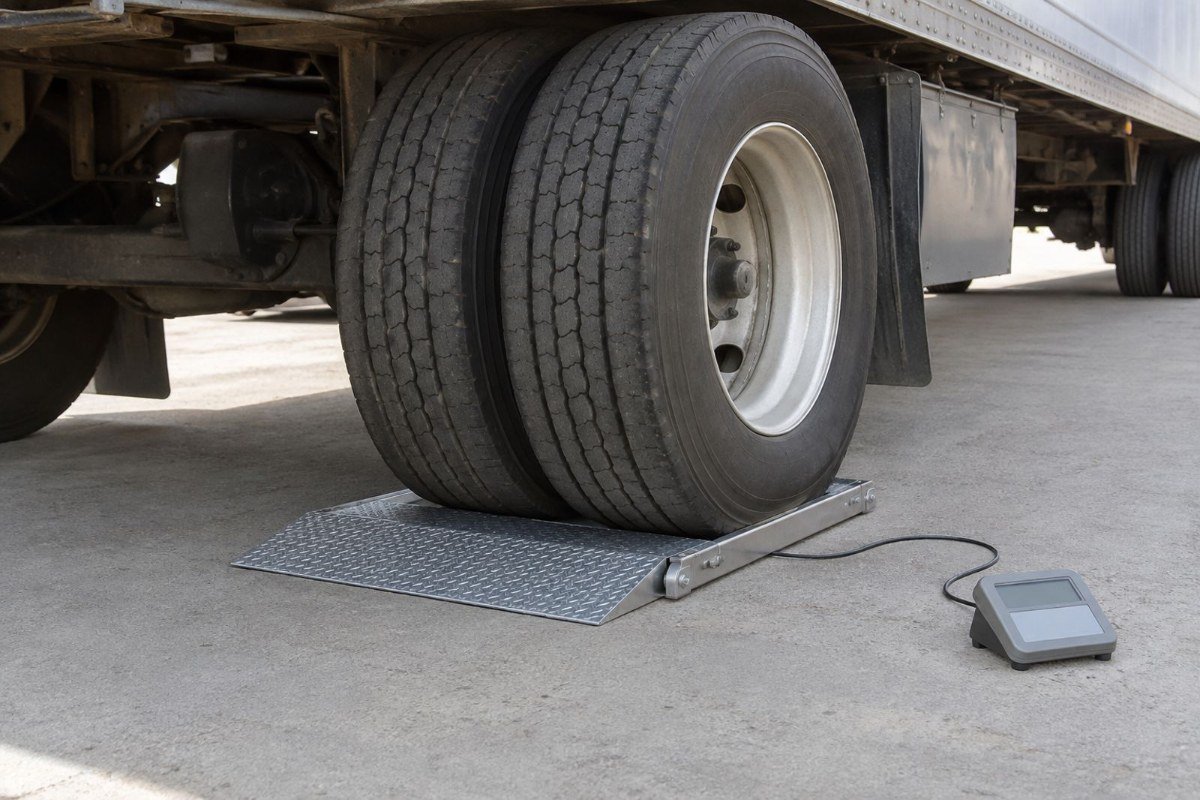
If you load trucks regularly, a portable or permanent axle scale lets you check each axle group before the truck leaves. Remember that axle scales are for checking and load planning; for legal-for-trade gross weights, use a certified full-length or multi-platform truck scale. Our overview of industrial scales covers the wider range. If you need certified gross weights, our guide on how to buy a truck scale covers pit, pitless and portable options.
ScaleBlog may earn a commission if you buy through links on this page, at no extra cost to you. See our affiliate disclosure.
Liberty Scales pick
Liberty LS-80KX Heavy-Duty 12′ Truck Axle Scale
- 80,000 lb capacity, available wired or wireless
- Choose two or four weighbridges and four or eight ramps
- 1/2 in deck plate with eight enveloped shear beam load cells
- LS-7561 multi-channel indicator with ticket printing (date, time, weight)
Note: this is a non-NTEP axle scale — great for load checks, not for legal-for-trade weights.
Use code SCALEBLOG10 for 10% off.
SellEton pick
SellEton SL-AXL-682SP Axle Scale System
- Made in the USA, heavy-duty steel deck with integrated load cells
- 7 ft (60,000 lb), 12 ft (80,000 lb) and 10 × 10 ft (60,000 lb) models
- Rice Lake 682 Synergy Plus indicator: stainless steel, IP69-rated, 5 in color display
- For agriculture, trucking, construction and waste operations
Best for: yards that want a permanent-duty axle scale with a premium indicator.
Use code SCALEBLOG10 for 10% off.
Frequently Asked Questions
What is the axle weight limit?
On the US Interstate System, the federal limit is 20,000 lb for a single axle and 34,000 lb for a tandem axle (two axles more than 40 in and not more than 96 in apart), with an 80,000 lb gross vehicle limit. Groups of axles are also limited by the Federal Bridge Formula. States can set different limits on non-Interstate roads.
How much weight can a semi carry per axle?
On the Interstate, each tandem on a five-axle tractor-semitrailer can carry up to 34,000 lb when the two tandems are at least 36 ft apart. Two full tandems total 68,000 lb, which leaves about 12,000 lb for the steer axle within the 80,000 lb gross limit — as long as every axle group also passes the Bridge Formula. Tire, axle and suspension ratings can be lower than the legal limit, so check those too.
How much weight per axle is legal in Canada?
Axle and gross weight limits in Canada are set by each province and territory, not by the US federal rules, and they differ from the US figures. Check with the transportation ministry of every province on your route before you load.
How much weight can a 7,000 lb axle carry?
A 7,000 lb axle is rated by its manufacturer to carry up to 7,000 lb. Stay within the lowest of the axle, tire and wheel ratings, as well as any legal limits for the road you are on.
Why do axle scale readings not add up to my gross weight?
Weighing one axle group at a time is affected by many variables, so the sum of separate axle weights is not a reliable legal-for-trade total, according to Mettler Toledo. For a certified gross weight, the whole truck needs to be on a certified scale at once.
Sources
- Federal Highway Administration — Bridge Formula Weights
- Federal Highway Administration — Oversize/overweight permits (Freight Management and Operations)
- Mettler Toledo — Legal-for-trade axle weighing
- Liberty Scales — LS-80KX truck axle scale specifications
- SellEton — SL-AXL-682SP axle scale system specifications
Last reviewed October 2026. This article is general information, not legal advice — confirm limits with the state DOT for your route.