








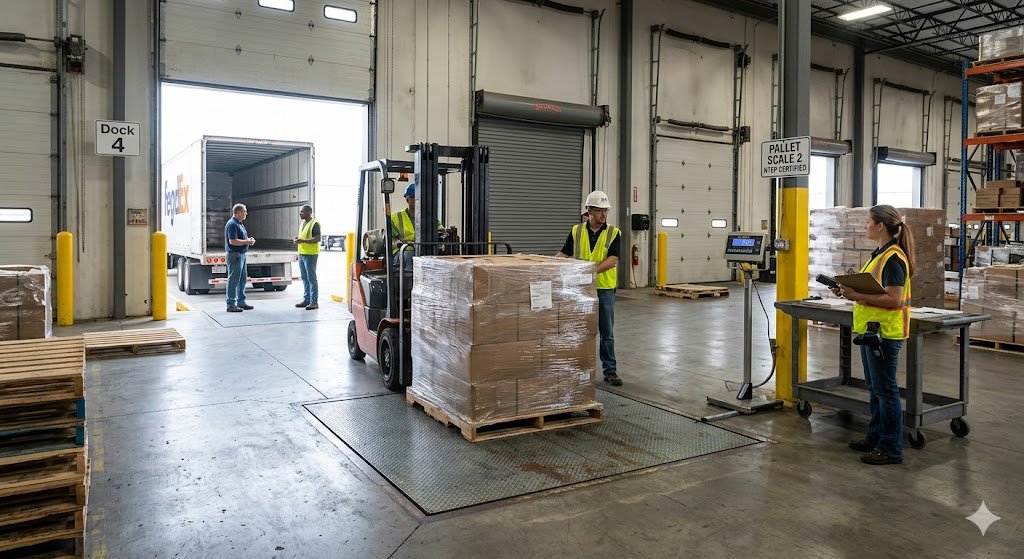
Weighing a pallet before it ships is not the same as weighing a pallet for inventory or receiving. The requirements are different, the consequences of an inaccurate weight are different, and the scale specifications that matter are different. A pallet scale in a shipping application must produce a weight that matches — within tolerance — the weight a carrier will measure at their terminal. If it does not, the difference becomes a freight adjustment: a corrected invoice that includes the weight discrepancy charge, a potential freight class reclassification, and an inspection surcharge. This guide is written specifically for shipping applications — outbound freight, LTL shipments, and Bill of Lading weight declaration — where pallet weight accuracy has a direct commercial consequence on every shipment.
Table of Contents
Step 1 — Understand What You Are Actually Weighing
Before specifying a scale, establish exactly what components will be on the platform when you weigh a pallet for shipment. This is not a trivial step. The most common cause of freight weight adjustments is not an inaccurate scale — it is an incomplete weight declaration that omits components the carrier will include in their measurement.
Every outbound pallet weight must include:
- The goods themselves — all units, cases, or containers in the shipment
- All inner and outer packaging — boxes, bags, foam, wrapping, corner boards
- The pallet — a standard 48″ × 40″ wooden stringer pallet weighs 35–70 lb, depending on condition; a plastic pallet weighs 30–50 lb
- All stretch wrap applied after weighing invalidates the measurement — stretch wrap must be applied before the pallet goes on the scale, or its weight must be added manually
- Banding, dunnage bags, and any other load-securing materials
The weight declared on the Bill of Lading must reflect the complete, ready-to-ship unit as the carrier will receive it. Weigh the pallet after it is fully built, wrapped, and secured — not before.
Step 2 — Determine the Right Capacity
Pallet scale capacity for a shipping application follows the same principle as any scale: specify at least 20–30% above your maximum expected pallet weight. Operating a scale consistently near its rated capacity accelerates load cell wear and degrades accuracy at the top of the weighing range.
Capacity selection guide for outbound freight:
| Pallet Type | Typical Loaded Weight | Recommended Scale Capacity |
|---|---|---|
| Light consumer goods — e-commerce | 200–800 lb | 2,500 lb |
| Standard mixed freight | 500–1,500 lb | 2,500–5,000 lb |
| Industrial goods, machinery parts | 1,000–2,500 lb | 5,000 lb |
| Heavy freight — steel, stone, bulk materials | 2,000–4,500 lb | 5,000–10,000 lb |
| Double-stacked or oversize loads | Above 4,000 lb | 10,000 lb |
LTL shipment limits are set by each carrier (commonly somewhere around 10,000–20,000 lb per shipment), but you weigh pallet by pallet. Most loaded pallets fall well under 5,000 lb; choose 10,000 lb capacity only if you regularly ship very heavy or double-stacked pallets. For operations with consistently lighter pallets — consumer goods, food products, packaged retail — a 5,000 lb model provides adequate headroom at lower cost.
Step 3 — Platform Size and Loading Method
Platform size determines whether your pallet sits fully on the scale or overhangs the edge. An overhanging pallet transfers part of its weight through the overhang to the floor rather than through the load cells. The result is a weight reading that is systematically lower than the true pallet weight — and lower than what the carrier will measure at their terminal.
Platform size requirements:
- A standard GMA pallet (48″ × 40″) requires a platform of at least 48″ × 48″ (4 ft × 4 ft) to ensure all four corners sit within the weighing surface.
- A 60″ × 60″ (5 ft × 5 ft) platform provides additional margin for non-standard pallet sizes. It is recommended for operations using a pallet jack to roll the pallet onto the scale — the extra width accommodates the full pallet jack fork length without risk of the jack wheels riding off the back edge.
- Euro pallets (47.2″ × 47.2″) fit comfortably on a 48″ × 48″ platform.
- For double-stacked loads or oversized freight, a 4 ft × 6 ft platform is the appropriate minimum.
Loading method and profile height:
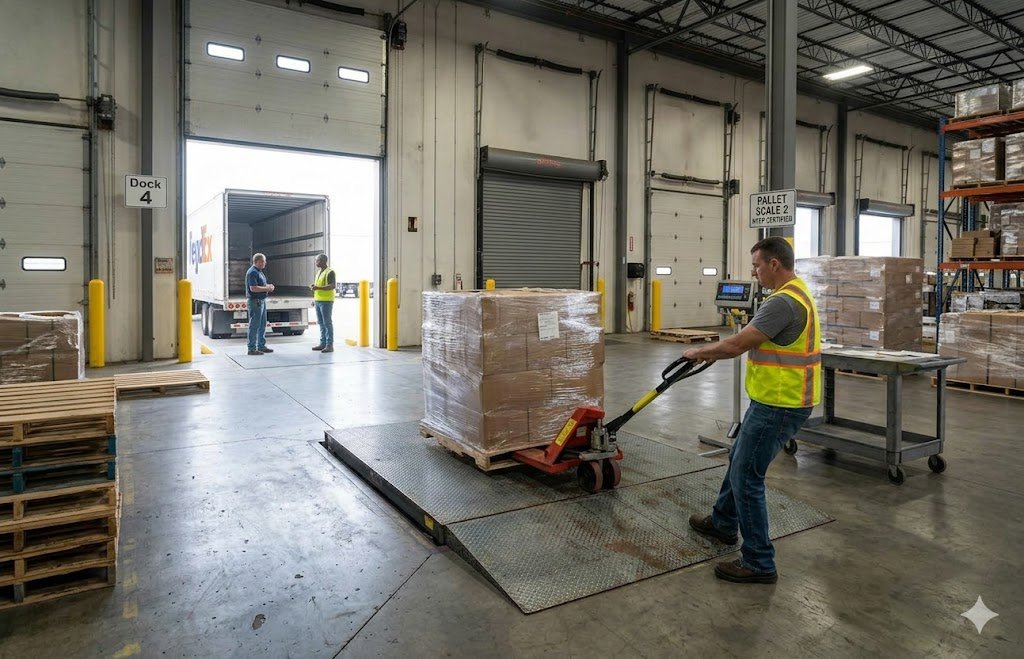
The pallet scale must be accessible to the equipment used to move pallets in your facility. Most fixed pallet scales sit 3.5–5.5 inches above the floor level. A standard pallet jack requires approach ramps to bridge this height. Confirm whether ramps are included with the scale or purchased separately — ramps add to the floor footprint and must be accounted for in dock space planning.
If loading by forklift, confirm the platform height is compatible with fork clearance — forks must slide under the pallet without contacting the scale frame. For operations moving pallets by pallet jack as a primary workflow, a pallet jack scale — which integrates weighing into the jack itself — may be a more efficient solution. See our article on what a pallet jack scale is and how it works for the full comparison.
Step 4 — NTEP Certification for Freight Billing Applications
NTEP certification is legally required when the scale reading determines a price or charge you bill — for example, freight or goods you invoice by weight. When you only declare weights to a carrier, it is not always a legal requirement, but it is the standard that makes your weights defensible.
NTEP is required (or strongly advisable) for your pallet scale if:
- You re-bill freight charges to your customers based on the weight (and, in practice, whenever you want BOL weights you can defend against carrier reweighs)
- The weight is used to bill a customer for goods sold by weight
- The weight is used in a freight quote that becomes a commercial agreement
NTEP is not required if:
- The scale is used only for internal inventory tracking or production monitoring
- The weight is used as an estimate only, and the carrier’s certified scale provides the final billing weight
For most shipping docks, an NTEP-certified, regularly calibrated scale is the right choice: it is legally required if you bill anyone by weight, and certified, documented weights are far stronger evidence when you dispute a carrier adjustment. Verify the Certificate of Conformance (CC) number on the scale’s data plate before purchasing for any freight billing application.
Step 5 — Readability for LTL Freight Applications
LTL freight carriers bill to the nearest pound. A pallet scale with 0.5 lb or 1 lb readability is entirely adequate for LTL freight billing accuracy — fine enough to match carrier measurements without the unnecessary cost of sub-pound readability at pallet weights.
More important than readability in this application is repeatability — the scale’s ability to produce the same weight reading for the same loaded pallet across multiple measurements. A scale that reads 1,247 lb, then 1,251 lb, then 1,249 lb for the same unchanged pallet is not producing a reliable measurement regardless of its stated readability. Repeatability is determined by load cell quality, platform rigidity, and installation stability — not by the number of decimal places on the display.
Repeatability standard for shipping applications: The weight of the same pallet measured three consecutive times without repositioning should not vary by more than 1 lb on a properly installed, calibrated pallet scale. If it does, the cause is one of three things: platform flex under load, load cell imbalance, or an unstable installation surface.
Step 6 — Platform Construction and Environmental Specification
A pallet scale on a shipping dock faces conditions that are fundamentally different from a laboratory or retail environment. Forklift traffic, dropped loads, moisture from dock exposure, and temperature cycles from open dock doors all affect scale performance over time.
Platform construction specifications for shipping dock use:
- Reinforced steel deck: The platform must resist deck deflection under dynamic loading — pallets dropped onto the scale, forklift approach, and side-loading from a pallet jack. A platform that flexes under load shifts force away from the load cells, producing a low reading. Confirm the deck is fully welded and reinforced.
- Load cell protection: Load cells in a dock environment are exposed to moisture, forklift impacts, and cleaning chemicals. Specify load cells with a minimum IP67 rating — fully sealed against water and dust ingress. For cold storage or washdown dock applications, specify stainless steel load cells.
- Junction box rating: The junction box — which combines the signals from multiple load cells — must be rated NEMA 4X for any dock environment exposed to rain, cleaning water, or high humidity. An unrated junction box corrodes within one season in a wet dock environment.
- Adjustable leveling feet: A scale that cannot be leveled on an uneven dock floor will not produce accurate weights. Confirm that the model specifies adjustable leveling feet with sufficient range to accommodate typical dock floor irregularities.
Step 7 — Indicator and Connectivity for Shipping Operations
The scale indicator — the display and control unit — determines how weight data moves from the scale to your shipping documents and systems.
For manual shipping operations: A basic indicator with a large backlit display, tare function, and RS-232 or USB output for printing weight tickets is sufficient. Most carrier-compliant BOL workflows require a printed weight record — confirm the indicator can drive a label or ticket printer.
For integrated shipping operations: An indicator with Ethernet or Wi-Fi connectivity allows the pallet weight to feed directly into a Transportation Management System (TMS) or Warehouse Management System (WMS), populating the BOL automatically and eliminating manual weight entry. This is the most effective way to eliminate the transcription errors that generate freight adjustments at high shipment volumes.
For SOLAS VGM compliance: Operations shipping containers by sea must provide a Verified Gross Mass (VGM) for every container under SOLAS regulations. The scale used for VGM must be NTEP or equivalent certified, and the indicator must produce a printout that meets the carrier’s VGM documentation requirements. Confirm VGM-compliant output with the carrier before selecting the indicator.
Rice Lake Weighing Systems manufactures the RoughDeck series of floor and pallet scales — NTEP-certified platforms built specifically for shipping dock applications, with fully welded reinforced decks, IP67-rated load cells, and indicators with direct TMS/WMS connectivity. The RoughDeck’s structural design minimizes deck deflection under dynamic loading, which is the primary cause of weight inaccuracy in high-throughput pallet weighing environments.
Step 8 — Installation: Fixed vs Portable
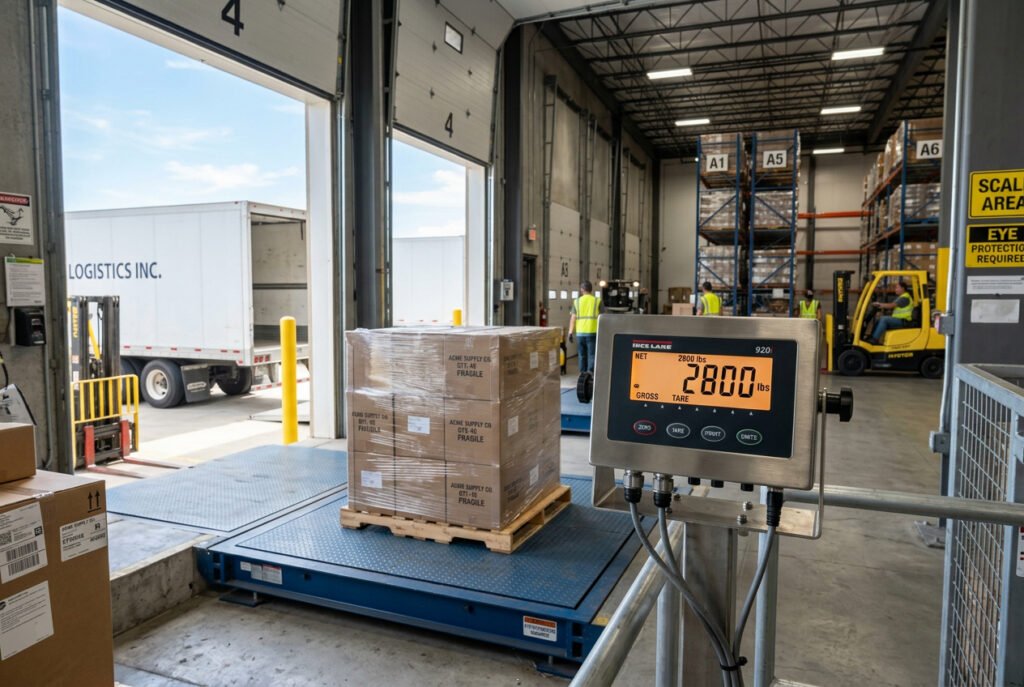
Fixed installation — surface-mounted or pit-mounted — is the standard configuration for dedicated shipping dock scale stations. A surface-mounted scale with approach ramps sits above floor level and requires ramps for pallet jack access. A pit-mounted scale sits flush with the floor — no ramps required, cleaner workflow, and no trip hazard — but requires concrete pit construction.
Portable pallet scales — U-frame designs that slide under a pallet wherever it sits — eliminate the fixed station requirement entirely. They are the practical solution for operations that weigh pallets in multiple locations, have limited dock space, or do not have the infrastructure for a fixed installation. Trade-offs include slower weighing speed and lower maximum capacity than fixed floor scales.
For operations regularly weighing above 6,000 lb, or where shipment volume is high enough to justify a dedicated scale station, a fixed surface-mounted floor scale with approach ramps is the appropriate solution. For lighter, more variable operations, a portable pallet scale or pallet jack scale provides sufficient accuracy at lower infrastructure cost.
FAQs
What size pallet scale do I need for LTL shipping?
For standard LTL freight operations, a 48″ × 48″ platform with 5,000 lb capacity covers the majority of pallet sizes and weights. If you ship pallets above 2,500 lb regularly, or use a pallet jack to load the scale, a 60″ × 60″ platform with 10,000 lb capacity provides the deck area and headroom needed for safe, accurate weighing.
Does a pallet scale used for freight billing need to be NTEP certified?
If you bill anyone based on the weight (for example, re-billing freight to customers), yes — the scale must be NTEP-certified and legal for trade. For weights you only declare to a carrier on a Bill of Lading, NTEP is not always legally required, but it is strongly recommended because carriers bill on their own certified reweighs. Verify the Certificate of Conformance number before purchasing.
How accurate does a pallet scale need to be for LTL freight?
LTL carriers bill to the nearest pound. A pallet scale with 0.5 lb or 1 lb readability provides sufficient accuracy for freight billing purposes. More critical than readability is repeatability — the scale should produce the same reading for the same unchanged pallet within 1 lb across three consecutive measurements.
Does stretch wrap weight need to be included in the declared pallet weight?
Yes. The weight declared on the Bill of Lading must reflect the complete ready-to-ship unit, as the carrier will receive and weigh it. Stretch wrap, banding, corner boards, dunnage, and the pallet itself must all be included. The most reliable approach is to weigh the pallet after it is fully built, wrapped, and secured for shipment.
What is the difference between a pallet scale and a floor scale for shipping applications?
A pallet scale is designed specifically for pallet weighing — with a platform sized for standard pallets, low profile for roll-on access, and capacity range matched to freight weights. A floor scale is a broader category that includes pallet-sized platforms and also larger formats for other industrial applications. For outbound LTL freight specifically, a dedicated pallet scale or a floor scale in the 48″ × 48″ to 60″ × 60″ range with the appropriate capacity is an appropriate tool.
Conclusion
A pallet scale in a shipping application must satisfy requirements that go beyond capacity and platform size. It must be NTEP certified for legal-for-trade freight billing. It must be installed and calibrated to produce repeatable weights within the tolerance that prevents carrier adjustments. The platform must be large enough that the full pallet — including all four corners — sits within the weighing surface. And the weight must include every component the carrier will include in their measurement: goods, packaging, pallet, and all securing materials. Get these specifications right before purchase, and the scale pays for itself in the first batch of freight adjustments it prevents.
For operations weighing pallets as part of a broader LTL freight workflow, see our article on how LTL freight weight affects your shipping cost for the full picture of how pallet weight drives freight class and billing.
Sources
- NIST Handbook 44 (2026), Section 2.20 Scales — nist.gov
- NCWM NTEP Certificate of Conformance database — ncwm.com
- NMFTA, National Motor Freight Classification — nmfta.org
Last reviewed September 2026 by the Scale Blog editorial team. Never exceed the rated capacity of the scale, pallet or handling equipment.