








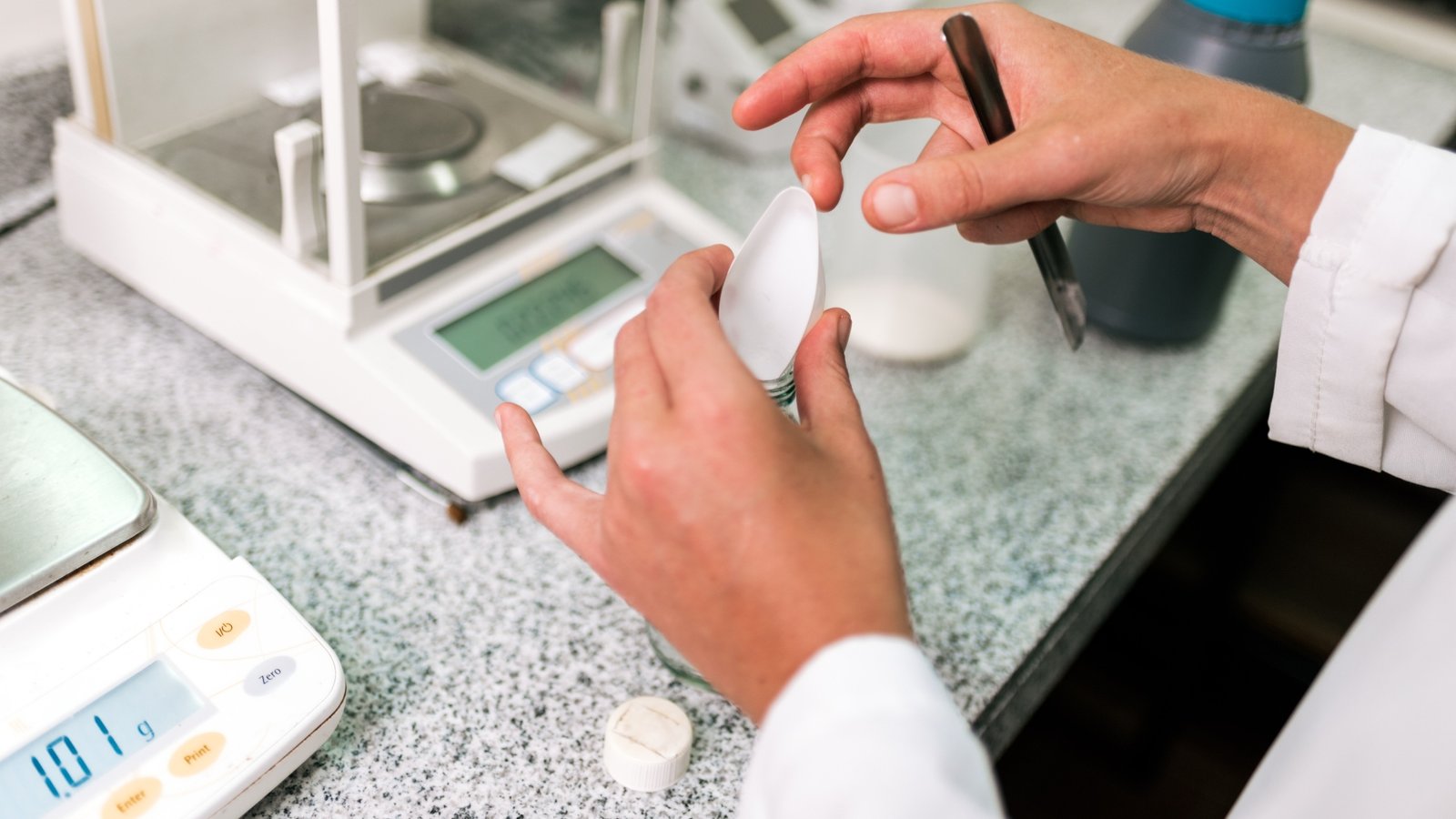
An analytical balance reads to 0.0001 g (0.1 mg). A precision balance reads to 0.001–0.1 g (1–100 mg). If your method requires sub-milligram resolution — quantitative chemical analysis, pharmaceutical weighing, or ISO-accredited work — you need an analytical balance. If not, a precision balance delivers the accuracy you need at significantly lower cost and without the environmental controls an analytical balance demands.
| If you need to weigh… | Use this |
|---|---|
| Reagents to ±0.1 mg for quantitative analysis | Analytical balance |
| Pharmaceutical APIs per USP/EP | Analytical balance |
| Routine solution preparation (±1 mg sufficient) | Precision balance |
| Large samples >500 g | Precision balance |
| General QC and formulation | Precision balance |
| Either could work (0.001 g readability zone) | See overlap section |
The two most common laboratory balances are the precision balance and the analytical balance. They look similar, perform the same fundamental function — measuring mass — and are frequently confused with each other at the point of purchase. The confusion is expensive in both directions. Buying an analytical balance for routine solution preparation and general QC work means paying significantly more for sensitivity that the application does not require, and then managing all the environmental controls that sensitivity demands.
Buying a precision balance for quantitative chemical analysis or pharmaceutical ingredient weighing means producing results with insufficient resolution — results that may be scientifically invalid or regulatory non-compliant. The distinction between the two is well defined. This article covers it completely, so the right instrument is chosen the first time.
Table of Contents
The Single Most Important Difference: Readability
The defining difference between a precision balance and an analytical balance is readability — the smallest increment each instrument can display and resolve.
An analytical balance reads to 0.1 mg (0.0001 g). This is described as a “four-place” balance — it displays results to four decimal places in grams. At this readability, the balance can distinguish between 10.0000 g and 10.0001 g — a difference of one ten-thousandth of a gram. This level of sensitivity is what makes analytical balances the standard instrument for quantitative chemical analysis, pharmaceutical ingredient weighing, and any application where sub-milligram differences in mass are scientifically or commercially meaningful.
A precision balance reads to 0.001 g to 0.1 g (1 mg to 100 mg). This is a “two-place” to “three-place” balance depending on the model. At 0.001 g (1 mg) readability, the finest precision balances approach analytical performance at higher capacities. At 0.1 g (100 mg) readability, a precision balance is suitable only for routine work where gram-level accuracy is sufficient.
The practical consequence: if your method requires you to weigh 50 mg of a reagent to within ±0.1 mg, a precision balance with 1 mg readability cannot serve that application — the readability itself is ten times coarser than the tolerance required. An analytical balance with 0.1 mg readability is the only instrument that resolves the measurement.
How They Differ Across Six Key Specifications
| Specification | Precision Balance | Analytical Balance |
|---|---|---|
| Readability | 0.001–0.1 g (1–100 mg) | 0.1 mg (0.0001 g) |
| Typical capacity | 200 g – 32 kg | 60–520 g |
| Draft shield | Optional on most models | Standard — always enclosed |
| Weighing mechanism | Strain gauge or EMFC | Electromagnetic force compensation (EMFC) |
| Environmental sensitivity | Moderate — tolerates lab conditions | High — requires controlled placement |
| Typical price range | $300–$3,000 | $1,500–$8,000+ |
For NTEP-certified analytical and precision balances for laboratory use, Liberty Scales offers a 10% discount with code SCALEBLOG10.
The Draft Shield: Why Analytical Balances Have One and Most Precision Balances Do Not
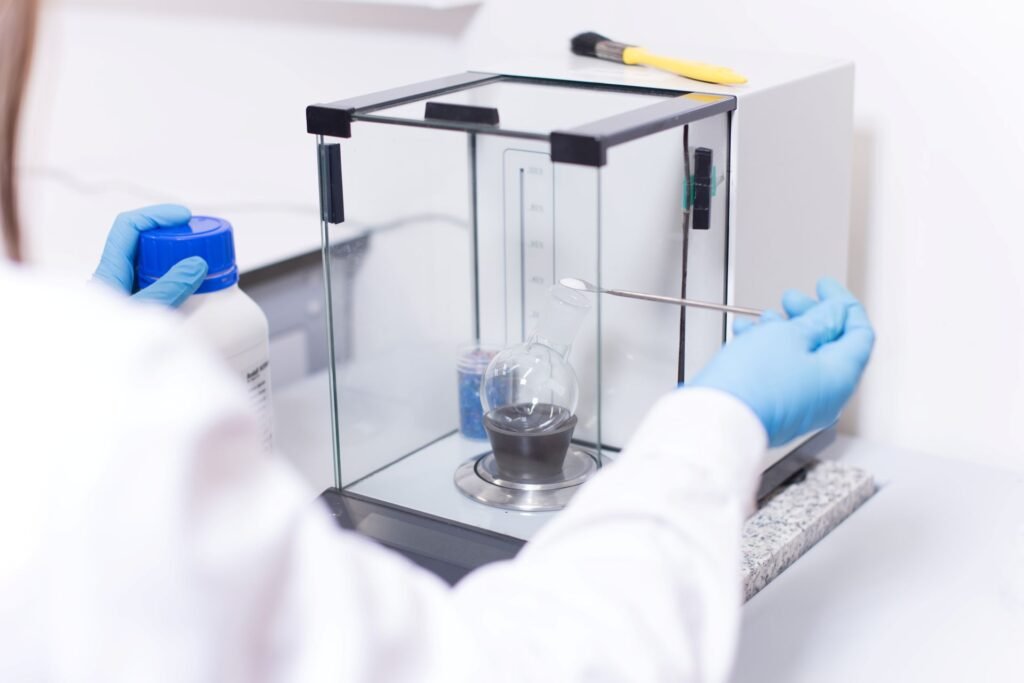
The enclosed draft shield on an analytical balance is not an accessory — it is a structural necessity. At 0.1 mg readability, an air current from an HVAC vent three feet away produces a measurable force on the weighing pan. A researcher walking past the balance creates enough air movement to shift the reading. The draft shield encloses the weighing pan in a still chamber, protecting the measurement from these forces.
As Adam Equipment explains, precision balances at lower capacities with finer readabilities — such as 1 mg readability models — benefit from an optional draft shield. At higher capacities and coarser readabilities, the force that air movement exerts on the weighing pan becomes negligible relative to the readability, and a draft shield adds no measurement benefit.
The practical implication is direct: if a balance in your laboratory does not have a draft shield, it is a precision balance. If it has an enclosed glass or acrylic weighing chamber, it is operating at analytical readability and requires the environmental controls that go with it.
For a comparison specifically covering top-loading balances versus analytical balances — including capacity differences above 500 g — see our top loading balance vs analytical balance guide.
Weighing Mechanism: EMFC vs Strain Gauge
Most analytical balances use electromagnetic force compensation (EMFC) — a mechanism that generates a magnetic counterforce proportional to the sample mass and measures the electrical current required to maintain equilibrium. EMFC produces the repeatability and linearity required for four-decimal-place results. It is more expensive to manufacture than strain gauge technology and operates reliably only across a limited capacity range, which is why analytical balances top out at 520 g in most configurations.
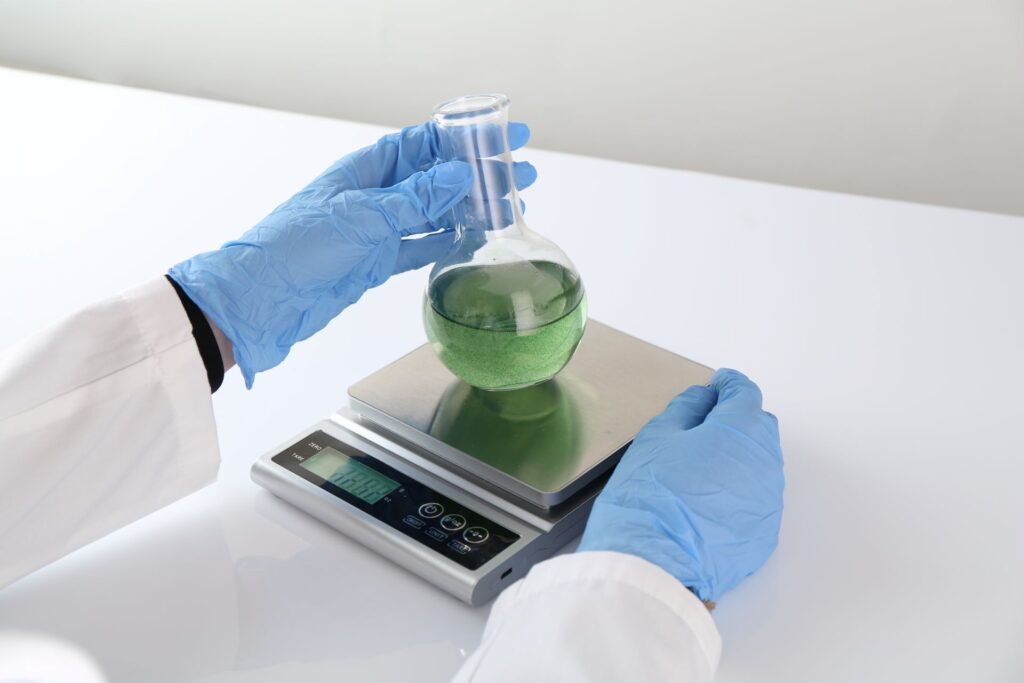
Most precision balances use strain gauge load cells — metal elements that flex microscopically under load, with the flex converted to an electrical signal by attached gauges. Strain gauge technology is robust, cost-effective, and scalable to very high capacities. It is less capable of resolving sub-milligram differences than EMFC, which is why precision balances do not achieve analytical readability at useful capacities.
Some high-specification precision balances at the lower end of their capacity range use EMFC to achieve 1 mg readability — these instruments sit at the boundary between the two categories and are sometimes called “semi-analytical” balances. They approach analytical performance at capacities up to 1–2 kg, a combination that EMFC at standard analytical balance capacity cannot achieve.
Environmental Sensitivity: What Each Balance Requires
This is the practical difference that affects day-to-day laboratory workflow most directly.
Analytical balance environmental requirements:
- Level, vibration-free surface — an anti-vibration table recommended in most environments
- Placement away from HVAC vents, windows, doors, and fume hood sashes
- Stable temperature — away from heat sources, cold storage, and direct sunlight
- 30–60 minutes warm-up time after powering on
- Draft shield doors closed during all measurements
- Samples were equilibrated to room temperature before weighing
- Anti-static precautions for powder samples and plastic vessels
Precision balance environmental requirements:
- Level surface — a standard laboratory bench is adequate for most applications
- Reasonable temperature stability — standard laboratory conditions are sufficient
- Away from obvious vibration sources, such as centrifuges on the same bench surface
- Standard warm-up time — typically 15–30 minutes for higher-readability models
As Sartorius notes, analytical balances require controlled environments that precision balances can tolerate without. A precision balance placed at a busy laboratory bench in a standard working environment will perform reliably. An analytical balance in the same location will produce fluctuating, inaccurate readings unless the environmental requirements are met.
Application Comparison: Which One Belongs Where
Use an analytical balance for:
- Quantitative chemical analysis — weighing reagents where stoichiometry requires sub-milligram precision
- Pharmaceutical API and excipient weighing for R&D and QC
- Preparing primary and secondary standard solutions
- Gravimetric analysis of unknowns
- Any application governed by USP Chapter 41 or GMP requirements that specifies minimum balance performance
- Formulation work where ingredient quantities are in the milligram range
- Pipette calibration verification
Use a precision balance for:
- Buffer preparation and general solution making, where gram-level accuracy is sufficient
- Weighing bulk reagents, raw materials, and large sample volumes
- Production-scale formulation and batch verification
- Teaching laboratory experiments where sub-milligram precision is not required
- Industrial QC applications where tolerance is at the gram level
- Weighing samples before analytical processing — taring a vessel before transferring to a more sensitive instrument
- Any application where the smallest quantity to be weighed comfortably exceeds the balance’s minimum weight at its readability
The Overlap Zone: When Either Could Work
Between approximately 1 mg and 10 mg minimum sample weight, both instrument types have models that could serve the application — a high-specification precision balance at 1 mg readability and an analytical balance at 0.1 mg readability.
In this overlap zone, the decision depends on three factors:
1. Regulatory framework: If the application falls under GMP, GLP, or USP Chapter 41, the balance must demonstrate that its minimum weight — the smallest mass it can weigh with acceptable relative uncertainty — is below the smallest quantity the method requires. An analytical balance almost always provides a more comfortable margin in this calculation than a precision balance at 1 mg readability.
2. Sample capacity: If the samples and containers combined routinely exceed 500 g, an analytical balance cannot serve the application at any price — its capacity ceiling is the constraint. A high-capacity precision balance is the only option.
3. Cost and environmental overhead: An analytical balance in a high-throughput routine QC environment requires more environmental control, more frequent calibration verification, and more operator training than a precision balance at 1 mg readability. If the readability requirement genuinely sits at 1 mg rather than 0.1 mg, the precision balance is the operationally simpler and more cost-effective solution.
For detailed guidance on specifying an analytical balance once the decision to use one is made, see our analytical balance buying guide. For the full breakdown of every balance type, including semi-micro and microbalance options above the analytical category, see our guide to types of laboratory balances.
FAQs
What is the main difference between a precision balance and an analytical balance?
Readability. An analytical balance reads to 0.1 mg (0.0001 g) and requires an enclosed draft shield. A precision balance reads to 0.001–0.1 g and is suitable for routine laboratory weighing at higher capacities. The analytical balance is the correct choice wherever sub-milligram mass differences are scientifically or commercially meaningful.
Can a precision balance replace an analytical balance?
Not for applications requiring sub-milligram readability. A precision balance with 1 mg (0.001 g) readability cannot resolve differences smaller than 1 mg — it cannot detect, report, or reproduce a 0.5 mg difference in sample mass. If the method or regulatory framework requires 0.1 mg readability, only an analytical balance satisfies the requirement.
Why does an analytical balance have a draft shield, but a precision balance usually does not?
At 0.1 mg readability, air currents exert a measurable force on the weighing pan that appears in the displayed result. A draft shield encloses the pan in a still chamber to protect measurements from this effect. At the gram-level readability of most precision balances, air movement does not produce forces large enough to affect the displayed result, so a draft shield adds no measurement benefit.
Which balance is better for pharmaceutical work?
Pharmaceutical ingredient weighing — particularly active pharmaceutical ingredients (APIs) at milligram quantities — requires an analytical balance with 0.1 mg readability. USP Chapter 41 and GMP requirements specify the minimum balance performance that analytical balances satisfy, and most precision balances do not for these applications. For bulk excipient weighing at gram quantities, a precision balance is appropriate.
Is a precision balance accurate enough for chemistry?
It depends on the chemistry. For solution preparation, buffer making, and any work where concentrations are at the gram-per-liter scale, a precision balance with 0.001 g readability is entirely adequate. For quantitative analysis, primary standard preparation, and stoichiometric work where reactant masses are in the milligram range, an analytical balance is required.
Conclusion
The decision between a precision balance and an analytical balance comes down to the readability your application requires and the environmental controls your laboratory can consistently provide. Analytical balances deliver four-decimal-place results in grams — the standard for quantitative research, pharmaceutical QC, and regulated laboratory environments. Precision balances deliver two-to-three-decimal-place results across significantly higher capacities — the standard for routine laboratory work, bulk weighing, and applications where gram-level accuracy is sufficient.
Neither is better than the other in any absolute sense. The right instrument is the one whose readability matches the smallest mass difference your method requires you to resolve — no finer, no coarser.