








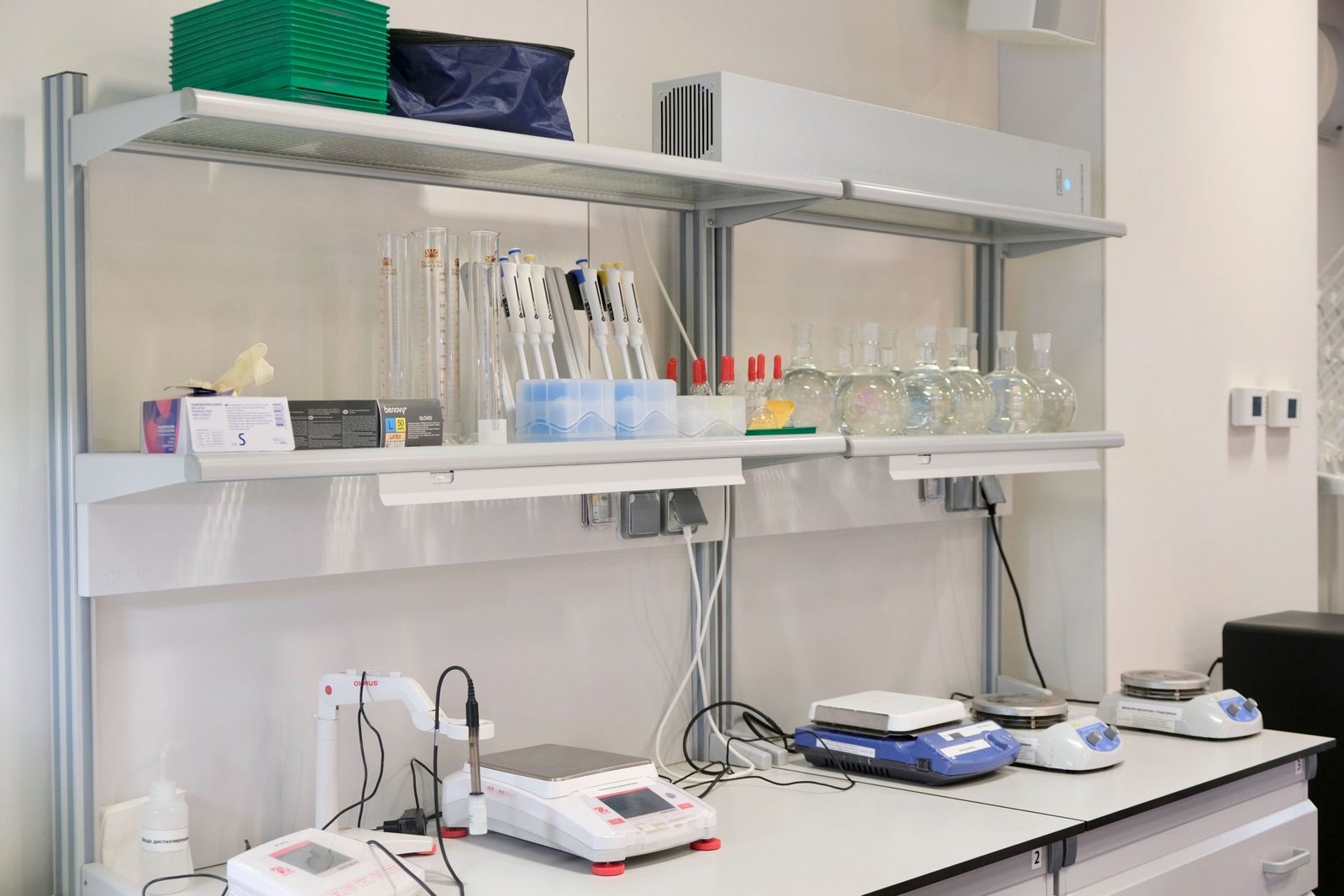
Every laboratory balance is built around the same fundamental purpose — measuring mass accurately — but the instruments available span six orders of magnitude in readability, from balances that read to 100 nanograms to top-loading platforms that handle several kilograms. Choosing the wrong type for an application does not just mean inconvenience. It means either over-specifying an expensive instrument for work that does not need it, or under-specifying an instrument that cannot resolve the mass differences that determine whether a result is valid. This article covers every major type of laboratory balance, what each one is built for, where the limits of each type lie, and how to match the instrument to the application.
How Laboratory Balances Are Classified
Laboratory balances are classified primarily by readability — the smallest increment the instrument can display. Readability determines the minimum mass difference a balance can detect and report, which determines the applications it can serve. As Sartorius identifies, the six main categories from finest to coarsest readability are ultra-microbalance, microbalance, semi-micro balance, analytical balance, precision balance, and high-capacity balance. Moisture analyzers are a distinct instrument type that combines a balance with a drying element and are covered separately in our article on what a moisture analyzer is.
The relationship between readability and capacity follows an inverse pattern — the finer the readability, the lower the maximum capacity. A balance that reads to 0.001 mg typically handles no more than 10 g. A balance that handles 10 kg reads to no finer than 0.1 g. Selecting the right type begins with identifying the smallest mass difference that matters in your application and the largest sample you will routinely weigh.
Ultra-Microbalance
- Readability: 0.0001 mg (0.1 µg / 100 nanograms)
- Typical capacity: typically about 2–6 g
- Draft shield: Required — fully enclosed weighing chamber
An ultra-microbalance is the most sensitive weighing instrument in routine laboratory use. It detects mass changes of 100 nanograms — one ten-millionth of a gram. At this readability, the instrument responds to static electricity on a vessel, the residual moisture on a fingertip, and minor air movement from a nearby researcher walking past. Every environmental variable that is inconsequential on a precision balance becomes a measurement error at this level.
Ultra-microbalances are two-component instruments — the electronics and the measuring cell are housed separately to prevent heat from the electronics from disturbing the weighing environment. They are placed on dedicated vibration isolation tables and operated in rooms with controlled temperature, humidity, and air movement.
Applications: Nanotechnology research, particulate filter weighing for PM2.5 and PM10 environmental monitoring, isotope ratio analysis, pharmaceutical impurity testing at trace levels, and any application where the sample mass is below 1 mg and the resolution requirement is in the sub-microgram range.
Microbalance
- Readability: 0.001 mg (1 µg)
- Typical capacity: typically up to about 10 g
- Draft shield: Required — enclosed weighing chamber with anti-static features
A microbalance reads to 1 microgram — one millionth of a gram. Like the ultra-microbalance, it requires a vibration isolation table and a controlled environment. The Mettler Toledo XPR series is among the most widely referenced microbalance platforms in pharmaceutical and research laboratories, offering automated draft shield operation and built-in leveling detection.
Microbalances are used when sample masses are in the microgram range and where even the mass change from sample evaporation or moisture absorption is relevant to the result. Handling samples on a microbalance requires tweezers or anti-static tools — never bare hands — and vessels must be allowed to equilibrate to room temperature before weighing.
Applications: Advanced pharmaceutical research, toxicology and forensic trace analysis, gravimetric filter analysis, catalyst research, materials characterization, and calibration of semi-micro balances.
Semi-Micro Balance
- Readability: 0.01 mg (10 µg)
- Typical capacity: 60–220 g
- Draft shield: Required — includes draft ring around the weighing pan as an additional precaution
A semi-micro balance bridges the gap between the extreme sensitivity of a microbalance and the practical working capacity of an analytical balance. Semi-micro balances are often dual-range instruments — reading at 0.01 mg readability below a threshold weight (typically 62–82 g) and at 0.1 mg readability above it. This dual-range design increases versatility significantly by allowing the same instrument to serve both ultra-fine sample weighing and routine analytical work.
Semi-micro balances are more common in pharmaceutical research and analytical chemistry than microbalances, because the 10 µg readability covers the vast majority of high-precision weighing tasks without the full environmental sensitivity burden of a true microbalance. They still require vibration isolation and placement away from drafts, air conditioning outlets, and high-traffic areas.
Applications: Pharmaceutical compound weighing, differential weighing, pipette calibration verification, dissolution testing sample preparation, fine chemical formulation, and research applications requiring five-decimal-place results.
Analytical Balance
- Readability: 0.1 mg (0.0001 g)
- Typical capacity: 60–520 g
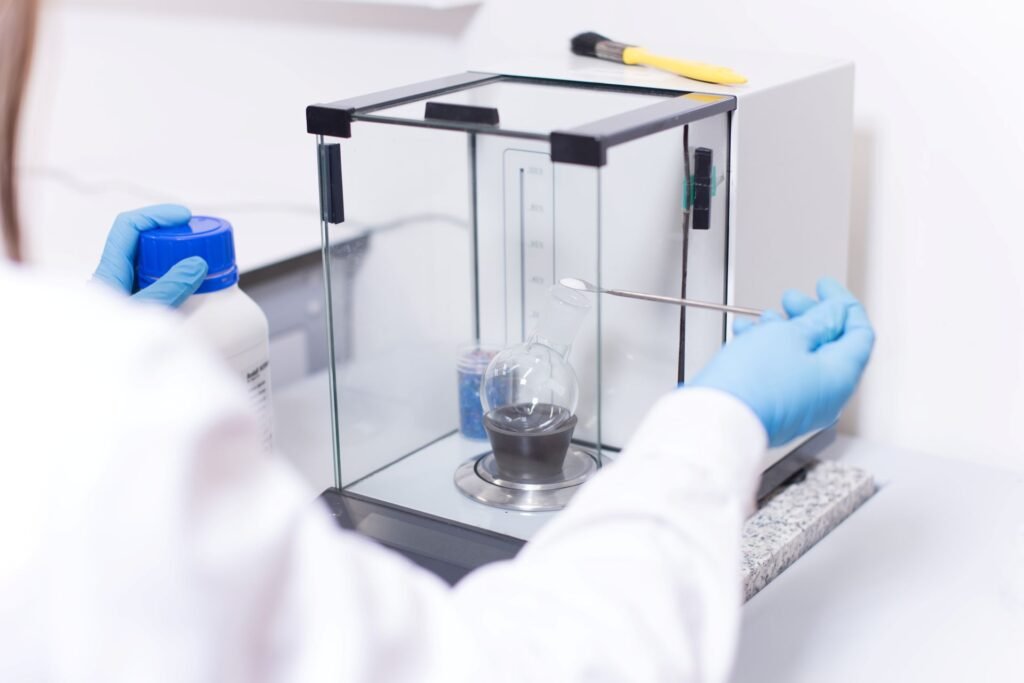
- Draft shield: Standard — enclosed glass weighing chamber
The analytical balance is the most commonly used high-precision balance in research, pharmaceutical, food testing, and quality control laboratories globally. Its 0.1 mg readability covers the vast majority of quantitative laboratory weighing tasks — weighing reagents, preparing standard solutions, checking fill weights, and performing gravimetric analysis. Analytical balances are the reference instrument in most QC and research environments and the starting point for regulatory compliance in pharmaceutical weighing.
Analytical balances use electromagnetic force compensation (EMFC) technology, which generates a counterforce proportional to the sample mass and measures that force directly. This mechanism produces the repeatability and linearity required for four-decimal-place results. The enclosed draft shield is standard — not optional — because air currents at 0.1 mg readability introduce errors that are visible in the displayed result.
The analytical balance is described as a “four-place” balance — displaying results to four decimal places in grams. This terminology is useful shorthand when specifying instruments for regulated laboratory environments.
Applications: Quantitative chemical analysis, reagent and standard preparation, pharmaceutical ingredient weighing for R&D and QC, food nutrition sample preparation, environmental sample weighing, academic research, and any application requiring four-decimal-place results in grams.
Precision Balance (Top-Loading Balance)
- Readability: 0.001 g to 0.1 g (1 mg to 100 mg)
- Typical capacity: 200 g to 32 kg, depending on model
- Draft shield: Optional on lower-capacity models; not required on higher-capacity models
A precision balance — also called a top-loading balance — trades readability for capacity. At 0.001 g (1 mg) readability, it sits just one step below an analytical balance in sensitivity while offering significantly higher capacity. At 0.1 g readability and 10 kg capacity, it serves as a general-purpose bench scale for laboratory environments. The precision balance category covers a wider range than any other type, which is why it is the most versatile balance in a laboratory setting.
Unlike analytical balances, precision balances do not universally require a draft shield. Lower-capacity precision balances with finer readabilities benefit from a draft shield, while higher-capacity models with coarser readabilities do not require one because air currents at the gram level do not materially affect the result.
Precision balances use strain gauge load cells rather than EMFC technology in most cases, which allows higher capacities at lower manufacturing cost. Some laboratory-grade precision balances do use EMFC to achieve 1 mg readability at capacities up to 1 kg — these sit at the high end of the precision category and approach analytical performance.
Applications: Solution preparation and buffer making, bulk reagent weighing, sample preparation before analytical weighing, formulation and compounding at gram-level precision, teaching laboratory work, industrial quality control, and any routine weighing task where sub-milligram precision is not required.

High-Capacity Laboratory Balance
- Readability: 0.1 g to 1 g
- Typical capacity: 3 kg to 70 kg
- Draft shield: Not required
High-capacity laboratory balances handle loads that precision and analytical balances cannot — bulk powders in large vessels, raw material batches, animal cages in research facilities, and large industrial samples. They maintain laboratory-grade accuracy and data connectivity while serving applications where capacity, not readability, is the primary requirement.
These instruments look more like industrial bench scales than laboratory balances, and their readability reflects the different measurement demands of high-capacity applications. A 0.1 g readability on a 30 kg instrument is a 1-in-300,000 resolution — substantially finer than an industrial scale, and appropriate for formulation and batch verification at production scale.
Applications: Raw material weighing in pharmaceutical and chemical manufacturing, animal weighing in research facilities, large batch formulation, and any application requiring accurate results on samples too large for a precision or analytical balance.
Quick Reference Comparison Table
| Balance Type | Readability | Typical Capacity | Draft Shield | Primary Use |
|---|---|---|---|---|
| Ultra-microbalance | 0.0001 mg | 2–10 g | Required | Nano-scale research, trace analysis |
| Microbalance | 0.001 mg | 3–30 g | Required | Pharmaceutical trace, filter weighing |
| Semi-micro | 0.01 mg | 60–220 g | Required | Pharma R&D, differential weighing |
| Analytical | 0.1 mg | 60–520 g | Standard | QC, research, standard prep |
| Precision | 0.001–0.1 g | 200 g–32 kg | Optional | Routine lab work, formulation |
| High-capacity | 0.1–1 g | 3–70 kg | Not required | Bulk weighing, production |
How to Match Balance Type to Application
Three questions determine the right balance type for any application.
What is the smallest mass difference that matters in your measurement? This defines the minimum readability required. If your method requires you to detect 1 mg differences, a precision balance with 0.001 g readability is sufficient. If your method requires you to detect 0.1 mg differences, an analytical balance is required. If your method requires detection below 0.1 mg, a semi-micro or microbalance is needed.
What is the largest sample you will routinely weigh, including its container? Container tare weight consumes a significant portion of working capacity. An analytical balance with 200 g capacity might accommodate a 25 g sample in a 150 g beaker, leaving 25 g of remaining capacity. If your routine tare weights are higher, you need a higher-capacity instrument. For a detailed guide to specifying analytical balances, see our article on how to choose an analytical balance.
What regulatory requirements apply to your measurements? Pharmaceutical weighing under USP Chapter 41 specifies minimum weight requirements — the smallest mass that a balance can weigh with acceptable uncertainty. GLP and GMP frameworks require documented calibration and traceability. The balance type must satisfy both the readability requirement of the method and the compliance requirement of the regulatory framework.
FAQs
What are the main types of laboratory balances?
The main types are ultra-microbalance (0.0001 mg readability), microbalance (0.001 mg), semi-micro balance (0.01 mg), analytical balance (0.1 mg), precision balance (0.001–0.1 g), and high-capacity balance (0.1–1 g). Each type serves a different readability and capacity range and is suited to different laboratory applications.
What is the difference between an analytical balance and a precision balance?
An analytical balance reads to 0.1 mg (0.0001 g) and requires an enclosed draft shield. A precision balance reads to 0.001–0.1 g and handles significantly higher capacities. Analytical balances are used for high-precision quantitative work; precision balances are used for routine weighing where sub-milligram accuracy is not required. A detailed comparison appears in our article on analytical balance vs precision balance.
What is a semi-micro balance used for?
A semi-micro balance reads to 0.01 mg (10 micrograms) and is used in pharmaceutical R&D, fine chemical analysis, differential weighing, and pipette calibration. It bridges the gap between the extreme sensitivity of a microbalance and the practical working capacity of a standard analytical balance, often featuring a dual-range design that provides five-decimal-place readability for light samples.
Do all laboratory balances need a draft shield?
No. Ultra-micro, micro, semi-micro, and analytical balances require enclosed draft shields because their readability is fine enough that air currents produce visible measurement errors. Precision balances at lower capacities benefit from optional draft shields. High-capacity precision balances and high-capacity balances generally do not require a draft shield because the mass differences introduced by air movement are negligible relative to their readability.
How do I know which balance type my lab needs?
Identify the smallest mass difference your method requires you to detect — this sets the minimum readability. Then identify the largest sample plus container weight you will routinely weigh — this sets the minimum capacity. The balance type that satisfies both requirements is the correct choice. If regulatory requirements apply, confirm the selected balance also meets the compliance specifications of your framework.
Conclusion
Every type of laboratory balance occupies a defined position in a readability-capacity continuum. Ultra-micro and microbalances serve the finest measurements at the lowest capacities. Semi-micro and analytical balances cover the mainstream of quantitative research and pharmaceutical QC. Precision balances handle routine work at higher capacities. High-capacity balances bridge the laboratory and production environments. The right choice is always determined by the readability required by the method, the capacity required by the sample and container, and the compliance requirements of the regulatory framework.
Choosing a balance that is more sensitive than necessary is an avoidable cost; choosing one that is less sensitive than required is a scientific error. For detailed guidance on selecting an analytical balance specifically, see our analytical balance buying guide.
Sources
- Sartorius, Analytical Balances (analytical and semi-micro definitions).
- A&D, Analytical vs Precision Balance (readability, capacity and draft shields).
- American Pharmaceutical Review, USP 41 and 1251 Chapters on Balances.
Last reviewed September 2026 by the Scale Blog editorial team. Capacities and readabilities vary by manufacturer and model — confirm against the data sheet.