









Carrier rate increases are announced once a year. The billing errors that inflate your shipping costs happen every day.
UPS and FedEx each raised base rates in 2025 and again in early 2026. Those increases get the attention. What gets less attention is the more controllable portion of your shipping bill — the portion generated by inaccurate package weights, incorrect tare deductions, oversized packaging, and carrier invoice adjustments triggered by weight discrepancies.
That portion is controllable. It responds directly to how accurately you weigh each package before it leaves your operation. This article explains exactly how inaccurate weighing inflates shipping costs, what each type of error costs in practice, and the specific steps that eliminate the most common and expensive mistakes.
Table of Contents
Why Carrier Invoice Adjustments Are the Most Expensive Weighing Error
A carrier invoice adjustment is a charge added to your account after a package has shipped. It occurs when the carrier’s automated scanning and weighing system measures a different weight or dimension than what you declared when you created the label.
Adjustments most frequently occur when the weight, dimensions, and packaging details on the label do not match the actual package. Carriers use overhead scanners and in-line scales at sorting facilities to verify every package. Any discrepancy triggers an automatic adjustment.
The adjustment has two components. First, the carrier charges the difference between what you paid and what the correct rate would have been. Second, most carriers add an adjustment processing fee on top of that. UPS, for example, can add a Shipping Charge Correction Audit Fee — the greater of a per-package amount or a percentage of the corrections — when a shipper’s average corrections exceed its threshold. Check the carrier’s current fee schedule for exact figures.
The financial impact compounds quickly. As an illustration: an operation shipping 500 packages a day with a 5% adjustment rate sees 25 adjustments daily; at an assumed $3.00 average correction plus fees, that is roughly $100+ per day, or tens of thousands of dollars a year, from weight errors alone.

How Actual Weight Errors Occur and What They Cost
Actual weight errors fall into four categories. Each has a specific cause and a specific fix.
Weighing Before the Package Is Fully Packed
This is the most common error at high-volume packing stations. The operator weighs the product alone or the product in an unsealed box and enters that weight into the shipping software. The final sealed package — with packing fill, tape, inserts, and documentation inside — weighs more than the declared weight.
The fix is simple. Always weigh the fully sealed, ready-to-ship package. The weight entered on the label must match the package as the carrier will receive it — not the product alone, not the unsealed box.
Incorrect Tare Deduction
Applying the wrong tare weight — or forgetting to tare at all — produces a systematic weight error on every package that uses that box size. If a 3 lb box is tared as a 2 lb box, every package using that configuration is declared 1 lb light. Every one of those packages generates an adjustment.
Measure and record the actual weight of every box size in regular use. Update tare presets on the scale whenever box suppliers or specifications change. For a full explanation of how the tare function works and how to use it correctly, see our article on what is the tare function on a shipping scale and why does it matter.
Using an Uncalibrated or Drifted Scale
A scale that was accurate six months ago may be reading 0.5 lb high or low today. Load cells drift over time due to temperature cycling, mechanical stress, and normal use. An uncalibrated scale generates a consistent weight error across every package it measures — without any visible sign that anything is wrong.
Calibrate shipping scales on a regular schedule. As a guide, high-volume packing stations often verify daily and calibrate monthly or quarterly, while lower-volume operations may calibrate every 6–12 months — set the interval from your own verification results. Any scale that has been moved, dropped, or overloaded must be recalibrated before returning to service. For full guidance on calibration frequency and procedure, see our article on warehouse scale calibration: how often and how to do it right.
Rounding Errors
Most carriers bill in whole pounds, rounding up to the next whole pound. A package that weighs 6.1 lb is billed as 7 lb. A package that weighs 5.9 lb is billed as 6 lb.
This means a scale that reads 0.2 lb heavy — common in a drifted or poorly calibrated instrument — can push packages across the next whole-pound threshold. On a 6 lb package with a 0.2 lb error, the declared weight is 6.2 lb, which rounds up to 7 lb. The correct billing weight is 6 lb. That is a one-pound billing error on every package of that weight.
Across 100 packages per day in that weight range, every extra billable pound adds cost — depending on service and zone, that can add up to hundreds of dollars a day in unnecessary overpayment — caused entirely by a scale that needs calibration.
Dimensional Weight — the Second Cost That Accurate Weighing Controls
Actual weight is only one of the two weights that determine your carrier bill. Dimensional weight — also called DIM weight — is the second. Carriers charge whichever is greater.
FedEx explains the principle directly: for each shipment, the charge is based on the dimensional weight or actual weight of the package, whichever is greater. Both UPS and FedEx use a DIM factor of 139 for domestic shipments as of 2026. USPS also uses 139 (since July 12, 2026; previously 166) for parcels exceeding one cubic foot.
The formula is straightforward:
Length (in) × Width (in) × Height (in) ÷ 139 = Dimensional Weight (lb)
Practical example: A package measuring 18″ × 14″ × 10″ has a cubic volume of 2,520 cubic inches. Divided by 139, the dimensional weight is 18.1 lb — rounded up to 19 lb. If the actual package weighs 4 lb, the carrier bills 19 lb. The difference is 15 lb of billing weight that produces no physical product value.
An accurate shipping scale tells you exactly what the package actually weighs. That actual weight figure, compared against the calculated DIM weight, tells you which billing method applies. Knowing this before the label is printed allows three cost-reducing actions:
- If the DIM weight is significantly higher than the actual weight, the package is in a box that is too large for the product. Switching to a smaller box eliminates the DIM weight premium entirely on those shipments.
- If actual weight and DIM weight are close, accurate actual weight measurement ensures you are not being pushed into a higher billing tier by a scale that reads heavy.
- If actual weight is consistently higher than DIM weight, your packaging density is good, and actual weight accuracy is the primary cost control lever.

The 2026 Dimensional Weight Rounding Change
Starting August 18, 2025, both UPS and FedEx changed their dimensional weight calculation rules. Both carriers now round each package dimension up to the next whole inch before applying the DIM formula — even for fractions as small as 0.1 inches. USPS adopted the same ceiling rounding, and a 139 divisor, for parcels over 1 cubic foot from July 12, 2026.
This means a package measuring 11.1″ × 9.1″ × 6.1″ is now treated as 12″ × 10″ × 7″ for billing purposes. The cubic volume used for calculation rises to 840 cubic inches, about 36% more than the raw measured volume of roughly 616 cubic inches.
The practical implication for accurate weighing: package dimensions must be measured precisely to the nearest inch and entered correctly. An operator who estimates dimensions rather than measuring them introduces an error that the new rounding rule amplifies. A package estimated at 11″ × 9″ × 6″ that actually measures 11.4″ × 9.4″ × 6.4″ bills at 12″ × 10″ × 7″ — not 11″ × 9″ × 6″.
Use a tape measure, not estimation. Measure at the longest point of each dimension. Enter dimensions into the shipping software before creating the label — do not rely on defaults or previously saved profiles for packages that may have changed.
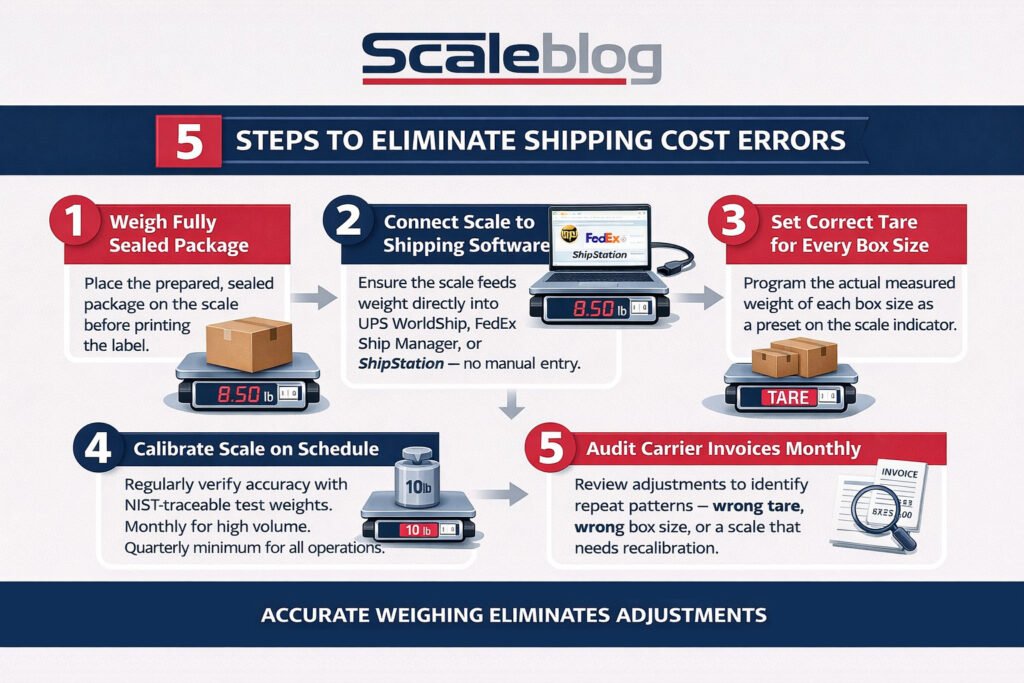
Five Steps to Reduce Shipping Costs Through Accurate Weighing
Step 1: Weigh Every Package Fully Sealed
Establish a packing station protocol. No label is printed until the package is fully sealed with all contents, packing fill, inserts, and tape in place. The weight entered on the label is the weight of the package as the carrier receives it.
This single step eliminates the most common source of carrier invoice adjustments. Entering accurate weight information and pulling it directly from a connected scale helps avoid the most common adjustment triggers.
Step 2: Connect the Scale Directly to the Shipping Software
A scale connected via USB feeds weight data directly into UPS WorldShip, FedEx Ship Manager, ShipStation, or equivalent software. The operator places the sealed package on the scale. The software reads the weight automatically. No manual entry — and no manual entry errors.
Manual weight entry is the second largest source of adjustment-generating weight discrepancies. Eliminating it with a connected scale removes an entire category of billing error from the operation. For guidance on selecting and specifying a connected shipping scale, see our article on how to choose a shipping scale for your business.
Step 3: Maintain Accurate Tare Presets for Every Box Size
Measure the actual weight of every box size your operation uses. Enter those weights as presets on the shipping scale indicator. Review and update the presets whenever box specifications change — different suppliers produce boxes of different weights, and a box that weighed 1.8 lb from last quarter’s supplier may weigh 2.1 lb from this quarter’s.
A tare error of 0.3 lb per package, across 300 packages per day, is 90 lb of daily billing error. Whether that error runs high or low determines whether you are overpaying or generating adjustments.
Step 4: Calibrate Scales on a Regular Schedule
Put scale calibration on a fixed calendar schedule. Do not wait for a visible problem. Load cell drift is not visible — the scale continues to display readings, and those readings look reasonable. The only way to confirm accuracy is to verify against a certified test weight.
Use NIST-traceable test weights at the scale’s rated capacity. If the reading is off by more than the scale’s stated accuracy tolerance, recalibrate before the next shift. For high-volume operations, this check should be part of the daily shift startup procedure.
Step 5: Audit Carrier Invoices Monthly
Carrier invoice adjustments reveal patterns. Three adjustments on the same box size in a week means that the box size has a systematic error — either the tare preset is wrong or the box is consistently oversized for the product. Five adjustments on packages from one packing station mean that the scale needs calibration.
Monthly invoice audits convert adjustment data into actionable corrections. The audit takes 30 minutes. The corrections it enables save money every shipping day for the following month.
Packaging Size — the Lever That Works Alongside Accurate Weighing
Accurate weighing tells you what you are paying. Right-sized packaging determines what you should be paying.
The most expensive packaging mistake is putting a product that fits in a 10″ × 8″ × 6″ box into a 14″ × 12″ × 8″ box — because the product is fragile and a larger box feels safer. The actual weight is identical. The DIM weight is approximately 3.4 times higher. On a product with a 2 lb actual weight, that is the difference between billing at 2 lb actual weight versus billing at 8 lb DIM weight.
A scale that accurately reads the actual weight surfaces this DIM weight gap immediately. When actual weight and billing weight diverge significantly, the cause is almost always a box that is too large for the product. Accurate weighing is what makes that gap visible, which is what makes it fixable.
Conclusion
Accurate package weighing does not reduce the carrier’s base rate. It does eliminate the additional costs that inaccurate weighing generates on top of that rate — invoice adjustments, adjustment processing fees, DIM weight premiums from oversized packaging, and rounding errors from drifted scales.
The operations that control their shipping costs in 2026 are the ones that treat weighing accuracy as a systematic process rather than an afterthought. Every package weighed on a calibrated scale, with the correct tare preset, after being fully sealed, and with its weight fed directly into the shipping software, produces a label that matches what the carrier will measure. When label weight matches carrier weight, adjustments disappear. When adjustments disappear, the shipping bill reflects only the base rate, which is the number that is genuinely difficult to reduce further.
To understand the weighing instruments that make this possible, see our article on what is a shipping scale and how does it work.
FAQs
How does accurate weighing reduce shipping costs?
Accurate weighing eliminates three categories of unnecessary shipping costs. First, it prevents carrier invoice adjustments by ensuring the weight on the label matches what the carrier measures at its sorting facility. Second, it reveals when DIM weight significantly exceeds actual weight — the signal that a box is too large and generates a dimensional weight premium. Third, it prevents rounding errors from a drifted scale from pushing packages across whole-pound billing thresholds unnecessarily.
What is a carrier invoice adjustment, and how do I avoid it?
A carrier invoice adjustment is a charge added to your account after a package ships when the carrier’s measurement differs from your declared weight or dimensions. To avoid adjustments: always weigh the fully sealed package before printing the label, connect the scale directly to the shipping software to eliminate manual entry errors, maintain accurate tare presets for every box size in use, and calibrate scales on a regular schedule so readings remain within the scale’s stated accuracy tolerance.
How is dimensional weight calculated for UPS and FedEx in 2026?
Both UPS and FedEx use a DIM factor of 139 for domestic shipments. The formula is: length × width × height (all in whole inches) ÷ 139 = dimensional weight in pounds, rounded up to the next whole pound. Effective August 18, 2025, both carriers round each dimension up to the next whole inch before applying the formula — even for fractions as small as 0.1 inches. The carrier bills whichever is greater: actual scale weight or calculated dimensional weight.
How often should a shipping scale be calibrated?
As a guide, high-volume packing stations often verify daily and calibrate monthly or quarterly, while lower-volume operations may calibrate every 6–12 months — set the interval from your own verification results. Any scale that has been moved, dropped, or overloaded must be recalibrated before returning to service. Load cell drift is not visible in the readings — the only way to confirm accuracy is to verify against a certified NIST-traceable test weight at the scale’s rated capacity.
What is the most common cause of carrier shipping invoice adjustments?
The most common cause is weighing the package before it is fully sealed — entering the weight of the product alone or an unsealed box, rather than the final sealed package as the carrier will receive it. The second most common cause is manual weight entry errors when the scale is not connected directly to the shipping software. Both are prevented by establishing a packing station protocol that requires all packages to be fully sealed before weighing and that uses a USB-connected scale to feed weight data directly into the shipping software.
Sources
- UPS, UPS Daily Rates and Service Guide (2026), including shipping charge corrections.
- FedEx, FedEx Service Guide (2026).
- U.S. Postal Service, Domestic Competitive Products Pricing and Mailing Standards Changes, effective July 12, 2026.
Last reviewed September 2026 by the Scale Blog editorial team. Dollar figures are illustrations, not quotes; your rates depend on your contract, service and zone.