



Choosing the right scale for weighing pigs at market weight is more commercially critical than it is for almost any other livestock species. The reason is simple: the market weight window for finishing pigs — the range between under-weight and over-weight for premium deadweight payments — is typically only 10–15 kg wide. At average pig growth rates of 700–900 g per day, a pen of pigs can pass entirely through that window in less than two weeks. Miss it and you either leave money on the table by selling underweight animals, or you pay a penalty for overlying pigs that have grown past the buyer’s specification. Accurate, reliable, and frequent weighing is the only management tool that prevents both outcomes.
This guide covers what to look for in a pig weighing scale, which features matter most at market weight, and how to set up a system that works at finishing unit scale.
Table of Contents
Why Pig Weighing Is Different From Other Livestock
Before specifying a scale, it helps to understand what makes pig weighing operationally distinct from weighing cattle or sheep.
Narrow weight window: Packers pay on carcass weight and grade, and most contracts have a target weight window with discounts for pigs that are too light or too heavy. In the U.S., market hogs are now heavy: USDA NASS reports that barrows and gilts slaughtered in 2025 averaged 287 lb live and 215 lb dressed. Check your own packer’s grid, because the target window — and the penalty for missing it — is what makes the weighing programme directly responsible for a large share of your margin.
High-throughput weighing: A 500-head finishing unit sending pigs to market in batches of 50–100 animals needs a weighing system that moves pigs quickly and calmly. Rough or prolonged handling stresses pigs, can cause bruising and carcass damage, and adds to the weight pigs lose before slaughter — so a slow or awkward weighing setup costs money before the pig leaves the farm.
Group versus individual weighing: Pig finishing units often make batch selling decisions based on the average weight of a group rather than individual weights. However, individual weighing identifies the range within the group — heavy pigs ready to go now, light pigs that need more time — allowing selective drafting that maximises the number of pigs hitting the target window in each batch.
Handling stress is just one of several factors covered in our full guide to what affects animal weight accuracy on a farm scale — including platform leveling, calibration, and load cell condition.
What Capacity Do You Need for a Pig Weighing Scale?
Capacity is the maximum weight the scale can measure without risk of damage or loss of accuracy. For finishing pig applications, the answer is straightforward:
Recommended capacity: 300–500 kg minimum for an individual pig weighing
This may seem high for animals that weigh 90–115 kg at market, but there are good reasons not to buy the minimum:
- A scale operating near the top of its capacity range is less accurate than one operating in its mid-range. A 300 kg scale reading a 110 kg pig is at 37% of capacity — well within the optimal accuracy zone
- Larger breeding sows, boars, and replacement gilts may need to be weighed on the same scale. Mature sows commonly reach 200–280 kg; boars can exceed 300 kg
- Scales with higher capacity typically have more robust construction, which matters in a pig finishing environment
For group weighing platforms where multiple pigs are on the scale simultaneously, capacity must reflect the combined weight of the group. A platform designed to take six finishers at 110 kg each needs a minimum 660 kg capacity — specify 1,000 kg or above for this application.
“According to the USDA Economic Research Service, finishing pigs are fed for approximately four months to reach slaughter weights of between 270–285 pounds — a narrow target window that makes accurate and timely weighing essential for maximizing returns.”
Platform Size and Design: Getting Pigs On and Off Safely
The platform must be large enough for a finishing pig to stand comfortably with all four feet on the weighing surface. An oversized platform that allows a pig to turn around mid-weigh will produce a stabilised reading — eventually — but will slow the process considerably.
Individual pig weighing platform:
- Minimum 100 cm × 70 cm for finishing pigs
- Side rails or a weigh crate to contain the animal during weighing are strongly recommended — a pig that can step sideways off the platform before the reading stabilises wastes time and stresses the animal
Group weighing platform:
- Minimum 150 cm × 150 cm for groups of 4–6 pigs
- Must have solid non-slip flooring — rubber matting or cast steel grid — to prevent scrambling and injury
- Entry and exit gates that open independently allow pigs to flow through without reversing, which reduces handling stress significantly
Floor height and ramp access: Low-profile platforms that sit close to floor level reduce the step-up for pigs and improve animal flow. If ramp access is required, a shallow angle (less than 20 degrees) and an anti-slip surface are essential — pigs are reluctant to use steep ramps and will baulk, adding time and stress to the process.
“The Pork Information Gateway explains that pork processors publish specific carcass weight requirements in packer grids — and that the optimum market weight is the average weight at which margin over feed and facility cost is maximized, making pre-market weighing a direct profit management tool.”
The Three Scale Types Best Suited for Pig Weighing
1. Weigh Crate / Weigh Crush (Best for Individual Accuracy)
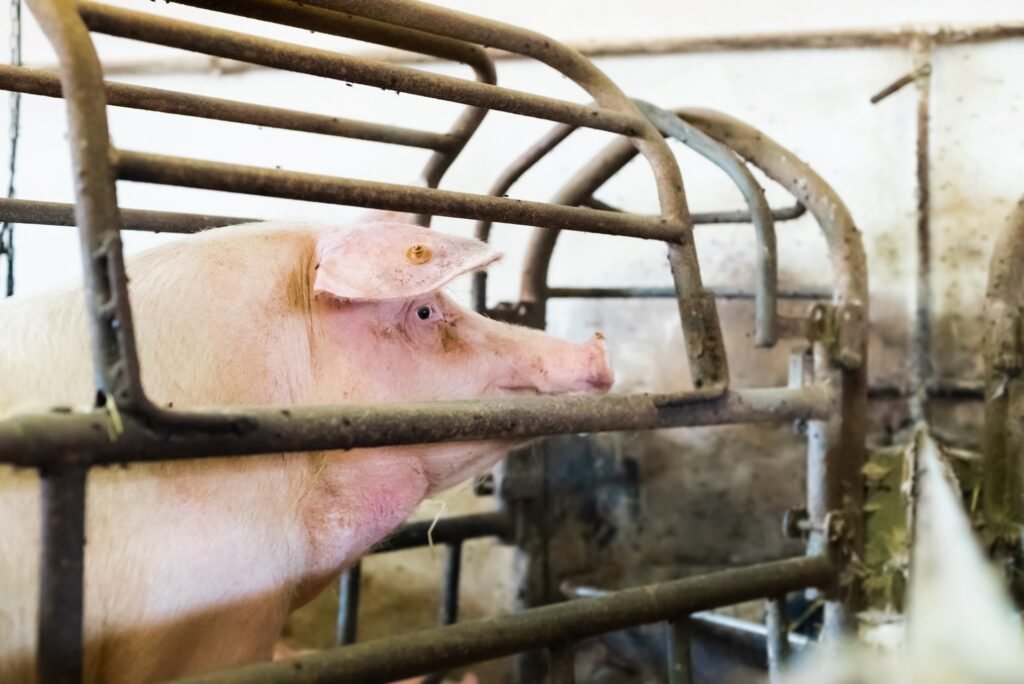
A dedicated pig weigh crate combines a weighing platform with fixed or adjustable side rails that contain one pig at a time. The animal is enclosed just enough to stand still but not so confined that it becomes agitated. This setup produces the most accurate individual weights because the pig cannot step off the platform mid-reading. For step-by-step guidance on positioning, foundation, and race design, see our guide on how to set up a livestock scale and chute system on your farm.
Best for: Operations where individual pig weights are recorded against ear tags or RFID tags for performance monitoring or abattoir documentation requirements.
The SellEton’s Cage System Portable Livestock Weighing Scale is a well-regarded option for operations weighing finishing pigs individually — its portable cage design contains the animal during the read and delivers consistent, NTEP-certified weights.
2. Group Weighing Platform (Best for Throughput)
A large flat platform — typically 1.5 m × 1.5 m or larger — allows a small group of pigs to be weighed together. The total weight divided by the number of animals gives an average. This is faster than individual weighing but sacrifices the ability to identify the lightest and heaviest animals in the group.
Best for: Large finishing units making batch selling decisions based on group average weight, where the speed of processing outweighs the value of individual data.
3. Portable Weigh Bars Under Existing Flooring
Weigh bars installed under a section of existing slatted or solid floor turn a pen or loading area into a temporary weighing station. Pigs walk over the area naturally during routine management, and weights are recorded without a specific weighing handling event.
Best for: Units with existing good-quality flooring and a preference for minimal additional handling. Less accurate than a dedicated crate, but it reduces stress-related shrinkage significantly.
For a full comparison of weigh bar systems, self-contained platforms, and crush-mounted scales, see our complete portable livestock scale buying guide.
Key Scale Features for Pig Market Weight Operations
Auto-Zero and Stability Detection
The indicator must auto-zero between animals and have a stability detection function that confirms the reading has settled before displaying or locking the weight. Without stability detection, operators tend to read the display before the animal has fully settled — producing systematically low or inconsistent weights.
Legal for Trade Certification
If the weight recorded at farm determines the price paid by the buyer — as it does in some liveweight trading arrangements — the scale must be certified legal for trade. In the US, this means NTEP Class III certification. In the UK and Australia, it requires Weights & Measures approval. Verify this before purchase if your trading arrangement is based on farm liveweight.
Data Storage and EID Integration
For operations recording individual pig weights for performance monitoring, abattoir feedback comparison, or genetic recording programmes, an indicator with onboard data storage and EID tag reader compatibility is a significant operational advantage. It eliminates manual recording, allows direct comparison of farm liveweight against abattoir deadweight, and builds a growth performance database over time.
Battery Operation
A battery-powered indicator allows the scale to be used anywhere on the unit — in finishing pens, in the loading area, or in a separate weighing facility — without trailing mains cables that create both a trip hazard and a cleaning problem in a pig unit environment.
Washdown Rating
Pig units are pressure-washed regularly with chemical disinfectants. Any scale used permanently or semi-permanently in a pig housing environment needs an IP65 minimum rating on both the platform load cells and the indicator. IP67 or IP68 is preferable for scales that remain in place through cleaning cycles.
Recommended Weighing Frequency for Finishing Pigs
The right scale is only as useful as the weighing programme behind it. For finishing pigs targeting market weight:
- Weigh the whole group at approximately 50 kg liveweight — establishes the baseline for the finishing period
- Weigh every two weeks from 70 kg onward — at 700–900 g ADG, pigs gain 10–13 kg per fortnight; two-week intervals capture meaningful progress and give sufficient warning before the group enters the target weight window
- Weigh and draft individually as the group approaches the target — sort forward pigs ready for the next market, hold back light pigs for an additional week or two
- Weigh the loaded batch before departure if liveweight trading — confirms the actual weight for invoice purposes and identifies shrinkage between farm weight and abattoir receipt weight
“Finishing pigs typically gain 1.8–2.2 pounds per day during the finishing phase — meaning a pen of pigs can move through a 15–20 lb market weight window in as little as one to two weeks.”
For a full breakdown of how often to weigh finishing pigs alongside every other livestock species, see our dedicated weighing frequency guide.
Conclusion
The best scale for weighing pigs at market weight is not the cheapest model with sufficient capacity — it is the one that integrates reliably into your handling system, processes animals quickly enough to minimise shrinkage, produces stable individual or group weights, and connects to your record-keeping system. For most finishing units, a dedicated pig weigh crate with a stable-indicator display, auto-zero, IP65-rated washdown protection, and battery operation covers every requirement. Add EID integration if you run a performance monitoring programme. Add a legal for trade certification if your trading arrangement is based on farm liveweight. The window for selling pigs at peak value is narrow — your weighing system should be precise enough to find it every time.
FAQs
What weight should pigs be before going to market?
Most pig buyers specify a deadweight range of 60–85 kg, corresponding to a liveweight of approximately 90–115 kg at typical kill-out percentages of 72–76%. US packer specifications commonly target 240–280 lb (109–127 kg) liveweight. The exact specification depends on your buyer — always confirm target weight and penalty thresholds before the finishing period begins.
What capacity scale do I need for weighing pigs?
A minimum of 300–500 kg capacity for individual finishing pigs. For group weighing platforms accommodating 4–6 pigs simultaneously, specify 1,000 kg or above. Higher capacity than strictly necessary improves accuracy by keeping the animal’s weight in the scale’s optimal operating range.
How often should finishing pigs be weighed?
Every two weeks from approximately 70 kg liveweight onward. At typical growth rates of 700–900 g per day, pigs gain 10–13 kg per fortnight. Two-week intervals give sufficient advance warning before the group enters the target market weight window, allowing selling decisions to be planned rather than reactive.
Does a pig weighing scale need to be legal for trade?
Only if the weight recorded at the farm determines the transaction price in a liveweight trading arrangement. In that case, NTEP Class III certification is required in the US, and Weights & Measures approval in the UK and Australia. If pigs are sold on deadweight and the abattoir scales determine the price, farm scale legal for trade certification is not required but is still good practice.
What is the best type of scale for weighing individual pigs?
A dedicated pig weigh crate — a platform with fixed or adjustable side rails that contains one pig at a time — produces the most accurate individual weights. The containment prevents the pig from stepping off the platform before the reading stabilises, which is the most common cause of inaccurate individual pig weights.
Sources
- USDA National Agricultural Statistics Service, Livestock Slaughter 2025 Summary (April 2026).
Last reviewed September 2026 by the Scale Blog editorial team.