



This article contains affiliate link(s). If you purchase through these links, Scale Blog may earn a commission at no additional cost to you. See our full Affiliate Disclosure for details.
Knowing how to weigh cattle without a scale comes down to one reliable tool — a flexible measuring tape — and a formula that farmers and ranchers have used for decades. By measuring heart girth circumference and body length, you can estimate your animal’s live weight to within roughly ±5%, or about 50 lbs on a 1,000 lb animal. That level of accuracy is sufficient for medication dosing, feed management, tracking average daily gain, and making informed market decisions. For a small herd cattle weighing situation where a full livestock scale isn’t practical or cost-effective, these methods are a legitimate working alternative.
If regular weighing is practical in your operation, a portable livestock scale removes the guesswork entirely and produces data you can act on with confidence. Most weight tape results are given in pounds. If you need the equivalent in kilograms for breed records or export documentation, our kg to lb converter handles the switch instantly.
Table of Contents
Why Accurate Weight Matters Even Without a Scale
Knowing your cattle’s approximate live weight isn’t just useful — in several situations, it’s essential.
Medication dosing is the most critical use case. Dewormers, antibiotics and other treatments are dosed by body weight. In a study published in The Veterinary Journal (Wood, Reyher and Barrett, 2015), veterinary surgeons, stock handlers and students visually estimated cattle weights, and 55% of their estimates were more than 10% away from the reference weight, with heavier animals most often underestimated. Underdosing a dewormer because you guessed a cow 200 lb too light is one of the fastest ways to encourage parasite resistance.
Feed efficiency and ration planning also depend on weight. A beef cow in a cow-calf operation eating roughly 2–3% of her body weight in dry matter daily will need a very different ration at 900 lbs versus 1,200 lbs. Getting this wrong costs money at both ends — overfeeding wastes feed, underfeeding affects reproductive performance and weaning weight of calves.
Market readiness is the third major use. Most buyers and processors have target weight ranges. Knowing when your steers are approaching market weight — without hauling them to a commercial scale — saves time and reduces unnecessary stress on the animals.
Method 1: The Heart Girth + Body Length Formula (Most Accurate)
This is the most reliable way to estimate an individual animal’s weight without a scale, and it only needs a flexible tape and a calculator.
“According to Washington State University Extension, the heart girth formula — heart girth × heart girth × body length ÷ 300 — provides a reliable field estimate of cattle weight in pounds when a scale is not available.”
What you need: A flexible measuring tape — a cloth or vinyl tape works better than a rigid one. A helper to keep the animal settled is useful but not always necessary.
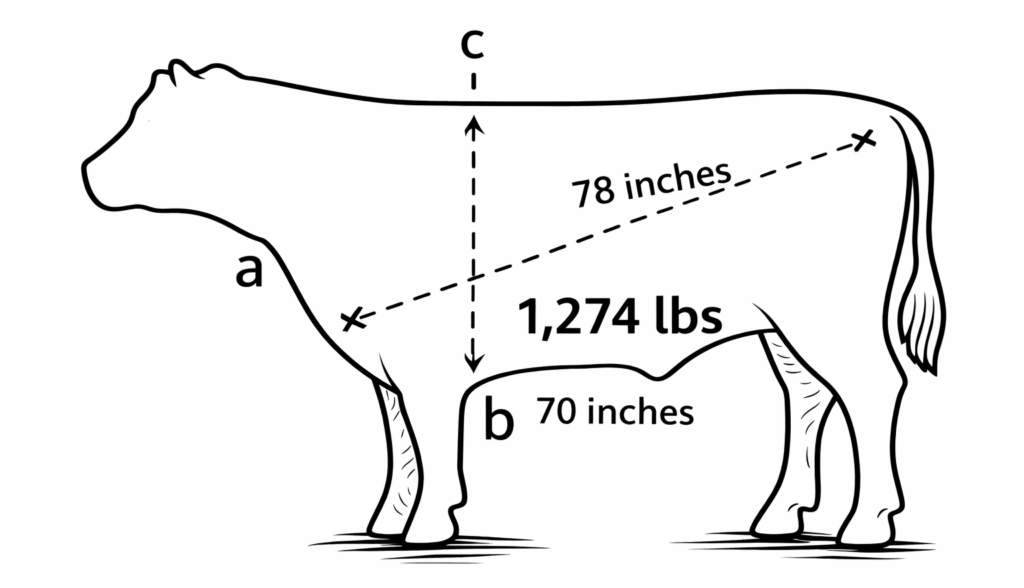
Step 1: Measure heart girth circumference: Pass the tape tightly around the animal’s body just behind the front legs, at the lowest point of the chest. This is the heart girth measurement. Keep the tape level, snug but not compressed.
Step 2: Measure body length: Measure from the point of the shoulder (the bony protrusion at the front of the shoulder) to the pin bone (the bony protrusion at the back of the hip). This is your body length measurement.
Step 3: Apply the formula: Use the standard cattle body weight formula:
Heart Girth × Heart Girth × Body Length ÷ 300 = Estimated Weight (lbs)
Example: A beef cow with a 70-inch heart girth and 78-inch body length: 70 × 70 × 78 ÷ 300 = 1,274 lbs
The calculation itself follows the standard cattle weight formula — heart girth squared, times body length, divided by 300 — which we cover in full with worked examples and accuracy limits.
Known as Schaeffer’s formula, it was the most reliable of five estimation techniques tested on Brown Swiss and Jersey cows in a peer-reviewed study (Wangchuk, Wangdi and Mindu, Journal of Applied Animal Research, 2018), ahead of a weigh tape and well ahead of Agarwal’s formula and the Rondo tape.
“A comparative study published in the Journal of Applied Animal Research found that among several estimation techniques, Schaeffer’s formula produced weight estimates that were not significantly different from actual weighbridge measurements — the strongest result of any non-scale method tested.”
Practical tip: Measure first thing in the morning before feeding and watering. Gut fill alone can add 50–100 lbs of daily weight variation to a reading, which will throw off your estimate if the animal has a full rumen.
Method 2: The Livestock Weigh Tape (Fastest Field Method)
A livestock weigh tape is a purpose-made measuring tape where the graduations on one side show heart girth inches, and the other side shows estimated body weight in pounds directly — no calculation required. A Coburn Livestock Weigh Tape is an affordable, practical tool every cattle producer should carry — it fits in a shirt pocket and eliminates the calculation step entirely.
This is the fastest method for small herd cattle weighing in the field. A beef cattle weigh tape costs around $5–$15 at most farm supply stores and gives results in under a minute.
How to use it: Loop the tape around the heart girth, just as in Method 1 above, and read the weight directly from the marked side of the tape.
How accurate is a cattle weigh tape? Weigh tapes are reasonably accurate when used consistently, and they ranked second only to Schaeffer’s formula in the Wangchuk et al. comparison. A 2021 study in Veterinary Record Open (Sherwin and colleagues) also found heart girth tapes useful for estimating the weight of pre-weaned calves. Accuracy improves when you measure at the same time of day, with the animal standing square on level ground, and use a tape made for the type of cattle you are measuring (beef or dairy).
“Research published in Veterinary Record Open found that heart girth tapes provide a relatively accurate estimation of cattle bodyweight with a mean absolute error of 2.66 kg — sufficient for routine on-farm management decisions.”
Important limitations to know:
- Weigh tapes are calibrated for specific breed types — most are designed for British and European beef breeds. Dairy breeds, Zebu-type cattle, and heavily pregnant cows will return less accurate readings
- For animals over 2,000 lbs (large bulls in particular), the formula and standard tapes become progressively less accurate
- Technique consistency matters more than precision — if the same person measures the same way every time, the estimates are reliable for tracking trends even if the absolute number is slightly off
Method 3: Body Condition Scoring (Qualitative Estimation)
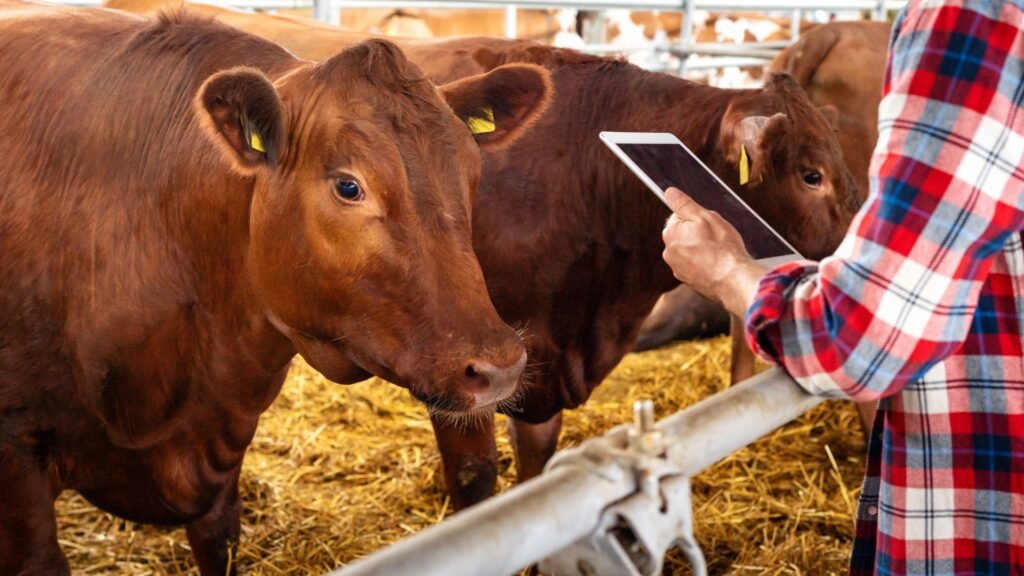
Body condition scoring cattle (BCS) doesn’t give you a weight in pounds, but it tells you something arguably more useful — whether your animal is carrying the right amount of fat and muscle for its stage of production.
The BCS system for beef cattle runs from 1 to 9:
- 1–3: Thin, visible ribs and spine, no fat cover — nutritionally deficient
- 4–5: Moderate condition, ribs visible on close inspection, some fat cover — target for most breeding cows
- 6–7: Good condition, ribs not visible, smooth fat cover over back and tailhead — typical for cows entering calving season
- 8–9: Fat to obese, heavy fat deposits around tailhead — overconditioned
A BCS of 5 at calving is widely cited as the minimum required for optimal reproductive performance in beef cows. Research from Oklahoma State University extension found that cows calving at BCS 5 or above showed significantly higher rebreed rates in the subsequent 60–90 day breeding season compared to cows in poorer condition.
Used alongside heart girth measurements, body condition scoring rounds out your field estimate — a cow with a 70-inch girth but a BCS of 3 will likely weigh less than the formula suggests because she’s carrying less muscle and fat than a well-conditioned animal of the same frame.
Method 4: Visual Weight Estimation (Least Reliable — Use With Caution)
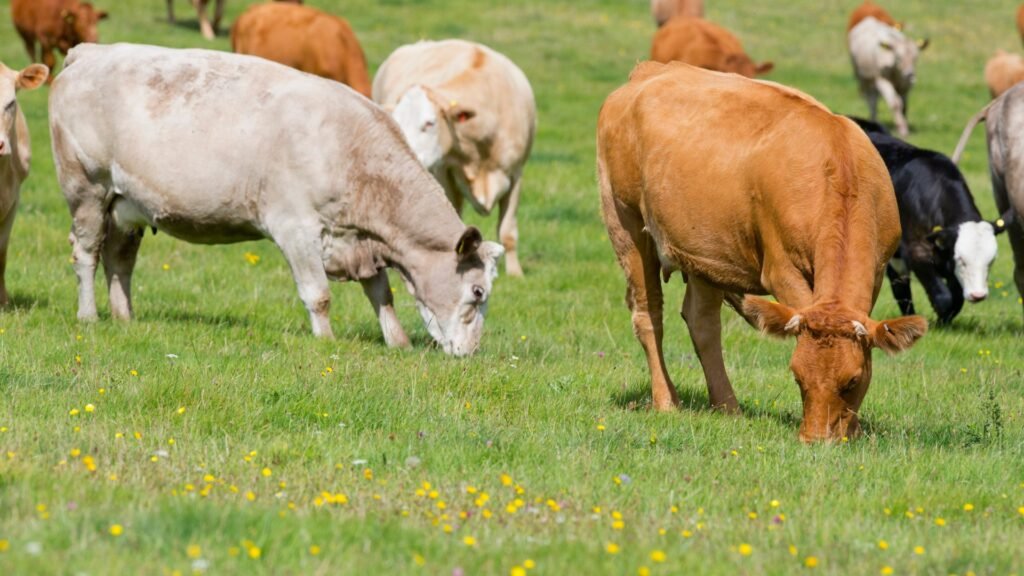
Visual weight estimation is the method most farmers default to out of habit — standing back and looking at an animal and making a judgment call. It’s fast, requires no equipment, and experienced stockpeople can get reasonably close on animals they handle regularly.
However, visual weight estimation of cattle is consistently the least accurate of all methods. The same research that showed 55% of professional estimates were off by more than 10% also found that accuracy dropped significantly for heavier animals — the ones where an error matters most, particularly for correct medication dosing.
Use visual estimation only for:
- Quick sorting decisions in the field where rough groupings are sufficient
- Checking whether an animal’s condition has visibly changed between observation periods
- As a secondary check alongside a tape measurement, not as a replacement for it
“A study published on PubMed found that 55% of visual weight estimates by veterinarians, stock handlers, and students were more than 10% away from the actual reference weight — making visual assessment alone an unreliable basis for drug dosing or market decisions.”
Once you have a reliable baseline estimate, the next step is tracking cattle weight gain over time to monitor growth against breed benchmarks.
A Quick Comparison: Which Method to Use When
| Situation | Best Method |
|---|---|
| Medication dosing (dewormer, antibiotic) | Heart girth + body length formula |
| Daily field check, no calculation wanted | Livestock weigh tape |
| Monitoring herd nutrition and reproduction | Body condition scoring |
| Quick sort / rough grouping | Visual estimation |
| Tracking average daily gain over weeks | Weigh tape, same time, same technique |
| Pre-sale weight estimate | Formula method + BCS combined |
Conclusion
Knowing how to weigh cattle without a scale is a practical skill every farmer with a small to mid-sized herd should build into their routine management. The heart girth and body length formula — applied with a flexible measuring tape first thing in the morning — is the most accurate field method available and reliable enough for medication dosing, feed efficiency planning, and assessing market readiness. The livestock weigh tape is faster for routine checks. Body condition scoring adds context that numbers alone can’t capture.
None of these methods replaces a calibrated livestock scale for formal sale weights or official records. But for the day-to-day decisions that actually drive herd profitability — how much to feed, when to treat, and when to sell — a tape measure and consistent technique will take you further than most farmers realise. For farms ready to move beyond estimation, our guide to setting up a livestock scale and chute system covers everything from site selection to calibration.
For a complete breakdown of recommended weighing schedules by species and production stage, see our guide on how often you should weigh livestock.
FAQs
How do you estimate cattle weight without a scale?
Measure the heart girth circumference and body length in inches, then apply the formula: heart girth × heart girth × body length ÷ 300 = estimated weight in pounds. This is accurate to within approximately ±5% when measured correctly.
How accurate is a cattle weigh tape?
Weigh tapes are reasonably accurate for routine management when used consistently. In a peer-reviewed comparison of five methods on dairy cows, the weigh tape was second only to Schaeffer’s formula, and a 2021 Veterinary Record Open study found heart girth tapes useful for pre-weaned calves. Use a tape made for your type of cattle and measure the same way each time.
What is the heart girth formula for cattle weight?
The standard formula is: heart girth (inches) × heart girth (inches) × body length (inches) ÷ 300 = estimated weight in pounds. For example, a cow with a 70-inch girth and 78-inch body length estimates to weigh 1,274 lbs.
Can you use visual estimation to weigh cattle?
Visual estimation is the least reliable method. In a 2015 study in The Veterinary Journal, 55% of visual estimates by vets, stock handlers and students were more than 10% off the reference weight, and heavy animals were usually underestimated. Use it only for rough sorting, never for dosing.
When is the best time to measure cattle for weight estimation?
Measure first thing in the morning before feeding or watering. Gut fill can add 50–100 lbs of variation throughout the day, which will skew your estimate if the animal has a full rumen.
Sources
- Wood, S., Reyher, K.K. and Barrett, D.C. (2015). Comparison of visual assessment and heart girth tape measurement for estimating the weight of cattle in clinical practice. The Veterinary Journal.
- Wangchuk, K., Wangdi, J. and Mindu, M. (2018). Comparison and reliability of techniques to estimate live cattle body weight. Journal of Applied Animal Research.
- Sherwin and colleagues (2021). Accuracy of heart girth tapes in the estimation of weights of pre-weaned calves. Veterinary Record Open.
Last reviewed September 2026 by the Scale Blog editorial team.