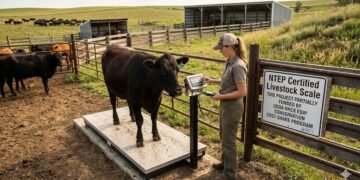




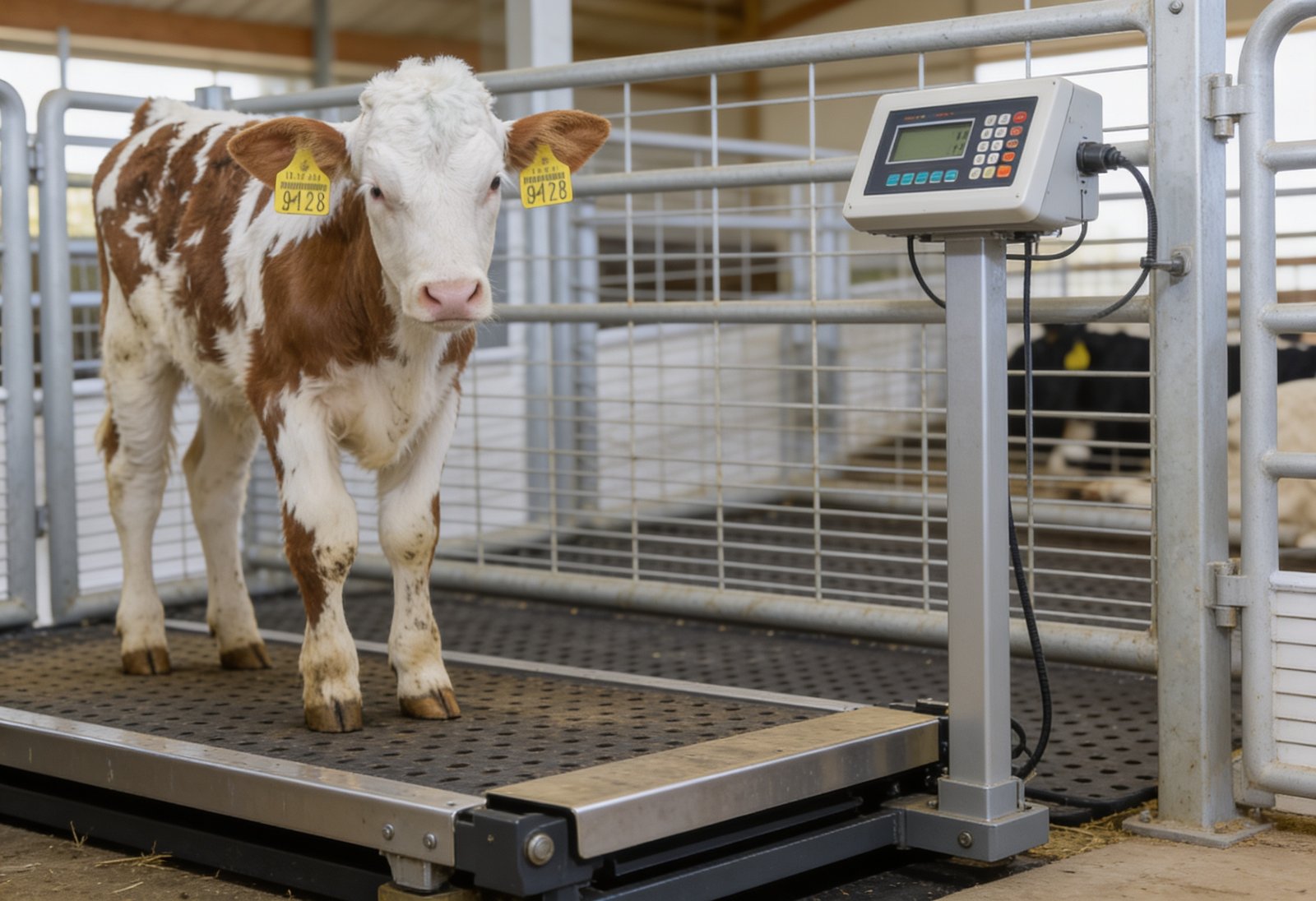
There are five ways to weigh a cow: a certified livestock scale, the heart girth formula, a weigh tape, body condition scoring, and visual estimation. Only a certified scale is accurate enough — and legally required — for commercial sale by weight. The formula and weigh tape estimate within about 5% for dosing and feed decisions. Body condition and visual methods do not produce a usable weight.
Knowing how much a cow weighs is one of the most practically useful data points in cattle management. It drives medication dosing, feeding decisions, breeding assessments, market preparation, and transport load compliance. How you obtain that weight — whether from a certified livestock scale, a tape measure formula, or a weigh tape — determines how accurate the number is and what decisions it can reliably support.
This article covers every method available for weighing cattle, from the most accurate to the least, with step-by-step instructions for each, the accuracy each produces, and the decisions each is and is not reliable enough to support.
| Method | Accuracy | Best for | Legal for sale? |
|---|---|---|---|
| Certified livestock scale | ±1 lb | All decisions, commercial sale | Yes |
| Heart girth formula | ±5% | Dosing, ration planning | No |
| Weigh tape | 1–6% | Quick field monitoring | No |
| Body condition score | Not a weight | Nutritional assessment | No |
| Visual estimation | >10% error | Last resort only | No |
Table of Contents
Method 1 — Livestock Scale (Most Accurate)
A certified livestock scale is the only method that produces a weight accurate enough for every cattle management decision — commercial sales by live weight, precise medication dosing, verified performance data, and transport compliance. Every other method in this article is an estimate. A scale produces a measurement.
How to weigh a cow on a livestock scale:
Step 1 — Prepare the scale. Confirm the scale is level using the built-in bubble indicator. Zero the scale with nothing on the platform. If the scale has a cage or pen, tare the pen weight if it will remain on the platform during weighing. For full setup guidance, see our article on how to set up a livestock scale and chute system.
Step 2 — Weigh before morning feeding. As confirmed by Tractor Supply Co., weigh cattle before they eat or drink in the morning. Gut fill — the weight of feed and water in the rumen — adds 50–100 lb of daily weight variation that is not body weight. A cow weighed after a full morning feed will read 50–100 lb heavier than the same cow weighed before feeding. For consistent performance records, always weigh at the same time of day under the same feeding conditions.
Step 3 — Move the animal onto the platform. Drive the animal through the chute onto the scale platform. Allow the animal to settle. The scale’s motion-averaging indicator — present on all quality livestock scales — will lock a stable reading once the animal’s movement averages out. Do not attempt to read the weight while the indicator is still fluctuating.
Step 4 — Record the weight. Note the locked weight reading alongside the animal’s ID, the date, and the time. For EID-tagged herds, an EID-compatible indicator pairs the tag number and the weight automatically without manual data entry. For the complete guide to tracking individual cattle weights over time, see our article on how to track cattle weight gain.
Step 5 — Exit the animal. Open the exit gate and move the animal through. Reset the scale to zero before the next animal enters.
Accuracy: A calibrated, NTEP-certified livestock scale produces weight readings accurate to ±1 lb — effectively exact for all practical cattle management purposes. This is the reference against which every other weighing method is measured.
Required for: Commercial cattle sales by live weight, NTEP-certified transactions, medication dosing for controlled substances with narrow therapeutic windows, verified performance data for breeding programs, and transport load compliance verification.
For the full guide to selecting the right livestock scale for your operation — including weigh bar systems, cage systems, and alleyway configurations — see our complete guide to farm and livestock scales.
Method 2 — Heart Girth Formula (Most Practical Without a Scale)
The heart girth formula — also called Schaeffer’s formula — is the most widely used weight estimation method for cattle when a scale is not accessible. It uses two tape measurements and a simple calculation to produce an estimated weight accurate to approximately ±5% when performed correctly.
As confirmed by a comparative study in the Journal of Applied Animal Research, Schaeffer’s formula produced weight estimates not significantly different from actual weighbridge measurements — the strongest validation result of any non-scale method tested.
The formula:
Heart Girth (inches) × Heart Girth (inches) × Body Length (inches) ÷ 300 = Estimated Weight (lb)
Step-by-step instructions:
Step 1 — Restrain the animal: The animal must be standing square — four feet on level ground, head held in a natural forward position, not looking up or down. A chute or halter makes this practical. With the animal’s head down, the chest expands, causing an overestimation of weight. Head position affects the heart girth measurement significantly. As University of Arizona Cooperative Extension confirms, proper animal restraint and positioning are essential for accurate body measurement estimates.
Step 2 — Measure heart girth. Pass a soft cloth measuring tape around the animal’s body immediately behind the front legs, over the heart, the point slightly behind the shoulder blade, and very close to the forelegs. The narrowest part of the chest is the correct spot — immediately behind the front legs, over the heart. Pull the tape snug but not tight — the same consistent tension on every measurement. Record in inches. As eXtension Beef Cattle confirms, consistent tape placement at this exact position is the most important factor in measurement accuracy.
Step 3 — Measure body length. Measure in a straight horizontal line from the point of the shoulder (the front of the shoulder joint) to the pin bone (the rear point of the rump). As confirmed by Tractor Supply Co., this distance is shown as the A–B measurement in the standard cattle weight illustration. Record in inches.
Step 4 — Apply the formula. Multiply heart girth by itself (square it), multiply by body length, then divide by 300.
Worked example:
A mature Angus beef cow: Heart girth = 72 inches, Body length = 56 inches.
72 × 72 × 56 ÷ 300 = 290,304 ÷ 300 = 967 lb estimated weight
Another worked example — the standard reference:
Heart girth = 70 inches
Body length = 78 inches
70 × 70 × 78 ÷ 300 = 1,274 lb estimated weight.
As Tractor Supply Co. confirms, this is the standard reference example used across the industry for the heart girth formula.
Accuracy: ±5% when measurements are taken correctly by a consistent operator. For a 1,000 lb animal, that means the estimate falls between 950 and 1,050 lb. For the complete breakdown — worked examples for beef and dairy cattle, a quick-reference table by heart girth, and breed adjustments — see our full guide to the cattle weight formula.
Suitable for: Medication dosing at normal label rates, feed ration planning, general performance monitoring, and any management decision where ±5% accuracy is sufficient.
Not suitable for: Commercial sales by live weight (legal requirement for certified scale), controlled substance dosing with narrow therapeutic windows, and performance records where exact weights are required for genetic evaluation.
The same heart girth principle applies to other livestock — see our pig weight guide for the swine-specific formula and accuracy range. Our goat weight guide covers the adjusted formula for smaller ruminants.
Method 3 — Livestock Weigh Tape (Fastest Single-Measurement Method)
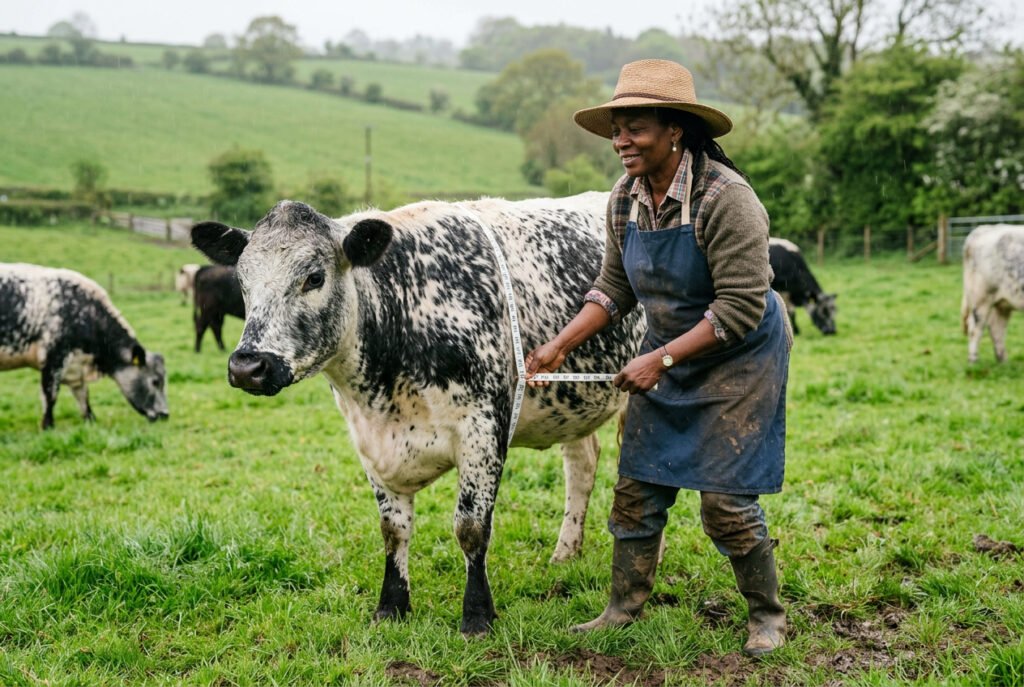
A livestock weigh tape is a purpose-made measuring tape with the weight estimation printed directly on the tape — the graduations on one side show heart girth inches, and the corresponding estimated weight in pounds appears on the other side. There is no calculation required. Measure the heart girth, and read the estimated weight directly from the tape.
Weigh tapes are specially marked to measure the heart girth and convert that measurement to a fairly accurate estimate of the animal’s body weight, printed on the tape. They are easy to use and can be utilized effectively for monitoring purposes — especially when used in a consistent manner by the same person. As University of Arizona Cooperative Extension notes, weigh tapes are inexpensive, practical, and appropriate for beef, dairy, sheep, and goat monitoring.
How to use a livestock weigh tape:
Step 1 — Position the tape. With the animal standing square and head forward, pass the tape around the body immediately behind the front legs at the heart girth position — the same location as the formula method.
Step 2 — Read the weight. Pull the tape snug. The weight in pounds appears on the tape opposite the measurement point. No calculation required.
Accuracy: Dairy breeds and Bos indicus cattle require breed-specific tapes — standard beef cattle tapes underestimate dairy cow weights and overestimate Bos indicus weights due to different body proportions at equivalent heart girth measurements. As confirmed by a peer-reviewed study in Veterinary Record Open, heart girth tapes provide relatively accurate bodyweight estimation (MAE: 2.66 kg), with inter-observer consistency and breed-appropriate tape selection being the primary variables affecting accuracy.
Suitable for: Quick field assessments, monitoring growth trends over time when the same person uses the same tape consistently, and all the same applications as the formula method.
Not suitable for: The same limitations as the formula method — commercial sales, controlled substance dosing, and genetic evaluation records.
Method 4 — Body Condition Score (For Nutritional Assessment Only)
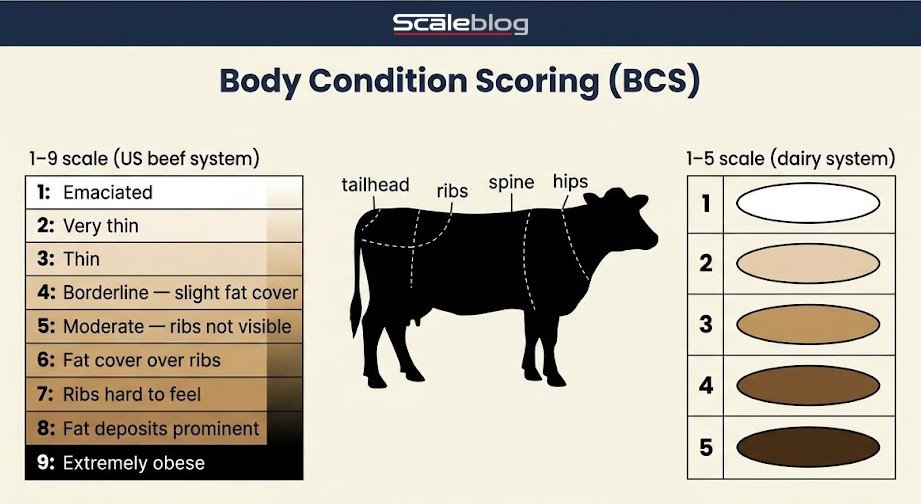
Body condition scoring (BCS) is a visual and tactile assessment of the amount of fat cover on specific anatomical reference points — the tailhead, the ribs, the spine, and the hips. It produces a score on a 1–9 scale (US beef system) or 1–5 scale (dairy system), not a weight figure.
BCS does not produce a weight estimate. It assesses the animal’s nutritional status — whether it is underweight, at optimal condition, or carrying excess condition — which is a different measurement from body weight. A large-framed cow can be at a healthy BCS 5–6 while weighing considerably more than a small-framed cow at the same BCS score.
As confirmed by Oklahoma State University Extension, body condition scores assess the amount of muscling and fat cover on an animal — not its actual body weight. Using BCS as a proxy for weight is a common error that produces unreliable medication doses and inaccurate market weight estimates.
Suitable for: Assessing nutritional status and making feeding decisions — specifically whether an animal needs more or less energy in its ration. Not for any application requiring a weight figure.
Method 5 — Visual Estimation (Least Reliable — Use as a Last Resort Only)
Experienced stockmen can estimate cattle weights visually — assessing frame size, muscle development, and body condition against a mental reference calibrated through years of handling known-weight animals. This approach works adequately as a rough sort — identifying animals that are clearly too light for market or obviously overweight — but produces errors of 10–20% or more in controlled studies.
A guesstimate or visual observation is usually very inaccurate and not recommended when determining medication dosages, rations, or any other time an accurate weight is important. As a PubMed-indexed clinical study found, 55% of visual weight estimates by experienced handlers were off by more than 10% from actual scale weight, with underestimation most common in heavier animals.
Visual estimation is the approach of last resort — useful only when no measuring tape is available, and a rough sort is the objective. Never use visual estimation for medication dosing, commercial sale weights, transport compliance, or performance records.
When Each Method Is Appropriate: Quick Reference
| Decision | Scale | Formula | Weigh Tape | BCS | Visual |
|---|---|---|---|---|---|
| Commercial sale by live weight | ✅ Required | ❌ Not legal | ❌ Not legal | ❌ | ❌ |
| Medication dosing — standard | ✅ | ✅ | ✅ | ❌ | ❌ |
| Medication dosing — controlled substances | ✅ Required | ⚠️ Use with caution | ⚠️ Use with caution | ❌ | ❌ |
| Feed ration planning | ✅ | ✅ | ✅ | ✅ | ❌ |
| Breeding weight assessment | ✅ | ✅ | ✅ | ✅ | ❌ |
| Performance records — genetic evaluation | ✅ Required | ❌ | ❌ | ❌ | ❌ |
| Transport weight compliance | ✅ Required | ❌ | ❌ | ❌ | ❌ |
| Growth monitoring — trend tracking | ✅ | ✅ | ✅ | ✅ | ❌ |
| Quick field assessment | ✅ | ✅ | ✅ | ✅ | ⚠️ Last resort |
The Measurement Mistakes That Reduce Estimation Accuracy
Whether using the formula or a weigh tape, four technique errors consistently reduce accuracy.
Wrong heart girth location: Measuring too far forward — in front of the shoulder blade rather than behind it — produces a consistently high reading. Measuring too far back — past the girth groove — produces a consistently low reading. The correct position is immediately behind the front legs at the heart girth point, where the chest is narrowest.
Animal not standing square: As with the animal’s head down, the chest expands, causing an overestimation of weight. The animal must have its head in a natural forward position and be standing on level ground with weight distributed evenly on all four feet. As University of Arizona Cooperative Extension confirms, consistent animal positioning at the time of measurement is as important as tape placement for reproducible results.
Measuring after feeding: Gut fill adds 50–100 lb of temporary weight to the reading. Both scale measurements and tape measurements are most accurate when taken before the morning feed and water — the same conditions used to set management benchmarks. It is recommended that the animal be kept off feed and water for 12 hours before measuring. As eXtension Beef Cattle confirms, consistent pre-measurement conditions are essential for producing weight records that reflect true body weight changes over time.
Inconsistent tape tension: Too tight underestimates weight. Too loose overestimates weight. Consistent, snug — not tight — tension on every measurement is essential for reproducible results across weighing sessions.
Newborn Calves — Special Considerations
Birth weight measurement requires a different approach from adult cattle. A newborn calf is too small for a livestock scale platform, too active for reliable tape measurement in the first minutes after birth, and light enough to be weighed using bathroom scales or a simple hanging scale.
Birth weights are best measured on a set of analog bathroom scales by holding the calf in your arms and deducting your own weight. This is accurate to the nearest pound — sufficient for birth weight recording purposes. After the first few days, the heart girth method becomes applicable for calves, though accuracy is somewhat reduced compared to adult cattle due to the proportionally rounder body shape of young calves. A peer-reviewed study in Veterinary Record Open confirmed that heart girth tapes provide reliable bodyweight estimation for pre-weaned calves across Holstein, Jersey, and Norwegian Red breeds.
For reference, birth weights by breed and the performance benchmarks from birth through to market weight, see our cattle weight chart.
Why Scale Weights Are Non-Negotiable for Commercial Sales
Any cattle transaction where the buyer pays based on live weight requires a certified, NTEP-certified scale reading — not an estimate. This is a legal requirement, not a preference.
As confirmed by the National Conference on Weights and Measures, any scale used in a commercial transaction where weight determines price must be NTEP certified and sealed by a state Weights and Measures inspector. A formula estimate or weigh tape reading has no legal standing as a commercial weight for a sale transaction. A buyer who accepts a tape-estimated weight for a live cattle purchase is not receiving the legal protection that a certified scale weight provides.
For operations that sell cattle directly from the farm by live weight, a certified livestock scale is not optional equipment — it is the legal instrument that makes the transaction defensible to both parties.
FAQs
What is the most accurate way to weigh a cow?
A certified livestock scale is the only method that produces a weight accurate enough for every cattle management decision. It produces readings accurate to ±1 lb. The heart girth formula and weigh tape methods produce estimates accurate to approximately ±5% — sufficient for most management decisions but not for commercial sales or genetic evaluation records.
How do you weigh a cow without a scale?
The most reliable method without a scale is the heart girth formula: Heart Girth × Heart Girth × Body Length ÷ 300 = estimated weight in pounds. Measure the heart girth circumference immediately behind the front legs at the heart point, measure the body length from the point of the shoulder to the pin bone, and apply the formula. A livestock weigh tape provides the same estimate from heart girth alone without requiring the calculation. Full details are in our article on how to estimate cattle weight without a scale.
How accurate is the heart girth formula for cattle weight?
The heart girth formula is accurate to approximately ±5% when measurements are taken correctly — meaning a 1,000 lb animal will typically estimate between 950 and 1,050 lb. Accuracy decreases for dairy breeds, Bos indicus cattle, pregnant cows, and animals over 2,000 lb. The formula is validated in peer-reviewed research as the most reliable non-scale estimation method for cattle.
When should I weigh cattle for the most accurate reading?
Weigh cattle before morning feeding and watering for the most consistent, accurate readings. Gut fill — the weight of feed and water in the rumen — adds 50–100 lb of daily weight variation that is not body weight. Weighing at the same time under the same feeding conditions at every session ensures that weight changes in records reflect real body weight changes rather than feeding variation.
Do I need a certified scale to sell cattle by live weight?
Yes. Any cattle transaction where the buyer pays based on live weight requires a certified NTEP scale reading. Formula estimates and weigh tape readings are not legally acceptable for commercial weight transactions. The scale must be NTEP certified and sealed by a state Weights and Measures inspector before being used for commercial sales.
How do you weigh a newborn calf?
Newborn calves are most practically weighed by holding the calf and standing on bathroom scales, then subtracting your own weight. This is accurate to the nearest pound — sufficient for birth weight recording. After the first few days, the heart girth formula can be applied to calves, though accuracy is slightly reduced compared to adult cattle.
Conclusion
Weighing a cow accurately requires matching the method to the decision it needs to support. A certified livestock scale is the only appropriate instrument for commercial transactions, genetic evaluation, and transport compliance. The heart girth formula and weigh tape are reliable tools for the vast majority of day-to-day management decisions — medication dosing, feed planning, growth monitoring, and breeding assessments — where ±5% accuracy is sufficient.
The technique errors that reduce estimation accuracy — wrong tape position, animal not standing square, measuring after feeding — are all preventable with consistent practice. The same measurements, taken by the same person, using the same technique at the same time of day, produce results accurate enough to track individual animal performance and make sound management decisions across an entire herd.