
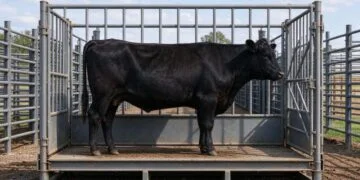







Quick answer: A mature U.S. beef cow typically weighs 1,200–1,600 lb (545–725 kg), and research summarized by the American Society of Animal Science puts today’s average near 1,400 lb — up from about 1,050 lb in 1975. Mature beef bulls usually weigh 1,700–2,300 lb, a mature Holstein about 1,500 lb and a Jersey about 900 lb. Registered Angus calves averaged 74–79 lb at birth in 2025, and fed cattle sent to market averaged 1,432 lb live weight in 2025 (USDA NASS).
Knowing whether your cattle are at the right weight for their age and breed is one of the most practical management tools available to any producer. A calf that is significantly underweight at weaning signals a health, nutrition, or management problem. A heifer that has not reached 60–65% of her mature weight before breeding will underperform reproductively. A steer that falls short of expected market weight costs money on the pen and in the sale ring.
This article provides reference weight charts for the major US cattle breeds by age and sex, explains what drives the differences between breeds, and covers the key weight benchmarks every producer should know — weaning weight, yearling weight, breeding weight, and finished market weight. For producers who need to estimate cattle weight without access to a scale, see our article on how to estimate cattle weight without a scale.
Table of Contents
Why Cattle Weight Varies So Much Between Breeds
Before using any weight chart as a management reference, it is important to understand the three variables that drive weight differences between individual animals — and why a single “average cow weight” figure is almost meaningless without context.
Frame size is the primary structural driver of weight. The Beef Improvement Federation (BIF) Frame Score system — based on hip height at a given age — predicts mature weight reliably across breeds. Each Frame Score unit represents approximately 2 inches of hip height difference and roughly 100–115 lb of mature weight difference. A Frame Score 7 Charolais cow will weigh substantially more than a Frame Score 4 Angus cow of the same age, even in identical body condition.
Sex affects both the rate of maturity and mature weight. Bulls reach greater mature weights than steers, and steers reach greater mature weights than heifers of equivalent genetics. If frame size is equal, heifers will mature quicker than steers — reaching puberty at a lower percentage of their mature weight.
Body condition can shift a mature cow’s apparent weight by 400 lb or more without any change in actual frame size. A mature cow weighing 1,200 lb in medium fatness or body condition weighs about 900 lb when extremely thin and 1,600 lb when extremely fat. All weight figures in this article assume moderate body condition (BCS 5) unless otherwise noted.
Raising a mixed-species operation? Our goat weight by breed guide covers the same growth-tracking approach, adapted for how dramatically goat weight varies by breed.
Cattle Weight Calculator (Tape Measure Method)
Formula: Cattle weight (lb) = heart girth² (in) × body length (in) ÷ 300. For example, a cow with a 70-inch heart girth and 64-inch body length weighs about 1,045 lb (474 kg).
How accurate is it? Tape estimates usually land within about 5–10% of scale weight for animals in average condition. Gut fill, pregnancy, very thin or very fat animals and young stock can push it further off, so confirm on a livestock scale before sales, medication dosing or feed decisions.
| Heart girth | Body length | Weight (lb) | Weight (kg) |
|---|---|---|---|
| 50 in (127 cm) | 45 in (114 cm) | 375 | 170 |
| 55 in (140 cm) | 50 in (127 cm) | 505 | 230 |
| 60 in (152 cm) | 55 in (140 cm) | 660 | 300 |
| 65 in (165 cm) | 60 in (152 cm) | 845 | 385 |
| 70 in (178 cm) | 64 in (163 cm) | 1,045 | 475 |
| 75 in (191 cm) | 67 in (170 cm) | 1,255 | 570 |
| 80 in (203 cm) | 70 in (178 cm) | 1,495 | 675 |
| 85 in (216 cm) | 73 in (185 cm) | 1,760 | 795 |
| 90 in (229 cm) | 76 in (193 cm) | 2,050 | 930 |
Average Mature Cow Weight by Breed
There is no official weight for each breed — mature size depends on genetics, frame score, body condition and age. Two things are clear from the research, though: U.S. beef cows have become much heavier over the past 50 years, and the differences between the major beef breeds are smaller than many online charts suggest.
- The average U.S. beef cow now weighs about 1,400 lb, up from roughly 1,050 lb in 1975 and 1,350 lb in 2009 (American Society of Animal Science summary, citing Oklahoma State University and Beef Improvement Federation data).
- Industry nutritionists quoted in the Angus Journal (June 2025) estimate cow weight has been rising by about 100 lb per decade.
- Most mature commercial beef cows at body condition score 5 fall roughly between 1,200 and 1,600 lb.
How beef breeds compare at maturity
The most rigorous breed comparison available comes from the USDA-ARS U.S. Meat Animal Research Center (USMARC), which analyzed more than 100,000 weight records from crossbred cows of 18 breeds (Zimmermann et al., Journal of Animal Science, 2021). Angus-sired cows were the heaviest at maturity. The table shows how other breeds compared.
| Breed of sire | Mature cow weight vs. Angus |
|---|---|
| Angus | Heaviest (baseline) |
| Charolais | about 20 lb lighter |
| Hereford | about 39 lb lighter |
| Simmental | about 74 lb lighter |
| Limousin | about 95 lb lighter |
| Red Angus | about 99 lb lighter |
| Shorthorn | about 132 lb lighter |
| Gelbvieh | about 145 lb lighter |
| Beefmaster | about 151 lb lighter |
| Braunvieh | about 301 lb lighter |
Brahman, Salers, Santa Gertrudis, Maine-Anjou, Brangus and Chiangus also fell within this range in the study’s ranking. These are average breed effects in crossbred research cows; differences between herds and bloodlines within a breed are often larger than the differences between breeds, so weigh your own cows rather than relying on a breed label.
Dairy breeds
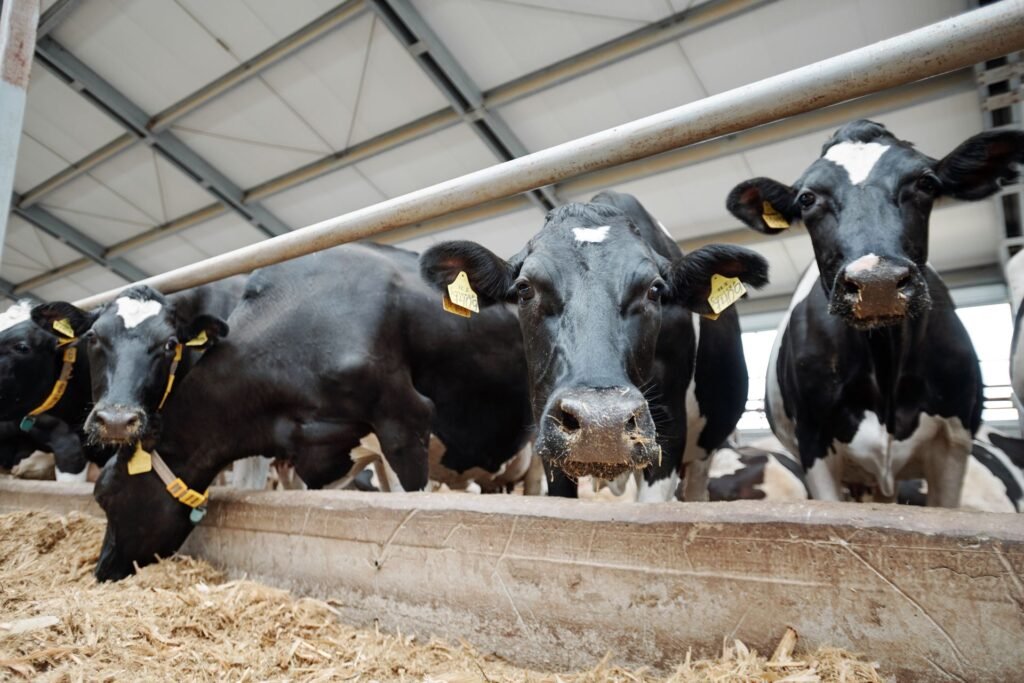
Dairy cows are bred for milk rather than muscle, and sizes differ sharply by breed. The Purebred Dairy Cattle Association lists a mature Holstein at about 1,500 lb, a Guernsey at about 1,200 lb and a Jersey at about 900 lb.
Average Mature Bull Weight by Breed
Mature beef bulls commonly weigh 1,700–2,300 lb, and many producers aim for about 2,200 lb or less because heavier bulls cost more to feed and are harder on facilities. For weights by breed and age from yearling to maturity, see our guide to average bull weight.
Cattle Weight Reference — Metric Conversions
For producers in Canada, Australia, the UK and other metric markets, here are the key reference weights converted to kilograms (1 lb = 0.4536 kg).
| Reference point | Pounds | Kilograms |
|---|---|---|
| Average U.S. mature beef cow (current) | ~1,400 lb | ~635 kg |
| Average U.S. mature beef cow (1975) | ~1,050 lb | ~476 kg |
| Typical mature commercial beef cow range | 1,200–1,600 lb | 545–725 kg |
| Mature Holstein cow | ~1,500 lb | ~680 kg |
| Mature Guernsey cow | ~1,200 lb | ~545 kg |
| Mature Jersey cow | ~900 lb | ~410 kg |
| Mature beef bull | 1,700–2,300 lb | 770–1,045 kg |
| Average U.S. fed cattle at slaughter (2025) | 1,432 lb live | ~650 kg live |
Need to convert your own scale readings? Use our weight converter.
Breed weight standards are published in both pounds and kilograms depending on the source. Use our kg to lb converter to switch between units without manual calculation.
Cattle Weight by Age — Growth Benchmarks
These are the weight benchmarks most commonly used in US beef cattle production management. All figures represent Angus and Angus-cross cattle at moderate body condition unless noted — the most common beef breed composition in the US.
Calves — Birth to Weaning (0–7 Months)
Beef calves typically weigh about 60–95 lb at birth and are commonly weaned at 150–210 days in the 450–650 lb range, with steers heavier than heifers. For month-by-month milestones and breed differences, see our guide “how much does a calf weigh?”
Growing Cattle — Post-Weaning to Yearling (7–14 Months)
| Age | Steer Weight (lb) | Heifer Weight (lb) | Notes |
|---|---|---|---|
| 7 months (weaning) | 540–650 | 480–575 | |
| 8 months | 590–720 | 520–630 | |
| 9 months | 650–790 | 565–690 | |
| 10 months | 710–860 | 615–750 | |
| 11 months | 775–930 | 665–810 | |
| 12 months (yearling) | 840–1,000 | 715–870 | |
| 14 months | 950–1,100 | 800–960 | Heifer breeding target weight |
Key milestone — yearling weight: Yearling weight is one of the most important performance indicators in beef cattle. Yearling weights for Angus cattle have increased by 96 lb since the 1970s due to improved genetics and management. The current Angus adjusted yearling weight benchmark is approximately 1,050–1,100 lb for steers.
Breeding Heifers — Weight Target Before First Breeding
Heifer breeding weight is one of the most consequential weight benchmarks in cow-calf production — because a heifer that is too light at breeding will fail to cycle, fail to conceive, or produce a weak first calf.
Heifers should weigh 60–65% of their expected mature weight at first breeding — typically at 14–15 months of age.
| Expected mature cow weight (lb) | Target breeding weight at 60–65% (lb) |
|---|---|
| 1,100 | 660–715 |
| 1,200 | 720–780 |
| 1,300 | 780–845 |
| 1,400 | 840–910 |
| 1,500 | 900–975 |
| 1,600 | 960–1,040 |
Why this benchmark matters: A heifer at 55% of mature weight at breeding has significantly lower conception rates than one at 65%. The extra 60–80 lb difference between an underweight heifer and a target-weight heifer has a direct impact on the calving percentage and ultimately the economic return of the cow-calf enterprise.
Feedlot and Market Cattle — Finishing Weights
Finished cattle are heavier than ever. USDA’s National Agricultural Statistics Service reports that commercial cattle slaughtered in 2025 averaged 1,432 lb live weight, up 33 lb from 2024, with an average dressed (carcass) weight of 878 lb.
| Class (federally inspected, 2025) | Average dressed weight (lb) | Approximate live equivalent* |
|---|---|---|
| All cattle | 878 | 1,432 (reported live weight) |
| Steers | 955 | ~1,500 |
| Heifers | 871 | ~1,370 |
| Cows | 658 | — |
| Bulls | 917 | — |
Carcass and Hanging Weight Reference
For producers selling on the rail or direct-to-consumer, the relationship between live weight and carcass yield is a critical commercial calculation.
| Live Weight (lb) | Estimated Hot Carcass Weight (lb) | Estimated Dressing Percentage |
|---|---|---|
| 1,000 | 600–630 | 60–63% |
| 1,100 | 660–693 | 60–63% |
| 1,200 | 720–756 | 60–63% |
| 1,300 | 780–819 | 60–63% |
| 1,400 | 840–882 | 60–63% |
| 1,500 | 900–945 | 60–63% |
Dressing percentage is the ratio of hot carcass weight to live weight. The typical range for beef cattle is 60–63%, depending on body condition, fill at weighing, and breed. British breeds like Angus tend toward the higher end of this range. Dairy breeds and Brahman-influenced cattle often yield slightly lower dressing percentages.
The Weight Gain Numbers That Matter for Herd Management
Understanding daily gain targets helps producers identify animals that are falling behind — before the weight deficit becomes a management crisis.
Target Average Daily Gain (ADG) by production stage:
| Stage | Target ADG (lb/day) |
|---|---|
| Nursing calf (birth to weaning) | 2.0–3.0 |
| Backgrounding — grass (weaning to 12 months) | 1.0–2.0 |
| Backgrounding — grain supplement | 2.0–3.0 |
| Feedlot finishing | 3.0–4.0 |
| Replacement heifer development | 1.5–2.0 |
An animal gaining below the lower threshold for its production stage is a signal requiring investigation — whether that is nutritional deficiency, parasite load, illness, or genetic underperformance. For the complete guide to tracking cattle weight gain over time using a livestock scale, see our article on how to track cattle weight gain.
How to Use a Livestock Scale to Capture These Benchmarks
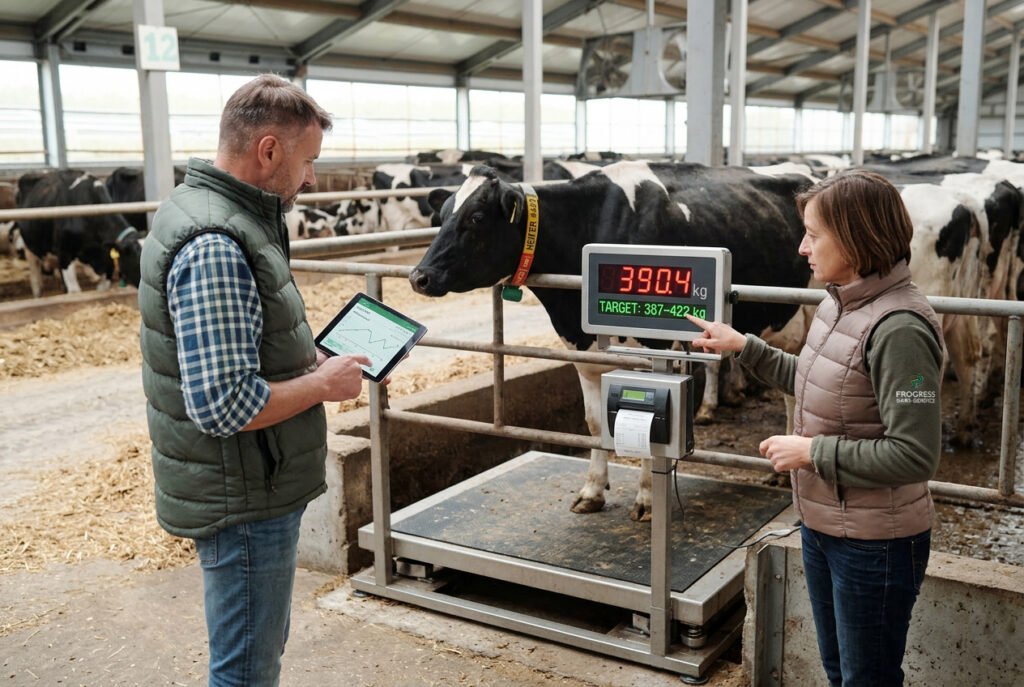
A weight chart is only useful if you have an accurate weight to compare against it. Estimating cattle weight by eye — even by experienced producers — carries a typical error of 5–10%, which is enough to miss a breeding weight benchmark or miscalculate a medication dose.
The practical approach for most operations is to weigh at four key points:
- Birth: Calf birth weights are strongly correlated with future performance and calving ease in subsequent generations. A birth weight record on every calf is the foundation of a genetic improvement program.
- Weaning: Weaning weight adjusted for age and dam age is the primary performance indicator for the cow-calf enterprise. Accurate weaning weights require a calibrated livestock scale — not an estimate.
- Pre-breeding: Heifers should be weighed 60 days before the intended breeding date to confirm they are on track to reach 60–65% of mature weight. Those falling short need supplemental nutrition — not a guess.
- Pre-sale or pre-slaughter: The most commercially consequential weighing event for most operations. The difference between an accurate scale weight and an estimated weight at market is real money.
For the full guide to selecting the right livestock scale for your operation — including weigh bar systems, cage systems, and portable options — see our complete guide to farm and livestock scales.
If your operation raises more than cattle, our pig weight by age guide covers the same growth-tracking approach for hog operations.
Estimating Cattle Weight When a Scale Is Not Available
When a livestock scale is not accessible — at a remote paddock, at an auction, or in a field emergency requiring medication dosing — the heart girth formula provides a reasonable weight estimate for cattle.
The heart girth formula:
Weight (lb) = (Heart Girth in inches² × Body Length in inches) ÷ 300
For the complete step-by-step guide to using this formula correctly — including how to measure heart girth and body length accurately, worked examples for different breed sizes, and when estimation is not sufficient — see our article on how to estimate cattle weight without a scale.
FAQs
What is the average weight of a beef cow?
A mature U.S. beef cow in moderate body condition (BCS 5) typically weighs 1,200–1,600 lb, and the national average is now close to 1,400 lb — up from about 1,050 lb in 1975. In USDA’s U.S. Meat Animal Research Center breed comparison, Angus-sired cows were the heaviest at maturity, with Charolais and Hereford close behind, so breed differences are smaller than many charts suggest.
How much does a calf weigh at birth?
Most beef calves weigh 65–95 lb at birth. Bull calves are typically 5–10 lb heavier than heifer calves at birth. Birth weight varies significantly by breed — Continental breeds like Charolais tend to produce heavier calves than British breeds like Angus, which is one reason Angus is commonly used as a calving-ease breed in first-calf heifer programs.
How much should a heifer weigh before breeding?
A replacement heifer is commonly targeted to reach 60–65% of her expected mature weight at first breeding, typically at 14–15 months of age. If the cows in your herd average 1,400 lb, that means a breeding weight of about 840–910 lb. Heifers well below target tend to cycle later and have lower conception rates.
What is the average slaughter weight for cattle in the US?
USDA NASS reports that commercial cattle slaughtered in the U.S. in 2025 averaged 1,432 lb live weight, 33 lb more than in 2024. Federally inspected steers averaged 955 lb dressed weight and heifers 871 lb, which corresponds to roughly 1,500 lb and 1,370 lb live.
How much does a yearling steer weigh?
A well-managed Angus or Angus-cross yearling steer at 12 months should weigh approximately 840–1,000 lb, depending on weaning weight, post-weaning nutrition, and genetic potential. High-performance genetics and intensive nutrition can push yearling weights to 1,100 lb or above in commercial feedlot programs.
What is the dressing percentage in cattle?
Dressing percentage is the ratio of hot carcass weight to live weight, expressed as a percentage. Most beef cattle yield a dressing percentage of 60–63%. A 1,300 lb steer with a 62% dressing percentage produces approximately 806 lb of hot carcass weight.
Conclusion
Cattle weight benchmarks — at birth, weaning, yearling, breeding, and market — are the reference points that separate informed management decisions from guesswork. A calf below the weaning weight target, a heifer below the breeding weight target, or a steer below the expected yearling weight are all problems that a scale and a chart identify early enough to act on.
The figures in this guide are reference points drawn from USDA, university and breed-association data. Individual animals and herds vary widely with genetics, nutrition, region and management, so the most valuable benchmark is your own herd’s weight history, recorded consistently on a calibrated scale.
Accurate, reliable weight data requires a calibrated livestock scale at key production events. For the complete guide to choosing, setting up, and using a livestock scale, see our farm and livestock scales guide.
Sources
- USDA National Agricultural Statistics Service, Livestock Slaughter 2025 Summary (April 2026).
- Zimmermann, M.J., Kuehn, L.A., Spangler, M.L., Thallman, R.M., Snelling, W.M. and Lewis, R.M. (2021). Breed and heterotic effects for mature weight in beef cattle. Journal of Animal Science, 99(8).
- American Society of Animal Science, Cow Size: Implications for Grazing Rangelands and the Beef Industry (2025).
- Oklahoma State University Extension, Mature Cow Size Considerations (AFS-3301).
- American Angus Association, Adjusted Weight Average by Birth Year.
- Angus Journal, Not Your Granddaddy’s Cows (June 2025).
- Purebred Dairy Cattle Association, Dairy Breeds.
- Kris Ringwall, NDSU Extension, BeefTalk: How Much Should Bulls Weigh?, republished by Drovers (2020).
Last reviewed September 2026 by the Scale Blog editorial team. Figures are updated as USDA and breed associations publish new data.