








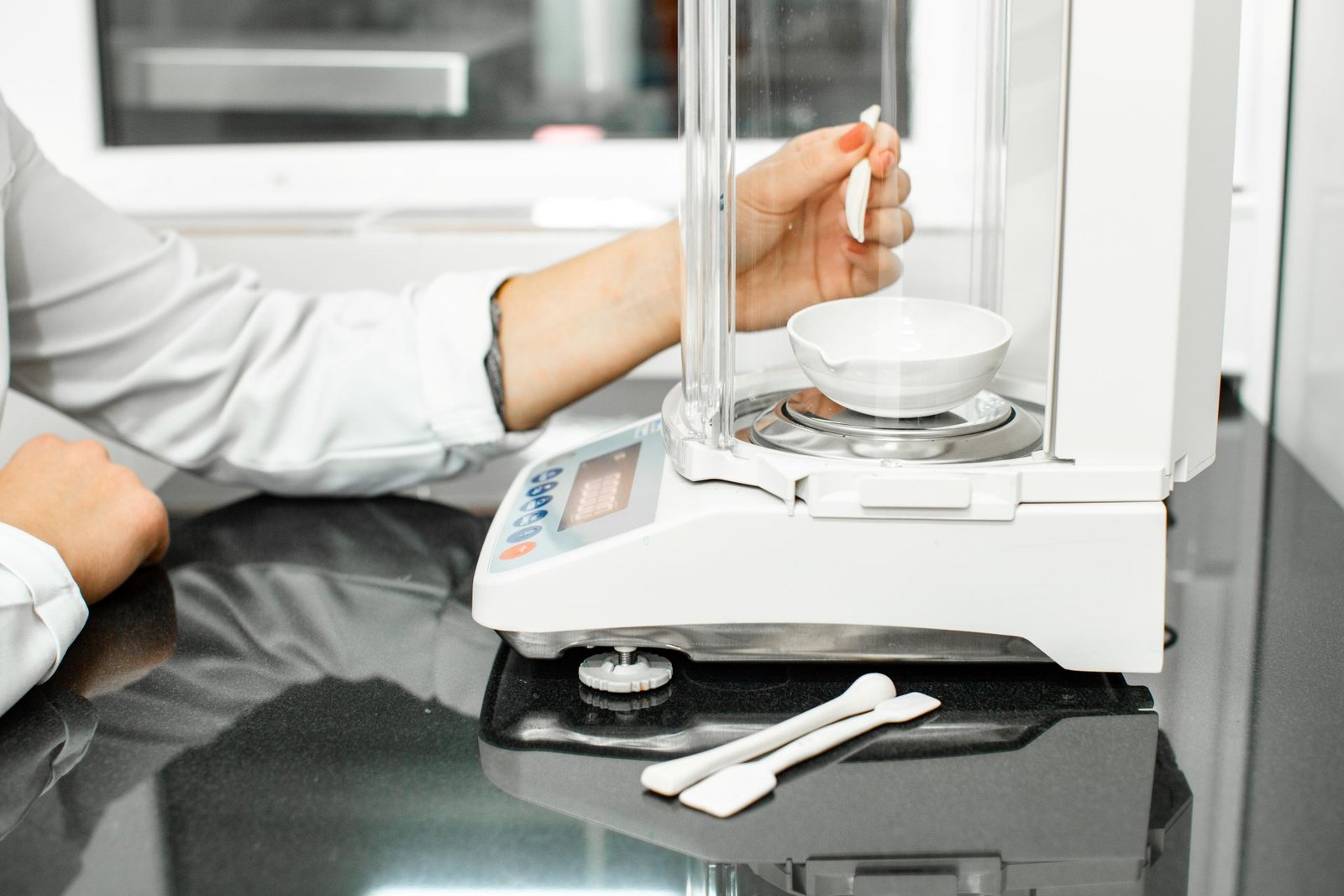
A laboratory balance measures mass to readabilities from 0.0000001 g (0.1 µg) to 0.1 g depending on type. The six types — ultra-micro, microbalance, semi-micro, analytical, precision, and top-loading — are selected based on the smallest mass difference your method requires. In GLP, GMP, and ISO/IEC 17025 regulated environments, balance selection, calibration frequency, and weighing documentation are regulatory requirements, not operational preferences.
A laboratory balance is one of the most consequential instruments in any analytical environment. Every concentration calculation, every batch release decision, every published research result that involves a mass measurement depends on whether the balance used to make it was appropriate, calibrated, and operating correctly. Choosing the wrong instrument, placing it in the wrong environment, or failing to maintain the calibration record that regulatory frameworks require can invalidate data — not after the fact, but retroactively, back to the last successful calibration event.
This guide covers every laboratory balance type, the environmental factors that govern accuracy, moisture analysis, calibration requirements, and the four regulatory frameworks — GLP, GMP, USP Chapter 41, and ISO/IEC 17025 — that govern how laboratory weighing must be performed, documented, and audited in regulated environments.
Table of Contents
The Difference Between a Balance and a Scale — and Why It Matters in a Lab
The terms balance and scale are used interchangeably in everyday language. In a laboratory context, the distinction carries practical weight.
A scale measures weight — the force of gravity acting on an object. A balance is used to determine mass, which does not depend on gravity. Modern electronic laboratory balances measure a force (usually by electromagnetic force compensation, EMFC) and convert it to mass, which is why they must be calibrated or adjusted with reference weights where they are installed: gravity varies from place to place, and a balance moved to a different site or floor can read differently until it is recalibrated.
The four specifications that define any laboratory balance’s capability — readability, accuracy, repeatability, and linearity — are explained in full in our article on what is a laboratory balance and how is it different from a scale.
The 6 Laboratory Balance Types — From Nanogram to Kilogram
Laboratory balances span six orders of magnitude in readability. Selecting the right type starts with identifying the smallest mass difference your method requires you to detect — and the largest sample plus container you will routinely weigh. The complete treatment of every type, including capacity ranges, draft shield requirements, and primary applications, is in our article on types of laboratory balances.
1. Ultra-Microbalance and Microbalance
Ultra-microbalances read to 0.0001 mg (100 nanograms). Microbalances read to 0.001 mg (1 microgram). Both require vibration isolation tables, controlled temperature and humidity, and fully enclosed weighing chambers. Maximum capacity is typically 2–30 g.
Primary applications: Particulate filter weighing for PM2.5 and PM10 environmental monitoring, pharmaceutical trace impurity analysis, nanotechnology research, and isotope ratio studies.
2. Semi-Micro Balance
Semi-micro balances read to 0.01 mg (10 micrograms) with typical capacities of 60–220 g. Many are dual-range instruments — providing five-decimal-place readability for light samples and four-decimal-place readability above a threshold weight. Draft shields are required.
Primary applications: Pharmaceutical API and reference standard weighing, differential weighing, pipette calibration verification, and fine chemical research requiring five-decimal precision.
3. Analytical Balance
The analytical balance — reading to 0.1 mg (0.0001 g) at capacities typically between 60 and 520 g — is the most widely used high-precision instrument in research, pharmaceutical QC, and regulated testing laboratories. The enclosed draft shield is standard. EMFC technology produces the repeatability and linearity required for four-decimal-place results.
For guidance on specifying an analytical balance for a regulated laboratory environment, see our complete analytical balance buying guide.
Primary applications: Quantitative chemical analysis, reagent and standard solution preparation, pharmaceutical ingredient weighing, content uniformity testing, gravimetric analysis, and any application requiring four-decimal-place results in grams.
4. Precision Balance
Precision balances read to 0.001–0.1 g at capacities from 200 g to 32 kg. Depending on the model and price point they use either EMFC or strain-gauge load cells; strain-gauge designs make higher capacities affordable. Draft shields are optional at coarser readabilities.
Primary applications: Routine solution preparation, buffer making, bulk reagent weighing, formulation at gram-level precision, teaching laboratory work, and industrial QC where sub-milligram resolution is not required.
5. Analytical Balance vs Precision Balance — Choosing Between Them
The most common and most expensive purchasing mistake in laboratory weighing is choosing the wrong balance type. The decision is determined by one number — the smallest mass difference your method requires you to resolve. The complete comparison — covering readability, mechanism, draft shield, environmental sensitivity, and cost — is in our article on precision balance vs analytical balance.
6. High-Capacity Laboratory Balance
High-capacity balances handle 3–70 kg at 0.1–1 g readability. They bridge the gap between precision laboratory instruments and industrial scales.
Primary applications: Raw material weighing in pharmaceutical and chemical manufacturing, animal weighing in research facilities, large batch formulation, and production-scale QC verification.

Moisture Analyzers — When a Balance Is Not Enough
A moisture analyzer is a dedicated laboratory instrument that measures moisture content by the Loss on Drying (LOD) method — weighing a sample before and after a controlled drying cycle and expressing the weight difference as a percentage. It combines a precision balance and a heating element in a single automated unit, replacing the oven-balance-desiccator workflow that previously required 1–4 hours with a single automated process producing results in 3–15 minutes.
Moisture analyzers are standard equipment in pharmaceutical QC, food production, plastics processing, and chemical manufacturing — any environment where moisture content is a quality specification, a release criterion, or a regulatory requirement. Three heating technologies cover different application needs: halogen heating for most routine laboratory applications, infrared for temperature-sensitive samples, and microwave for high-moisture materials such as pastes and dairy products.
The complete guide — covering how moisture analyzers work, heating element types, when to use one versus a drying oven, and the four key specifications — is in our article on what is a moisture analyzer and when do you need one.
Environmental Factors That Govern Laboratory Balance Accuracy
At 0.1 mg readability, a laboratory balance detects forces that are invisible in normal laboratory conditions — the air pressure from a centrifuge three feet away, a temperature change of 1°C, static charge on a plastic weighing vessel, and vibration transmitted through a standard bench surface all produce errors that appear on the fourth decimal place.
The seven environmental factors that affect laboratory balance accuracy — and the specific, practical fix for each — are covered in our article on what affects lab balance accuracy. A summary of each factor:
Vibration: Transmitted through bench surfaces from nearby equipment and foot traffic. Fix: anti-vibration table with isolation feet.
Air currents: From HVAC vents, open windows, and fume hood sash movement. Fix: closed draft shield doors, placement at least 1 meter from any air movement source.
Temperature and thermal gradients: Component drift from ambient temperature changes; convection currents from samples not at room temperature. Fix: internal calibration for drift compensation; always equilibrate samples to room temperature before weighing.
Static electricity: Builds up on plastic vessels, powder samples, and synthetic clothing in low-humidity environments. Fix: metal weighing vessels, humidity above 40% RH, anti-static ionizer.
Sample condition: Hygroscopic samples gain moisture during weighing; volatile samples lose mass. Fix: sealed containers for hygroscopic materials; rapid weighing for volatiles.
Leveling: A tilted balance shifts force off the vertical load cell axis. Fix: Check the bubble level before every session and adjust the leveling feet.
Air buoyancy: Relevant in high-accuracy calibration work where sample density differs significantly from reference weight density. Fix: buoyancy correction function available in most modern analytical balance software.
Laboratory Balance Calibration — Internal, External, and What the Record Must Contain
Calibration is the process that keeps a laboratory balance accurate and produces the documentary evidence that every weighing result was generated by an instrument performing within specification.
Two calibration methods apply in laboratory environments. Internal calibration uses a certified weight sealed inside the balance — activated automatically or manually — to compensate for temperature drift without operator intervention. It provides continuous calibration throughout the working day. External calibration uses separately certified OIML E2 or ASTM Class 1 reference weights placed manually by a qualified technician, producing a multi-point linearity verification with full NIST-traceable documentation.
Neither method alone is sufficient in a regulated laboratory environment. The optimal program combines both — daily internal calibration for temperature drift compensation, and periodic formal external calibration that produces the certified documentary record required by GLP, GMP, USP Chapter 41, and ISO/IEC 17025 audits.
The complete calibration guide — covering the two methods in detail, reference weight classes, the multi-point external calibration procedure, documentation requirements, risk-based frequency guidelines, and out-of-tolerance response — is in our article on how to calibrate a lab balance.
The Regulatory Frameworks That Govern Laboratory Weighing
Four regulatory frameworks govern laboratory balance use in pharmaceutical, research, food, chemical, and accredited testing environments. Each imposes different requirements, and understanding which one applies to your laboratory is the starting point for building a compliant weighing program.
GLP — Good Laboratory Practice
GLP governs non-clinical laboratory studies under FDA 21 CFR Part 58 and the OECD GLP Principles. It requires fitness-for-purpose instrument selection, NIST-traceable calibration at defined intervals, ALCOA+ documentation for all weighing records, and written SOPs governing all balance operations.
GMP — Good Manufacturing Practice
GMP governs pharmaceutical manufacturing and QC testing under FDA 21 CFR Part 211. It adds formal equipment qualification — Installation Qualification (IQ), Operational Qualification (OQ), and Performance Qualification (PQ) — to the GLP requirements. Electronic records in GMP environments must satisfy FDA 21 CFR Part 11 audit trail requirements.
USP Chapter 41 and Chapter 1251 — Pharmaceutical Weighing Standards
USP Chapter 41 is the mandatory pharmacopeial standard for balances used to “accurately weigh” materials in pharmaceutical contexts. The February 2026 revision added measurement uncertainty as an explicit compliance requirement — calibration certificates that show only pass/fail without documented uncertainty values are no longer audit-defensible. USP Chapter 1251 provides the scientific framework for IQ/OQ/PQ and minimum weight determination.
Minimum weight — the smallest quantity a balance can weigh with acceptable relative uncertainty — is calculated from demonstrated repeatability, not from the balance’s readability specification. It must be verified using the actual tare vessels used in routine work. The complete USP 41 and 1251 compliance guide — including the 2026 revision changes, the minimum weight formula, and the full audit readiness checklist — is in our article on pharmaceutical lab weighing and USP standards.
ISO/IEC 17025 — Laboratory Accreditation
ISO/IEC 17025:2017 is the international standard for testing and calibration laboratory competence, recognized internationally through the mutual recognition arrangement now run by the Global Accreditation Cooperation Incorporated (Global ACI). For a laboratory balance, accreditation under ISO/IEC 17025 requires calibration by an accredited provider, reported measurement uncertainty at 95% confidence on every calibration certificate, and documented conformity decision rules.
The full ISO/IEC 17025 balance calibration guide — covering the standard’s specific clauses, certificate requirements, traceability chain documentation, and how to build a compliant calibration program — is in our article on ISO/IEC 17025 and lab balance calibration.
For the complete comparison of GLP and GMP requirements — where they overlap and where they diverge for laboratory balances — see our article on GLP and GMP compliance for lab balances.

Selecting the Right Balance for Your Laboratory — The Decision Framework
Every laboratory balance selection decision follows the same sequence regardless of the regulatory framework or application.
Step 1 — Readability: Identify the smallest mass difference your method requires you to detect. This sets the minimum readability — and determines whether you need an analytical balance, a semi-micro balance, or a precision balance.
Step 2 — Capacity: Identify the largest sample plus container you will routinely weigh. Confirm the balance capacity accommodates this weight with a 10–20% buffer. Container tare weights — a 100 mL glass beaker weighs 80–100 g — consume a significant portion of working capacity on lower-capacity analytical balances.
Step 3 — Calibration type: Internal calibration for GLP and GMP environments, where temperature drift compensation is the primary daily requirement. External calibration capability for ISO/IEC 17025 accreditation requirements. Most regulated laboratories need both.
Step 4 — Connectivity: USB or RS-232 for LIMS integration. GLP-compliant printout with operator ID, date, time, and balance identification for all regulated applications. FDA 21 CFR Part 11 audit trail for pharmaceutical GMP electronic record environments.
Step 5 — Installation environment: Confirm the installation location meets all environmental requirements — anti-vibration surface, away from HVAC vents and heat sources, humidity controlled at 40–55% RH, and minimum 30–60 minute warm-up time after power-on.
Step 6 — Compliance qualification: For GMP, confirm IQ/OQ documentation packages are available from the supplier. For USP 41, verify minimum weight using the actual tare vessels at commissioning. For ISO/IEC 17025, confirm the calibration provider’s accreditation scope covers mass measurement at your balance’s readability level.
Whichever brand you choose, ISO/IEC 17025 traceability comes from calibration by an accredited provider, not from the balance itself.
Quick Reference: Balance Type by Application
| Application | Balance Type | Minimum Readability | Regulatory Framework |
|---|---|---|---|
| Pharmaceutical API weighing — R&D | Semi-micro | 0.01 mg | GMP / USP 41 |
| Pharmaceutical QC release testing | Analytical | 0.1 mg | GMP / USP 41 |
| Reference standard preparation | Analytical | 0.1 mg | GMP / USP 41 |
| Chemical quantitative analysis | Analytical | 0.1 mg | GLP / ISO 17025 |
| Environmental filter weighing | Semi-micro | 0.01 mg | ISO 17025 |
| Routine solution preparation | Precision | 0.001–0.01 g | GLP |
| Food production QC | Precision | 0.001–0.1 g | GMP / FSMA |
| Bulk raw material weighing | High-capacity | 0.1–1 g | GMP |
| Moisture content testing | Moisture analyzer | — | GMP / GLP |
| Teaching laboratory | Precision | 0.001 g | None / institutional |
FAQs
What is a laboratory balance?
A laboratory balance is a precision instrument used to measure mass with high accuracy and repeatability. It uses electromagnetic force compensation or strain gauge load cells to produce readings in grams, milligrams, or micrograms — at readabilities far finer than commercial or industrial scales. The full explanation is in our article on what is a laboratory balance.
What is the most accurate type of laboratory balance?
Ultra-microbalances provide the finest readability at 0.0001 mg (100 nanograms) — the highest resolution instrument in routine laboratory use. For most research and pharmaceutical QC applications, a semi-micro balance at 0.01 mg or an analytical balance at 0.1 mg is the appropriate standard. The full comparison of all six balance types is in our article on types of laboratory balances.
What environmental conditions does an analytical balance require?
A level, vibration-free surface; placement away from HVAC vents and air movement sources; stable temperature between 20–25°C; relative humidity between 40–55%; and a minimum 30–60 minute warm-up after powering on. The complete environmental requirements guide — with specific fixes for vibration, drafts, temperature, static, and other factors — is in our article on what affects lab balance accuracy.
What regulatory framework applies to my laboratory balance?
GLP applies to non-clinical research studies. GMP applies to pharmaceutical manufacturing and QC. USP Chapter 41 applies to any balance used to “accurately weigh” materials in a pharmaceutical context — the February 2026 revision requires documented measurement uncertainty on all calibration certificates. ISO/IEC 17025 applies to accredited testing and calibration laboratories. Many pharmaceutical laboratories operate under both GMP and USP 41 simultaneously.
How often does a laboratory balance need to be calibrated?
Daily in-house verification checks are standard for all regulated environments. Formal external calibration — producing a NIST-traceable certificate with reported measurement uncertainty — should be performed every 3–12 months depending on usage intensity and regulatory framework. Pharmaceutical GMP production balances typically require calibration every 3–6 months. The complete calibration frequency guide is in our article on how to calibrate a lab balance.
Conclusion
A laboratory balance program has three layers: the right instrument for the application, the right environment for the instrument, and the right calibration and documentation program for the regulatory framework.
Getting the instrument wrong — under-specifying readability or over-specifying capacity — is a recoverable error that wastes capital. Getting the environment wrong invalidates the instrument’s performance regardless of how well it was specified. Getting the calibration documentation wrong creates regulatory exposure that extends retroactively to every result the instrument has generated since the last compliant calibration event.
The articles in the Scale Blog Laboratory & Research cluster cover every layer of this decision in detail — from first principles through the most technically specific compliance requirements of USP Chapter 41’s February 2026 revision and ISO/IEC 17025 accreditation. Use the links throughout this guide to go as deep as your application requires.
Sources
- Sartorius, Analytical Balances.
- A&D, Analytical vs Precision Balance.
- American Pharmaceutical Review, USP 41 and 1251 Chapters on Balances.
- eCFR, 21 CFR 58.63 and 21 CFR 211.160.
- ANAB, Global ACI Transition Guide.
Last reviewed September 2026 by the Scale Blog editorial team.