







A checkweigher is a weighing system that verifies the weight of every individual product or package passing through a production line — automatically, in real time, and without stopping the line. Unlike a standard scale that measures weight when an operator places something on it, a checkweigher integrates into the production flow and compares each item’s measured weight against pre-set upper and lower limits, then accepts or rejects the item based on the result. For any manufacturer that packages goods sold by weight, a checkweigher is not a nice-to-have — it is the mechanism that keeps you on the right side of labelling law, quality standards, and customer expectations on every single unit that leaves the facility.
Table of Contents
How a Checkweigher Works
Checkweighers are specialised weighing devices that go beyond simply displaying weight — they compare the measured weight to a pre-set target weight range and trigger an action based on whether the item falls within, above, or below that range.
The mechanical sequence of a typical in-motion checkweigher consists of three belt sections:
1. Infeed Belt
The infeed belt controls the speed and spacing of products arriving from the upstream production line. It separates items to ensure only one product is on the weigh belt at a time, and brings each product to the correct speed and position for an accurate weight reading.
2. Weigh Belt
The weigh belt sits on a high-precision load cell. As the product travels across it, the load cell takes multiple weight readings over the transit time and the onboard computer averages those readings to determine the product’s weight. The entire weighing event takes a fraction of a second — advanced checkweighers can process over 500 items per minute, depending on product size and accuracy requirements.
3. Reject and Outfeed
Products within the specified weight range pass to the outfeed belt and continue down the line. Products outside the range — either underweight or overweight — are diverted by a reject mechanism. Common reject methods include a pneumatic pusher that sweeps the item sideways off the belt, a diverting arm, or a separate reject belt that drops or lifts out-of-tolerance packages into a collection bin.
The result is a 100% inspection rate — every product weighed, every product either confirmed or removed, with no sampling and no operator judgment required in the core process.
Static vs In-Motion Checkweighers
In-Motion (Dynamic) Checkweighers
In-motion checkweighers are the standard for high-volume production lines. Products are weighed while moving — there is no pause, no manual placement, and no interruption to line throughput. They are the dominant type in food and beverage packaging, pharmaceutical blister packing, and fast-moving consumer goods operations. Integration of metal detectors, X-ray inspection systems, and barcode scanners at a single inspection point is standard in modern food manufacturing, allowing multiple quality attributes to be verified simultaneously at a single station.
Static (Benchtop) Checkweighers
Static checkweighers — also called benchtop checkweighers — are used where products are weighed individually rather than on a continuous moving line. The operator places the item on the platform; the scale compares the reading to the programmed target and gives a clear over/under/acceptable indication via coloured lights or a display. Static checkweighers are appropriate for small-batch production, quality spot checks, laboratory use, and operations where throughput does not justify a full in-line system.
Where Checkweighers Are Used
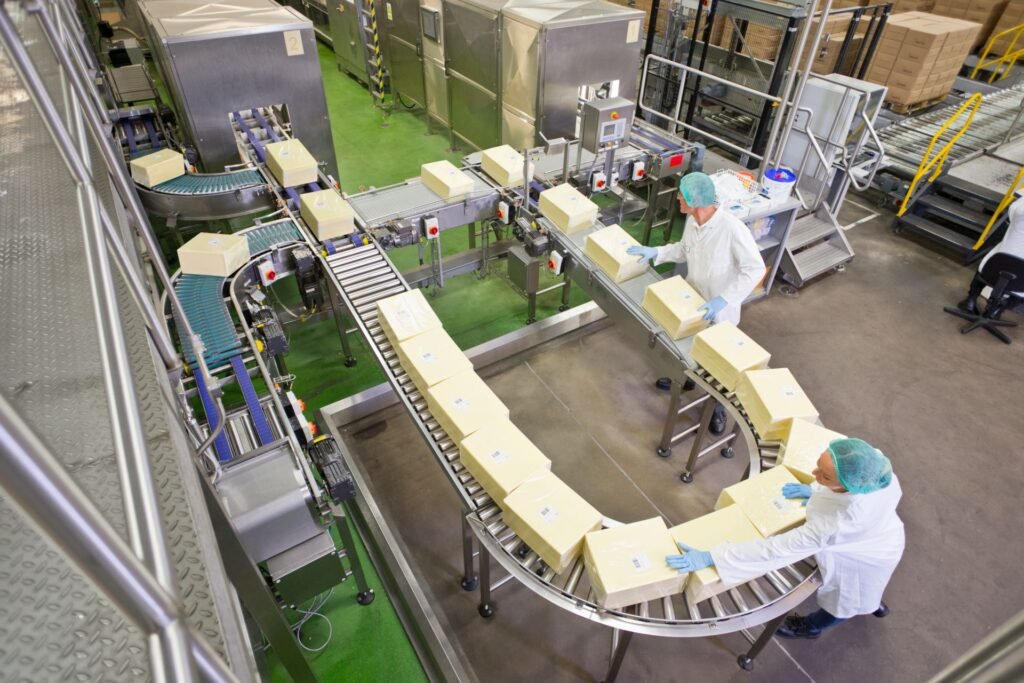
Food and Beverage Packaging
The primary application. Every packaged food product sold with a declared net weight must comply with the US net weight labelling law. Under NIST Handbook 133 — the national procedure for checking net contents of packaged goods — the average net quantity of contents of packages in a lot must at least equal the declared weight, and no individual package may fall below the labelled weight by more than the Maximum Allowable Variation (MAV). A checkweigher enforces both requirements continuously — not through sampling, but through 100% inspection of every package produced.
The financial case for checkweighing in food production runs in both directions. Underweight packages create legal liability and customer complaints. Overweight packages — product giveaway — directly reduce margin on every item shipped. A checkweigher eliminates both, tightening the fill process around the target weight rather than setting the filler conservatively high to avoid underweight risk.
Pharmaceutical Manufacturing
In pharmaceutical production, weight is a proxy for dose. A tablet that is 5% underweight may contain 5% less active ingredient. A capsule that is overweight may contain an unintended overage. GMP regulations require that pharmaceutical manufacturers verify the net content of finished product — checkweighers perform this verification at production speed with a complete audit trail of individual package weights.
Manufacturing Quality Control
Checkweighers are used in discrete manufacturing to detect missing components in assembled or packaged goods — a method sometimes called missing-piece detection by weight. If a finished electronics package should contain a charger, a cable, and a manual, the combined weight of a correctly packed box falls within a predictable range. A box missing any component will be measurably lighter. The checkweigher catches it before it reaches the customer.
Similarly, in metal parts manufacturing, checkweighers verify that machining operations have removed the correct amount of material — a bearing housing that is too heavy suggests insufficient machining; one that is too light suggests over-machining or a missing component.
Logistics and Distribution
High-volume distribution centres use checkweighers to verify that outgoing shipments match their declared weights for freight billing, to detect mispacked orders before they leave the warehouse, and to avoid chargebacks from retail customers who mandate accurate pack weights as a condition of supply.
The Regulatory Framework for Checkweighing in the US
Understanding the regulatory drivers for checkweighing is essential for any US manufacturer of packaged goods.
NIST Handbook 133 is the procedural guide used mainly by state and local weights and measures officials — and referenced in federal rules such as USDA FSIS’s 9 CFR 442 — to test whether packaged goods comply with net content labelling requirements. It defines the Maximum Allowable Variation (MAV) for different product categories and weights, and the sampling plans used during inspections. A facility that cannot demonstrate consistent compliance with these requirements during an inspection risks product seizure, fines, and mandatory corrective action.
NIST Handbook 44, Section 2.24 covers automatic weighing systems, including automatic checkweighers used in commercial or regulated applications. Checkweighers used for legal-for-trade purposes must meet the tolerances and test requirements defined in this section.
FDA regulations (21 CFR) require food manufacturers to use good-quality weighing equipment for any measurement that determines label compliance. For pharmaceutical manufacturers, GMP documentation requirements mean that checkweigher data — individual package weights, batch statistics, reject rates — must be available for inspection.
USDA FSIS regulations for meat and poultry products incorporate NIST Handbook 133 by reference, making its sampling plans and MAV tables mandatory for USDA-inspected establishments.
Choosing the Right Checkweigher: Key Specifications
Throughput Speed
Match the checkweigher’s rated throughput — measured in packages per minute — to your line speed. An undersized checkweigher becomes a bottleneck; an oversized one is wasted capacity. Most benchtop static checkweighers handle 10–30 items per minute per operator. In-motion systems typically range from 60 to 500+ items per minute, depending on product and accuracy class.
Weight Range and Accuracy
Specify the minimum and maximum product weight the system must handle, and the accuracy class required. A checkweigher specified for 500g products with ±1g accuracy will not perform reliably on 20g products — the relative error would be too large. As a rule of thumb, the checkweigher’s accuracy should be small compared with the MAV for your package size — for light pharmaceutical or precision food packs that often means about 0.1 g or better, while larger bulk packs can tolerate coarser performance. Confirm the achievable accuracy at your line speed with the supplier.
Environmental Specification
For food, dairy, meat, and beverage environments where the checkweigher will be cleaned with water, specify an IP66 or IP69K system with full stainless steel construction. For dry manufacturing and general industrial use, IP54 or IP65 may be appropriate. For a detailed explanation of what each IP rating means in practice, see our article on IP ratings for industrial scales explained.
Data Output and Integration
Modern production environments require checkweighers to feed weight data — individual pack weights, batch averages, standard deviations, reject counts — into quality management systems, ERP platforms, or statistical process control (SPC) software. Confirm the data output format and communication protocol before purchasing. For guidance on calibration requirements for checkweighers as precision measuring equipment, see our article on how often industrial scales should be calibrated.
Reject System
Match the reject mechanism to your product and line layout. Pneumatic pushers work well for rigid cartons and bottles. Diverting arms suit fragile or irregularly shaped products. Reject belt systems work for high-speed lines where a pusher would cause product damage. Lockable reject bins prevent out-of-specification items from being accidentally reintroduced to the line — specify them for any regulated application. For counting and parts verification applications where a checkweigher may work alongside a counting scale, see our article on what is a counting scale and how does it work.
Do You Need a Checkweigher?
A checkweigher is worth specifying when any of the following apply:
- You package goods sold with a declared net weight under the US labelling law
- Your production line speed exceeds what an operator can manually verify with a bench scale
- You operate under GMP, USDA, FDA, or FSMA requirements that mandate net content verification
- Your retail or wholesale customers require documented weight compliance as a condition of supply
- Product giveaway — consistent overfilling above the target weight — is costing a measurable margin
- You assemble kits or multi-component packages where missing components must be detected before shipment
- You are subject to Weights and Measures inspections that include net content verification
A standard bench scale with checkweighing function is sufficient when production volumes are low — under 30 items per minute — and sampling-based verification meets your quality system requirements. An in-motion checkweigher is the correct investment once line speed, volume, or regulatory requirements make 100% continuous inspection necessary.
Conclusion
A checkweigher is the quality control instrument that closes the gap between what your packaging line fills and what the law requires on the label. It enforces net weight compliance on every single product without slowing the line, catches missing components before they reach the customer, eliminates product giveaway by tightening the fill window around the target, and produces the documented weight records that regulatory inspectors and major retail customers increasingly require. The decision between a static benchtop unit and a full in-motion system comes down to throughput — once your line speed exceeds what manual spot-checking can cover reliably, a checkweigher is not optional. It is what makes your weight declaration credible.
FAQs
What is a checkweigher used for?
A checkweigher verifies that every product or package on a production line falls within a pre-set weight range — automatically, at line speed, and without operator intervention. It is used to enforce net weight labelling compliance, eliminate product giveaway from overfilling, detect missing components in assembled packages, and produce documented weight records for regulatory and customer compliance.
What is the difference between a static and an in-motion checkweigher?
A static (benchtop) checkweigher weighs products individually when placed on the platform by an operator — suitable for low-volume production and spot-checking. An in-motion checkweigher weighs products continuously as they move along a conveyor belt — the standard for high-volume packaging lines where 100% inspection at line speed is required.
Is a checkweigher required by law in the US?
Not explicitly mandated for every manufacturer, but the net weight compliance requirements under NIST Handbook 133 — used by USDA, FDA, FTC, and state Weights and Measures officials for inspection — effectively require manufacturers to demonstrate 100% compliance. A checkweigher is the most reliable way to achieve and document that compliance. For USDA-inspected meat and poultry establishments, NIST Handbook 133 is incorporated by reference into mandatory regulations.
How many items per minute can a checkweigher process?
Static checkweighers typically handle 10–30 items per minute per operator. In-motion checkweighers range from 60 to 500+ items per minute, depending on product size, weight range, and accuracy requirements. Advanced high-speed systems can exceed 500 items per minute for small, lightweight products on dedicated packaging lines.
What is a product giveaway in the context of checkweighing?
Product giveaway is the cost of consistently filling packages above the declared net weight to avoid the risk of underweight non-compliance. If a 500g package is filled to an average of 510g to create a safety margin, the extra 10g per pack is given away free. A checkweigher tightens the fill process around the target weight, reducing giveaway by allowing the fill point to be set closer to the declared weight with confidence that non-compliant underweight items will be caught and rejected.
Sources
- National Institute of Standards and Technology, NIST Handbook 133 (2026), Checking the Net Contents of Packaged Goods.
- National Institute of Standards and Technology, NIST Handbook 44 (2026), Section 2.24 Automatic Weighing Systems.
- USDA Food Safety and Inspection Service, 9 CFR Part 442, Quantity of Contents Labeling and Procedures and Requirements for Accurate Weights (§ 442.2 incorporates NIST Handbook 133 by reference).
- U.S. Food and Drug Administration, 21 CFR 101.7, Declaration of net quantity of contents; 21 CFR 211.68, Automatic, mechanical, and electronic equipment.
Last reviewed September 2026 by the Scale Blog editorial team. Compliance requirements depend on your product and jurisdiction; confirm with your weights and measures authority or regulator.