



Knowing how often to weigh livestock is one of those questions that sounds simple until you try to apply a single answer across cattle, pigs, sheep, and young stock at different production stages. The honest answer is: it depends on what you are trying to achieve. Weighing for market readiness is different from weighing to monitor herd health. Weighing finishing pigs is different from weighing breeding ewes. This guide breaks down recommended livestock weighing frequency by species and production stage, and explains what the numbers should actually tell you when you get them.
Table of Contents
Why Weighing Frequency Matters More Than Most Farmers Realise
Weight is one of the earliest indicators of a problem. An animal losing weight — or simply failing to gain at the expected rate — can signal disease, nutritional deficiency, parasite burden, social stress, or inadequate feed access, often before any visible symptoms appear. The earlier you catch a deviation from the expected growth curve, the cheaper and simpler the intervention.
Beyond health, regular farm animal weight tracking directly affects profitability. Selling an animal two weeks too early costs you kilograms of gain you have already paid for in feed. Selling two weeks too late costs you feed with no return. Neither error is obvious without data, and data requires a weighing schedule.
The challenge is that weighing too frequently adds labour costs and causes handling stress, which itself temporarily depresses weight through shrinkage. Oklahoma State University Extension notes that cattle moved around a corral lose roughly an additional 0.5% of body weight for every 30 minutes of handling, and cattle off feed and water shrink further over time. A good weighing schedule captures enough data points to track average daily gain (ADG) meaningfully without weighing so often that the process itself skews the results or exhausts your stockmanship.
Cattle: Recommended Weighing Frequency
Beef Cattle — Finishing
Beef cattle on a finishing programme should be weighed every 3–4 weeks as a minimum. This interval is long enough to show meaningful gain — a well-performing beef animal should add 0.8–1.5 kg per day — and short enough to catch underperformers before they drag down the feed conversion ratio of the whole group.
Key weighing points for finishing cattle:
- At housing — baseline weight entering the finishing period
- Every 3–4 weeks through finishing — tracking ADG against breed and system targets
- Pre-sale / pre-slaughter — confirm target market weight is achieved and estimate carcase weight
Weigh at the same time of day relative to feeding, and after the same period off feed and water where possible, to reduce variation between sessions.
Cattle on grain-based finishing rations commonly gain well over 3 lb per day: Kansas State University’s Focus on Feedlots reported January 2025 closeouts averaging 3.58 lb per day for steers and 3.27 lb per day for heifers. At those rates, a 3–4 week weighing interval captures meaningful performance data between sessions.
Beef Cattle — Store and Growing Stock
Store cattle and growing young stock benefit from monthly weighing as a minimum, with a weigh at turnout in spring and at housing in autumn as fixed markers regardless of what happens in between. These two weights give you the season’s performance data — the growth achieved on grass versus the expected target. On days between scheduled weighing sessions, some producers use body measurements to track condition — our guide to how to estimate cattle weight without a scale covers the most reliable field methods.
Dairy Cattle
Dairy cows are typically weighed every 4 weeks, aligned with body condition scoring (BCS) assessments. Weight and BCS together give a more complete picture than either alone — a cow can maintain weight while losing condition, or appear heavy while her BCS is declining due to fluid retention.
Critical weighing points for dairy cows:
- Dry-off — benchmark entering the dry period
- Pre-calving (3–4 weeks before) — monitor for excessive condition loss or gain
- Early lactation (weeks 2–6) — the high-risk period for negative energy balance and associated metabolic disease
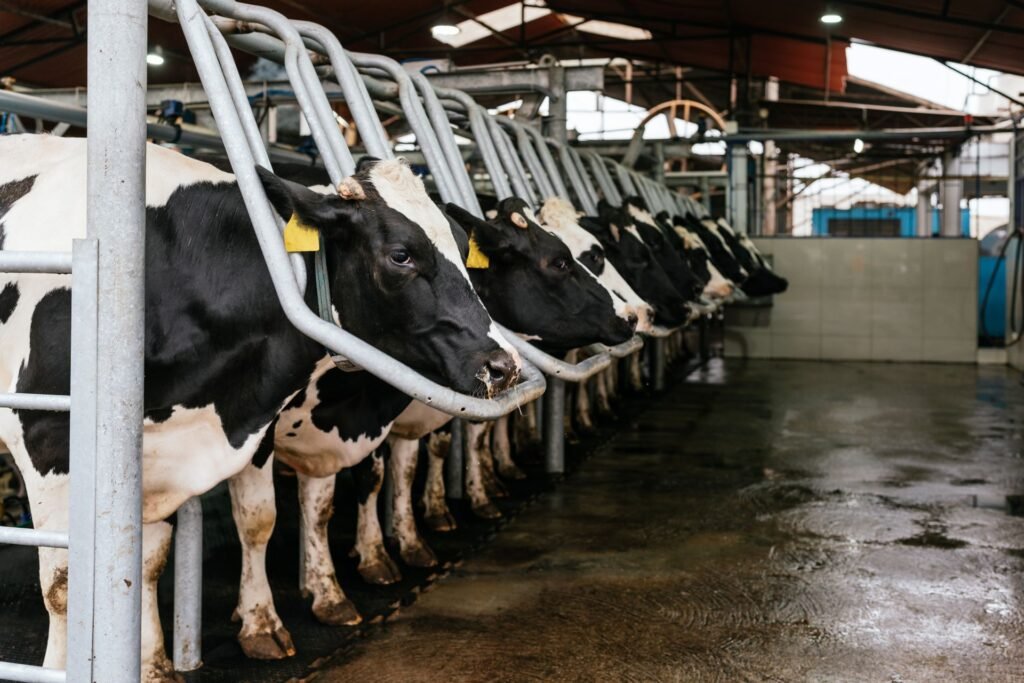
Dairy nutrition guidance commonly recommends scoring body condition at least at pregnancy confirmation, dry-off and calving, and aiming for cows to lose no more than about one body condition score unit after calving to protect milk production and fertility.
Pigs: Recommended Weighing Frequency
Pigs have the fastest growth rates of common farm livestock and the narrowest market weight windows, which makes their weighing schedule the most time-sensitive.
Finishing Pigs
Pigs on a finishing programme should be weighed every 2 weeks from approximately 50 kg liveweight onward. Most finishers target a deadweight of 80–100 kg, which represents a live weight of around 95–115 kg. The window between under-weight and over-weight for premium deadweight payments is often only 10–15 kg — a margin a pig can pass through in less than two weeks at typical growth rates of 700–900 g per day.
Weigh a representative sample of the group if individual weighing is impractical — typically 10–15% of the pen — and use the average to estimate when the pen will hit target weight.
Choosing the right equipment is as important as the weighing schedule — see our guide to the best scale for weighing pigs at market weight for a full specification breakdown.
Weaners and Growers
Weigh pigs at weaning, at 8 weeks, and at approximately 30–35 kg as they transition into the finishing stage. These three fixed points confirm that each stage is on track and allow feed allocation to be adjusted before problems compound.
Sheep: Recommended Weighing Frequency
Finishing Lambs
Lambs being finished for market should be weighed every 3 weeks from weaning. Lamb growth rates of 200–350 g per day mean a 3-week interval captures a weight gain of 4–7 kg — enough to show clearly whether the animal is on track for target market weight.
Sort the group at each weigh: forward lambs ready for market, mid-weight lambs continuing, and light lambs that may need assessment. This prevents the common error of holding back the whole group while the light end catches up, which wastes feed on animals that are already past their most efficient growth phase.
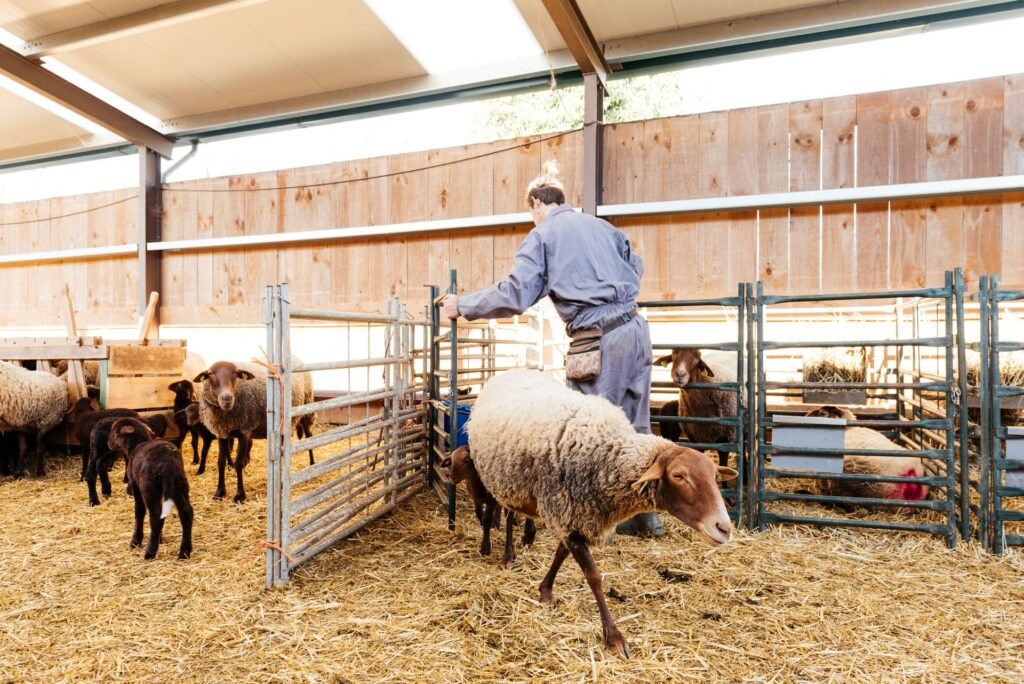
Selecting replacements on measured, age-adjusted weights rather than by eye gives you objective data to compare animals fairly — and it is the same approach breed associations use to calculate adjusted weaning and yearling weights.
Breeding Ewes
Breeding ewes should be weighed and condition scored at four key points in the production cycle:
- Weaning — identify thin ewes needing preferential treatment before mating
- Flushing / pre-mating (6 weeks before) — confirm ewes are gaining or at target BCS for mating
- Mid-pregnancy (day 90–100) — adjust nutrition for ewe body weight and litter size
- Pre-lambing (3–4 weeks before) — final check to ensure ewes are not over- or under-conditioned entering lambing
Young Stock and Calves: First 12 Months
Young stock are disproportionately valuable data points. Calf growth in the first 12 months of life has long-term consequences for mature size, reproductive performance, and milk production in dairy replacements.
Weigh calves:
- At birth — baseline and health indicator
- At weaning — assess pre-weaning ADG; target varies by breed and system
- Monthly through the first year — catch check-backs early; assess the programme against breed growth standards
A heifer that hits puberty at a higher percentage of mature body weight will cycle earlier and conceive more reliably. Monitoring weight against breed targets from birth is one of the most practical tools for improving reproductive performance in beef and dairy herds.
Body condition at calving is one of the strongest predictors of how quickly beef cows return to heat after calving and how many become pregnant in a controlled breeding season — which makes pre-calving weighing and body condition scoring one of the most commercially important checks of the year.
For operations recording individual animal weights, EID tagging and how it works with livestock scales automates the ID step and eliminates transcription errors entirely.
Practical Tips to Improve the Accuracy of Your Weighing Sessions
Getting the frequency right is only half the job. Consistency of method matters equally:
- Weigh at the same time of day — gut fill variation across the day can account for 3–5% of live weight
- Use the same pre-weigh period off feed and water — 12–16 hours is standard for cattle; 3–4 hours for pigs and sheep where practical
- Calibrate your scale before each session — even a 1% error compounds across a season of data
- Record every individual weight — group averages hide the underperformers who need action
- Account for shrinkage — animals weighed after a long journey or handling session will be lighter; factor in a shrinkage allowance before comparing with previous records
“Routine weights on meat animals should only be collected every two weeks — weighing more often leads to more work for less accurate data due to day-to-day variation in gut fill and animal condition.”
For a full walkthrough of calculating average daily gain and comparing performance against breed benchmarks, see our guide on how to track cattle weight gain over time.
Conclusion
There is no single universal answer to how often you should weigh livestock — but there is always a right answer for your species, stage, and goal. As a starting point: beef finishers every 3–4 weeks, pigs every 2 weeks from 50 kg, lambs every 3 weeks from weaning, and dairy cows every 4 weeks aligned with BCS. Young stock should be weighed monthly in year one. Whatever your schedule, consistency of method matters as much as frequency — weight data is only useful if it is comparable from session to session. Start with a simple schedule, stick to it, and the numbers will tell you things about your animals that no amount of visual assessment ever could.
FAQs
How often should you weigh beef cattle?
Beef cattle on a finishing programme should be weighed every 3–4 weeks. Store and growing cattle benefit from monthly weighing as a minimum, with fixed weights at housing and turnout as seasonal benchmarks.
How often should you weigh finishing pigs?
Finishing pigs should be weighed every 2 weeks from approximately 50 kg liveweight. The market weight window for premium deadweight payments is narrow — typically 10–15 kg — and pigs can pass through it in less than two weeks.
How often should you weigh sheep?
Finishing lambs should be weighed every 3 weeks from weaning. Breeding ewes should be weighed, and condition scored at four key points: weaning, pre-mating, mid-pregnancy, and pre-lambing.
How often should you weigh calves?
Weigh calves at birth, at weaning, and monthly through the first year of life. Early growth in calves has long-term consequences for reproductive performance and mature productivity.
Does weighing stress affect livestock weight?
Yes. Animals typically lose 0.5–3% of live weight through shrinkage during handling and transport. Weigh at the same time of day, after a consistent period off feed and water, to ensure data is comparable between sessions.
Sources
- Kansas State University, Focus on Feedlots.
- Oklahoma State University Extension, Managing Shrink and Weighing Conditions in Beef Cattle.
- Penn State Extension, Adjusting and Monitoring Meat Animal Growth Rate.
Last reviewed September 2026 by the Scale Blog editorial team.