





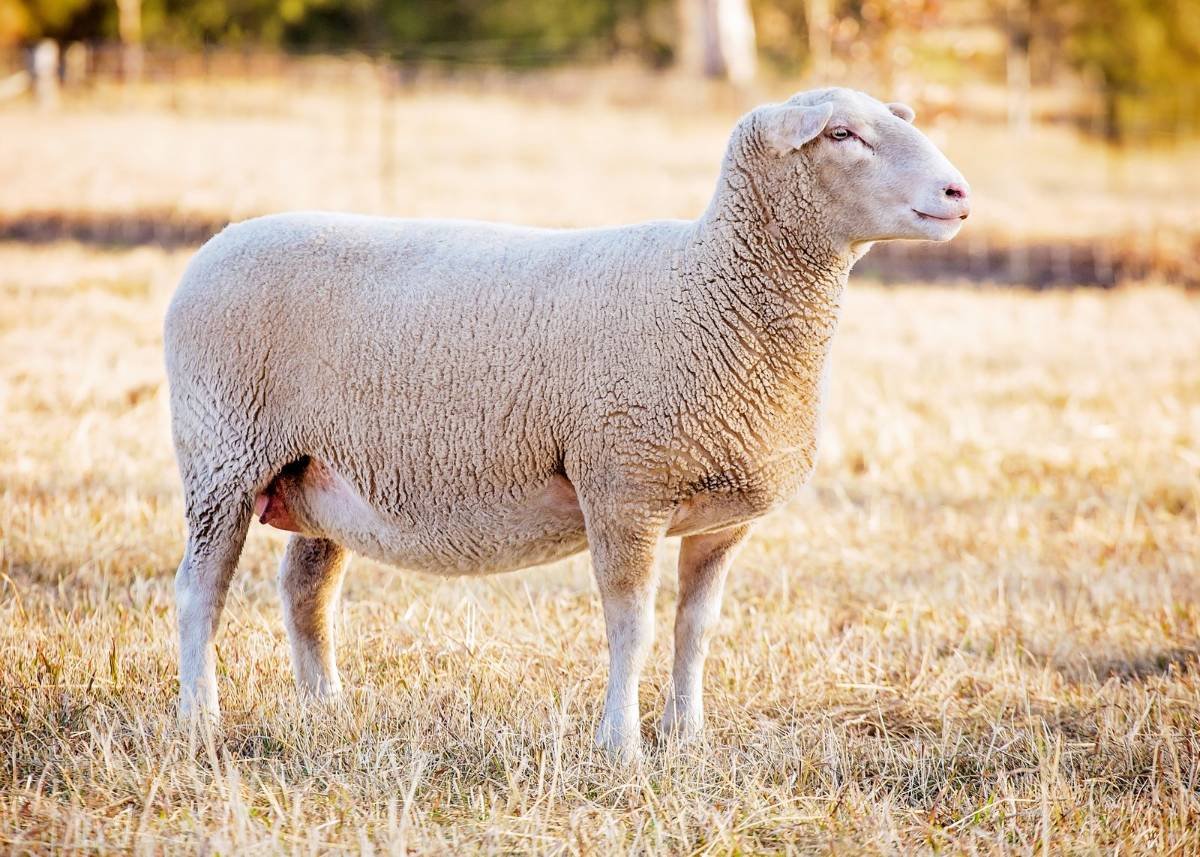
A mature sheep typically weighs 100–350 lb (45–159 kg), depending on breed and sex. Most meat-breed ewes weigh about 130–250 lb (59–113 kg), rams of the same breeds run heavier, and newborn lambs usually weigh 8–12 lb (3.6–5.4 kg).
| Sheep | Typical weight | Notes |
|---|---|---|
| Mature ewe (meat breeds) | 130–250 lb (59–113 kg) | Southdown at the light end, Suffolk and Hampshire at the heavy end |
| Mature ram (meat breeds) | 180–350 lb (82–159 kg) | Big Suffolk rams can reach 350 lb |
| Wether / market lamb | 120–160 lb (54–73 kg) | Typical weight for the traditional US lamb market |
| Newborn lamb | 8–12 lb (3.6–5.4 kg) | Singles heavier than twins or triplets |
Of course, “a sheep” covers everything from a small hair-sheep ewe to a 300-pound Suffolk ram. So how much does a sheep weigh on your place? The rest of this guide breaks sheep weight down by breed, age and sex — and gives you a free sheep weight calculator for when there is no scale in the barn.
Table of Contents
Sheep Weight by Breed
Breed makes the biggest difference to sheep weight. The figures below are mature weights published by each breed’s association or by Oklahoma State University’s Breeds of Livestock project. We left out breeds where we could not find a university or breed-society figure.
| Breed | Mature ewe | Mature ram | Type | Source |
|---|---|---|---|---|
| Suffolk | 180–250 lb (82–113 kg) | 250–350 lb (113–159 kg) | Meat | OSU |
| Hampshire | 200 lb+ (91 kg+) | 275 lb+ (125 kg+) | Meat | OSU |
| Dorset | 150–200 lb (68–91 kg) | 225–275 lb (102–125 kg) | Meat (dual-purpose) | OSU |
| Southdown | 130–180 lb (59–82 kg) | 190–230 lb (86–104 kg) | Meat | OSU |
| Dorper | About 209 lb (95 kg) average | About 233 lb (105.5 kg) average | Hair / meat | Dorper Sheep Breeders’ Society of SA |
| Katahdin | 120–160 lb (54–73 kg) | 180–250 lb (82–113 kg) | Hair | OSU |
| Rambouillet | 150–200 lb (68–91 kg) | 250–300 lb (113–136 kg) | Fine wool | OSU |
| Merino (Delaine, C-type) | 125–180 lb (57–82 kg) | 175–235 lb (79–107 kg) | Fine wool | OSU |
| Romney | 150–200 lb (68–91 kg) | 225–275 lb (102–125 kg) | Long wool | OSU |
A few patterns jump out. Meat breeds such as Suffolk and Hampshire are the heavyweights. Hair sheep like the Katahdin are noticeably lighter, which is part of their appeal for smaller farms. Fine-wool breeds sit in the middle, and remember that a ewe in full fleece carries extra weight that disappears at shearing.
Breed averages are a starting point, not a target. Condition, age, pregnancy and how the flock was fed all move the number — which is why it pays to weigh your own animals. Raising goats too? Our guide on how much a goat weighs uses the same approach.
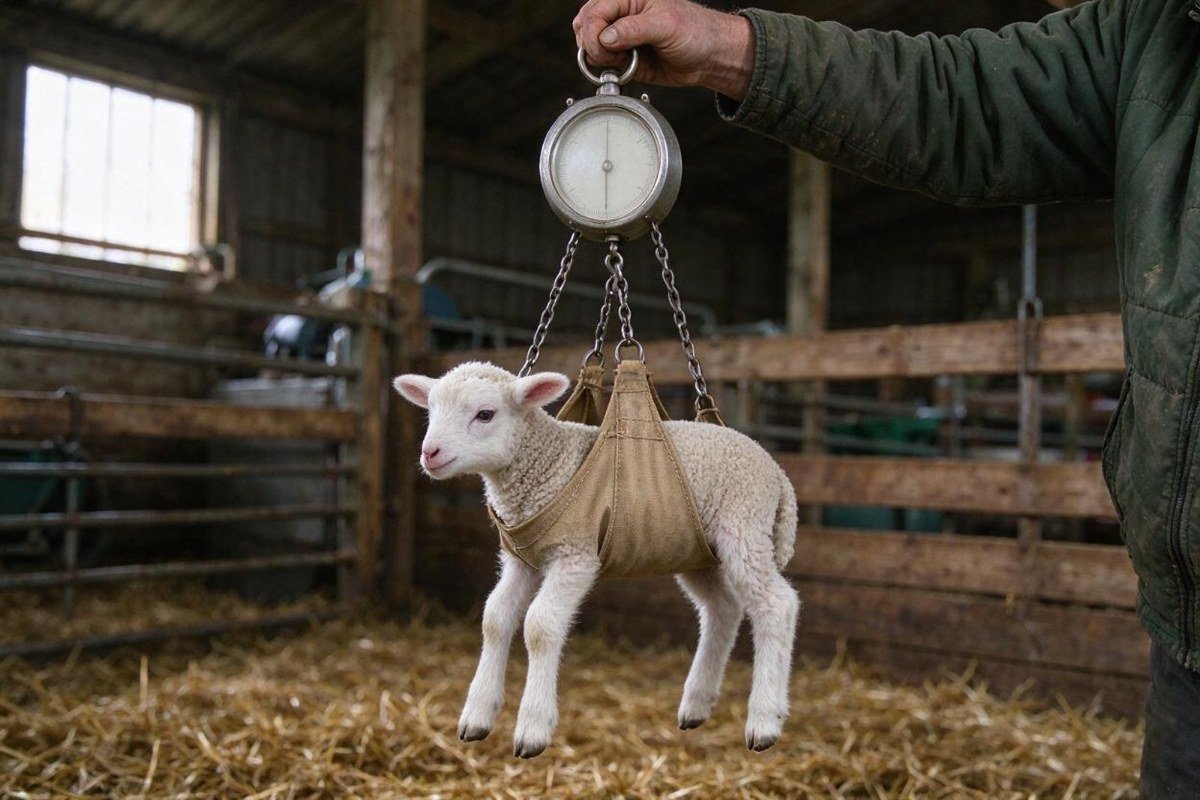
How Much Does a Lamb Weigh?
Lambs grow fast, so the answer depends on when you ask. Here is how weight typically changes from birth to market:
| Stage | Typical weight | Notes and source |
|---|---|---|
| Birth | 8–12 lb (3.6–5.4 kg) | Singles are usually heavier than twins or triplets. Penn State Extension suggests a goal of 8–10 lb for lambs from moderate-sized ewes (about 150–175 lb). |
| Weaning (about 60 days) | Varies with breed, litter size and milk supply | Weaning weights are usually compared adjusted to 60 days. Penn State’s worked example: a twin ewe lamb that was 10 lb at birth weighed 62 lb at 61 days. |
| 6 months (Dorper example) | 105–120 lb (48–55 kg) | Dorper society averages: ewe lambs 47.8 kg, ram lambs 54.6 kg at 6 months. |
| Show lamb (4-H) | About 110 lb (50 kg) at show | Utah State guidance targets about 110 lb, gaining roughly 0.6–0.7 lb a day from selection. |
| Market lamb | 120–160 lb (54–73 kg) | The traditional US market prefers larger lambs; some holiday markets want 60–100 lb lambs. |
If you are selling into a specialty or holiday market, ask your buyer what weight they want before you set a finishing plan. K-State notes buyers for Ramadan and Eid al-Fitr often look for 60–80 lb lambs, and Eid al-Adha buyers for 60–100 lb or more — well under the traditional 120–160 lb target.
Weighing young lambs regularly is the easiest way to catch a slow grower early. For a schedule that works, see how often you should weigh livestock.
Sheep Weight Calculator
No scale? A cloth measuring tape gets you surprisingly close. Enter your sheep’s heart girth and body length below — in inches or centimeters — and the calculator estimates live weight in pounds and kilograms.
Sheep Weight Calculator (tape method)
Units:
Formula: heart girth (in) × heart girth (in) × body length (in) ÷ 300 = weight (lb), from WSU Extension. Centimeters are converted to inches first. Estimate only — use a scale when dosing or selling by weight.
The calculator uses the tape formula published by Washington State University Extension: heart girth × heart girth × body length ÷ 300 = weight in pounds, with all measurements in inches. WSU’s own example is a sheep with a 35 in heart girth and a 30 in body length: 35 × 35 × 30 ÷ 300 = about 122 lb (55 kg).
Treat the answer as an estimate. A peer-reviewed study cited by veterinarian Elliott Garber on Creatures.com found some heart-girth models miss by more than 10% — that is 15 lb or more on a 150 lb ewe. Good enough for tracking growth; not good enough for dosing or selling. We use the same idea for other species in our cattle weight calculator and cattle weight chart.
How to Measure a Sheep for Weight
Accurate inputs make or break a tape estimate. Here is how to take both measurements:
How to measure a sheep’s heart girth and body length to estimate its weight with a tape.
Get a helper and a soft tape
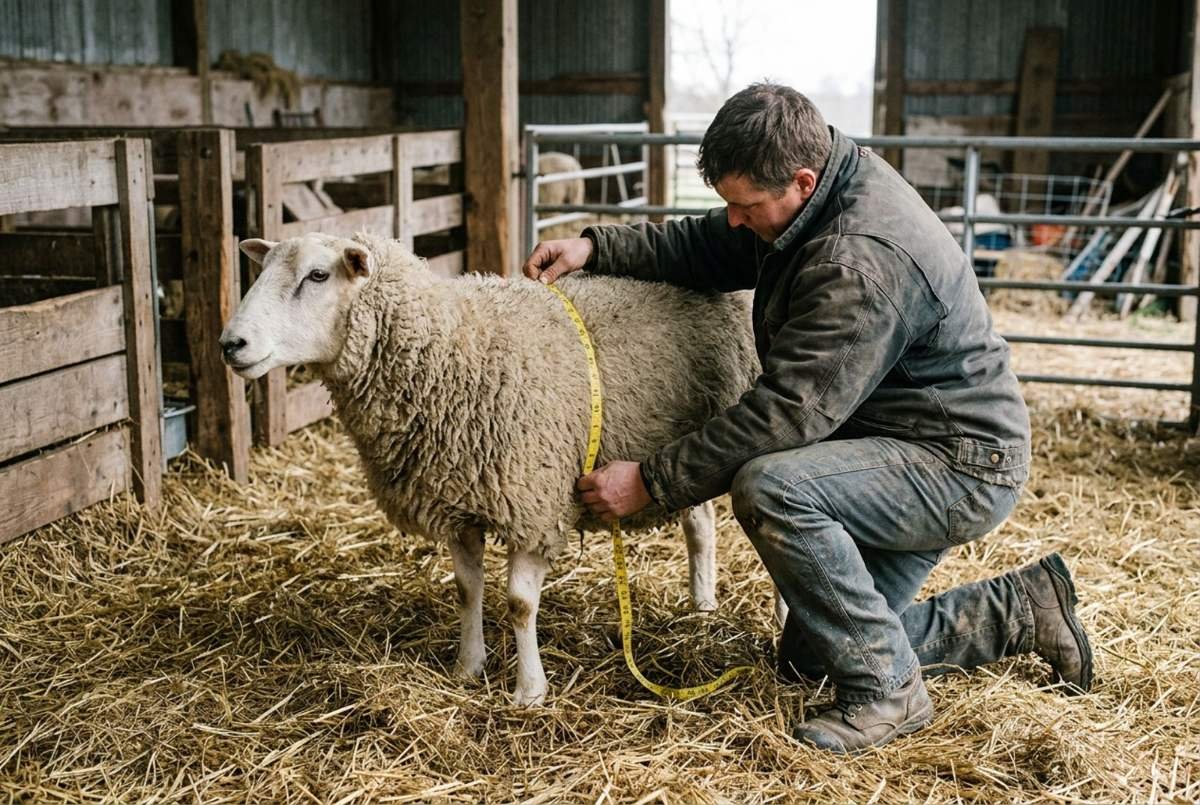
Use a cloth or vinyl measuring tape (not a steel one) and have someone hold the sheep so it stands square on level ground with its head up.
Find the heart girth position
Place the tape around the body just behind the front legs and shoulder blades — right where the heart sits.
Press the wool flat
On a woolly sheep, push the tape down through the fleece so you measure the body, not the body plus the wool. Pull it snug but not tight, and read the heart girth.
Measure body length
Measure along the side of the sheep from the front of the shoulder to the rear of the hindquarters, keeping the tape straight — follow the A–B line in WSU Extension’s illustration (linked in the sources).
Write both numbers down
Record each measurement straight away, in inches if you want to use the formula by hand.
Calculate
Multiply heart girth × heart girth × body length and divide by 300 for weight in pounds — or type the numbers into the calculator above.
Repeat and average
Take each measurement twice. If they differ, measure a third time and use the average.
Measure at the same time of day each time, ideally before the sheep has eaten and drunk, because a full rumen adds weight. For the bigger picture on what throws readings off — on a tape or a scale — see what affects animal weight accuracy.
Body Condition Score and Why Weight Matters for Dosing
Weight tells you how big a sheep is; body condition score (BCS) tells you how fat or thin it is. Utah State University Extension recommends scoring by hand on a 1–5 scale, because wool makes scoring by eye unreliable. Feel along the backbone in the loin, just behind the last rib:
| BCS | What you feel at the spine | Condition |
|---|---|---|
| 1 | Sharp spine, like the tips of your fingers | Very thin |
| 2 | Like the knuckles of a closed fist | Thin |
| 3 | Like knuckles with your fingers slightly curved | Good / average |
| 4 | Like the back of your hand | Fat |
| 5 | Like the fleshy base of your palm; dip along the spine | Very fat |
USU suggests ewes should be around 3–3.5 at breeding and 3–3.5 at lambing for singles (3.5–4 for twins), and that about 90% of a flock should score between 2 and 4.
Why weight matters for dewormers
Dewormer doses are set per pound of body weight, so guessing costs you. South Dakota State University Extension advises calculating doses from each animal’s weight where possible — or, if you dose the whole flock at one rate, basing it on the heaviest animal. Underdosing leaves the toughest parasites alive to breed, which speeds up resistance. A scale, or at least a tape, takes the guesswork out. Always follow the product label and your veterinarian’s advice.
What Affects a Sheep’s Weight?
Two sheep of the same breed and age can weigh quite differently, so “how much does a sheep weigh?” rarely has a single answer. When your numbers do not match the breed table, one of these is usually the reason:
- Sex. In most of the breeds listed above, mature rams weigh 50–100 lb more than ewes of the same breed.
- Age. Sheep keep growing well past their first year. Breed societies quote mature weights, which is why the Dorper society lists its averages for animals with six or more permanent teeth.
- Fleece. A wool sheep in full fleece weighs more than the same sheep the week after shearing. That is why WSU tells you to press the wool flat when you tape a sheep — and why it helps to note fleece length when you record a weight.
- Pregnancy. A late-pregnant ewe carrying twins weighs a good deal more than she will after lambing, so compare her weight with her body condition score, not just the scale.
- Gut fill. A full rumen and a long drink add weight that disappears overnight. Weigh at the same time of day, ideally before feeding, so your records compare like with like.
- Body condition. A thin ewe and a fat ewe of the same frame size can differ by a full body condition score or more, which is why condition scoring and weighing work best together.
The practical takeaway: average sheep weight figures are useful for planning, but your own flock’s weights — taken the same way each time — are what you should manage by. A simple spreadsheet of weight, date, fleece status and BCS for each animal goes a long way. For cattle producers, the same logic is covered in our cattle weight chart, and goat keepers can compare notes with our goat weight guide.
When to Use a Scale Instead of a Tape
A tape is fine for keeping an eye on growth. Reach for a real scale when the number has consequences: dosing dewormers and other medicines, selling lambs by weight, checking ewes before breeding, or tracking average daily gain across a group. Sheep and goats are usually weighed in a crate (cage) scale or on a platform set on load bars, so the animal is contained and the reading settles quickly.
What to look for: a capacity well above your heaviest ram, a crate sized for your breed, an indicator with a hold or averaging function for animals that will not stand still, and a design you can move between pens. Our guide to what to look for in a portable livestock scale covers the details, and the farm scales guide compares every type on the farm.
ScaleBlog may earn a commission if you buy through links on this page, at no extra cost to you. See our affiliate disclosure.
Liberty Scales pick
Liberty LS-930 5′ × 30″ Cage System Portable Livestock Scale
- 2,000 lb capacity with 0.5 lb accuracy
- Cage system for hogs, sheep, calves, goats and pigs
- LS-7510-SS indicator with accumulation mode
- Swivel casters for moving between pens
Best for: small flocks that want a contained, portable crate for sheep and goats.
Use code SCALEBLOG10 for 10% off.
SellEton pick
Gallagher 5,500 lb Load Bars (sold by SellEton)
- 5,500 lb (2,500 kg) capacity
- Fits under most livestock platforms, sheep crates and wool presses
- Hot-dip galvanized steel, fully sealed waterproof load cells
- Compatible with Gallagher weigh scales and most other makes; 2-year warranty
Best for: producers who already have a sheep crate or platform and want to add weighing. You will need a weigh-scale indicator as well.
Use code SCALEBLOG10 for 10% off.
Keeping pigs as well as sheep? Our pig weight guide explains the numbers for hogs.
Frequently Asked Questions
Can a sheep weigh 300 pounds?
Yes. Rams of large meat breeds regularly pass 300 lb — Oklahoma State University lists mature Suffolk rams at 250–350 lb and Rambouillet rams at 250–300 lb. Ewes rarely get that heavy; most mature ewes weigh 120–250 lb depending on breed.
At what weight is a lamb ready for market?
For the traditional US market, buyers prefer lambs of about 120–160 lb, according to the American Lamb Board as cited by K-State Research and Extension. Some holiday and ethnic markets want lighter lambs — around 60–100 lb — so check with your buyer first.
How much does a newborn lamb weigh?
Most newborn lambs weigh 8–12 lb, with singles heavier than twins or triplets. Penn State Extension suggests aiming for 8–10 lb lambs from moderate-sized ewes of about 150–175 lb.
How can I estimate a sheep’s weight without a scale?
Use a soft tape: multiply heart girth by heart girth by body length (all in inches) and divide by 300 to get pounds, per WSU Extension. Press the wool flat when you measure the girth. Expect some error — use a scale for dosing or selling.
How much does a ram weigh?
It depends on breed. Mature rams range from about 180–250 lb in Katahdin hair sheep up to 250–350 lb in Suffolks, according to Oklahoma State University’s breed profiles.
Sources
- Washington State University Extension — Heart girth and weight
- Creatures.com (Elliott Garber, DVM) — How much does a sheep weigh, and how to estimate it
- Oklahoma State University Breeds of Livestock — Suffolk, Hampshire, Dorset, Southdown, Katahdin, Rambouillet, Delaine Merino and Romney profiles
- Dorper Sheep Breeders’ Society of South Africa — Breed standards
- Penn State Extension — Improving newborn lamb survival
- Penn State Extension — Adjusting weaning weights
- Utah State University Extension — Feeding market lambs
- K-State Research and Extension — Marketing lambs in Kansas (MF3710)
- Utah State University Extension — Body condition scoring for sheep
- South Dakota State University Extension — Are your dewormers effective?
- Liberty Scales — LS-930 cage system specifications
- SellEton — Gallagher 5,500 lb load bars specifications
Last reviewed October 2026.