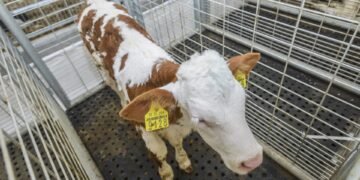
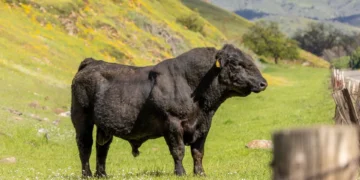




The cattle weight formula is: Heart Girth² × Body Length ÷ 300 = weight in pounds. Measure heart girth (the circumference behind the front legs) and body length (point of shoulder to pin bone) in inches. Square the heart girth, multiply by body length, divide by 300. Example: a cow with 70-inch heart girth and 78-inch body length weighs (70 × 70 × 78) ÷ 300 = 1,274 lbs. With careful measuring, the estimate is usually within about 5–10% of scale weight.
Every cattle producer needs to know how much their animals weigh. Medication dosing is calculated by body weight. Ration planning is based on body weight. Market readiness is judged by body weight. Average daily gain — one of the most important performance metrics on any beef operation — is calculated from two body weight measurements taken weeks apart.
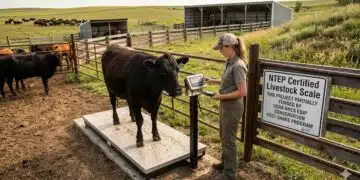
The problem is that most small and mid-size operations do not have a livestock scale on every pasture, in every lot, or available at every moment a weight is needed. A portable livestock scale is the most accurate tool for the job — but when one is not available, two measurements and a formula get you a reasonable estimate — usually within about 5–10% of scale weight.
That level of accuracy is sufficient for the decisions most producers need to make in the field. This article explains the formula in full — where it comes from, how to apply it correctly, worked examples for beef and dairy cattle, the limitations producers need to understand, and when only a real scale will do.
Table of Contents
The Standard Cattle Weight Formula
This formula is also known as Schaeffer’s formula (sometimes spelled Shaffer’s formula) — named after the livestock extension work that established it as the standard field calculation for estimating live cattle weight from body measurements. It uses two measurements — heart girth and body length — to produce an estimated live weight in pounds.
The formula is:
Weight (lbs) = Heart Girth (inches) × Heart Girth (inches) × Body Length (inches) ÷ 300
Or written more compactly:
Weight (lbs) = (Heart Girth² × Body Length) ÷ 300
The formula has been used for decades, and it holds up in testing. In a peer-reviewed comparison of five weight-estimation techniques on Brown Swiss and Jersey cows, Wangchuk, Wangdi and Mindu (Journal of Applied Animal Research, 2018) found Schaeffer’s formula to be the most reliable method, followed by a weigh tape, while Agarwal’s formula and the Rondo tape were less accurate. Because that study used dairy-type cows, expect somewhat more variation with heavily muscled beef cattle, very young calves or animals in extreme body condition.
Heart girth predicts weight reliably across species, not just cattle — our guide on how much a pig weighs breaks down the equivalent Kansas State University formula for hogs.
The heart girth formula produces a result in pounds. If your scale indicator displays kilograms, use our weight converter to convert the result directly.
The Two Measurements You Need
Measurement 1 — Heart Girth
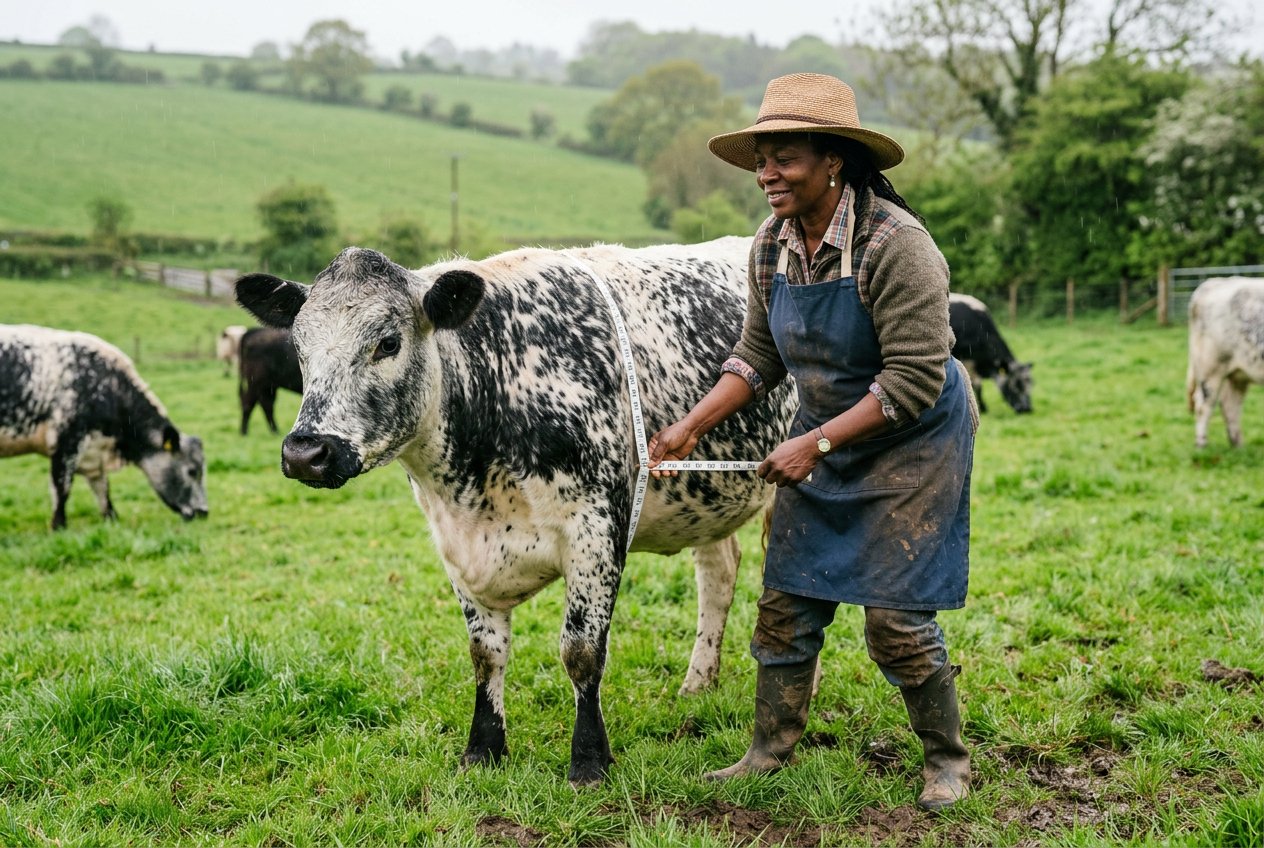
Heart girth is the circumference of the animal’s body measured at its deepest point — directly behind the front legs, over the heart.
To measure heart girth correctly:
Place a flexible cloth or vinyl measuring tape around the animal’s body. Position it directly behind the front legs, snug against the body at the point just behind the shoulder blade. The tape should pass over the withers (the ridge at the top of the shoulder) and under the chest. Pull it snug but not tight — do not compress the body. Read the measurement in inches.
Heart girth is the more important of the two measurements. Research from Pennsylvania State University found that heart girth had the highest single-measurement correlation with body weight in cattle across breed and age groups. Heart girth had the highest correlation for Holstein cattle ranging from 1 to 2 years of age, and a single heart girth measurement provides a surprisingly accurate weight estimate because it captures the animal’s mass at its largest point.
Measurement 2 — Body Length
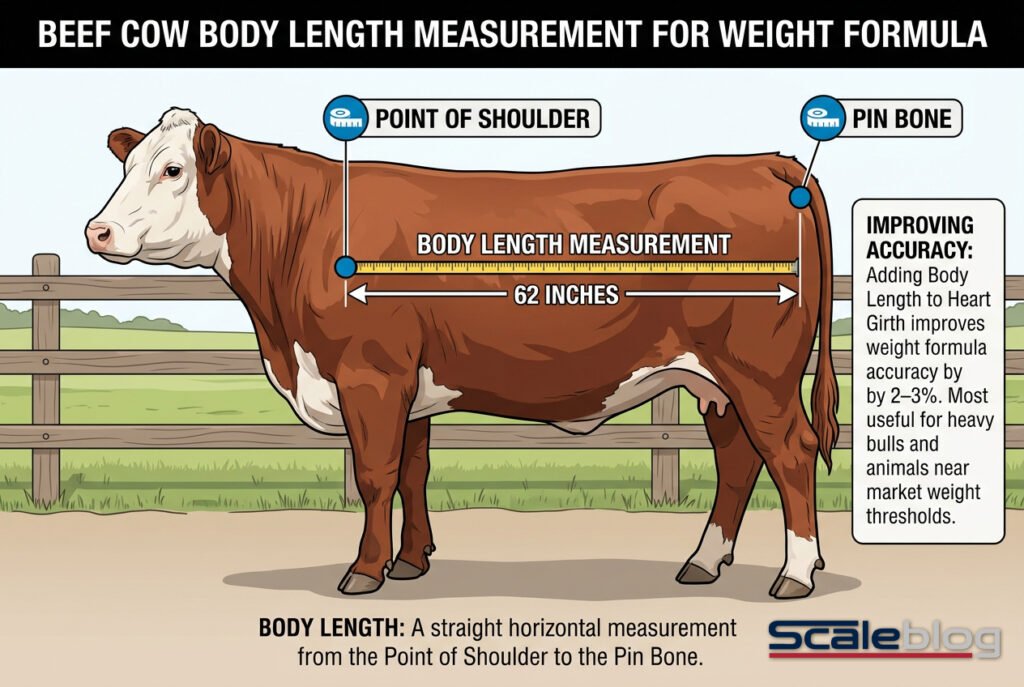
Body length is the straight-line distance from the point of the shoulder to the pin bone (the point of the rump).
To measure body length correctly:
Stand to the side of the animal. Place one end of the tape at the bony point of the shoulder — the front edge of the scapula. Run the tape in a straight horizontal line to the pin bone — the rearmost bony prominence of the hindquarters. Read the measurement in inches.
Body length measurement improves formula accuracy by approximately 2–3% compared to using heart girth alone. For most field decisions, heart girth alone is sufficient. For animals at the extremes of the weight range — very heavy bulls, very large mature cows — adding body length to the calculation reduces error meaningfully.
Cattle Weight Calculator (Tape Measure Method)
Formula: Cattle weight (lb) = heart girth² (in) × body length (in) ÷ 300. For example, a cow with a 70-inch heart girth and 64-inch body length weighs about 1,045 lb (474 kg).
How accurate is it? Tape estimates usually land within about 5–10% of scale weight for animals in average condition. Gut fill, pregnancy, very thin or very fat animals and young stock can push it further off, so confirm on a livestock scale before sales, medication dosing or feed decisions.
Worked Examples
Example 1 — Mature Beef Cow
Heart girth: 70 inches Body length: 78 inches
(70 × 70 × 78) ÷ 300 = (4,900 × 78) ÷ 300 = 382,200 ÷ 300 = 1,274 lbs
The formula (heart girth × heart girth × body length ÷ 300 = weight in pounds) appears in extension guidance such as University of Arizona Cooperative Extension’s Backyards & Beyond (Winter 2007). A mature beef cow with these measurements is estimated to weigh approximately 1,274 lbs.
Example 2 — Growing Beef Heifer
Heart girth: 58 inches Body length: 55 inches
(58 × 58 × 55) ÷ 300 = (3,364 × 55) ÷ 300 = 185,020 ÷ 300 = 617 lbs
Example 3 — Large Beef Bull
Heart girth: 82 inches Body length: 88 inches
(82 × 82 × 88) ÷ 300 = (6,724 × 88) ÷ 300 = 591,712 ÷ 300 = 1,972 lbs
Note: For very large bulls over 2,000 lbs, the standard formula becomes less accurate. If the formula produces a result near or above 2,000 lbs, treat the estimate with a wider margin of error and use a livestock scale when precision is required.
Quick Reference Table — Estimated Weight by Heart Girth
If you only have heart girth and need a fast field estimate, this table covers the common range for beef and dairy cattle. These values are derived from the formula using typical beef body proportions — they are estimates, not certified weights.
| Heart Girth (inches) | Estimated Weight (lbs) — Beef |
|---|---|
| 40 | 320–380 |
| 45 | 450–520 |
| 50 | 580–660 |
| 55 | 720–820 |
| 60 | 860–980 |
| 65 | 1,020–1,160 |
| 70 | 1,200–1,360 |
| 75 | 1,390–1,580 |
| 80 | 1,600–1,810 |
These ranges assume typical body length proportions for the heart girth stated. Use the full two-measurement formula when precision matters.
How Accurate Is the Cattle Weight Formula?
With careful, consistent measuring, the formula usually lands within roughly 5–10% of scale weight for mature cattle in average condition. For a 1,000 lb animal, that means an estimate somewhere around 900–1,100 lb, and closer when the same person measures the same way each time. Accuracy drops for calves, heavily pregnant cows, animals with a full rumen and breeds whose body shape differs from the average.
That level of accuracy is sufficient for:
Medication dosing. Dewormers, antibiotics, and anti-parasitics are dosed by body weight. A 5% error on a 1,000 lb animal is 50 lbs, which produces a dosing difference within the safety margin of most livestock medications when given at the correct label dose. However, conservative practice recommends dosing at the higher end of the estimate for dewormers specifically, since underdosing is a primary driver of anthelmintic resistance in beef herds.
Feed ration planning. A beef cow in a cow-calf operation consumes roughly 2–3% of her body weight in dry matter daily. Supplementation calculations are based on body weight, and errors in weight estimation translate directly to over- or under-supplementation. A 5% weight error produces a proportional ratio error — acceptable for management decisions, not sufficient for precision nutrition programs.
Tracking average daily gain. Measuring the same animal at consistent intervals — every 28–56 days — allows calculation of average daily gain even from estimated weights, provided the same technique and the same person make the measurements each time. Consistency of technique matters more than absolute accuracy for growth tracking purposes.
Market readiness assessment. An estimate within about 5–10% is sufficient to determine whether an animal is approaching target market weight. It is not sufficient for the final sale weight; all sale transactions must use a certified livestock scale.
What Reduces Formula Accuracy — And What to Do About It
Gut Fill
Gut fill — the weight of feed and water currently in the digestive tract — can add 50–100 lbs of daily weight variation to a reading. An animal weighed immediately after returning from a full day of grazing and watering will measure 50–100 lbs heavier than the same animal measured after an overnight fast.
Best practice: Measure first thing in the morning before feeding and watering. Morning measurements before gut fill provide the most consistent and comparable results across sessions.
Pregnancy
A heavily pregnant cow carries significant additional weight that is not reflected in body frame measurements. The formula estimates frame-based live weight — it does not account for calf weight, placental fluids, or the weight of a full uterus. In late pregnancy, formula estimates may understate actual live weight by 50–150 lbs.
Best practice: Note pregnancy status when recording measurements. Do not use formula-based estimates for medication dosing decisions in heavily pregnant cows where the dosage margin is narrow — use a livestock scale.
Breed Differences — Beef vs Dairy
Body shape affects any girth-based estimate. Dairy cattle such as Holsteins carry less muscle and fat than beef cattle of the same heart girth, while heavily muscled beef cattle can weigh more than their measurements suggest. Interestingly, the Wangchuk et al. study that found Schaeffer’s formula the most reliable method was carried out on Brown Swiss and Jersey dairy cows, so the formula itself is not a beef-only tool.
Heart girth tapes used for dairy cattle must be specifically calibrated for dairy breeds — tapes calibrated for beef cattle will give inflated estimates when used on Holsteins or other dairy breeds.
Best practice: For weigh tapes, use one made for the type of animal you are measuring (beef, dairy or breed-specific), because tapes are calibrated to typical body shapes. For the formula, the most reliable way to improve accuracy is to check a few of your own animals against a scale and note whether your estimates run high or low for your herd.
Body Condition
An animal at Body Condition Score (BCS) of 8–9 carries significantly more fat than the formula assumes. An animal at BCS 1–2 carries significantly less. For each one-unit change in BCS, beef cows gain or lose approximately 7% of their BCS-5 weight. A BCS 8 cow and a BCS 3 cow with identical heart girth measurements may differ by 150+ lbs in actual live weight.
Best practice: Adjust formula estimates upward for animals in BCS 7–9 and downward for animals in BCS 1–3.
Measurement Technique Consistency
The most common source of formula error is inconsistent measurement technique — measuring heart girth too far forward, too far back, or at an angle rather than perpendicular to the body. A 1-inch error in heart girth measurement produces a 2–3% error in the final estimate. On a 1,200 lb animal, that is 24–36 lbs of additional uncertainty on top of the formula’s inherent ±5%.
Best practice: Have the same person make measurements each session. Practice on a few animals and verify against a scale when possible to calibrate your own technique. Use a cloth or vinyl tape — not a metal tape or string — for the most consistent results.
The Heart Girth-Only Method — Livestock Weigh Tapes
A livestock weigh tape is a purpose-made measuring tape that replaces manual calculation entirely. One side of the tape measures heart girth in inches. The other side directly displays the estimated weight in pounds for that heart girth measurement — no formula, no math, one reading.
Weigh tapes use the same underlying formula as the two-measurement method, but apply it at a single measurement point. They are faster to use in the field — particularly when measuring multiple animals — and are adequate for most routine management decisions.
Tool we recommend: for a quick heart-girth reading without the calculation, the Coburn Beef Stock Weigh Tape (108 in) is a long-established beef cattle tape; for dairy herds use the Coburn Dairy Weigh Tape by Breed. As an Amazon Associate, Scale Blog earns from qualifying purchases.
Penn State Extension reports that weight tapes are accurate to within 3–5% of actual body weight for animals over 330 lb (5–8% for calves of 110–330 lb), and that repeat measurements vary little whether one person or several take them. They are available for beef cattle, dairy cattle, calves, and heifers in breed-specific calibrations.
The trade-off is that weighing tapes sacrifices the 2–3% accuracy gain that body length measurement provides. For routine monitoring, this trade-off is acceptable. For medication dosing decisions or animals near a market weight threshold, the two-measurement formula is more reliable.
When the Formula Is Not Enough — Use a Livestock Scale
The cattle weight formula is a field management tool. It is not a substitute for a certified livestock scale in situations where accuracy, documentation, or legal compliance is required.
Use a livestock scale — not the formula — for:
- All sale transactions where the buyer pays by live weight
- Official production records and breed association documentation
- Regulatory or veterinary compliance documentation
- Precise medication dosing for narrow-margin compounds where underdosing or overdosing carries a significant animal health risk
- Research and performance data collection
- Any situation where a written weight record will be audited
For operations where regular weighing is practical, a portable livestock scale eliminates the guesswork of formula-based estimates and produces certified, defensible weight records. Our article on how to estimate cattle weight without a scale covers the full comparison of field estimation methods — including the formula, weigh tapes, and body condition scoring — and explains when a livestock scale is worth the investment.
FAQs
What is the cattle weight formula?
The standard cattle weight formula is: Heart Girth (inches) × Heart Girth (inches) × Body Length (inches) ÷ 300 = estimated live weight in pounds. This is known as Schaeffer’s formula. It produces estimates within ±5% accuracy when measurements are taken correctly, making it sufficient for medication dosing, feed planning, and growth tracking decisions.
Where do I measure heart girth on a cow?
Heart girth is the circumference of the animal measured directly behind the front legs, passing over the withers and under the chest. The tape should be positioned over the heart — just behind the shoulder blade — and pulled snug but not compressing the body. This is the most important measurement in the formula. A 1-inch error in heart girth measurement produces approximately 2–3% error in the final estimate.
Where do I measure body length on a cow?
Body length is the straight-line distance from the point of the shoulder — the front edge of the scapula — to the pin bone, which is the rearmost bony prominence of the hindquarters. Run the tape in a straight horizontal line between these two points and read the measurement in inches.
Is the cattle weight formula accurate enough for medication dosing?
Usually, yes, for routine dosing of products with a wide safety margin — but check the product label. A careful formula estimate is typically within about 5–10% of scale weight. For products where under-dosing encourages resistance, such as dewormers, many veterinarians advise dosing to the heaviest animal in the group or weighing on a scale.
Does the cattle weight formula work for dairy cattle?
Yes. In a peer-reviewed comparison on Brown Swiss and Jersey cows (Wangchuk et al., Journal of Applied Animal Research), Schaeffer’s formula was the most reliable of five estimation methods. Accuracy still varies with body condition and pregnancy, so check a few animals against a scale when you can. If you use a weigh tape rather than the formula, choose one made for dairy cattle.
What is the difference between a weigh tape and the two-measurement formula?
A livestock weigh tape estimates weight from heart girth alone — no math required. The two-measurement formula uses both heart girth and body length, improving accuracy by approximately 2–3%. Weigh tapes are faster in the field for routine monitoring. The two-measurement formula is more accurate for animals at the extremes of the weight range or for decisions where the extra precision matters.
Conclusion
The cattle weight formula — Heart Girth² × Body Length ÷ 300 — is one of the most practically useful calculations in livestock management. It requires nothing more than a flexible measuring tape and two minutes with an animal in a chute or panel setup. It produces an estimate accurate enough for the decisions that producers make daily: whether to dose, how to feed, and whether an animal is ready for market.
The two measurements that drive the formula are straightforward to take correctly. The common errors — measuring at the wrong point, measuring after feeding and watering, not accounting for breed differences — are all avoidable with consistent technique.
For any decision that requires an exact, documented, legally defensible weight, a certified livestock scale is the right tool. For everything else, the formula is what experienced producers have relied on for decades — because it works.
Sources
- Wangchuk, K., Wangdi, J. and Mindu, M. (2018). Comparison and reliability of techniques to estimate live cattle body weight. Journal of Applied Animal Research, 46(1).
- USDA National Agricultural Statistics Service, Livestock Slaughter 2025 Summary.
- Susan Pater, University of Arizona Cooperative Extension, Backyards & Beyond, Vol. 11 (Winter 2007).
- Jud Heinrichs and Coleen M. Jones, Penn State Extension, Monitoring Dairy Heifer Growth (updated December 2025).
Last reviewed September 2026 by the Scale Blog editorial team.