



Setting up a livestock scale and chute system correctly from the start saves you years of inaccurate weights, frustrated animals, and wasted handling time. The most common problems with farm weighing systems — animals refusing to enter, unstable readings, chronic zero drift, and damaged load cells — are almost always the result of poor installation decisions made before the first animal was ever weighed. This guide takes you through every step of setting up a livestock scale and chute system that works reliably, produces accurate data, and keeps both animals and operators safe.
Step 1: Site Selection — The Decision That Affects Everything Else
Where you put your weighing system determines how often you use it. A scale that requires animals to be moved a long distance from their housing or grazing, or one that sits in a poorly drained corner of the yard, will be avoided on busy days. A scale positioned naturally in the flow of routine animal movement gets used consistently.
Key siting criteria
- In line with existing animal movement — the ideal location is somewhere animals already pass regularly: between housing and grazing, between pens and the loading area, or integrated into the main handling race. Animals that encounter the scale as part of normal movement become familiar with it and weigh more calmly than animals brought to a dedicated weighing facility from elsewhere
- Level, firm ground — livestock scales require a level base. Ground that slopes, shifts seasonally, or compresses under repeated loading will cause zero drift and corner loading errors. This is not a minor issue — a 2-degree slope can introduce a 2–3% weighing error on every animal
- Good drainage — standing water under or around a scale corrodes load cells, causes electrical faults in cable connections, and creates a slipping hazard. Site on a raised pad or ensure surface water drains away from the scale location
- Accessible for maintenance — load cells and cable connections need periodic inspection. Do not build the scale into a position where the underside is inaccessible
- Adequate lighting — if weighing takes place in early morning, evening, or winter conditions, the weighing area needs artificial lighting. An indicator display that cannot be read in poor light slows the process and increases recording errors
Step 2: Foundation — Get This Right or Get It Wrong Forever
The foundation is the most permanent decision in a livestock scale installation. A scale bolted to a properly prepared concrete base on stable ground will produce accurate weights for 15–20 years. A scale sitting on compacted hardcore or timber sleepers will shift, settle, and drift continuously.
For permanent installations
A level, reinforced concrete base is the usual foundation for a fixed livestock scale. The scale manufacturer’s foundation drawing should always take priority over general guidance, and structural work should be done by a qualified contractor. Points to discuss with your installer:
- Thickness and reinforcement: sized to the scale’s capacity, the heaviest animals you will weigh and your soil conditions — heavier cattle and poor ground need a thicker, more heavily reinforced slab.
- Footprint: the base should extend beyond the scale frame on all sides so the frame bears evenly.
- Curing: concrete gains most of its design strength over about 28 days; follow the manufacturer’s and contractor’s guidance on when the scale can be installed and loaded.
- Level and drainage: a flat, level surface under each load point, with drainage so water and manure do not pool around load cells or cables.
For portable installations
Portable weigh bars or self-contained platform scales used at multiple locations need a consistent temporary base. Steel packing plates or purpose-made levelling pads under each corner allow rapid levelling on imperfect ground surfaces. Always check level with a spirit level before the first animal of each session. For farms that need a scale they can move between locations rather than a fixed installation, our portable livestock scale buying guide covers weigh bars, self-contained platforms, and every specification that determines field performance.
“The USDA Agricultural Marketing Service requires that all scales used to weigh livestock for commercial purchase or sale be installed and maintained in accordance with NIST Handbook 44 — and be tested for accuracy at least twice per calendar year by a competent agency.”
Step 3: Chute and Race Design — Making Animals Work With You
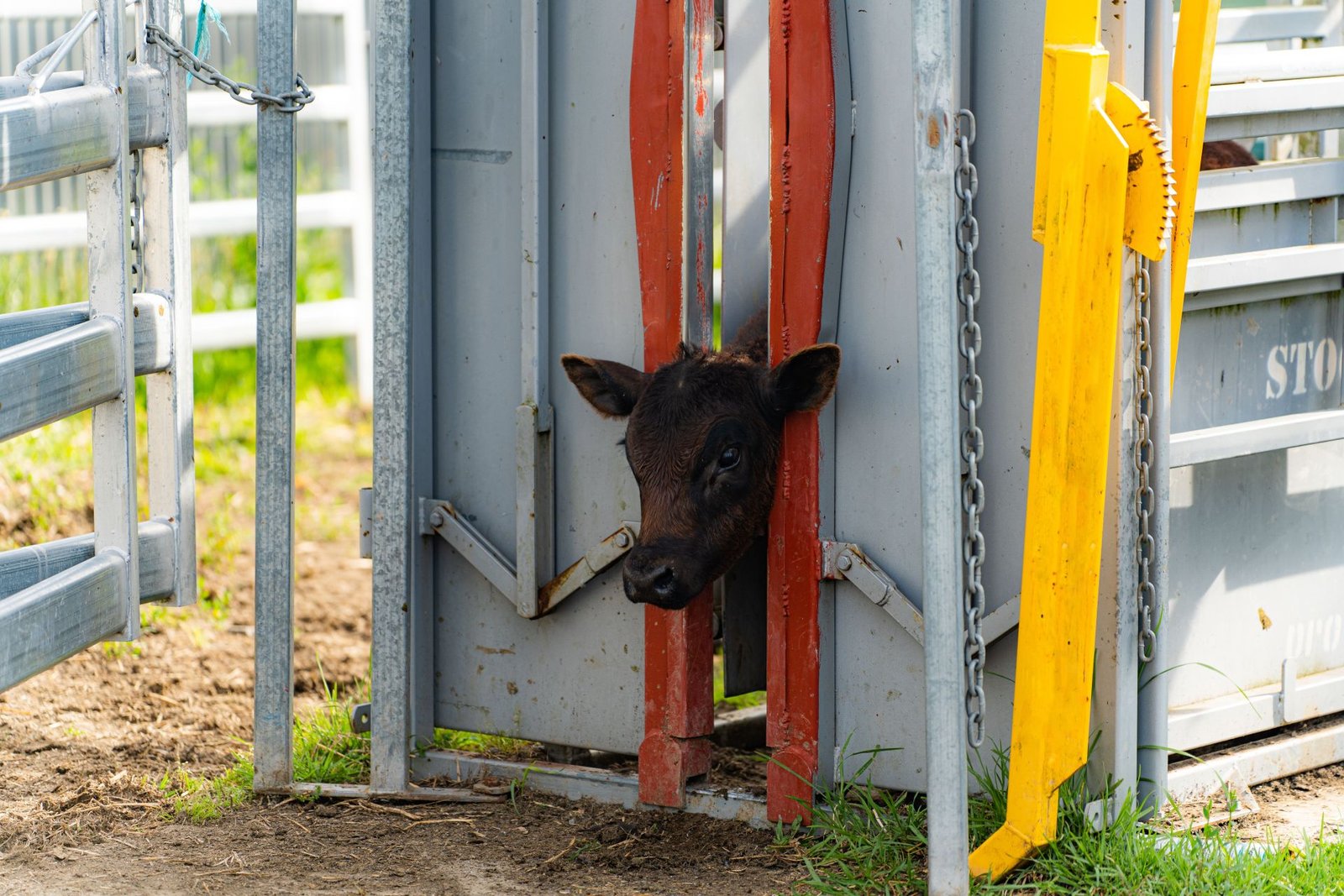
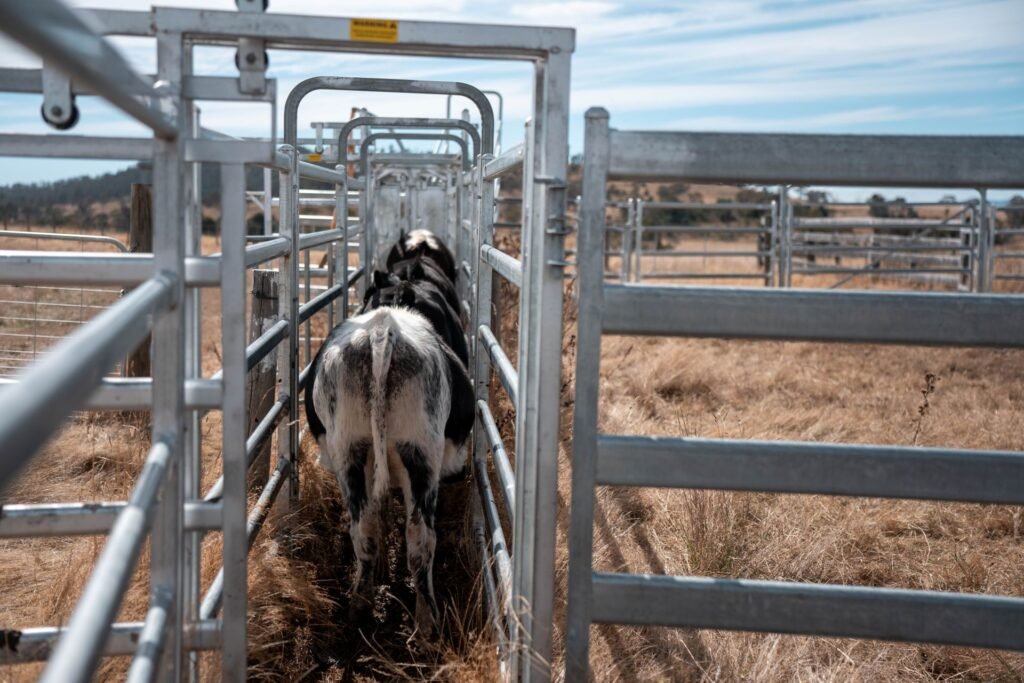
The chute and race system surrounding the scale determines animal flow — how willingly and calmly animals move into, through, and out of the weighing area. Poor race design is the single most common cause of weighing taking three times longer than it should. According to livestock handling expert Dr. Temple Grandin, an animal standing in the crowd pen should be able to see a minimum of two body lengths up the single-file chute before it turns, and a short straight section at the entrance lets cattle see two to three body lengths — this sightline encourages forward movement and is a foundational principle of low-stress livestock facility design.
Principles of good livestock race design for weighing
Single file approach: Animals should approach the scale in a single file. A wide approach that allows animals to bunch and jostle creates pressure that makes individuals reluctant to enter the scale. A narrowing funnel race that guides animals naturally into a single file reduces this problem significantly.
Curved or angled approach: Cattle and sheep move more willingly into a race they cannot see the end of. A slight curve or angled entry to the weighing area uses the animal’s natural behaviour — they follow the curve, expecting to rejoin the group — rather than fighting against it. Straight-through races that allow an animal to see a dead end or a gap at the far end cause balking and backing up.
Solid sides: Race sides should be solid from the ground up to shoulder height for cattle (approximately 1.2 m), with solid or slatted upper sections depending on preference. Solid lower sides prevent animals from seeing distractions outside the race and reduce the likelihood of a foot going through the side and causing injury or panic.
Minimum dimensions by species
| Species | Race Width | Race Length Before Scale | Scale Platform Length |
|---|---|---|---|
| Beef cattle (mature) | 28–32 in (700–800 mm) | 13–16 ft (4–5 m) | 6–7 ft (1,800–2,100 mm) |
| Dairy cows | 28–30 in (700–750 mm) | 13–16 ft (4–5 m) | 6–6.5 ft (1,800–2,000 mm) |
| Sheep (adult) | 16–20 in (400–500 mm) | 6–10 ft (2–3 m) | 4–5 ft (1,200–1,500 mm) |
| Pigs (finishing) | 20–24 in (500–600 mm) | 6–10 ft (2–3 m) | 3.5–4 ft (1,000–1,200 mm) |
For pig-specific weighing considerations including platform dimensions, weighing frequency, and market weight management, see our dedicated guide to the best scale for weighing pigs at market weight.
Chute systems sized for cattle often need adjustment for smaller animals — our pig weight guide is a useful reference when planning handling equipment for a mixed-species operation. Our goat weight guide is a useful reference when planning handling equipment for mixed livestock.
Exit race: The exit race after the scale must be at least as long as the approach race. Animals that can see and smell the mob on the other side of the scale will push forward to rejoin them, which causes movement during weighing and unstable readings. A solid-sided exit race of adequate length gives animals a clear direction of travel without the pull of the group disrupting the weighing moment.
Step 4: Load Cell and Weigh Bar Installation
Whether you are installing purpose-built load cells under a platform or positioning weigh bars under an existing crush or trailer floor, correct installation is critical for accuracy.
For weigh bars
- Position the bars parallel to each other and perpendicular to the direction of animal movement
- Ensure the bar ends extend equally beyond the platform edge on each side — asymmetric positioning causes corner loading errors
- All bars must sit on a firm, level surface. Use steel shims or packing plates to level individual bars if the floor is uneven — do not pack one end of a bar and leave the other end hanging
- Cable exits must be protected from animal feet and vehicle traffic. Use conduit or cable guards from the bar to the indicator cable entry point
For built-in load cells
- Follow the manufacturer’s torque specifications for mounting bolts — overtightening distorts the load cell housing and affects calibration
- Ensure all four cells are at exactly the same height. Use a precision straight edge across the platform frame after installation to confirm
- Apply the specified anti-rotation devices. Load cells that are free to rotate under eccentric loading produce inconsistent corner readings
Cable management
All cables between load cells and the indicator must be protected from mechanical damage, moisture ingress, and animal contact. Use armoured conduit where cables run through areas accessible to animals or vehicles. Seal all conduit entry points to the indicator housing with appropriate gland fittings — an unsupported cable entry is a moisture pathway into the electronics.
Step 5: Indicator Mounting and Setup
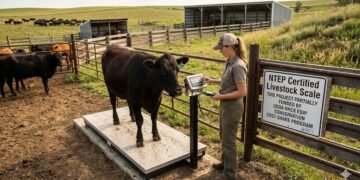
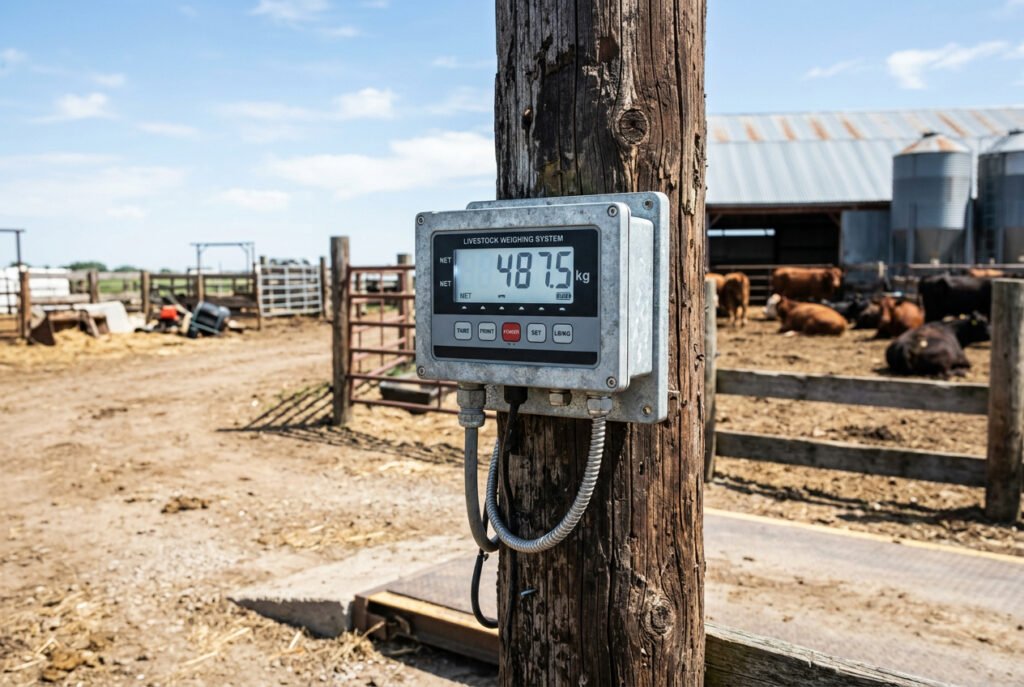
The indicator — the display unit that shows the weight — must be positioned where the operator can read it clearly while managing animals at the scale, without leaving their working position. If you will use the scale to sell livestock by weight, it needs to be suitable for legal-for-trade use: in the U.S. that generally means meeting NIST Handbook 44, carrying an NTEP Certificate of Conformance in most states, and passing inspection by your state weights and measures office. Check your state’s rules before relying on the scale for sales.
Mounting position
- Mount the indicator at eye level for the operator in their normal working position — typically on the side of the race or on a dedicated post adjacent to the scale
- Position it away from direct sun angle if possible — a backlit display helps, but direct sunlight behind the screen makes any display hard to read
- Ensure the indicator is within arm’s reach for zeroing, tare, and recording functions without the operator having to move away from the animal
- Use an IP65-rated or higher enclosure for the indicator if it is permanently mounted outdoors. Many indicators come with a separate weatherproof housing designed for post or rail mounting
Initial setup procedure
- Connect all load cell cables to the indicator following the manufacturer’s wiring diagram — polarity errors cause negative readings or no reading at all
- Power on the indicator and allow it to warm up for the specified period — typically 15–30 minutes for the electronics to stabilise
- Check that the indicator reads zero with nothing on the platform. If it does not return to zero consistently, check that all four load cells are making proper contact with the platform frame and that no debris is wedged under the platform
- Perform the initial span calibration using certified test weights. Place the test weights centrally on the platform and enter the known value into the indicator’s calibration mode. Follow the manufacturer’s calibration sequence exactly
- Verify corner loading accuracy by placing the test weight at each corner of the platform separately and confirming all four positions read within the manufacturer’s specified tolerance
- Test the auto-zero and tare functions before the first weighing session
- Record the calibration date, the test weight values used, and the calibration result in a maintenance log
If your indicator supports EID integration, our guide to how EID tagging works with livestock scales covers the panel reader, indicator compatibility, and data export workflow in full.
Step 6: Pre-Use Checks and Ongoing Maintenance
A correctly installed scale that is never maintained will drift into inaccuracy within 12–18 months.
Before every weighing session
- Check the platform is level using the built-in spirit level or a handheld level
- Zero the indicator before the first animal
- Visually inspect load cell cables for damage
- Check the platform surface — remove debris, mud accumulation, or any object wedged under the platform edges
Monthly
- Inspect load cell cable entries and conduit for moisture ingress or mechanical damage
- Check all mounting bolts for tightness — vibration from animals loosens fixings over time
- Clean load cell housings and inspect for corrosion or physical damage
Every 6 months
- Verify calibration using certified test weights
- Check corner loading accuracy
- Inspect the race and chute structure for loose panels, damaged anti-slip surfaces, or protruding fixings that could injure animals
Conclusion
Setting up a livestock scale and chute system that produces reliable data and lasts for decades comes down to five decisions made before the first animal steps on it: site it in the natural flow of animal movement, build the foundation properly and let it cure, design the race for animal behaviour rather than convenience, install load cells to specification, and mount the indicator where it can actually be used. Farmers who invest the time in getting these decisions right weigh more often, trust their data more, and make better management decisions as a result. The ones who rush the installation and fix problems as they appear spend years fighting a system that never quite works.
FAQs
How deep should a concrete base be for a livestock scale?
A minimum of 6 inches (150 mm) for sheep and pig scales, and 8–10 inches (200–250 mm) for cattle platform scales handling mature or heavy animals. The base must be reinforced with steel mesh, extend at least 12 inches (300 mm) beyond the platform footprint on all sides, and cure for a full 28 days before the scale is installed and loaded.
How do you level a livestock scale?
Use a spirit level across the platform surface before every weighing session. For permanent installations, use levelling feet or steel packing plates during installation to bring the platform to within 5 mm of level across its full footprint. For portable weigh bars, use steel shims or purpose-made levelling pads under each bar on imperfect ground surfaces.
How wide should a cattle weighing race be?
A cattle weighing race should be 28–32 inches (700–800 mm) wide for beef and dairy cattle. The approach race should be at least 13–16 feet (4–5 meters) long before the scale to allow animals to settle into single file. Solid lower sides up to approximately 4 feet (1.2 m) in height prevent animals from seeing distractions outside the race and reduce balking.
Should a livestock scale race be straight or curved?
A curved or angled approach race produces significantly better animal flow than a straight race. Cattle and sheep move more willingly into a race they cannot see the full length of — they follow the curve, expecting to rejoin the group. A straight race that allows an animal to see a dead end or gap at the far side causes balking, backing up, and slower weighing sessions.
How often should a farm livestock scale be calibrated after installation?
Calibrate with certified test weights immediately after installation to establish a verified baseline, then at least twice per year during normal operation. Also, calibrate after any significant event — the scale being moved, subjected to overloading, flooded, or after any repair or component replacement. Keep a written calibration log recording the date, test weight values used, and the result.
What IP rating does a livestock scale indicator need for outdoor installation?
A minimum of IP65 for any indicator permanently or semi-permanently mounted outdoors. IP65 protects against water jets from any direction, covering rain, hosing down, and typical farm washdown conditions. IP67 or IP68 is recommended for indicators mounted in enclosed or partially enclosed buildings where pressure washing takes place regularly.
Sources
- Temple Grandin, Directions for laying out curved cattle handling facilities.
- NIST, Handbook 44 — Current Edition.
Last reviewed September 2026 by the Scale Blog editorial team. Scale foundations, electrical work and legal-for-trade installations should be completed by qualified professionals following the manufacturer’s instructions.