



Tracking cattle weight gain over time is how you turn a set of individual weights into management intelligence. A single weight tells you where an animal is today. A series of weights tells you how fast it is growing, whether it is on track for its target, and whether your feed programme is converting efficiently into liveweight. Average daily gain — ADG — is the number that sits at the centre of almost every cattle performance decision, from selling dates to feeding adjustments to breeding selection. This guide covers how to calculate it, what benchmarks to measure it against, and which tools make the process reliable at farm scale.
Table of Contents
What Is Average Daily Gain and Why Does It Matter?
Average daily gain is the simplest and most powerful metric in cattle performance monitoring. It is calculated as:
ADG (lb/day) = (Current weight − Previous weight) ÷ Number of days between weighs
For example: a steer weighed at 705 lb on day 1 and 864 lb on day 56 has gained 159 lb in 56 days — an ADG of 2.84 lb/day (1.29 kg/day).
“Average daily gain is calculated as total weight gain divided by the number of days between weighings — and routine weights should only be collected every two weeks, as weighing more often leads to more work for less accurate data due to normal variation in gut fill and animal condition.”
ADG matters because it directly determines:
- Days to target weight — divide the remaining gain required by your current ADG to project slaughter or sale date. A 900 lb steer targeting 1,250 lb at 2.5 lb/day ADG is 140 days from market
- Feed efficiency — divide feed consumed per day by ADG to calculate feed conversion ratio. A deteriorating ADG on the same feed ration signals a problem before it becomes visible in the animal’s appearance
- Return on investment — every extra 0.25 lb/day of ADG across a 100-head finishing pen over 90 days is 2,250 lb of additional liveweight. At current beef prices, that is a marginal contribution worth tracking every single weigh session
- Animal identification — cattle consistently below breed ADG benchmarks for their age and system warrant investigation for health issues, parasite burden, or competitive disadvantage at the feed bunk
Cattle Weight Gain Benchmarks by Category
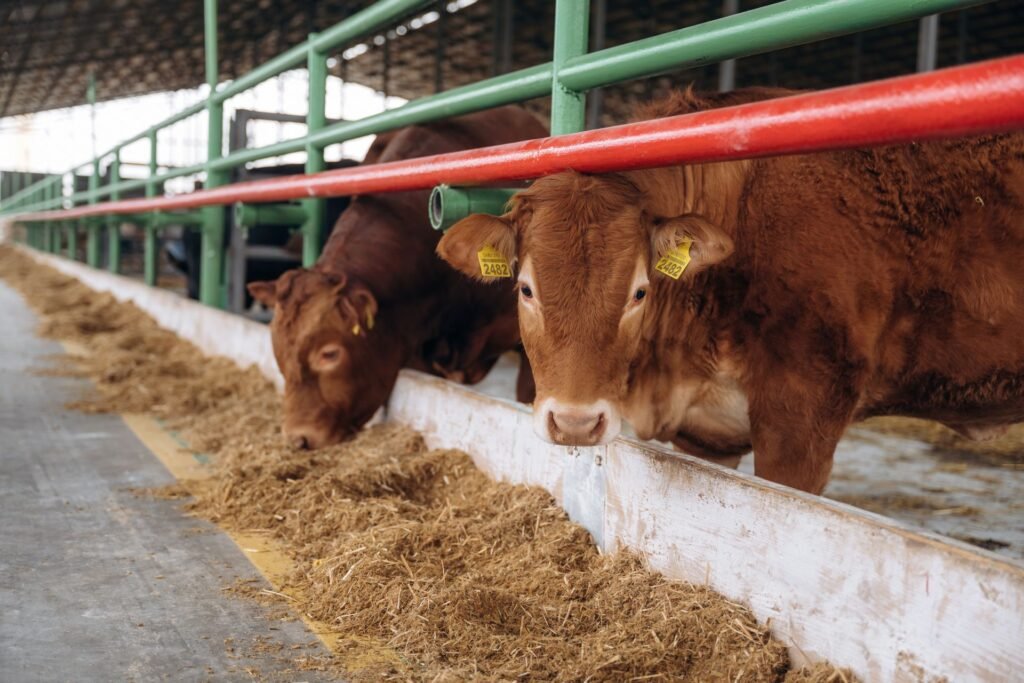
Benchmarks are only useful if they are appropriate for your breed, system, and production stage. Using a Continental breed finishing benchmark to evaluate a native breed cow-calf system will mislead you every time.
Beef cattle — feedlot finishing (high-energy ration)
| Group | Reference ADG |
|---|---|
| Kansas feedlot steers (January 2025 closeouts) | 3.58 lb/day (1.62 kg/day) |
| Kansas feedlot heifers (January 2025 closeouts) | 3.27 lb/day (1.48 kg/day) |
Oklahoma State University Extension’s fact sheet on Finishing Beef Cattle on the Farm summarizes 23 published studies: cattle finished on pasture gained about 1.55 lb per day, compared with 2.54 lb per day on high-concentrate diets in confinement, and conventional confinement finishing in some trials reached 4.0–4.4 lb per day. At those rates, weighing every 3–4 weeks is enough to capture meaningful ADG data.
Beef Cattle — Grazing (Grass-Based Systems)
| Production Stage | Expected ADG Range |
|---|---|
| Store cattle on good quality grass | 1.3–2.2 lb/day (0.6–1.0 kg/day) |
| Growing cattle — spring/summer turnout | 1.5–2.6 lb/day (0.7–1.2 kg/day) |
| Autumn grass / aftermath grazing | 0.7–1.5 lb/day (0.3–0.7 kg/day) |
“Penn State Extension’s grass-fed beef production guidance notes that in any grass-fed system a minimum of 2.0 lb of average daily gain should be the goal to keep cattle on a trajectory toward appropriate finishing — a benchmark that requires high-quality, vegetative-stage forages throughout the grazing season.”
Dairy Replacement Heifers
| Stage | Target ADG |
|---|---|
| Birth to weaning (about 8 weeks) | 1.2–1.8 lb/day (0.55–0.8 kg/day); aim to double birth weight |
| Holstein heifers after weaning | 1.7–2.0 lb/day (0.77–0.9 kg/day) |
| Jersey heifers after weaning | 1.5–1.7 lb/day (0.68–0.77 kg/day) |
The target for dairy heifers is not maximising ADG — it is hitting breed-specific weight-for-age targets that optimise reproductive development without over-conditioning. For Holstein-Friesian heifers, the typical target is 55–60% of mature body weight at first service.
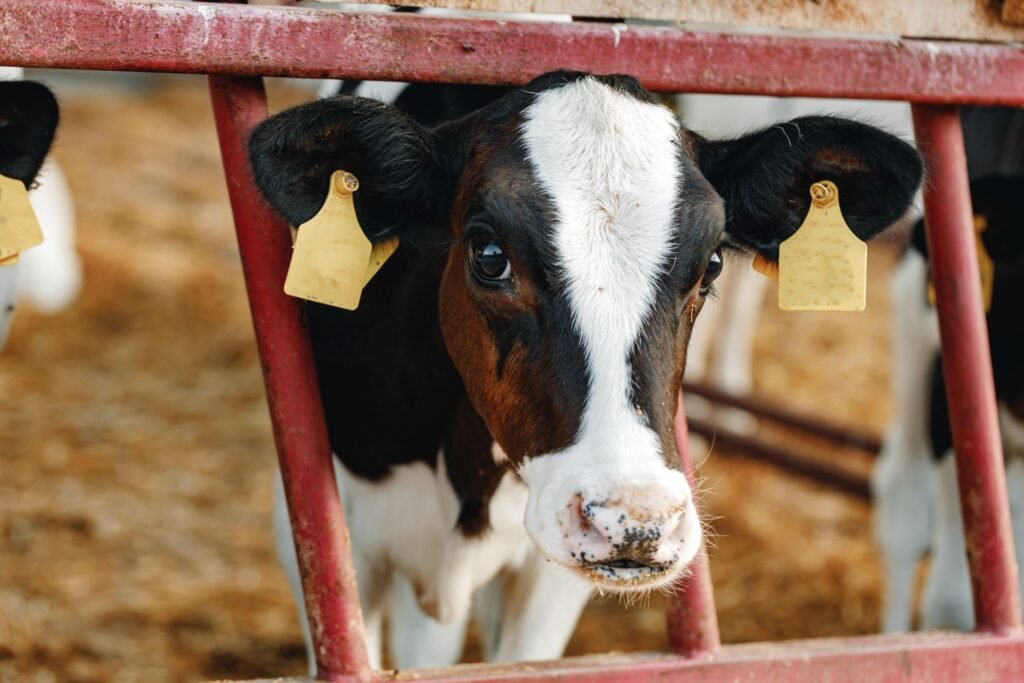
“Holstein heifers should reach 55% of mature body weight — typically 750–800 lb — by the desired breeding age of 13–15 months, and should be weighed at birth, weaning, 6 months, 12 months, pre-calving, and post-calving to monitor whether average daily gain targets are being met at each stage.”
Calves — Pre-Weaning
Pre-weaning ADG in beef calves is strongly influenced by milk supply and creep feeding. Targets vary by system, but 1.8–2.6 lb/day (0.8–1.2 kg/day) pre-weaning in well-managed beef herds is achievable and predictive of future performance.
Research summarized by Mississippi State University Extension found that developing beef replacement heifers to about 55% of mature body weight, rather than 62%, cut development costs (by $58 per head, or 21%, in one study) without lowering overall pregnancy rates — although fewer heifers conceived in the first 21 days of the breeding season. That trade-off is exactly why accurate weights against your chosen target are one of the highest-return uses of a farm livestock scale.
How to Set Up a Simple Weight Tracking System
You do not need expensive software to track cattle weight gain effectively. What you need is consistency — the same protocol applied every time, producing data that is genuinely comparable from session to session.
Step 1: Establish a Baseline Weight
Every tracking programme needs a starting point. For finishing cattle, this is the weight at housing or arrival. For calves, it is birth weight and weaning weight. For breeding cattle, it is weight at key production points — mating, pregnancy diagnosis, and calving. Record this weight with the date and a unique animal identifier. If a scale was not available at a key production event — arrival, weaning, or turnout — body measurement methods can provide a starting estimate: our guide to how to estimate cattle weight without a scale covers the most accurate field techniques.
Step 2: Choose a Weighing Interval
Match your weighing interval to your production system:
- Finishing cattle: every 3–4 weeks — frequent enough to track ADG meaningfully; long enough for the gain between weighs to exceed weighing variability
- Growing store cattle: monthly or at key events (housing, turnout, sale)
- Dairy heifers: monthly in year one; every 6–8 weeks thereafter until first calving
- Breeding cows: at key production points — weaning, pre-mating, pre-calving
Shorter intervals do not improve ADG accuracy — they introduce more noise from gut fill variation and handling stress into the calculation. A 14-day interval between weighings on finishing cattle produces an ADG figure with a potential error of ±0.3 kg/day from gut fill alone. A 28-day interval reduces that error to ±0.15 kg/day.
For a full breakdown of recommended weighing intervals across all livestock species and production stages, see our guide on how often to weigh livestock by species and production stage.
Step 3: Record Every Weight Against a Unique Identifier
The individual animal identifier — an ear tag number, an EID chip number, or a management tag — is what transforms a list of weights into an individual growth record. Without it, you have herd averages. With it, you have performance data for every animal.
If your scale indicator connects to an EID tag reader, this step is automated — the animal walks onto the platform, the reader captures the tag, and the indicator pairs the weight with the ID automatically. This eliminates transcription errors and dramatically speeds up the weighing process in large herds.
Step 4: Calculate ADG After Each Weigh
Once you have two weights from the same animal with a known number of days between them, calculate ADG using the formula above. In a spreadsheet, this is a simple formula. In farm management software, it is automatic.
Flag any animal whose ADG falls more than 20% below the benchmark for the group. These are the animals that warrant closer inspection — not necessarily treatment, but observation.
Step 5: Compare Against Benchmarks and Adjust
Weight data only earns its keep when it drives a decision. At each weigh, ask:
- Is the group ADG on track for the target slaughter or sale weight by the planned date?
- Are there individuals significantly below the group average? What might explain it?
- Has ADG declined from the previous interval? Is it a feed quality issue, a disease pressure issue, or a housing/management issue?
- Are any animals approaching target weight ahead of schedule? Can they be moved forward in the selling plan?
Tools for Tracking Cattle Weight Gain
Weighing Scale With Data Storage
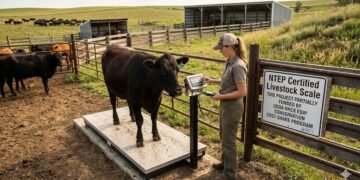
The foundation of any weight tracking programme is a scale that stores individual weights electronically. Manual paper records work but introduce transcription errors and make calculations laborious. A scale indicator with onboard memory and USB or Bluetooth export reduces both the labour and the error rate.
EID Tag Readers
Electronic identification tags — RFID ear tags — paired with a compatible scale indicator automate the animal ID step completely. The tag reader and scale communicate, recording each animal’s weight against its registered ID number in real time. For herds of more than 50 animals, EID integration pays for itself in labour savings within a single weighing season. For a complete explanation of the hardware, software, and workflow involved in automated weight recording, see our guide to how EID tagging works with livestock scales.
Farm Management Software
Software packages designed for livestock management — including dedicated cattle management platforms — allow you to import weight data from your scale, calculate ADG automatically, plot growth curves against breed benchmarks, and generate reports for health monitoring, breeding selection, and financial analysis. Many integrate directly with EID systems to create a seamless record from tag to report.
Spreadsheet (Minimum Viable System)
For smaller operations, a well-structured spreadsheet tracking animal ID, date, weight, days since last weigh, and calculated ADG is entirely adequate. The discipline required is consistency — same protocol, same timing, every session.
Common Mistakes That Make Weight Data Useless
Even farms that weigh regularly often fail to extract value from the data because of avoidable errors:
- Inconsistent pre-weigh protocols — gut fill variation makes session-to-session comparisons unreliable if animals are sometimes weighed on full stomachs and sometimes empty
- No individual identification — group average weights hide the underperformers who need action
- Intervals too short — weighing every two weeks on cattle produces noisy ADG figures that are hard to interpret; extend to 3–4 weeks minimum
- No benchmark comparison — weight data without a performance target is just numbers; always compare ADG against a breed-appropriate benchmark
- Data not acted on — the most expensive mistake of all; weight records filed away without influencing a feed, health, or selling decision are wasted effort
Inconsistent protocols are just one of eight accuracy factors covered in our guide to what affects animal weight accuracy on a farm scale — worth reading before your next weighing session.
Conclusion
Tracking cattle weight gain over time is not complicated — but it does require commitment to consistency. Calculate ADG after every weighing session, compare it against a breed-appropriate benchmark, flag the underperformers, and let the numbers drive your feed and selling decisions. The farmers who do this well — with any combination of scale, spreadsheet, and software — make better margin decisions every week. The ones who weigh sporadically, record inconsistently, or never compare against a benchmark are paying for data they never use.
FAQs
What is a good average daily gain for beef cattle?
It depends on breed and system. Continental cross cattle on a high-energy finishing ration typically achieve 1.2–1.8 kg/day. British breeds range from 0.9–1.4 kg/day. Grass-based store cattle typically gain 0.6–1.0 kg/day on good quality pasture. Always compare against a benchmark appropriate for your breed and system rather than a generic figure.
How do you calculate average daily gain in cattle?
ADG is calculated as: (Current weight − Previous weight) ÷ Number of days between weights. For example, a steer gaining 72 kg over 56 days has an ADG of 1.29 kg/day. The weighing interval should be at least 21–28 days for finishing cattle to produce a meaningful ADG figure.
How often should you weigh cattle to track weight gain?
Finishing cattle should be weighed every 3–4 weeks. Shorter intervals introduce noise from gut fill variation that makes ADG calculations unreliable. Longer intervals reduce the frequency of management decisions. For growing and storing cattle, monthly weighing at a minimum, with fixed weights at housing and turnout.
What tools do I need to track cattle weight gain?
At minimum, a livestock scale with data storage and a consistent recording system — a spreadsheet is adequate for small herds. For larger operations, an EID tag reader paired with a compatible scale indicator automates the animal ID step and eliminates transcription errors. Farm management software can import weight data, calculate ADG automatically, and plot growth curves against breed benchmarks.
Sources
- Kansas State University, Focus on Feedlots (January 2025 closeouts).
- Oklahoma State University Extension, Finishing Beef Cattle on the Farm.
- Penn State Extension, Grass-fed Beef Production.
- University of Maine Cooperative Extension, Bulletin #1078: Calculating the Average Daily Gain of a Dairy Calf or Heifer.
- Mississippi State University Extension, Impact of Pre-breeding Body Weight on Replacement Beef Heifer Production.
- Penn State Extension, Monitoring Dairy Heifer Growth.
Last reviewed September 2026 by the Scale Blog editorial team.