



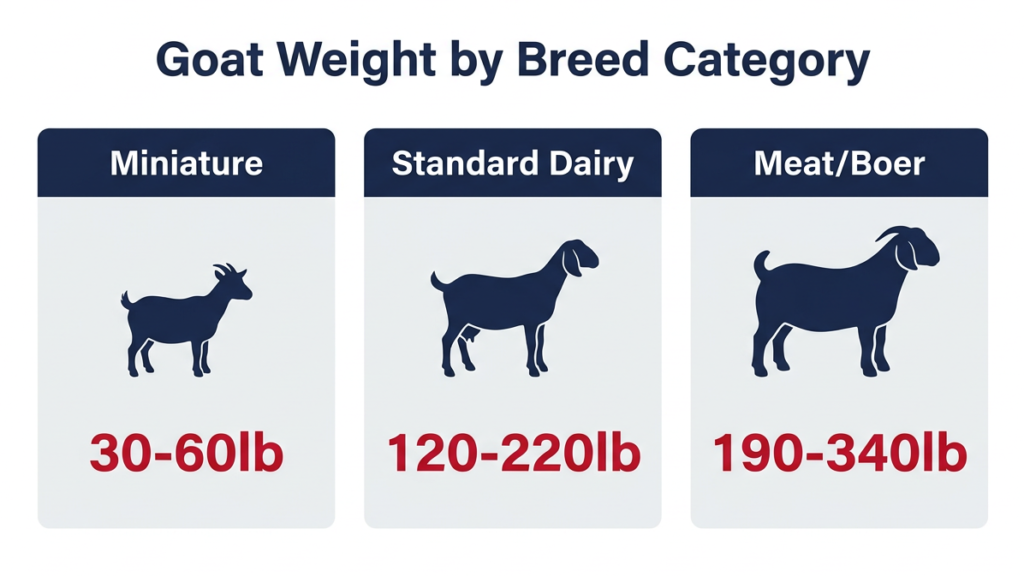
Quick answer: Goat weight depends mostly on breed type. Nigerian Dwarf dairy goats average about 75 lb; standard dairy breeds such as Nubian, Alpine and Saanen are expected to reach at least 135 lb (does) and 170 lb (bucks) under ADGA breed standards; and mature Boer meat goats weigh about 200–225 lb (does) and 240–300 lb (bucks), according to Oklahoma State University. Unlike cattle or hogs, goats are bred for very different purposes — dairy, meat, fiber or companionship — and that purpose drives size more than age alone.
Goat Weight by Breed Category
| Category | Breeds | Mature does | Mature bucks |
|---|---|---|---|
| Miniature dairy | Nigerian Dwarf | about 75 lb | about 75 lb |
| Standard dairy | Alpine, Nubian, Saanen | at least 135 lb | at least 170 lb |
| Standard dairy | LaMancha | at least 130 lb | at least 160 lb |
| Standard dairy | Oberhasli, Toggenburg | at least 120 lb | at least 150 lb |
| Meat | Boer | 200–225 lb | 240–300 lb |
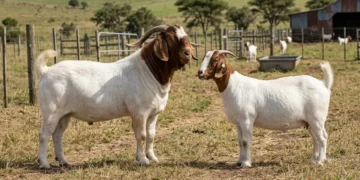
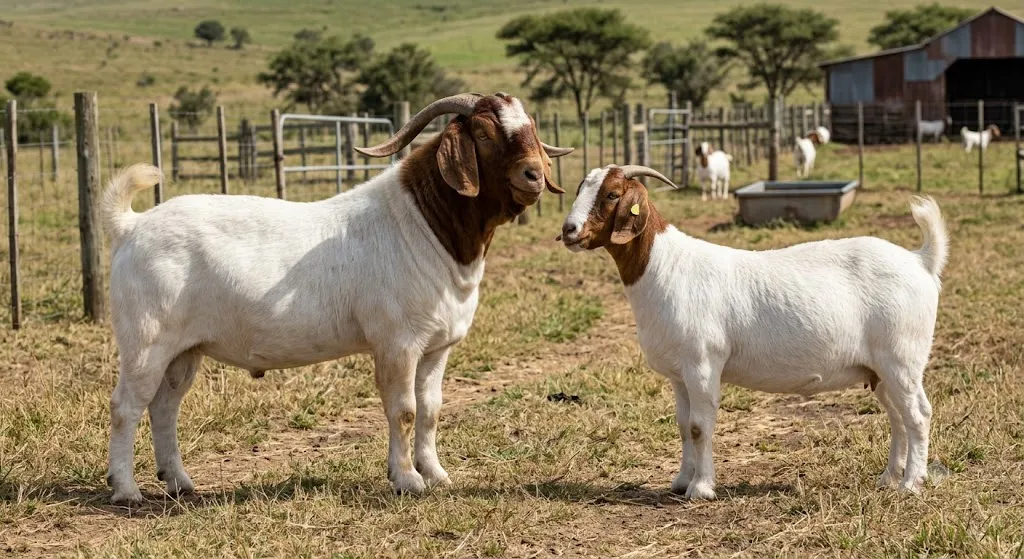
Boer goats are the largest common U.S. breed. Oklahoma State University puts mature Boer bucks at about 110–135 kg (240–300 lb) and does at 90–100 kg (200–225 lb) — roughly three times the weight of a mature Nigerian Dwarf, despite both being fully grown adult goats.
Growth Stages: Birth to Breeding Weight
Kid birth weight tracks breed size closely: miniature breeds such as Nigerian Dwarf produce small kids of just a few pounds, while standard dairy and meat breeds such as Boer produce considerably heavier kids, and single kids are usually heavier than twins or triplets. After birth, growth depends heavily on breed, milk supply, creep feed and parasite control, so weigh kids regularly and compare them with your own herd’s history.
Breeding weight matters more than breeding age for goats. Most producers wait until a doe reaches 65 to 70% of her expected adult weight before breeding — for a standard-sized doe, that means roughly 80 lb, typically reached by 7 to 8 months with good nutrition. Breeding an underweight doe risks smaller kids, harder deliveries, and reduced first-lactation milk production.
How to Weigh a Goat Without a Scale
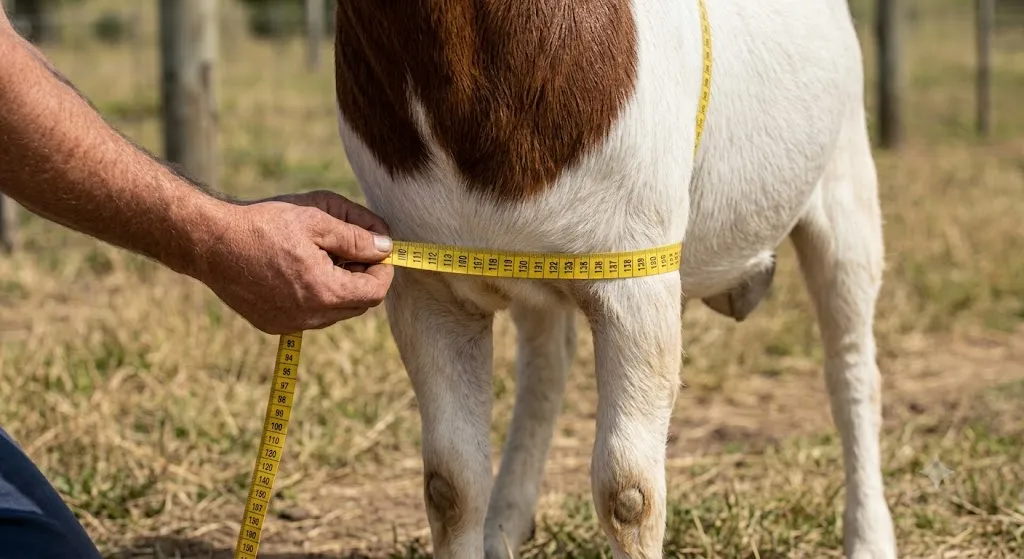
If you don’t have a livestock scale, the heart girth method — the same principle behind our pig weight formula and cattle weight formula — works for goats too, with one important difference: the divisor changes. Where pigs use 400, goats use 300, following the standard small-ruminant formula published by university extension services including Washington State University Extension: weight (lb) = heart girth² × body length ÷ 300.
To take the measurement, wrap a flexible tape snugly around the goat’s chest, just behind the front legs, to get the heart girth. Then measure body length from the point of the shoulder to the pin bone at the rear of the hip. Square the heart girth figure, multiply by body length, and divide by 300 to get an estimated weight in pounds.
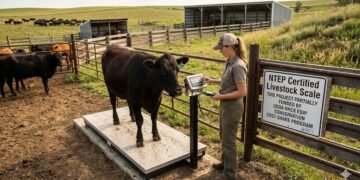
This method is accurate enough for tracking growth, planning feed rations, and gauging breeding readiness — but for anything priced by the pound, an NTEP-certified livestock scale is the right tool.
Tool we recommend: the Coburn Dairy Goat Weigh Tape (54 in) reads estimated weight directly from heart girth, with no calculation needed. As an Amazon Associate, Scale Blog earns from qualifying purchases.
Why Breed Matters More for Goats Than Most Livestock
Cattle and hogs are bred toward a converging market weight because most animals end up at the same processor targeting the same carcass specs. Goats don’t work that way. A Nigerian Dwarf is bred for milk production in a small footprint, a Boer is bred purely for meat yield and growth rate, and a Nubian splits the difference with both dairy output and larger frame size. That means a healthy, well-managed Nigerian Dwarf at 45 lb and a healthy, well-managed Boer buck at 300 lb are both exactly where they should be — breed standard, not a universal chart, is the right benchmark to weigh against.
What Affects Goat Weight Beyond Breed
Nutrition quality has an outsized effect on goats compared to other livestock, since goats are naturally selective browsers and underperform badly on poor forage. Parasite load is the other major factor — internal parasites are a leading cause of unexplained weight loss or stalled growth in goats of any breed, more so than in cattle or pigs. Sex plays a role within every breed category too, with bucks consistently outweighing does of the same breed by 15 to 30%, largely due to muscle mass rather than frame size.
Regular weight checks, even estimated ones, help catch a parasite problem or nutritional gap early — before it shows up as a doe that’s underweight at breeding time or a kid that’s falling behind its littermates. And if you’re comparing US weight data against international breed registries using metric figures, our weight converter handles the kg-to-lb conversion instantly.
FAQs
How much does a Nigerian Dwarf goat weigh?
The American Dairy Goat Association suggests an ideal weight of about 75 lb for Nigerian Dwarf goats, with does no taller than 22.5 in and bucks no taller than 23.5 in at the withers.
How much does a Boer goat weigh?
Oklahoma State University lists mature Boer bucks at about 240–300 lb and does at about 200–225 lb. Boer is the largest common meat goat breed in the U.S.
How much do goat kids weigh at birth?
Birth weight varies with breed and litter size. Miniature breeds such as Nigerian Dwarf produce kids of just a few pounds, while standard dairy and meat breeds such as Boer produce considerably heavier kids, and single kids are usually heavier than twins or triplets.
How can I weigh a goat without a scale?
Measure heart girth just behind the front legs and body length from the shoulder to the pin bone, both in inches. Apply the formula: weight in pounds equals heart girth squared, times body length, divided by 300.
At what weight should a doe be bred?
Most does should reach 65 to 70 percent of their expected adult weight before breeding. For a standard-sized doe, that’s roughly 80 pounds, typically reached by 7 to 8 months with good nutrition.
Why do goat weights vary so much between breeds?
Unlike cattle or hogs, goats are bred for different purposes — dairy, meat, fiber, or companionship — rather than a single market weight target. A healthy Nigerian Dwarf and a healthy Boer buck can differ in weight by a factor of six and both be exactly on target for their breed.
Conclusion
Goat weight doesn’t follow a single curve the way cattle or hog weight does — a healthy animal could be 35 lb or 335 lb depending entirely on what it was bred for. The breed-category chart above is a far more useful benchmark than any single “average goat weight” figure, and the heart girth formula gives you a reliable way to track progress between scale visits. Whether you’re managing a dairy herd, a meat operation, or a handful of miniature pets, regular weight checks against the right breed standard are what catch problems — parasites, poor forage, breeding readiness — while there’s still time to act.
Sources
- American Dairy Goat Association, Breed Standards.
- Oklahoma State University, Breeds of Livestock: Boer Goats.
- Oregon State University Extension, Weight Calculator: Sheep/Goat.
- Washington State University Extension, Heart Girth and Weight.
Last reviewed September 2026 by the Scale Blog editorial team.