






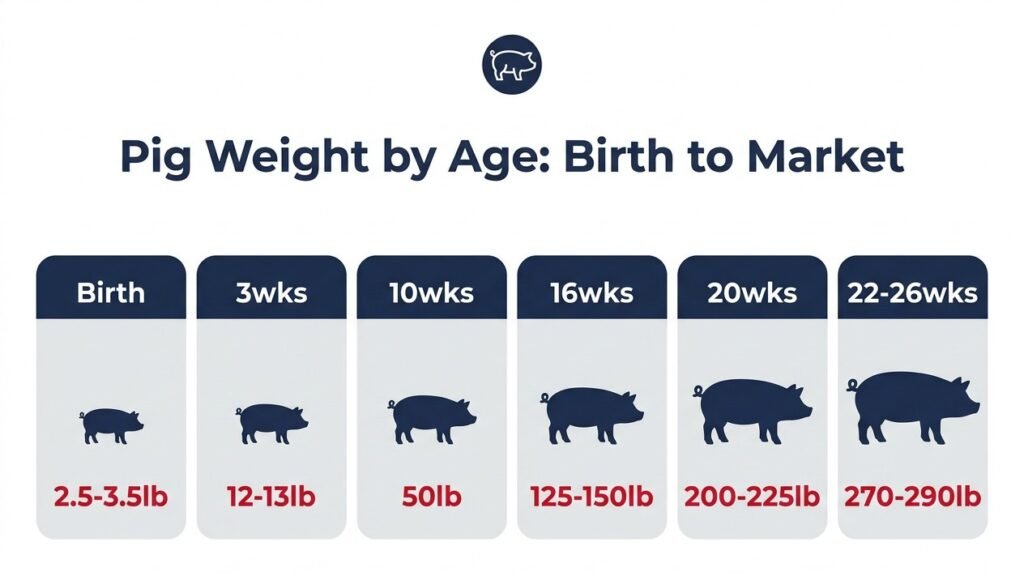
Quick answer: A U.S. market hog weighs about 285–290 lb live — USDA NASS reports that barrows and gilts slaughtered in 2025 averaged 287 lb (all hogs 289 lb). Pigs are born at about 2.5–3.5 lb, reach roughly 50 lb by 10 weeks and usually hit market weight at about 22–26 weeks.
That single figure hides most of what you actually need to know, though. Weight at eight weeks tells you almost nothing about whether a pig is on pace for market, and the growth curve between those two points is where profitable pigs and underperforming pigs diverge.
Pig Weight by Age: Birth to Market
| Age | Typical Weight |
|---|---|
| Birth | 2.5–3.5 lb |
| 3 weeks (weaning) | 12–13 lb |
| 6–8 weeks (nursery) | 20–30 lb |
| 10 weeks | ~50 lb |
| 16 weeks | 125–150 lb |
| 20 weeks | 200–225 lb |
| 22–26 weeks (market) | 270–290 lb |
Pigs in the nursery phase gain about one pound per day, using roughly 1.5 pounds of feed for every pound of gain. Growth accelerates once a pig moves past the 50-pound mark into the finishing phase, where most commercial operations see 1.75 to 2.2 pounds of gain per day — the pace that carries a 50-pound feeder pig to market weight in another 12 to 16 weeks.
What Counts as Market Weight
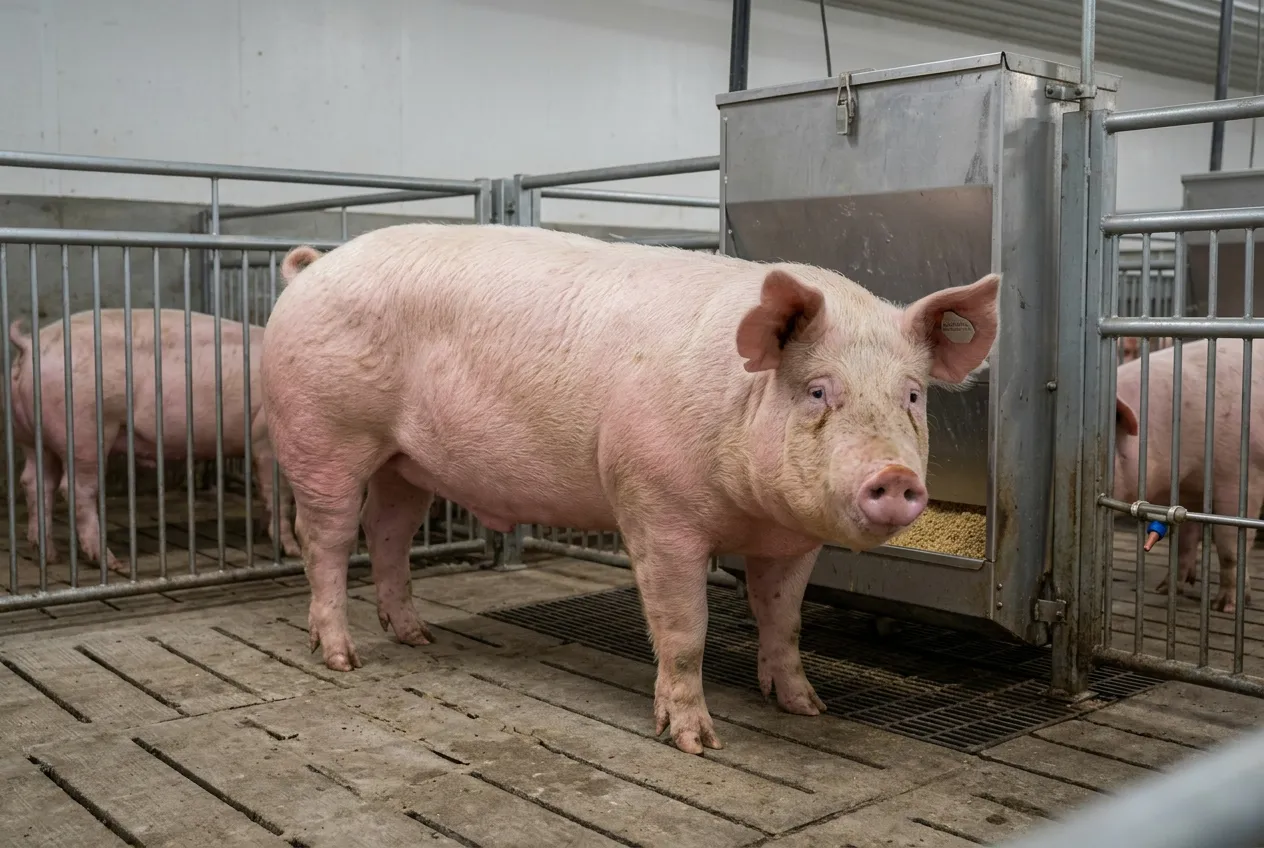
U.S. commercial hogs are now marketed at close to 290 lb live weight: USDA NASS reports that barrows and gilts slaughtered in 2025 averaged 287 lb live and 215 lb dressed (federally inspected), up slightly from 2024. This isn’t an arbitrary target — at this weight, a hog yields a carcass with the fat-to-lean ratio processors are built around, and the feed-to-gain economics stop favoring further growth. Producers selling whole or half hogs directly to individual buyers frequently market lighter, at 200–220 lb live, for a leaner cut profile. For current national trends by week and region, USDA’s Agricultural Marketing Service publishes ongoing live weight data through its Livestock Mandatory Reporting program.
Goats follow a very different pattern than pigs — breed drives weight far more than age. See our goat weight by breed guide for the full breakdown.
How to Weigh a Pig Without a Scale
If you don’t have access to a livestock scale, a flexible tape measure and one of two extension-validated formulas will get you within a working estimate — the same principle behind our heart girth formula for cattle, just calibrated differently for swine proportions.
Kansas State University’s single-measurement formula comes from a regression study of 100 growing-finishing pigs weighing 50–273 lb (Groesbeck, KSU Swine Update, 2003): weight (lb) = 10.1709 × heart girth (in) − 205.7492. In that study, 95% of predictions fell within about ±10 lb of actual weight.
Oregon State University’s two-measurement formula uses both heart girth and body length: weight (lb) = heart girth² × body length ÷ 400 — the same structure used for cattle, with a divisor calibrated to pigs.
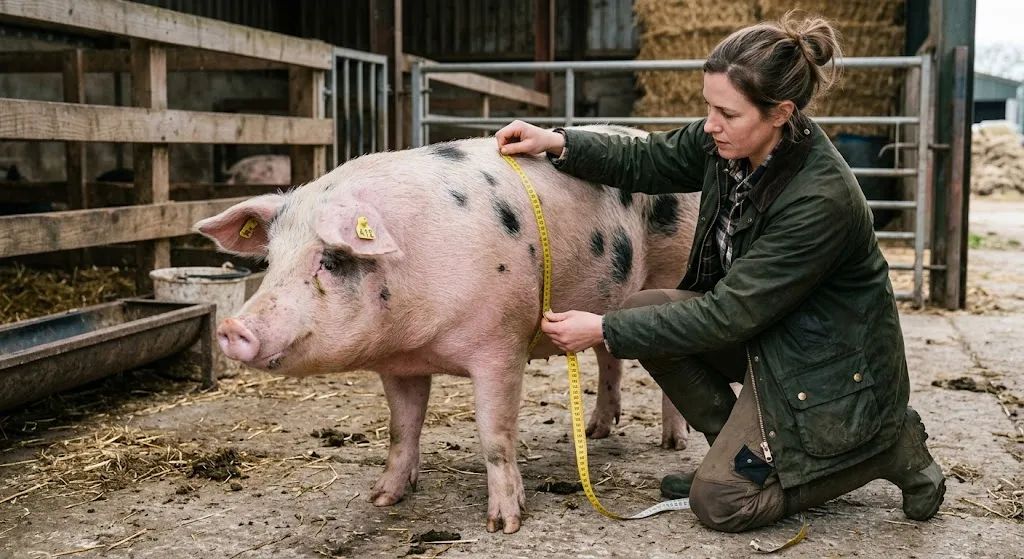
To take the measurement, stand the pig on a flat, level surface, since accuracy drops significantly on uneven ground. Wrap a flexible tape snugly around the body just behind the front legs — this is the heart girth — and take three separate readings, averaging them, since misreading by even one inch produces a 10-pound error. For the two-measurement method, also measure body length from between the ears to the base of the tail, then apply whichever formula fits the data you’ve collected.
Tool we recommend: if you would rather read weight straight off the tape, the Coburn Hog Weight Tape (60 in) is a long-established swine weigh tape. As an Amazon Associate, Scale Blog earns from qualifying purchases.
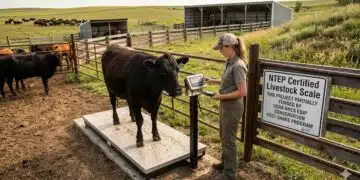
In the Kansas State study, heart girth alone predicted weight to within about ±10 lb for 95% of pigs — accurate enough for feed planning and tracking progress toward market weight, but not for a sale priced by the pound. For that, use a legal-for-trade (NTEP-certified) livestock scale.
Do Different Breeds Reach Different Weights?
Breed affects how fast a pig reaches market weight more than it changes the market-weight target itself. Commercial crossbred lines — typically Yorkshire × Landrace × Duroc genetics — are bred for feed efficiency and lean growth rate, reliably hitting 270+ lb within the standard 22–26 week window. Heritage breeds such as Berkshire and Hampshire generally grow 20–30% slower and are often marketed lighter, favoring flavor and marbling over lean yield speed. Sex plays a role too — barrows (castrated males) typically carry slightly more backfat and grow marginally faster than gilts on the same feed program.
The practical takeaway: a weight-by-age chart built from commercial crossbred data will consistently overstate the pace of a heritage-breed pig on pasture. If you’re raising heritage stock, benchmark your own herd’s growth curve after the first cohort rather than assuming the standard timeline applies.
What Affects Pig Weight Beyond Genetics
Overcrowded pens cut feeder access time and raise stress levels, which can noticeably reduce average daily gain even without visible illness. Feed conversion also worsens as pigs approach market weight, since a growing share of late-stage gain is fat rather than lean muscle. Health status matters just as much — even mild, subclinical illness slows growth measurably, and a pig tracking 15 lb behind benchmark at eight weeks often finishes 25–30 lb light at market if the cause isn’t caught early.
Regular weight checks, even estimated ones using the heart girth method, let you catch a slowing growth curve in time to act on it. And when you’re cross-referencing US benchmarks against metric breed data, our weight converter handles the kg-to-lb conversion in seconds.
FAQs
How much does a pig weigh at birth?
A healthy newborn piglet weighs between 2.5 and 3.5 pounds. Piglets grow quickly, reaching 12 to 13 pounds by three weeks of age at weaning.
What is considered market weight for a pig?
Market weight for commercial US hog production is typically 270 to 290 pounds live weight, reached at approximately 22 to 26 weeks of age. Pigs raised for direct retail sale are sometimes marketed lighter, around 200 to 220 pounds.
How can I weigh a pig without a scale?
Measure the pig’s heart girth with a flexible tape just behind the front legs. Apply the Kansas State University formula: weight in pounds equals 10.1709 times heart girth in inches, minus 205.7492. This estimate is accurate to within about 10 pounds for pigs between 50 and 273 pounds.
How much weight do pigs gain per day?
Nursery-stage pigs gain approximately 1 pound per day. Once pigs enter the grow-finish phase, daily gain typically increases to 1.75 to 2.2 pounds depending on genetics and feed program.
Do different pig breeds reach different market weights?
Most commercial and heritage breeds target a similar market weight range, but heritage breeds like Berkshire and Hampshire typically grow 20 to 30 percent slower than commercial crossbred lines such as Yorkshire-Landrace-Duroc genetics.
How accurate is the heart girth method for estimating pig weight?
The heart girth method is accurate within about 10 pounds for most pigs using the Kansas State University formula — reliable for feed planning and growth tracking, but not precise enough for sale contracts priced by the pound.
Conclusion
Weight alone won’t tell you if your pigs are performing well — the growth curve does. A pig tracking close to these benchmarks at each stage is on pace for market weight around five to six months. One that’s falling behind at eight or ten weeks usually stays behind unless something changes in feed, health, or pen conditions. Check weight regularly, whether with a scale or the heart girth method, and you’ll catch problems while there’s still time to fix them. That’s the difference between a herd that hits target weight reliably and one that guesses at sale day.
Sources
- USDA National Agricultural Statistics Service, Livestock Slaughter 2025 Summary (April 2026).
- Groesbeck, C.N. (2003). Use heart girth to estimate the weight of finishing pigs. Kansas State University Swine Update.
- Kansas Agricultural Experiment Station, Using heart girth to determine weight in finishing pigs.
Last reviewed September 2026 by the Scale Blog editorial team.