









A pallet jack scale combines two pieces of equipment into one: a standard hydraulic pallet jack for lifting and moving palletized loads, and a digital weighing system integrated into the forks. The result is a single tool that weighs a pallet during the lifting motion, without transferring the load to a stationary floor scale, without stopping to reposition the pallet, and without requiring a second operator or a second handling step. For operations that move high volumes of pallets and need a weight reading on each one, a pallet jack scale can dramatically reduce the time spent on weighing while maintaining the accuracy needed for shipping, inventory, and compliance purposes.
Table of Contents
How a Pallet Jack Scale Works
The operating principle is straightforward. As Mettler Toledo — the world’s largest weighing equipment manufacturer — describes it, pallet jack scales are precise, rugged, and engineered to provide high-accuracy weighing for pallets and containers in any warehouse application.
The mechanical and electronic sequence operates as follows:
1. Fork Insertion
The operator slides the forks of the pallet jack under the pallet in the same motion used with a standard manual pallet jack. No additional positioning or alignment step is required.
2. Lifting and Load Cell Activation
When the operator pumps the handle to raise the pallet, the weight of the load transfers onto integrated load cells mounted within or beneath the forks. These load cells are strain-gauge sensors that deform slightly under the applied force. That deformation changes the electrical resistance within the sensor in direct proportion to the weight applied.
3. Signal Processing and Display
The electrical signal from the load cells is transmitted to the digital weight indicator — the display mounted on the handle of the pallet jack. The indicator amplifies the signal, converts it from analog to digital format, and displays the weight reading. The entire process from lift to reading takes only a few seconds.
4. Tare and Net Weight
The operator uses the tare function to zero out the known weight of the empty pallet before the product is placed on it. This displays the net product weight rather than the gross weight of the pallet plus product, which is the figure needed for shipping documentation, inventory records, and freight billing. Alternatively, on many models, the operator lifts the empty pallet first to establish the tare weight automatically, then tares it off before weighing the loaded pallet.
Pallet Jack Scale vs Floor Scale: When to Use Each
A pallet jack scale is not a replacement for a stationary floor scale. It is a complement to one, deployed at different points in the workflow for different purposes. Understanding which tool fits which application prevents both over-investment and operational frustration.

When a Pallet Jack Scale Is the Right Tool
High-volume receiving verification — An incoming shipment of 40 pallets needs to be verified against the supplier’s declared weights before the truck leaves the dock. Walking a pallet jack scale across each pallet as it is unloaded produces a weight reading in the same motion as moving the pallet to its storage location. No separate weighing station, no queue at the floor scale, and no double-handling.
Outbound weight checks across multiple locations — A distribution center with multiple packing stations spread across a large floor can use a pallet jack scale to check outgoing pallet weights at each station before consolidation at the dock. This eliminates the need to route every pallet through a single floor scale location at the end of the packing process.
Space-constrained facilities — Operations without the floor space for a permanently installed platform scale and its approach ramps benefit from a pallet jack scale that requires no dedicated floor space when not in use.
Inventory and cycle counting — Weighing pallets of bulk goods during cycle counts provides a rapid check on inventory quantities without requiring product to be removed from pallets or transferred to a floor scale.
When a Floor Scale Is the Better Choice
Legal-for-trade commercial transactions requiring highest accuracy — A standard pallet jack scale, while accurate enough for internal workflow purposes, delivers typical accuracy of ±0.1% to ±0.2% of capacity. A stationary NTEP-certified floor scale, properly leveled and calibrated on a stable surface, offers superior measurement consistency for high-value commercial transactions where every pound matters financially.
Very high capacity loads — Most pallet jack scales are rated to 3,000–6,000 lb capacity. Loads regularly exceeding this range require a floor scale.
Fixed weighing stations on high-throughput lines — For a single high-throughput dock door processing hundreds of pallets per shift in a fixed location, a permanent floor scale with ramp access provides faster and more consistent throughput than a pallet jack scale that must be operated manually for each pallet.
For a detailed guide to specifying the right floor scale for your facility, see our article on how to choose a floor scale for your warehouse or factory. For a full comparison of bench scales and floor scales across all industrial applications, see our article on bench scale vs floor scale: which one does your operation need.
Types of Pallet Jack Scales
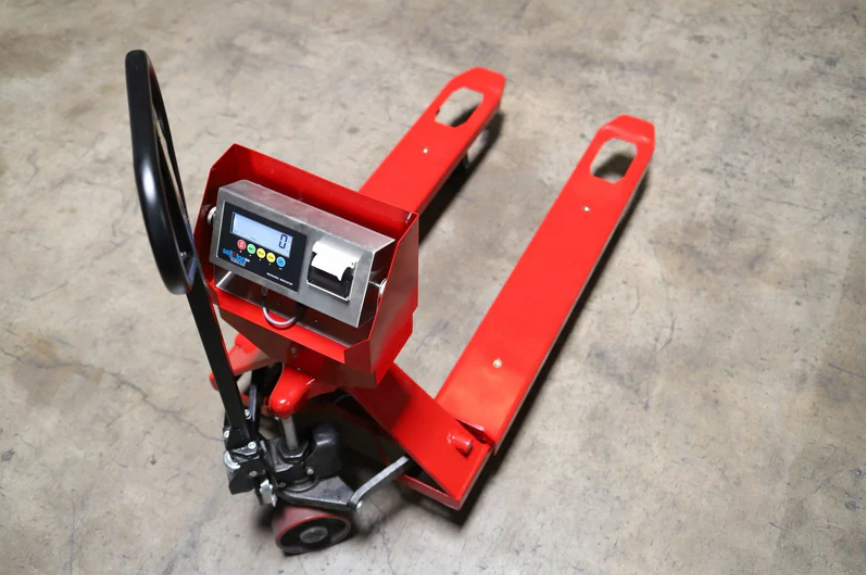
Manual Pallet Jack Scale
The most common type. The operator pumps the handle to raise the pallet hydraulically — the same action used with a standard manual pallet jack. Load cells in the forks measure the weight as the pallet lifts. Manual pallet jack scales are battery-powered for the indicator and display, with no external power connection required. They are the standard choice for most warehouse and distribution applications where mobility and simplicity are priorities.
Electric Pallet Jack Scale
An electric pallet jack scale integrates weighing capability with a powered lifting and drive system. The operator rides or walks behind the unit, which handles the lifting and movement electrically. As Liberty Scales notes, pallet jack scales are available in configurations that combine moving and weighing capabilities for industrial warehouse applications, with battery-powered operation for continuous use across shifts.
Electric models are suited to very large warehouses where the operator covers long distances per shift, or where heavy loads are handled continuously. They carry a substantially higher purchase price than manual models.
Pallet Jack Scale with Built-in Printer
Many models — both manual and electric — are available with a thermal printer integrated into the indicator housing. The printer produces a weight ticket immediately after each weighing, showing the gross weight, tare weight, net weight, date, time, and a sequential transaction number. For operations that need a paper trail for every pallet weighed — inbound receiving against a purchase order, outbound freight documentation, or NTEP-certified commercial transactions — a built-in printer eliminates the separate step of manually recording the weight or walking to a remote printer.
NTEP Certification for Pallet Jack Scales
Not all pallet jack scales are suitable for legal-for-trade commercial transactions. If the weight the scale records determines a price — for example, billing a customer by the pound for bulk material, or settling a freight invoice based on the scale’s reading — the scale must be NTEP-certified under NIST Handbook 44, verified by a state Weights and Measures inspector, and operated within the terms of its Certificate of Conformance.
NTEP-certified pallet jack scales are available from several manufacturers with capacities from 3,000 to 5,000 lb and readabilities from 1 to 2 lb. They carry a Certificate of Conformance (CC) number on the data plate, exactly as an NTEP-certified floor scale does.
For strictly internal use — inventory tracking, inbound receiving verification against internal records, or production monitoring — a non-NTEP pallet jack scale is entirely appropriate, provided the operation does not use that weight reading to determine a commercial transaction price. For a comprehensive explanation of when NTEP certification is required, see our article on how to choose a floor scale for your warehouse or factory.
Key Specifications When Choosing a Pallet Jack Scale
Capacity
Most manual pallet jack scales are available in 3,000 lb and 5,000 lb capacities — sufficient for the majority of standard GMA pallet loads. If your operation regularly handles loads above 4,000 lb, specify the 5,000 lb model with a 25% safety margin above your typical maximum load, consistent with the same capacity selection principle that applies to all industrial scales. For very heavy or non-standard pallets, evaluate whether a floor scale better fits the application.
Fork Dimensions
Standard pallet jack forks are designed to fit standard GMA pallets (48″ × 40″). If your operation handles Euro pallets (48″ × 48″), narrower pallets, or unusually configured loads, verify that the fork dimensions of the model you are specifying match the actual pallet dimensions in your facility. Narrow-fork models are available for European or non-standard pallet sizes.
Battery Life and Power
Most manual pallet jack scales are powered by rechargeable lithium-ion or lead-acid battery packs that provide 60–100 hours of indicator operation per charge. Electric pallet jack scales use larger battery systems that also power the drive mechanism. Confirm that the battery life covers your operational period without an inconvenient mid-shift recharge.
IP Rating for the Environment
For general dry warehouse use, a standard IP54 or IP65 indicator is appropriate. For wet or washdown environments — food distribution facilities, fish markets, produce operations — specify an IP65 or IP67 indicator housing at minimum. For a detailed explanation of what each IP rating covers in practice, see our article on IP ratings for industrial scales explained.
Data Connectivity
For operations that feed weight data directly into a warehouse management system, ERP platform, or inventory database, confirm that the indicator supports the required output — RS-232, USB, Bluetooth, or Wi-Fi. Many mid-range models include RS-232 as standard with Bluetooth or Wi-Fi as an option. Confirm compatibility with your specific WMS before purchasing.
Accuracy Considerations and Limitations
A pallet jack scale is inherently less accurate than a stationary floor scale under identical conditions. The primary reasons are:
- Surface and leveling — A stationary floor scale is installed on a level, stable surface. A pallet jack scale is used on real warehouse floors that may be uneven, sloped, or have surface irregularities that affect the load cell reading.
- Motion effects — Load cell readings on a pallet jack scale are taken while the pallet is suspended in a slightly elevated position. Any movement of the pallet during the reading — swinging, vibration, or operator movement — introduces measurement noise that the indicator must filter or average out.
- Load cell positioning — The load cells in a pallet jack scale are positioned in the forks and measure the weight through the fork geometry. The accuracy of the reading depends on the pallet being centered and loaded evenly across both forks.
For most warehouse and distribution applications — inbound verification, outbound freight weight estimation, cycle counting — the typical ±0.1% accuracy of a quality pallet jack scale is entirely adequate. As The Scale People — an ISO/IEC 17025 accredited calibration and scale service provider — notes, pallet jack scales enable users to weigh and relocate oversized pallets concurrently, saving time and making transportation more convenient. For applications requiring the highest accuracy, however, a stationary NTEP floor scale remains the better instrument. For guidance on calibrating both pallet jack scales and floor scales correctly, see our article on how often industrial scales should be calibrated.
Practical Operating Tips for Accurate Readings
- Zero the scale on a flat surface before the first use of each shift. Load cell readings drift slightly with temperature changes overnight. A fresh zero correction at the start of the shift takes five seconds and eliminates accumulated zero drift.
- Ensure the pallet is centered on the forks. An off-center load distributes weight unevenly between the two load cells, which reduces accuracy. Center the forks under the pallet before lifting.
- Allow the reading to stabilize before recording. The indicator will settle to a stable reading within two to three seconds of lifting the pallet. Recording the weight before the reading stabilizes captures a dynamic rather than a static weight.
- Tare the pallet weight before recording net product weight. Place the empty pallet on the forks, press Tare, and confirm the display reads zero before loading product. This produces an accurate net weight rather than gross weight.
- Keep the load cell area clean. Debris accumulated in the fork channels or around the load cell mounting points affects accuracy over time. A brief inspection and wipe-down at the start of each shift maintains consistent performance.
Conclusion
A pallet jack scale is a practical and productive addition to any warehouse, distribution center, or manufacturing operation that regularly weighs pallet loads as part of its workflow. It eliminates the separate handling step of transferring pallets to a stationary floor scale, produces a weight reading in the same motion as moving the load, and maintains sufficient accuracy for the vast majority of receiving, shipping, inventory, and documentation applications. It is not a replacement for a stationary floor scale where the highest accuracy or legal-for-trade compliance is required, but it is an effective complement to one deployed for mobility, speed, and operational efficiency across the areas of a facility where a permanent scale installation is impractical or unnecessary.
FAQs
What is a pallet jack scale?
A pallet jack scale combines a standard hydraulic pallet jack with an integrated digital weighing system. Load cells mounted in the forks measure the weight of a pallet as it is lifted, displaying the reading on a digital indicator on the handle. The operator lifts, weighs, and moves the pallet in a single operation — without transferring the load to a separate stationary floor scale.
How accurate is a pallet jack scale?
Quality pallet jack scales deliver typical accuracy of ±0.1% of capacity — equivalent to ±5 lb on a 5,000 lb load. This accuracy is sufficient for most warehouse receiving, shipping documentation, inventory, and cycle-counting applications. For commercial transactions where weight determines price, or for applications requiring the highest measurement consistency, a stationary NTEP-certified floor scale provides superior accuracy.
Does a pallet jack scale need to be NTEP certified?
Only if the weight it records is used in a commercial transaction where the price is determined by weight. For internal warehouse operations — receiving verification, inventory tracking, outbound freight estimation, cycle counting — NTEP certification is not required. NTEP-certified pallet jack scale models are available for operations that require legal-for-trade compliance.
What capacity pallet jack scale do I need?
Most warehouse pallet applications are covered by a 5,000 lb capacity model. If your typical loaded pallet weighs less than 4,000 lb, a 5,000 lb model provides a comfortable safety margin. For loads regularly exceeding 4,500 lb, evaluate whether a stationary floor scale with higher capacity is more appropriate for the application.
What is the difference between a pallet jack scale and a floor scale?
A pallet jack scale is mobile, weighs during the lifting motion, and requires no permanent installation — suited for high-volume receiving, verification across multiple locations, and space-constrained facilities. A floor scale is stationary, installed level on a stable surface, and provides higher accuracy and capacity — suited for fixed weighing stations, high-value commercial transactions, and very heavy loads. Most operations benefit from having both, with each deployed where its strengths are most useful.