
Choosing a scale for a butcher shop is not simply a matter of picking a digital scale that reads in pounds. Every butcher shop that sells meat by weight in the United States is legally required to use a scale that is NTEP-certified as Class III legal for trade, and many small shops unknowingly operate with non-compliant equipment. Beyond the legal requirement, the right scale for a butcher counter needs to handle wet, fatty products, survive daily cleaning, calculate price per pound automatically, and ideally connect to your point-of-sale system. This guide covers each decision you need to make in the order you should make them.
Table of Contents
The Legal Requirement You Cannot Skip: NTEP Certification
Before evaluating any features, understand this: in any US state where goods are sold by weight, the scale used to set the price must be certified as legal for trade under the National Type Evaluation Program (NTEP). This is not optional.
NTEP is administered jointly by the National Conference on Weights and Measures (NCWM) and the National Institute of Standards and Technology (NIST). Scales are evaluated against the standards in NIST Handbook 44 — covering accuracy, repeatability, temperature effects, and construction — and those that pass receive a Certificate of Conformance (CC number) that is printed on the scale’s serial plate.
An NTEP-certified scale for a butcher shop must carry Class III accuracy, the standard for general retail and food service applications. Class III scales can have up to 10,000 divisions, meaning they can reliably distinguish weight differences as small as 0.01 lb at lower capacities.
Buying an NTEP-certified scale is only the first step. A state weights and measures inspector must then verify and seal the scale before it can be used for commercial transactions. This inspection confirms accuracy under local conditions and is a recurring requirement — not a one-time process. Most states require annual inspection, and some inspectors conduct unannounced checks. An unsealed or uncertified scale found during an inspection must be removed from service immediately.
The practical implication: Never purchase a scale described as “not for trade” or “for reference only” for use at a butcher counter. These are not interchangeable with legal-for-trade models, regardless of their measured accuracy.
The Three Types of Scale a Butcher Shop Needs
A well-run butcher shop typically uses more than one type of scale, each serving a different part of the operation. Understanding the distinction will help you avoid buying the wrong tool for the job.
1. Price Computing Scale — The Customer Counter Scale
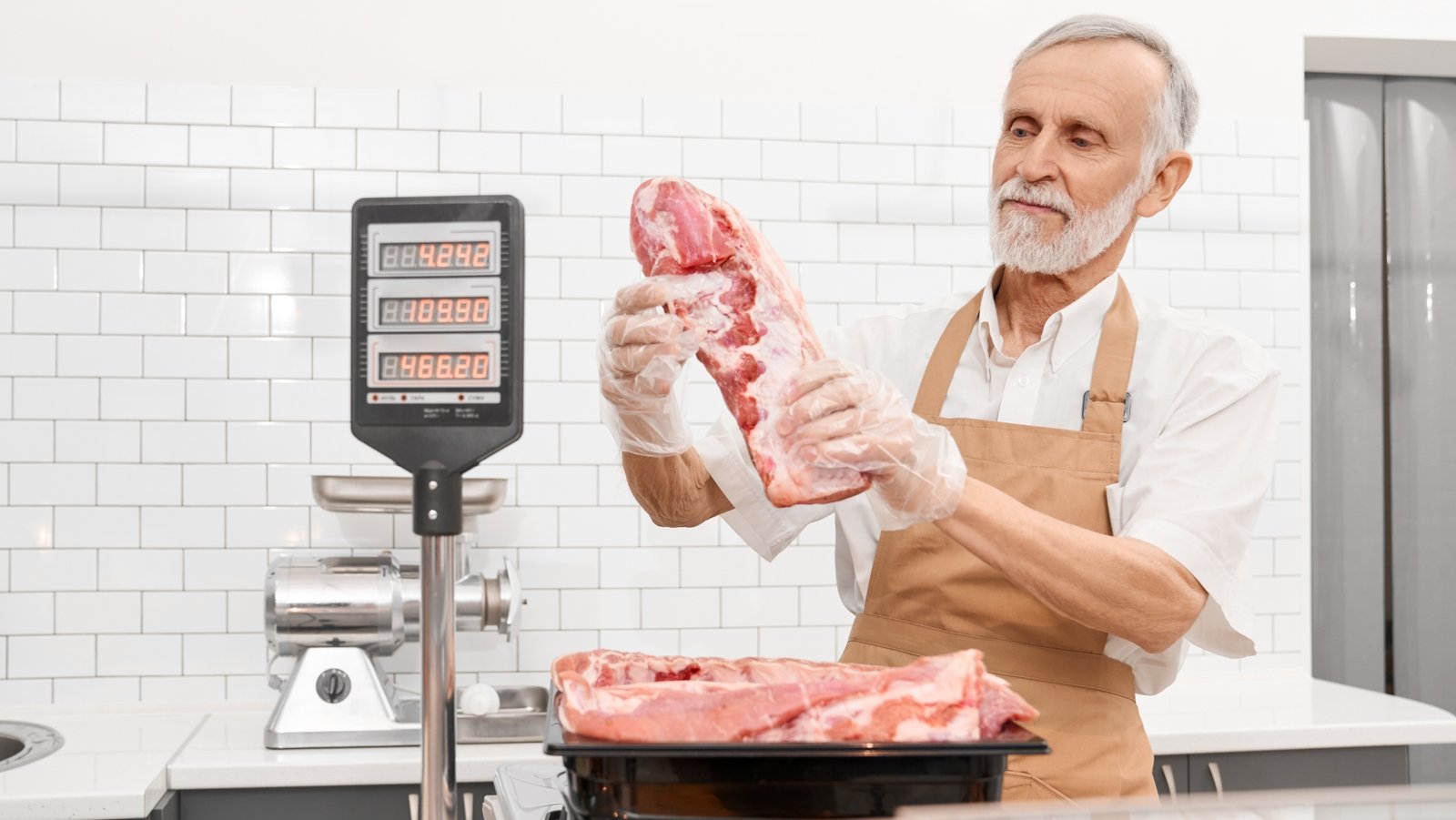
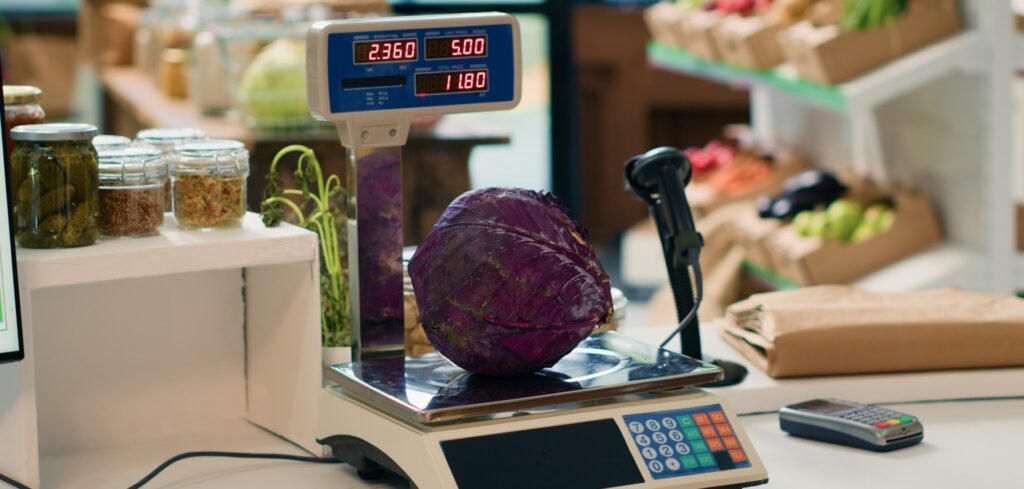
A price computing scale is the primary customer-facing scale used at the butcher counter. It automatically calculates the total price based on weight and price per pound, displaying both to the operator and the customer simultaneously via a dual display.
Key features to look for:
- Dual display — one screen for the operator, one facing the customer for transparency and trust
- PLU codes (price lookup) — allows you to pre-program prices for common cuts so staff only need to select the item, not manually enter the price
- Tare function — zeroes out the weight of the container or wrapping paper before weighing the meat
- Dual range capacity — a common configuration is 0–30 lb × 0.01 lb and 30–60 lb × 0.02 lb, which gives you finer resolution on lighter cuts without sacrificing capacity for larger ones
- NTEP Class III certified — mandatory if you are setting the sale price at this scale
A typical 60 lb capacity price computing scale with a stainless steel platter is sufficient for most retail counter applications. If you regularly cut whole roasts, large briskets, or bulk pork shoulders, confirm the scale’s platform is large enough to accommodate the product without overhanging the edges.
2. Label Printing Scale — For Pre-Packaged Meat
A label printing scale is used when you pre-package cuts of meat, sausages, or value-added products for display case sale. The scale weighs the item and immediately prints a thermal label displaying the product name, weight, price per pound, total price, sell-by date, and an embedded barcode.
This is essential for any butcher shop that pre-packs meat for customers to pick up from a refrigerated case, as the label provides all the price and weight information required for a self-serve transaction. The embedded barcode allows the total price to be scanned directly at checkout — no re-weighing required.
Look for:
- NTEP certification — the scale and printer combined must be legal for trade if the label price is what the customer pays at checkout
- PLU storage capacity — better models store 1,000–5,000+ PLU codes, letting you pre-program every product, including seasonal specials and marinated variants
- Thermal label printer — direct thermal printing requires no ink or ribbons, reducing ongoing consumable costs
- Stainless steel platform with removable platter — essential for end-of-day cleaning
3. Portion Control Scale — Back of House
A portion control scale lives in the cutting room, not at the customer counter. It is used by butchers to hit specific portion targets — a 6 oz steak, a 1 lb ground beef pack — with consistency. These scales are not used to set a price directly, so they do not always need to be NTEP certified, though many shops use certified models throughout for simplicity.
The back-of-house environment is where the washdown scale butcher shops use most heavily, and it becomes critical. The cutting room is wet, fatty, and cleaned with chemicals daily. A portion control scale in this environment needs a high IP rating and full stainless steel construction to survive the conditions.
Material and Hygiene: Why IP Rating and NSF Certification Matter
The meat-cutting environment is one of the most demanding for any piece of equipment. Blood, fat, bone fragments, and cleaning chemicals are a daily reality. A scale that cannot be properly cleaned is a food safety liability.
Stainless steel butcher scale construction is non-negotiable for any scale used near raw meat. Look for:
- Stainless steel platform/platter — resists corrosion from blood and cleaning chemicals
- Sealed or removable platform — allows full cleaning underneath
- Smooth surfaces with no exposed screws or cavities — bacteria hide in crevices
IP rating determines how well the scale withstands water and dust ingress:
- IP65 — protected against low-pressure water jets; suitable for basic counter cleaning
- IP67 — can withstand temporary submersion; good for busy deli counters
- IP68 — full washdown protection; suitable for heavy cleaning with hoses
- IP69K — withstands high-pressure, high-temperature steam cleaning; required for cutting room environments where industrial cleaning is routine
NSF certified food scale status (National Sanitation Foundation) confirms that the scale’s materials and construction meet food safety standards — specifically that surfaces do not leach chemicals into food, and that the design allows effective sanitation. NSF certification is not legally mandated for butcher shop scales in most jurisdictions, but it is strongly recommended and may be required if your facility is subject to USDA or state meat inspection.
POS Integration: Connecting Your Scale to Your Point of Sale
A POS integrated scale butcher shop setup eliminates one of the most common sources of pricing error: manual data entry at the register. Without integration, a staff member must weigh the product at the scale, note the price, walk to the register, and enter the price manually — introducing multiple opportunities for error.
With a POS-integrated scale or label printing scale with barcode output, the workflow becomes:
- Weigh the product on the scale
- The scale prints a barcode label (for pre-packs) or sends the price directly to the POS terminal
- The register scans or receives the total price automatically
Before purchasing any scale with POS integration in mind, confirm compatibility with your specific POS system. Not all scales communicate with all systems, and some POS providers require proprietary hardware. Check with your POS vendor before selecting a scale model.
For shops without a POS system, a standalone price computing scale with a receipt printer or label printer covers most customer-facing needs without integration complexity.
A Quick-Reference Buying Checklist
Before finalising your purchase, confirm the following:
- Scale carries NTEP Class III certification with a printed CC number on the serial plate
- A local weights and measures inspector can verify and seal the scale after installation
- Capacity and dual range suit your heaviest products
- Platform size accommodates your largest cuts without overhang
- Construction is stainless steel with a removable or sealed platter
- IP rating matches the cleaning environment (IP67 minimum for counters; IP68–IP69K for cutting rooms)
- NSF certification confirms whether your facility is subject to health or meat inspection
- PLU storage covers your full product range, including seasonal items
- POS compatibility verified with your specific system before purchase
- Scale comes with or supports a label or receipt printer if pre-packaging is part of your operation
Conclusion
Knowing how to choose a scale for a butcher shop starts with the legal foundation: NTEP Class III certification and state weights and measures approval are mandatory for any scale used to price meat by weight. From there, the decision breaks into three operational roles — customer counter (price computing), pre-packing (label printing), and portion control (back-of-house) — each with different certification, hygiene, and connectivity requirements.
For the customer counter and pre-packing station, a stainless steel platform, NSF certification, dual display, and PLU code storage are the features that will matter most day to day. For the cutting room, prioritise IP68 or IP69K washdown protection above all else. Match each scale to its environment and its role, verify NTEP compliance before purchase, and confirm with your state weights and measures department before going live. The right scale in the right position will pay for itself quickly in pricing accuracy and avoiding compliance issues.
FAQs
Do butcher shops legally need an NTEP certified scale?
Yes. In the United States, any scale used to set the price of goods sold by weight must be certified as legal for trade under the National Type Evaluation Program (NTEP) and verified by a state weights and measures inspector. Non-certified scales cannot legally be used for commercial pricing.
What is the best type of scale for a butcher shop counter?
A price computing scale with NTEP Class III certification, dual display (for customer and operator), PLU code storage, tare function, and a stainless steel platform. A 60 lb capacity with dual range accuracy (0–30 lb × 0.01 lb / 30–60 lb × 0.02 lb) suits most retail butcher counter applications.
What IP rating does a butcher shop scale need?
IP67 is the minimum recommended for customer counter scales. For cutting room and washdown environments where the scale is cleaned with hoses or chemicals, specify IP68 or IP69K.
What is the difference between a price computing scale and a label printing scale for a butcher shop?
A price computing scale calculates and displays the price at the counter during a customer transaction. A label printing scale prints a thermal barcode label for pre-packaged meat products, which is then scanned at checkout. Both must be NTEP certified if the label or displayed price is used to charge the customer.
Does a butcher shop scale need NSF certification?
NSF certification is not legally required in most US jurisdictions for butcher shop scales, but it is strongly recommended. NSF-certified scales are made from materials that meet food safety standards and are designed for sanitary cleaning environments. Facilities subject to USDA or state meat inspection may face additional requirements.