









Bench scale or floor scale — the decision looks simple, but is frequently made incorrectly. The most common error is defaulting to a floor scale for everything heavy and a bench scale for everything light, without considering where the scale will be used, how loads will be placed on it, and what functions the indicator needs to perform. A floor scale at a workstation where an operator stands forces constant bending and slows throughput. A bench scale at a receiving dock cannot accommodate a loaded pallet. Getting the type right before buying saves the cost of replacing equipment that technically works but creates daily operational friction. This guide makes the decision clear.
Table of Contents
What Each Scale Is
Bench Scale
A bench scale — also called a benchtop scale, compact scale, or tabletop scale — is a relatively small weighing instrument designed to sit on a workbench, countertop, or packing station. As Mettler Toledo — the world’s leading industrial scale manufacturer — defines it, a bench scale is used for smaller weighing needs and more intricate processes where the operator needs to be closer to the scale. Bench scale applications range from basic weighing to mixing, counting, and checkweighing.
Typical capacity range: 5 lb to 600 lb (2 kg to 300 kg), with most industrial bench scales falling in the 30–150 lb range. Readability can be as fine as 0.001 lb (0.1g) for precision applications, or as coarse as 0.1 lb for general industrial use.
Floor Scale
A floor scale — also called a platform scale or industrial platform scale — is a heavy-duty weighing system placed directly on the floor to weigh large, heavy, or palletised loads. Its platform sits at or near floor level, allowing forklifts, pallet jacks, and wheeled carts to roll directly onto it. Floor scales are the standard for warehouse receiving docks, shipping stations, and manufacturing facilities where loads cannot be lifted onto an elevated surface.
Typical capacity range: 1,000 lb to 20,000 lb (500 kg to 10,000 kg), with 5,000 lb being the most common warehouse specification.
The Core Difference: Load Size and How You Access It
The primary decision driver is the size and weight of what you are weighing — and how the load gets onto the scale.
| Factor | Bench Scale | Floor Scale |
|---|---|---|
| Typical capacity | 5–600 lb | 1,000–20,000 lb |
| Platform size | 6″×6″ to 24″×24″ | 24″×24″ to 60″×96″ and larger |
| Load placement | Workbench/countertop | Forklift, pallet jack, or hand truck |
| Mounting position | Workbench / countertop | Floor level |
| Primary application | Parts, components, packages, ingredients | Pallets, drums, bulk containers, crates |
| Readability | High — 0.001 lb to 0.1 lb | Standard — 0.5 lb to 2 lb |
| Portability | High — most models move easily | Low — most models are permanent |
| Typical cost | Lower | Higher |
If your heaviest load fits in one hand or on a workbench, a bench scale is the correct tool. If your loads arrive on pallets or in drums that require mechanical assistance to move, a floor scale is the correct tool. For many operations, the answer is both — bench scales at production and packing stations, floor scales at the receiving dock and shipping area.
When a Bench Scale Is the Right Choice
Production and Assembly Lines
Bench scales are the workhorse of manufacturing assembly lines and quality control stations. An operator standing at a workstation weighing individual components, verifying batch fills, portioning ingredients, or running a checkweighing process needs a scale at a comfortable working height — not one on the floor that requires constant bending. The compact footprint of a bench scale allows it to be positioned at any workstation without consuming significant floor space.
Parts Counting and Inventory
As discussed in our article on what is a counting scale and how does it work, most counting applications use bench-format instruments. The high internal resolution required for accurate average piece weight calculation is a feature of bench-class instruments — not floor scales — and the items being counted are typically small enough to be hand-placed on a bench platform.
Shipping and Receiving — Parcel and Carton Level
For verifying the weight of individual parcels, cartons, or bags in a shipping department, a bench scale with a 150–300 lb capacity handles the vast majority of outgoing shipments without the footprint or cost of a floor scale. Bench scales in this application are typically positioned on a packing table adjacent to the label printer, with the operator working at standing height throughout.
Food Production and Portion Control
Batch weighing of ingredients, portion control for packaged goods, and recipe formulation all happen at the bench level. The fine readability of a bench scale — to 0.1g on precision models — makes it appropriate for pharmaceutical compounding, spice blending, and any process where small weight differences matter. A floor scale’s coarser readability is typically insufficient for these applications.
Space-Constrained Environments
A bench scale occupies a fraction of the floor space of a platform scale. For facilities where floor space is at a premium — retail back rooms, laboratory spaces, small production cells — a bench scale is the practical choice where a floor scale would create a daily obstacle.
When a Floor Scale Is the Right Choice
Pallet Weighing — Receiving and Shipping
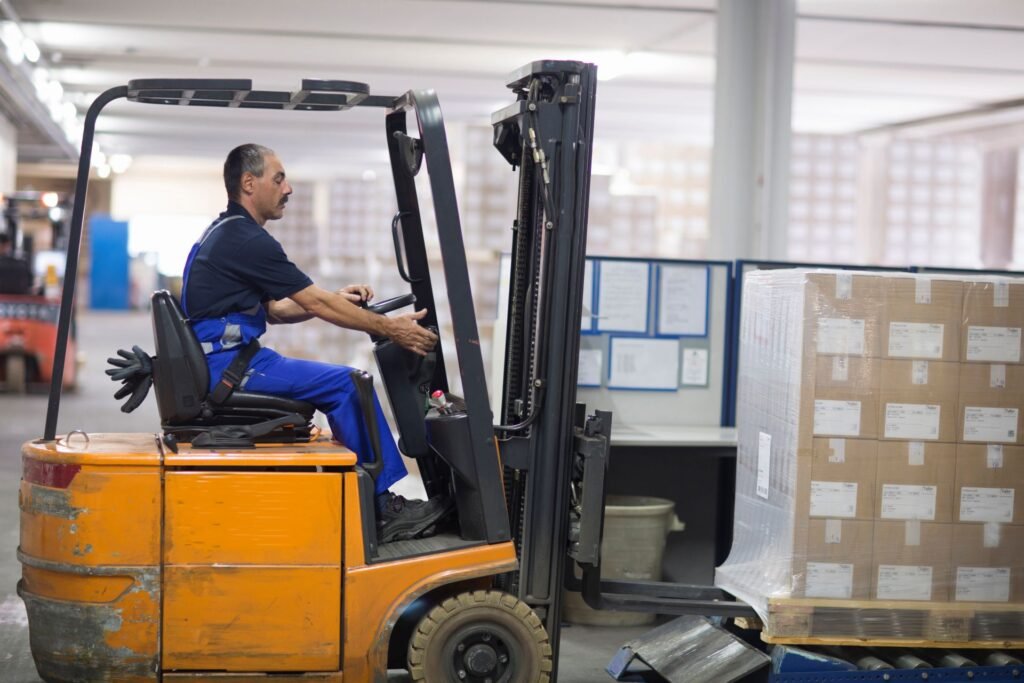
Any operation that regularly needs to weigh loaded pallets requires a floor scale. A standard GMA pallet loaded with product can reach 2,000–4,000 lb — well beyond the capacity of any bench scale. A floor scale at the receiving dock verifies incoming pallet weights against purchase orders; at the shipping dock, it confirms outgoing freight weights for carrier billing. For detailed guidance on specifying the right floor scale, see our complete floor scale buying guide for warehouses and factories.
Bulk Containers, Drums, and IBCs
55-gallon drums of liquid, intermediate bulk containers (IBCs), and large bulk bags all require a floor scale. These loads range from 400 lb for a full chemical drum to 2,500 lb for a full IBC — too heavy and too awkward to place on a bench scale safely.
Weighing Raw Materials in Bulk
Manufacturing operations that weigh batches of raw material in quantities of hundreds of pounds — steel components, chemical feedstocks, grain, aggregate — require the capacity and platform size of a floor scale. The load is typically scooped, poured, or rolled onto the platform rather than hand-placed.
Dockside and Loading Area Weighing
Freight weighing at a loading dock — verifying truck load weights, checking inbound delivery quantities — requires a floor scale capable of accommodating the loads and the mechanical handling equipment used to move them. A surface-mounted floor scale with approach ramps or a pit-mounted flush floor installation are the two standard configurations in this environment.
The Overlap Zone: When Either Could Work
There is a category of application — typically 50–300 lb items that can be lifted by two people — where both scale types are technically capable. The deciding factors in the overlap zone are:
- Working height — if the operator is standing, a bench scale at working height is faster and less fatiguing than bending to a floor scale
- Frequency — very high throughput (hundreds of weighings per shift) favours the ergonomics of a bench scale; infrequent weighing of heavy loads favours a floor scale
- Functions needed — if counting, checkweighing, or fine-resolution weighing is required alongside capacity, a bench scale with those capabilities is the better fit
- Floor space — a bench scale takes up minimal floor space; a floor scale and its ramps consume significant square footage
Using Both in the Same Facility

Most industrial operations of any size need both types — positioned at different points in the workflow for different functions. A common configuration:
- Receiving dock — 5,000 lb or 10,000 lb floor scale for verifying incoming pallet weights
- Production area — bench scales at each workstation for batching, counting, and QC weighing
- Packing line — 150–300 lb bench scale for final carton weight verification
- Shipping dock — floor scale for outgoing freight weight confirmation
Matching the scale type to the workflow step rather than buying one type for the whole facility is the approach that produces the lowest total cost and the best operational efficiency. For guidance on calibration intervals across both scale types in your facility, see our article on how often industrial scales should be calibrated.
Conclusion
The bench scale vs floor scale decision is not about which is better — it is about which is correct for the specific task, the specific load size, and the specific working position of the operator. Bench scales belong at workstations, production lines, and packing tables where operators work at standing height with loads that can be hand-placed.
Floor scales belong at docks and material handling areas where loads arrive by forklift, pallet jack, or hand truck and cannot safely be lifted onto an elevated surface. Most operations of any meaningful size need both. The mistake to avoid is buying one type for every application in the facility — it always creates at least one location where the wrong scale is, making every working day slightly harder than it needs to be.
FAQs
What is the difference between a bench scale and a floor scale?
A bench scale sits on a workbench or countertop and is designed for loads that can be hand-placed — typically 5–600 lb with fine readability for counting, checkweighing, and precision applications. A floor scale sits on the floor and is designed for heavy or bulky loads that arrive by forklift, pallet jack, or hand truck — typically 1,000–20,000 lb with standard readability for pallet and freight weighing.
Can a bench scale replace a floor scale?
Only if the loads fit within its capacity and platform size, and can be safely hand-placed. A bench scale cannot accommodate a loaded pallet, a full drum, or any load that requires mechanical handling equipment. If those loads need to be weighed, a floor scale is required.
What capacity bench scale do I need for a packing station?
For most packing station applications — cartons, boxes, and assembled products — a bench scale in the 150–300 lb range covers the majority of needs with readability fine enough to verify package weights accurately. For smaller items, parts counting, or precision portioning, specify a lower-capacity model with finer readability.
Do I need both a bench scale and a floor scale in my facility?
Most industrial operations need both. Floor scales belong at receiving docks and shipping areas for pallet and freight weighing. Bench scales belong at production workstations and packing stations for component weighing, counting, and QC. Using a floor scale at a production workstation forces constant bending; using a bench scale at a receiving dock cannot handle pallet-weight loads.
Which is more accurate — a bench scale or a floor scale?
Bench scales typically offer finer readability — as precise as 0.001 lb (0.1g) on high-resolution models — because they are designed for smaller, more precise weighing tasks. Floor scales use coarser readability (typically 0.5–2 lb), appropriate for large loads where that level of precision is sufficient. For applications requiring fine resolution at higher capacities, a precision bench scale is the correct specification.