

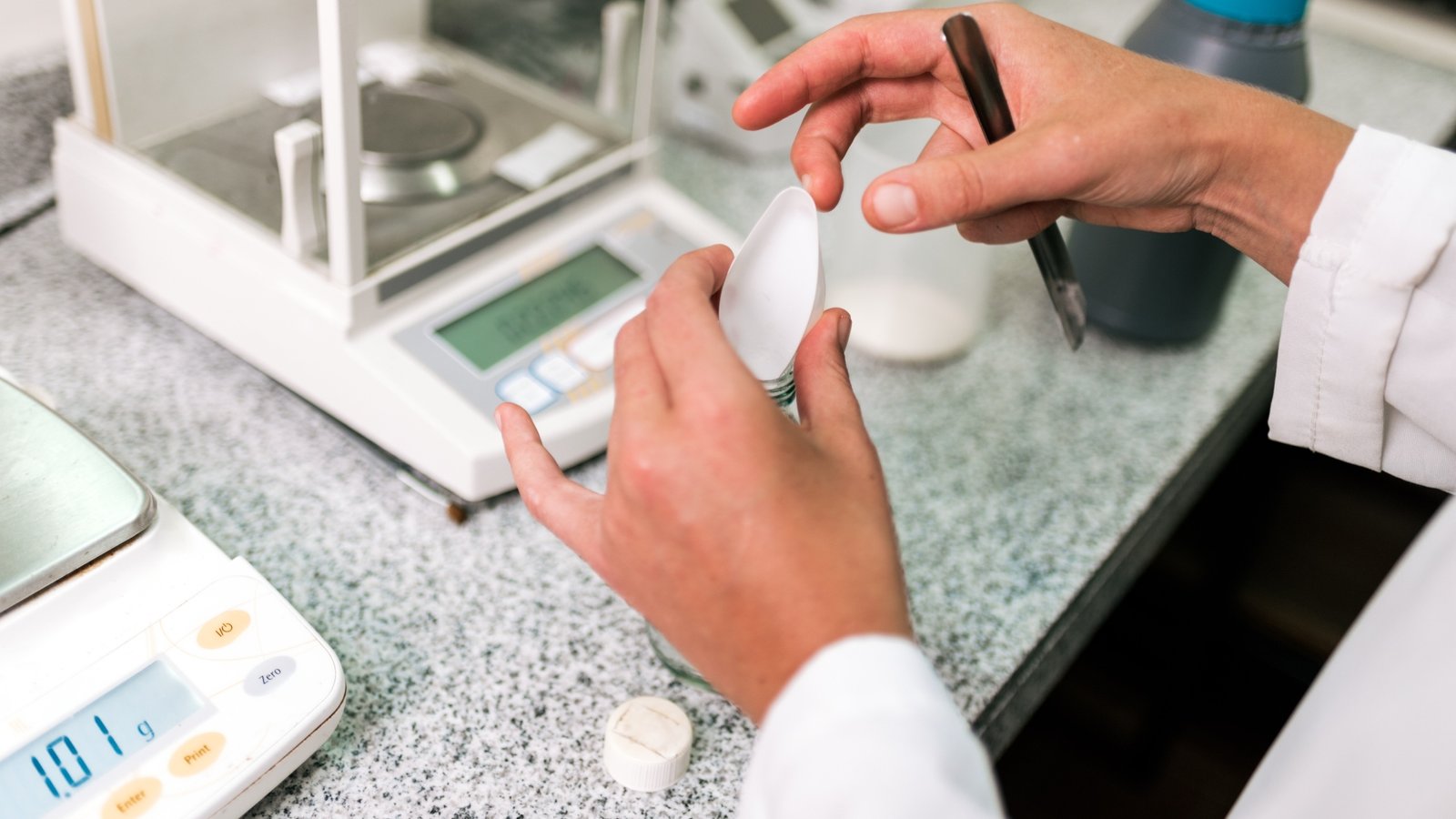








The decision between an analytical balance vs a precision balance, which to buy, comes down to one question before any other: what is the smallest sample you need to weigh accurately? An analytical balance measures to 0.0001 g (0.1 mg) — four decimal places — and is built for sub-milligram quantitative work in controlled environments. A precision balance, also called a top-loading balance, measures to 0.001 g (1 mg) or coarser, handles larger capacities, and tolerates standard lab conditions without specialist environmental controls. Choosing the wrong type does not just cost money — it either produces data with insufficient accuracy for your application, or commits you to an over-specified instrument with setup requirements your lab cannot sustainably support.
Table of Contents
The Core Difference: Readability and What It Actually Means
Readability is the smallest increment a balance can display — and it is the number that determines everything else about which instrument is appropriate for your work.
Analytical balance readability: 0.0001 g (0.1 mg): A four-decimal-place analytical balance displays mass to the nearest tenth of a milligram. This level of resolution is achieved using electromagnetic force restoration (EMFR) technology, where a precisely controlled electrical current counteracts the weight on the pan to hold it at a null position. The current required is proportional to the mass — and this relationship is converted to a digital readout. EMFR is sensitive enough to detect the weight of a fingerprint, which is why analytical balances always include an enclosed weighing chamber and draft shield, and must be isolated from air currents, vibrations, and temperature changes.
Precision balance 0.001 g readability (1 mg to 10 mg): A precision balance or top-loading balance laboratory instrument typically reads to three decimal places (0.001 g), though some models reach 0.01 g (two decimal places) at higher capacities. Many use strain gauge technology rather than EMFR — a simpler, more robust system that responds to the physical deformation of a load cell under weight. Precision balances can accommodate samples from a few grams to tens of kilograms and are generally more tolerant of ordinary lab conditions. Some models include a basic windshield rather than a fully enclosed chamber.
The practical implication: if your smallest sample is 500 mg of a reagent, a precision balance at 0.001 g readability introduces a potential relative error of 0.2% — acceptable for most general laboratory tasks. If your sample is 50 mg of an active pharmaceutical ingredient going into an HPLC standard, a precision balance’s potential 2% relative error at that mass is unacceptable, and an analytical balance is required.
What Each Balance Is Used For
When an Analytical Balance Is the Right Choice

Analytical balances are the instrument of choice wherever weighing uncertainty at the sub-milligram scale would compromise the integrity of results. Key applications include:
- Pharmaceutical formulation and QC — Preparing HPLC standards, weighing active pharmaceutical ingredients (APIs), and compounding where small mass variations directly affect drug concentration and patient safety
- Quantitative chemical analysis — Gravimetric analysis, where the mass of a precipitate or residue determines a result, demands four-decimal-place accuracy
- Reagent preparation — Preparing standard solutions for titrations or spectroscopy, where precise molarity depends on exact mass
- Density determination — Calculating density via the Archimedes method using submersion weighing, where small differences in apparent weight are meaningful
- Forensic science — Trace evidence analysis where sample masses may be in the low-milligram range
For pharmaceutical laboratories specifically: USP Chapter <41> “Balances” — the mandatory standard for pharmaceutical QC weighing — requires a repeatability test on every balance to determine its operating range. The minimum weight a balance can reliably weigh is calculated from its standard deviation in repeatability testing, not simply from its readability. A 4-place analytical balance with 0.0001 g readability typically yields a minimum weight of approximately 82–200 mg under real laboratory conditions — meaning it cannot reliably weigh samples below that threshold while meeting the 0.10% weighing tolerance USP mandates. Labs that need to weigh smaller masses reliably must specify semi-micro or microbalances, not simply any four-decimal-place instrument.
When a Precision Balance Is the Right Choice

A precision balance serves the majority of routine laboratory tasks where sub-milligram resolution is not required:
- Sample preparation for further analysis — Weighing 5–500 g quantities of starting material before processing
- General QC weighing — Checking batch weights, fill weights, or net content in production environments
- Educational settings — Teaching quantitative techniques where the exercises do not demand 0.0001 g resolution
- Industrial and manufacturing — Batch formulation, quality control of packaging, and component verification, where tolerances are wider than those of pharmaceutical analysis
- Medical applications — Weighing blood bags, tissue samples, or bioreactor components that exceed an analytical balance’s capacity
If your lab regularly weighs samples above 300 g, an analytical balance is also the wrong tool — most models have maximum capacities of 200–320 g, and overloading even once can permanently damage the EMFR weighing cell.
Environmental Requirements: A Major Practical Difference
This is the factor most lab managers underestimate when purchasing. An analytical balance’s sensitivity is its greatest strength and its most demanding operational requirement.
Analytical balance requirements:
- Draft shield (enclosed weighing chamber) — mandatory. Air currents from HVAC systems, open windows, or even breathing on the pan produce measurable errors at 0.0001 g resolution
- Anti-vibration table — strongly recommended. A granite or marble surface with vibration-dampening mounts isolates the balance from building vibrations, foot traffic, and nearby equipment. Without one, stabilisation times increase and readings fluctuate
- Warm-up period — allow 30–60 minutes after power-on before weighing. The EMFR system requires temperature equilibration to produce stable results
- Level surface — the built-in levelling bubble and adjustable feet must be set before each session; even a slight tilt introduces systematic error
- Static electricity control — powders and small samples can carry electrostatic charge that causes erratic readings; anti-static measures (ionisers, grounding) may be needed
- Temperature stability — direct sunlight, nearby ovens, and opening/closing lab doors cause thermal drafts that affect readings
Precision balance requirements:
- The standard laboratory bench surface is generally sufficient
- Basic windshield helps with readability at 0.001 g, but is not always essential
- Warm-up period is shorter (typically 5–15 minutes)
- More tolerant of ambient vibration and temperature variation
Calibration: Internal vs External — and Why It Matters for Compliance
Both balance types require calibration, but the approach and compliance implications differ.
Internal calibration uses a built-in motorised reference weight that automatically triggers a calibration cycle in response to temperature changes or at user-defined intervals. This is the standard for regulated environments — it means the balance is always calibrated against a known mass without operator intervention, supporting data integrity requirements under GLP and GMP. Most modern analytical balances for pharmaceutical or regulated research use include internal calibration.
External calibration requires the user to place certified calibration weights on the pan manually. This is common on lower-cost precision and analytical balances. It is acceptable in non-regulated settings but demands that a calibration procedure is followed consistently — and that traceable calibration weights are available and in date.
For GLP-compliant laboratory balance use — and for any lab subject to ISO 17025, USP Chapter <41>, or 21 CFR Part 11 — the balance must also provide a GLP data output: a time-stamped, instrument-identified printout or electronic record of each weighing. RS232 or USB connectivity for export to a computer, LIMS, or printer is therefore a specification requirement, not a nice-to-have, in regulated laboratories.
The Quick Decision Framework
Use this to determine which balance your lab needs:
| Factor | Choose Analytical (0.0001 g) | Choose Precision (0.001 g+) |
|---|---|---|
| Smallest sample | Below ~200 mg | Above 200 mg |
| Maximum sample | Up to ~300 g | Up to several kg |
| Application | Chemical analysis, pharma QC, gravimetric work | Sample prep, QC, education, production |
| Regulatory requirement | USP <41>, GLP/GMP, ISO 17025 | General lab practice |
| Environment | Controlled, draft-free, anti-vibration setup | Standard bench |
| Budget | Higher — £1,000–£10,000+ | Lower — £300–£3,000+ |
| Calibration | Internal (for regulated use) | Internal or external |
Conclusion
The analytical balance vs precision balance decision is not about buying the most accurate instrument available — it is about matching the instrument to the smallest mass your method genuinely requires. If your smallest sample is above 200 mg and your regulatory framework does not demand sub-milligram repeatability testing, a precision balance will serve you well, cost less, and require far less environmental overhead. If you are preparing pharmaceutical standards, performing quantitative chemical analysis, or working under USP Chapter <41>, GLP, or GMP requirements, an analytical balance with internal calibration and GLP data output is not optional.
The wrong choice in either direction is a liability: an under-specified precision balance produces data with unacceptable uncertainty, and an over-specified analytical balance in an uncontrolled environment produces equally unreliable data. Define your smallest sample weight first — everything else follows from that.
FAQs
What is the difference between an analytical balance and a precision balance?
An analytical balance reads to 0.0001 g (0.1 mg) and uses electromagnetic force restoration technology inside an enclosed draft shield chamber. A precision balance reads to 0.001 g or coarser, handles higher capacities (up to several kilograms), and is more tolerant of standard laboratory conditions.
Do I need an analytical balance for pharmaceutical lab work?
Yes, in most cases. Pharmaceutical QC labs operating under USP Chapter <41> require a balance that can meet a 0.10% weighing tolerance, and the mandatory repeatability test determines the minimum sample weight the balance can reliably handle. For most 0.0001 g analytical balances, this minimum is approximately 82–200 mg under real laboratory conditions.
Can a precision balance replace an analytical balance?
Only if your smallest sample weight stays well above the precision balance’s minimum reliable weight threshold. A 0.001 g precision balance introduces a potential 2% relative error on a 50 mg sample — which is unacceptable for pharmaceutical formulation or quantitative chemical analysis, but acceptable for general sample preparation or QC of larger quantities.
Does an analytical balance need an anti-vibration table?
It is strongly recommended. Analytical balances at 0.0001 g readability detect vibrations from foot traffic, nearby equipment, and building movement. An anti-vibration table with dampening mounts significantly reduces stabilisation time and improves measurement repeatability, particularly in busy laboratory environments.
What is internal calibration on a laboratory balance?
Internal calibration uses a motorised built-in reference weight to automatically perform calibration cycles in response to temperature changes or on a scheduled basis. This is the standard approach for regulated laboratories (GLP/GMP/USP compliance) because it removes the need for manual operator calibration and ensures the balance is always operating within its verified accuracy range.